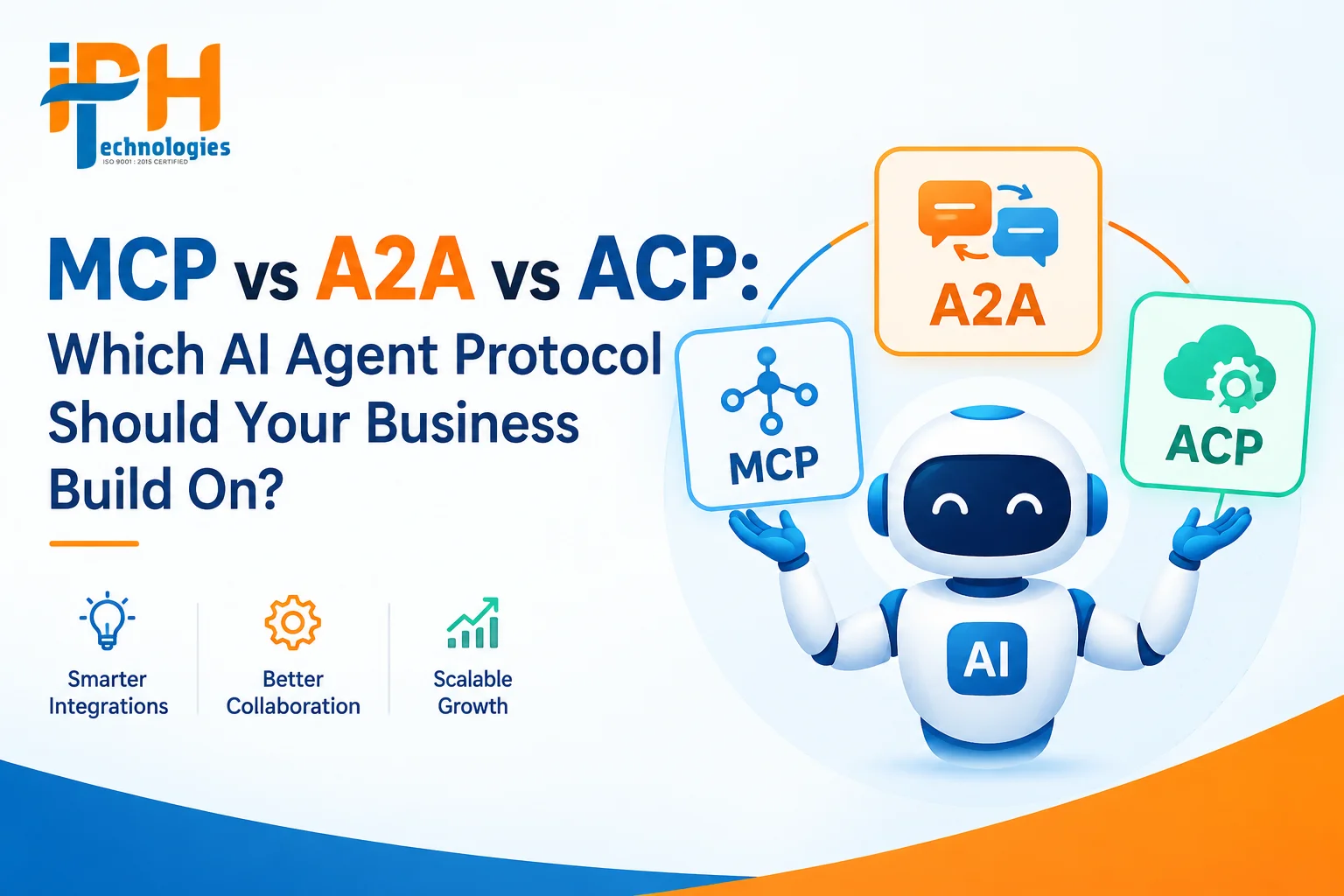


































































































Choosing an AI agent protocol feels like picking a side in a tech war. It isn’t. MCP, A2A, and ACP solve different problems, and one of them has already merged into another. Get this decision right, and your agents connect to your tools and partners with ease. Get it wrong, and you’ll be rebuilding integrations next year. Let’s work out which one your business should build on.
Quick Answer: Which Protocol Should You Choose?
Here’s the short version, in three lines:
- Pick MCP when your AI agent needs to reach tools, databases, and business apps.
- Pick A2A when one agent needs to hand work to another agent, especially across teams, vendors, or frameworks.
- Skip ACP for new builds. IBM’s Agent Communication Protocol merged into A2A in August 2025, so it’s no longer a standalone standard.
So the “versus” in the title is a bit misleading. You’re not choosing a winner. You’re choosing a stack: MCP for the tools, A2A for the teamwork. Let’s walk through why, and how to put it into practice without burning your budget.
Why AI Agent Protocols Matter for Business in 2026
Imagine every office in your building used a different power socket. You’d spend half your day hunting for adapters. That’s what enterprise AI felt like before agent protocols arrived. Every agent needed custom code for every tool, and again for every other agent.
Protocols fix that. A shared language between agents, tools, and data sources brings three real benefits:
- Lower integration costs. Ten agents and twenty tools used to mean two hundred custom connectors. A standard collapses that pile.
- Less vendor lock-in. When the protocol is open and neutrally governed, you can swap models or platforms without rebuilding everything.
- Easier governance. One predictable interface means one place to log, monitor, and restrict what agents do.
If you’re planning anything this year, picking a protocol isn’t a technical footnote. It’s an architectural decision that your future self will either thank or curse you for.
Also read: Right Iphone App Development Agency in USA
MCP (Model Context Protocol): Connecting Agents to Tools and Data
What MCP Actually Does
Think of MCP as a universal charging port for AI. It gives an agent one consistent way to find and use outside capabilities, such as your CRM, a SQL database, a ticketing system, or a file store. An MCP server exposes tools and data. An MCP client, usually inside your AI app, uses them.
The key idea is that MCP works vertically. It connects an agent downward to the things it needs. It doesn’t coordinate a group of agents working together. That’s a different job.
Where MCP Stands Today
Anthropic created MCP, and in December 2025 it donated the protocol to the Agentic AI Foundation, a fund hosted by the Linux Foundation. Anthropic, Block, and OpenAI co-founded that foundation, with support from Google, Microsoft, AWS, Cloudflare, and Bloomberg. When the donation was announced, Anthropic reported figures like roughly 97 million monthly SDK downloads and about 10,000 active servers, plus built-in support across tools like ChatGPT, Claude, Cursor, Gemini, Microsoft Copilot, and Visual Studio Code.
What does that mean for a business buyer? Neutral governance plus support from rival vendors makes MCP the safest bet for tool connectivity right now.
Also read: AI Coding Agent Cost in the USA
A2A (Agent2Agent): Enabling Agents to Collaborate Across Systems
How A2A Works
If MCP is the workshop where an agent picks up its tools, A2A is the meeting room where agents talk to each other. Each A2A-enabled agent publishes an Agent Card, a small JSON profile describing what it does and how to reach it. Other agents read the card, figure out whether this agent can help, and delegate a task.
Here’s the clever part. The agents collaborate without exposing their inner workings. Your procurement agent can ask a supplier’s agent for a quote without ever seeing the supplier’s internal tools or data. That privacy is a big deal when the other agent belongs to someone else.
Maturity and Adoption
Google introduced A2A in April 2025, and it later moved to the Linux Foundation. By its one-year mark in April 2026, the Linux Foundation reported more than 150 supporting organizations and integration across Google, Microsoft, and AWS platforms. The project also shipped version 1.0, its first stable specification, in March 2026, adding features such as signed Agent Cards.
One honest caveat: “150 supporting organizations” doesn’t equal “150 companies running it in production.” Independent analysts point out that adoption depth is still uneven. So pilot first, brag later.
Also Read: AI Invoice Management App
ACP (Agent Communication Protocol): What It Was and Where It Stands Today
ACP came from IBM Research and the BeeAI team in March 2025. It used plain REST conventions, handled asynchronous work by default, and was refreshingly simple to plug in. For a few months, it looked like a serious rival to A2A.
Then the market blinked. With A2A and ACP launching only about a month apart, fragmentation looked inevitable. Instead, on August 29, 2025, IBM and the Linux Foundation announced that ACP would fold into A2A. The ACP repository is now archived, and IBM’s own project page opens with a notice that ACP is part of A2A.
So what should you do?
- Starting from scratch: Use A2A. Don’t touch ACP.
- Already running ACP or BeeAI: Plan a migration. Migration paths and adapters were published when the merger happened.
- Seeing “ACP” in a vendor pitch: Ask which one they mean. The acronym now has cousins: the Agentic Commerce Protocol from OpenAI and Stripe, and Zed’s Agent Client Protocol for code editors.
The takeaway applies far beyond ACP: building on a young standard before the market settles can leave you with real switching costs.
Other Protocols Worth Watching
The protocol zoo keeps growing. A few names to keep on your radar:
- ANP (Agent Network Protocol). A community-driven effort aimed at decentralized, internet-scale agent networks. Fascinating, but still early.
- AG-UI. Focused on how agents communicate with user interfaces, for example streaming live updates into a chat window. Handy if you’re building copilot-style experiences.
- Agentic commerce protocols. This is where the money moves. The Agentic Commerce Protocol, developed by OpenAI and Stripe, helps make online checkout work for AI agents. Google’s Agent Payments Protocol (AP2) focuses on authorization and traceability, using cryptographically signed “mandates” to prove what a user approved. Coinbase’s x402 handles payments over the web. Analysts describe these as layers of one emerging stack, not enemies.
If you sell online or process payments, follow this space closely. If you don’t, you can safely ignore it for now.
Also read: Hire AI Agent Developer
MCP vs A2A vs ACP: Side-by-Side Comparison
| Factor | MCP | A2A | ACP (IBM) |
|---|---|---|---|
| Main purpose | Connects agents to tools and data | Lets agents discover and delegate to each other | REST-based agent messaging |
| Created by | Anthropic | IBM Research / BeeAI | |
| Governance | Agentic AI Foundation (Linux Foundation) | Linux Foundation | Merged into A2A |
| Maturity (Oct 2026) | Broadly adopted across major platforms | Stable v1.0 since March 2026 | Archived; migrate |
| Best for | Tool access, data lookups, system actions | Multi-agent workflows, partner and vendor agents | Legacy deployments only |
| Main limitation | Doesn’t coordinate peer agents | Production depth still uneven | No future development |
Decision Framework: Which Protocol Fits Your Use Case?
Not sure where you land? Walk through these questions in order:
- Does your agent need to call tools or read company data?
If yes, implement MCP. - Will more than one agent work on the same task?
If not, stick with MCP alone. If yes, keep going. - Do all those agents live in one codebase owned by one team?
If yes, a built-in orchestrator may be enough. If not, add A2A. - Do partners or vendors need their agents involved?
If yes, A2A is basically mandatory. - Are you running legacy ACP?
If yes, schedule the migration. - Will agents handle payments?
Add a commerce or payments layer, and involve legal early.
Here’s the honest truth: most mid-sized businesses stop at step 1 or 2. And that’s fine. Why buy a fleet-management system when you own one truck?
How These Protocols Work Together: Reference Architecture
Picture a layered cake.
- Top layer: the experience. A person chats with an assistant, and UI protocols like AG-UI can live here.
- Middle layer: coordination. A manager agent receives the request and uses A2A to delegate to specialist agents for billing, logistics, compliance, and so on.
- Bottom layer: capability. Each specialist uses MCP to reach its systems, like your ERP, CRM, or warehouse database.
- Wrapping the whole cake: governance. An API gateway, identity provider, and logging pipeline sit around every call.
The A2A project describes the split neatly: MCP gives each agent dependable tool access, while A2A gives those agents a dependable way to collaborate. Industry write-ups from 2026 add that most production multi-agent systems end up using both.
Security, Compliance and Governance
Access Control and Audit Trails
Here’s something people forget. Protocols standardize how agents talk. They don’t decide what agents are allowed to do. That’s on you.
Build in these basics from day one:
- Least privilege. Give every MCP server the narrowest permissions it can work with.
- Strong identity. Use proper authorization, and verify Agent Cards on the A2A side.
- Human approval gates. Require a person to confirm anything irreversible, like refunds, deletions, or large transfers.
- Tamper-resistant logs. Record which agent asked for what, when, and with which data.
Regulations to Map Early
| Framework | What it means for agent protocols |
|---|---|
| SOC 2 | Evidence of access control, change management, and logging across agent and tool calls |
| GDPR | Lawful basis, data minimization, and deletion rights for any personal data agents touch |
| CCPA/CPRA | Disclosure and opt-out rights for California consumers |
| HIPAA | Safeguards and business associate agreements wherever health information flows |
A practical tip: treat every third-party MCP server like any other third-party software. Review it, pin its version, and sandbox it. And since this isn’t legal advice, loop in your compliance counsel before launch.
Also Read: AI Enabled Kiosk Software Development Service
Agent Protocol vs Conventional API: When Each Makes Sense
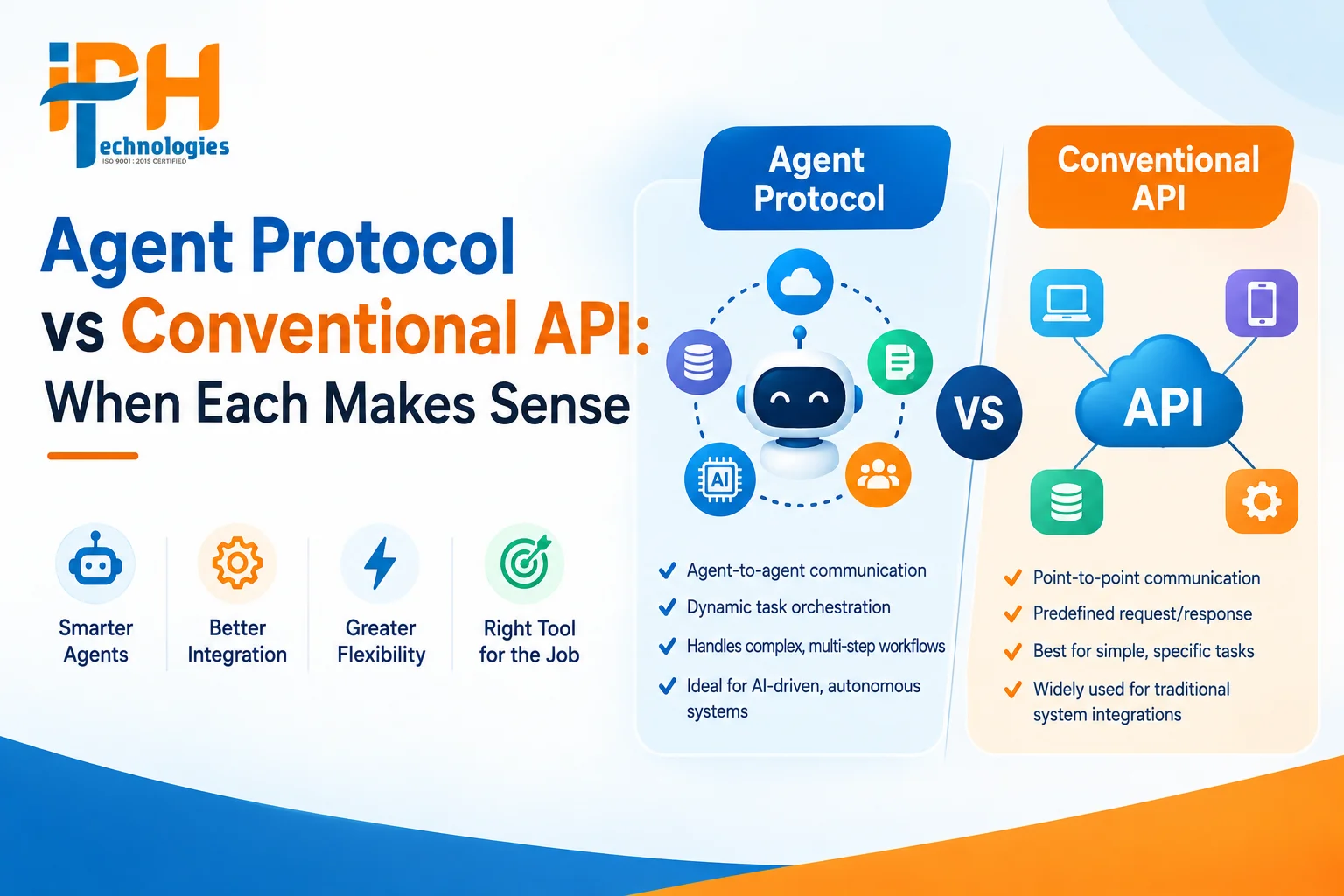
Please don’t throw away your REST APIs. They’re still the backbone of your systems. The real question is: who’s calling?
- A conventional API fits when a developer writes fixed code that calls known endpoints in a known order. It’s predictable, fast, and cheap.
- An agent protocol fits when an AI decides at runtime which capability to use, and needs clear, machine-readable descriptions to choose well.
In practice, the two cooperate. MCP servers often wrap your existing APIs, so your REST investment becomes the engine and MCP becomes the standard dashboard an agent can drive. And if your workflow never changes? A plain API call is simpler and cheaper. Use agent protocols where flexibility actually earns its keep.
Implementation Roadmap: From Pilot to Production in 90 Days
| Phase | Days | What happens |
|---|---|---|
| Discover | 1–15 | Choose one high-value workflow, map systems and data sensitivity, define success metrics |
| Prototype | 16–40 | Build two or three MCP servers over existing APIs, connect one agent, test with sanitized real data |
| Harden | 41–65 | Add authentication, rate limits, logging, evaluation tests, and human approval steps |
| Expand | 66–80 | Introduce a second agent and A2A delegation, only if the workflow calls for it |
| Launch | 81–90 | Staged rollout, monitoring dashboards, runbooks, and team training |
My advice: start narrow. One workflow done well beats five done halfway. Always.
Cost, Timeline and Team Requirements
A quick note before the numbers. These are planning estimates based on typical enterprise projects, not published benchmarks. Your integration complexity can move them a lot.
| Scope | Typical timeline | Core team |
|---|---|---|
| MCP pilot (one agent, two or three tools) | 4–8 weeks | 1 architect, 2 engineers, 1 QA, part-time security lead |
| MCP + A2A multi-agent system | 3–5 months | Above, plus an AI/ML engineer and a product owner |
| Enterprise rollout (multiple departments) | 6–12 months | Dedicated platform team, DevOps, compliance, change management |
What drives the bill? Mostly the number of systems you need to wrap, your security and compliance demands, and how much testing you need before you trust an agent with real actions. Model usage fees tend to surprise teams less than integration and evaluation effort.
Common Mistakes to Avoid When Adopting Agent Protocols
- Betting on a protocol that’s already merged. Starting a new ACP build in 2026 is exactly this.
- Treating “supports A2A” as proof of readiness. Ask vendors for real production references.
- Over-permissioned tools. An agent with admin rights is a breach waiting for a clever prompt.
- Skipping evaluation. If you can’t measure accuracy, you can’t improve it or defend it.
- Exposing everything at once. Dozens of tools can confuse an agent. Curate what it sees.
- Ignoring prompt injection. Data coming back from tools can carry hostile instructions. Validate and filter it.
- Going multi-agent too early. One well-equipped agent often beats a committee.
Also Read: How AI Gold Price Prediction in USA
Industry Use Cases
Fintech
A KYC agent checks identity databases and watchlists through MCP. When it spots something odd, it uses A2A to pass the case to a fraud-investigation agent run by a partner bank. Every step lands in an audit log that examiners can read.
Healthcare
A scheduling agent reads clinic availability via MCP, while an insurer’s benefits-verification agent answers through A2A. Patient data stays inside strict boundaries, and humans sign off on anything clinical.
Retail
A support agent looks up orders and stock levels using MCP, then hands returns to a logistics partner’s agent. At checkout, commerce protocols like AP2 or the Agentic Commerce Protocol come into play.
Logistics
A dispatch agent pulls telematics and warehouse data over MCP, then negotiates delivery windows with carrier agents over A2A. Exceptions go straight to a human planner.
Where AI Agent Protocols Are Heading
Expect more consolidation under the Linux Foundation, with MCP and A2A as sibling standards. A2A has already stretched beyond messaging into what its backers call economic coordination, which hints at agents negotiating and transacting more directly. Look for stronger agent identity, better registries so agents can find each other, and closer ties between payment protocols and the MCP/A2A pair.
So how do you prepare? Build on the open, governed standards. Keep your business logic behind clean interfaces. And stay ready to swap layers, because the ACP story proved the landscape can shift in a single quarter.
How IPH Technologies Helps You Build an Enterprise-Ready Agent Stack
At IPH Technologies, we specialize in turning visionary ideas into impactful solutions. With over 500 successful projects and 430+ satisfied clients, our team knows how to blend mobile apps, web applications, and custom software with the new agentic layer.
Here’s where we can help:
- Protocol strategy. We map your workflows and tell you plainly where MCP, A2A, or neither makes sense.
- MCP server development. We wrap your existing APIs and databases safely.
- Multi-agent design. We build A2A-based collaboration where it truly pays off.
- Security and compliance. We design access control, logging, and review processes with SOC 2, GDPR, CCPA, and HIPAA in mind.
- Migration support. Running legacy ACP or BeeAI? We’ll plan the move to A2A.
We use agile methods and keep our eyes on your business goals, not buzzwords. Want a second opinion on your agent architecture? Get in touch with our team.
Also Read: How to Validate An AI Product Idea Before Building It
Conclusion
So, which AI agent protocol should your business build on? Use MCP for tools and data, add A2A when agents have to collaborate across boundaries, and treat ACP as a short but important chapter that now lives inside A2A. Wrap it all in solid security, start with one valuable workflow, and use the 90-day roadmap to prove value before you scale. The protocols will keep evolving, but a layered, standards-based design keeps you flexible. Pick your first workflow this week and get moving.
Frequently Asked Questions (FAQs)
Are MCP and A2A competitors?
No. They solve different problems. MCP connects an agent to tools and data, while A2A connects agents to each other. The Linux Foundation itself describes A2A as complementary to MCP.
Is ACP still a good choice in 2026?
Not for new projects. ACP merged into A2A in August 2025, and its repository is archived. If you already use it, follow the migration guidance.
Do I need A2A if I only run one agent?
Probably not. A single agent with well-designed MCP tools covers most early use cases. Add A2A when you need to delegate work to other agents, especially external ones.
Can I use these protocols with my existing REST APIs?
Yes. A common approach is wrapping existing APIs in MCP servers, so agents can discover and call them in a standard way without you rewriting the underlying services.
How mature is A2A?
It reached its first stable release, version 1.0, in March 2026, and the Linux Foundation reported more than 150 supporting organizations a month later. Production depth still varies, so run a pilot first.
Who governs MCP now?
MCP sits under the Agentic AI Foundation, a fund inside the Linux Foundation, following Anthropic’s donation in December 2025.
Which protocol handles payments made by agents?
Neither MCP nor A2A is a payment protocol. Commerce standards such as the Agentic Commerce Protocol (OpenAI and Stripe) and AP2 (Google) cover checkout and authorization. Note that the “ACP” in that name is a different protocol from IBM’s.
How long does it take to go from pilot to production?
A focused, single-workflow project can reach a controlled production launch in roughly 90 days, as outlined above. Multi-department rollouts usually take six months or more.










.png)