










Picture a ski resort manager in Park City staring at next week’s forecast, trying to guess how many lift attendants to schedule. Now picture a Salt Lake City lender sorting through thousands of loan documents by hand. Different industries, same headache: too much data, too little time. AI Development for Utah Businesses
That’s the gap AI development fills. And Utah, honestly, is one of the best places in the country to fill it. The state has a deep tech workforce, a regulator that actively invites AI experimentation, and a business community that isn’t afraid to try new things.
So what can AI actually do for a Utah company, and how do you start? Let’s walk through it, practically and without the buzzword fog.
Also Read- 7 Benefits of Mobile Apps for Business
AI Development for Utah Businesses
Why Utah Is Becoming an AI Hotspot
Utah didn’t stumble into this. Several things lined up at once.
A Tech Economy With Real Depth
According to the Utah Department of Workforce Services, the state’s software and information technology sector employed about 78,200 people in 2024, at an average annual wage of roughly $133,540. That’s a lot of engineers, data people, and product builders in one place. Add financial services (about 66,200 workers), aerospace and defense (about 76,200), advanced manufacturing (about 77,170), and life sciences and healthcare (about 247,050), and you get five targeted industries employing nearly 494,900 people, around 31% of the state’s workforce.
Why does that matter? Because AI projects need two things: data-rich industries and people who can work with them. Utah has both.
AI Development for Utah Businesses
What the AI Readiness Rankings Say
Rankings are never perfect, but they’re a useful gut check. A study from Brainly, reported by KSL in July 2025, placed Utah third among states for AI preparedness, judging by jobs, education, and government funding. It put business AI adoption at 12.5%, second in the nation. Separately, DesignRush’s 2025 AI Readiness Index, summarized by the Davis Journal, named Salt Lake City America’s most AI-ready city and Utah the top state.
AI Development for Utah Businesses
A quick caution: the two reports use different methods and report different adoption percentages, so treat the numbers as directional rather than gospel. The shared message is clear, though. Utah businesses are leaning in. Also Read– Hire a Mobile Game Development Company In Usa
What Does “AI Development” Actually Mean?
AI development is the work of designing, training, integrating, and maintaining software that can learn from data, recognize patterns, make predictions, or take actions with limited human input. Think of it as hiring a tireless analyst who never gets bored of spreadsheets.
Custom AI vs. Off-the-Shelf Tools
Here’s the fork in the road most owners hit early.
Off-the-shelf tools (a chatbot widget, a writing assistant, a prebuilt analytics dashboard) are quick to start and cheap to test. They’re like renting a suit. It fits okay and looks fine for the occasion.
Custom AI is the tailored suit. It’s built around your data, your workflows, and your compliance needs. It costs more upfront, but it can do things a generic tool simply can’t, such as reading your proprietary documents or plugging into your legacy systems. If AI is going to be part of your competitive edge, custom usually wins.
Core AI Solutions Utah Businesses Are Building
Let’s get specific. These are the four solution types we see most often.
Conversational AI and AI Agents
Chatbots grew up. Modern AI agents don’t just answer questions. They look up an order, update a CRM record, book an appointment, and escalate to a human when something feels off. For a growing company, that means your support team handles the tricky stuff while the agent handles the repetitive 70%.
Predictive Analytics and Forecasting
Remember our ski manager? Predictive models blend weather, ticket sales, and historical traffic to forecast demand days ahead. The same idea works for inventory in retail, cash flow in finance, and maintenance schedules in manufacturing. You stop reacting and start planning.
Computer Vision
Cameras plus AI can inspect parts on a production line, count inventory on a shelf, or flag safety hazards on a job site. It’s like giving your operation a second set of eyes that never blinks.
Intelligent Document Processing
Contracts, invoices, claims, medical forms: most businesses drown in paperwork. Natural language processing can extract the fields that matter, classify documents, and route them automatically. This one often delivers the fastest payback. Also read- PWA vs Native Apps
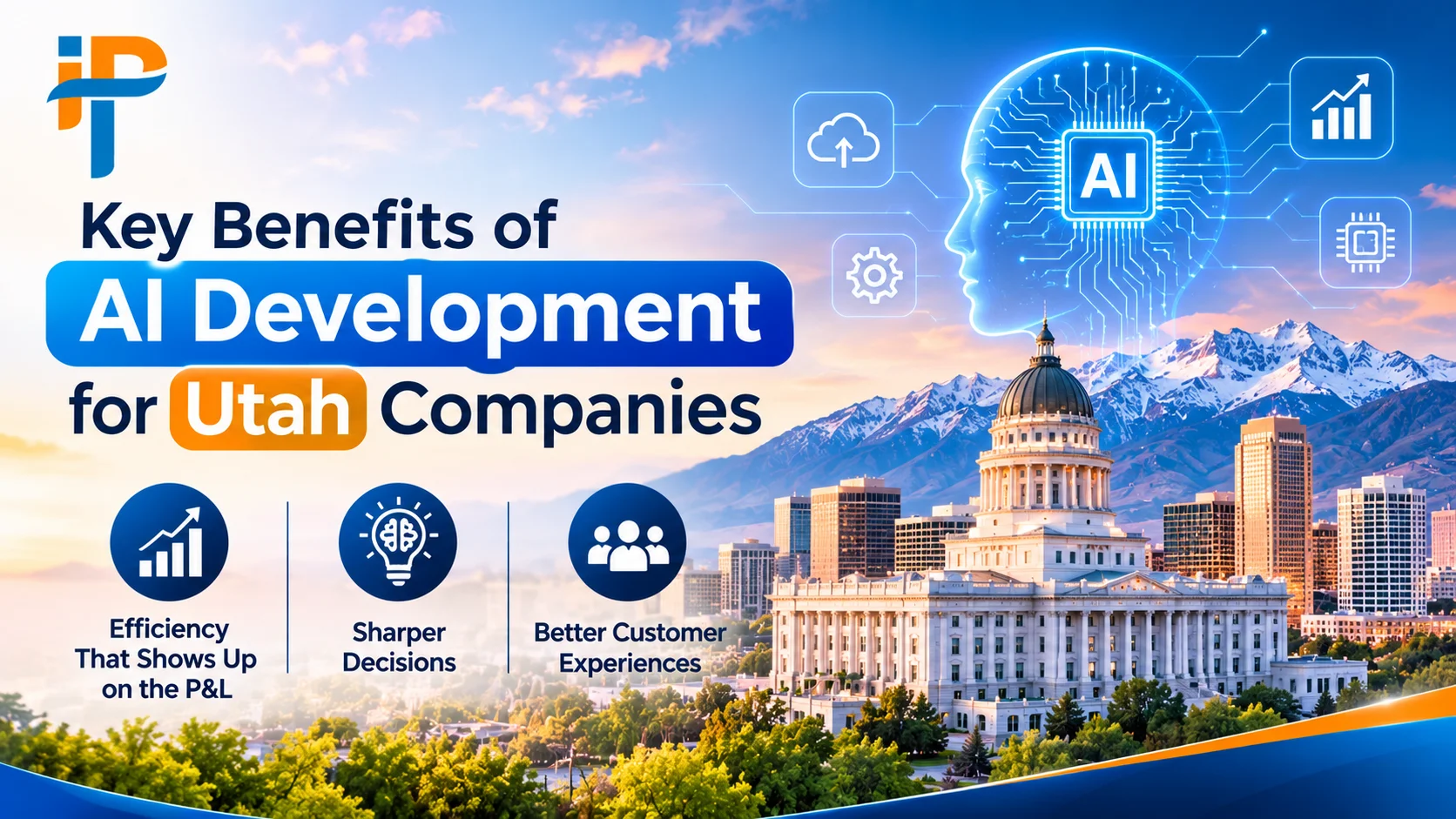
Key Benefits of AI Development for Utah Companies
Why bother? Because the upside is practical, not theoretical.
Efficiency That Shows Up on the P&L
Automating repetitive tasks frees people for work that actually needs judgment. A claims team that spends less time retyping data can process more cases, or spend more time on the complicated ones. Less rework, fewer errors, faster turnaround.
Sharper Decisions
Humans are great at context and terrible at crunching ten million rows. AI is the opposite. Pair them and you get decisions informed by patterns nobody had time to find. Where should we open the next location? Which customers are about to churn? Your data already knows, and AI helps it talk.
Better Customer Experiences
Customers expect fast, personal service at any hour. AI-powered recommendations, instant responses, and smarter routing deliver that without doubling your headcount. Small and mid-sized Utah companies can suddenly offer the kind of service that used to belong only to giants.
AI Use Cases by Utah Industry
Utah’s economy isn’t one thing, and the best AI projects are rooted in the specific work each industry does every day.
Industry Snapshot (Table 1)
| Industry | Utah Employment (2024) | Practical AI Use Cases |
|---|---|---|
| Software and IT | ~78,200 | Code assistance, AI-powered product features, automated QA, customer analytics |
| Life Sciences and Healthcare | ~247,050 | Clinical documentation, patient triage, scheduling optimization, drug-discovery data analysis |
| Financial Services | ~66,200 | Fraud detection, credit risk scoring, document processing, personalized advice engines |
| Aerospace and Defense | ~76,200 | Predictive maintenance, supply chain forecasting, quality inspection |
| Advanced Manufacturing | ~77,170 | Computer-vision inspection, demand forecasting, production scheduling |
Don’t see your industry? Retail, tourism, outdoor recreation, real estate, and education all have strong AI plays too, from dynamic pricing to personalized trip planning.
Healthcare and Life Sciences
This is where Utah is getting especially interesting. The state’s Office of Artificial Intelligence Policy announced three new clinical AI pilots on October 5, 2026, under its regulatory sandbox, according to Holland & Knight. One drafts individualized physical therapy plans, one handles refills of existing maintenance medications for stable adults, and one supports prescription treatment for mild to moderate acne. Licensed professionals review the AI’s output at first, and oversight loosens only after the system hits performance benchmarks.
You don’t need to be running a prescribing pilot to benefit. Ambient note-taking, smarter scheduling, and claims automation are everyday wins for clinics and health systems.
Financial Services
Banks, credit unions, and fintechs live on pattern recognition. Fraud detection models can spot suspicious transactions in real time, underwriting models can sharpen risk scoring, and document AI can slash onboarding time. Because the sector pays well and runs on data, it’s a natural fit.
Aerospace, Defense, and Advanced Manufacturing
Downtime is expensive. Predictive maintenance models analyze sensor data to flag a failing component before it fails. Computer vision catches defects a tired human eye might miss on the fifth hour of a shift. And forecasting tools help plants order the right materials at the right time.
Software and IT
For Utah’s many software companies, AI isn’t just a tool. It’s a product feature. Embedding smart search, summarization, or recommendations into your platform can be the difference between a product that’s fine and one that customers rave about. Also read- oil and gas app development utah
Utah’s AI Regulatory Environment
Here’s something many founders don’t expect: Utah’s approach is built to encourage experimentation, not choke it.
Key Facts at a Glance
| Topic | What to Know |
|---|---|
| Office of AI Policy | Created to run an AI learning laboratory (a regulatory sandbox) and set participant rules |
| Annual reporting | The office reports each year, before Nov. 30, to the Business and Labor Interim Committee |
| Regulatory mitigation agreements | Let approved participants test AI without enforcement of certain state requirements |
| Generative AI disclosure | Required when a consumer asks whether they are dealing with AI; effective May 1, 2024 |
Disclosure Basics
Under the AI Policy Act (SB 149), anyone using generative AI in a consumer interaction must clearly disclose it when a consumer asks whether they’re talking to a person or a machine, per Regulations.ai. The simplest habit: label your chatbot as AI from the start. It builds trust and keeps you well inside the line. Since Utah has amended its AI laws since 2024, have your counsel confirm the current requirements for your use case before launch.
What the Sandbox Does Not Cover
Don’t mistake the sandbox for a free pass. Holland & Knight notes that the nonenforcement in these agreements applies only to Utah state administrative enforcement. Federal rules, including FDA and DEA requirements, still apply. The agreements also provide no liability shield and don’t change the professional standard of care. In other words, the sandbox lowers friction. It doesn’t lower responsibility.
How an AI Development Project Works, Step by Step
Curious what the journey looks like? Here’s the typical path.
- Discovery. We pin down the business problem, the data you have, and what success looks like in numbers.
- Data assessment. Is your data clean, accessible, and permitted for this use? This step quietly decides most projects’ fate.
- Proof of concept. A small, fast build to prove the idea works before you commit the full budget.
- Development and integration. The real build: models, interfaces, and connections to your CRM, ERP, or databases.
- Testing and validation. Accuracy, bias, security, and edge cases get stress-tested. In regulated fields, humans stay in the loop.
- Deployment and monitoring. Launch, then watch performance, cost, and drift over time.
- Iteration. Add features based on real user feedback, not guesses.
Think of it like building a house. You don’t pour the foundation before the blueprint is approved. Also read- Aso vs Seo
Common Mistakes to Avoid
Even smart teams trip on these.
- Starting with technology instead of the problem. “We need AI” isn’t a goal. “Cut invoice processing from 5 days to 1” is.
- Ignoring data quality. Garbage in, garbage out, only faster.
- Skipping human oversight. Especially in healthcare and finance, keep qualified people reviewing high-stakes outputs.
- Underestimating ongoing costs. Models need monitoring, updates, and usage budgets after launch.
- Going big on day one. Launch narrow, prove value, then expand.
How to Choose an AI Development Partner
Ask three blunt questions. Have they shipped real projects, not just demos? Can they explain tradeoffs in plain English? Will they tell you when AI is the wrong answer? A good partner will occasionally talk you out of a project, and that honesty is worth more than any slide deck.
Also check how they handle security, data ownership, and post-launch support. You want a team that sticks around after go-live.
Why Partner With IPH Technologies
At IPH Technologies, we turn visionary ideas into working software. As a full-service app development company, we cover mobile apps, web applications, and custom software engineering, and we bring that same engineering discipline to AI-powered solutions.
Our track record: 800+ projects delivered, 430+ enterprise clients, 40+ countries served, and 13+ years of experience. We use the latest technology and agile methods, so you see working progress early and often instead of waiting months for a big reveal.
Whether you’re a Salt Lake City fintech, a Provo software startup, or a manufacturer in Ogden, we start with your goals, scope honestly, and build what genuinely moves your numbers. Also read-
Conclusion
Utah offers an unusual combination: a deep tech workforce, data-rich industries, and a regulatory approach that invites responsible experimentation. For businesses, the opportunity is concrete, from AI agents that lighten support loads to predictive models that cut downtime and document AI that clears paperwork piles. The winners won’t be the companies that adopt AI the loudest. They’ll be the ones that pick a real problem, build carefully, keep humans in the loop where it matters, and improve steadily. Start small, measure honestly, and scale what works.