














































































































Security is a critical concern for Software-as-a-Service (SaaS) companies operating in the United States. From customer authentication and payment processing to cloud integrations and API communication, SaaS platforms depend on secure connections to protect sensitive information.
Node.js is widely used to build scalable backend services, APIs, and cloud-based applications. However, vulnerabilities in TLS certificate validation can weaken the security of connections between applications and external services.
On October 21, 2026, the Node.js project announced security releases addressing multiple vulnerabilities, including high-severity issues affecting TLS hostname verification. These flaws can cause certain malformed IP address representations to bypass expected certificate hostname checks under specific conditions.
For SaaS businesses, understanding these risks is essential to maintaining secure integrations, protecting customer data, and reducing exposure to attacks.
What Is a Node.js TLS Certificate Validation Vulnerability?
Transport Layer Security (TLS) protects data exchanged between applications and servers. During a TLS connection, certificate validation helps verify that the server is trusted and that its certificate matches the intended hostname or IP address.
Node.js provides TLS functionality through its built-in node:tls module. By default, certificate verification is enabled for standard TLS connections unless application configuration or custom code changes that behavior.
A TLS certificate validation vulnerability occurs when this verification process incorrectly accepts a certificate that should be rejected.
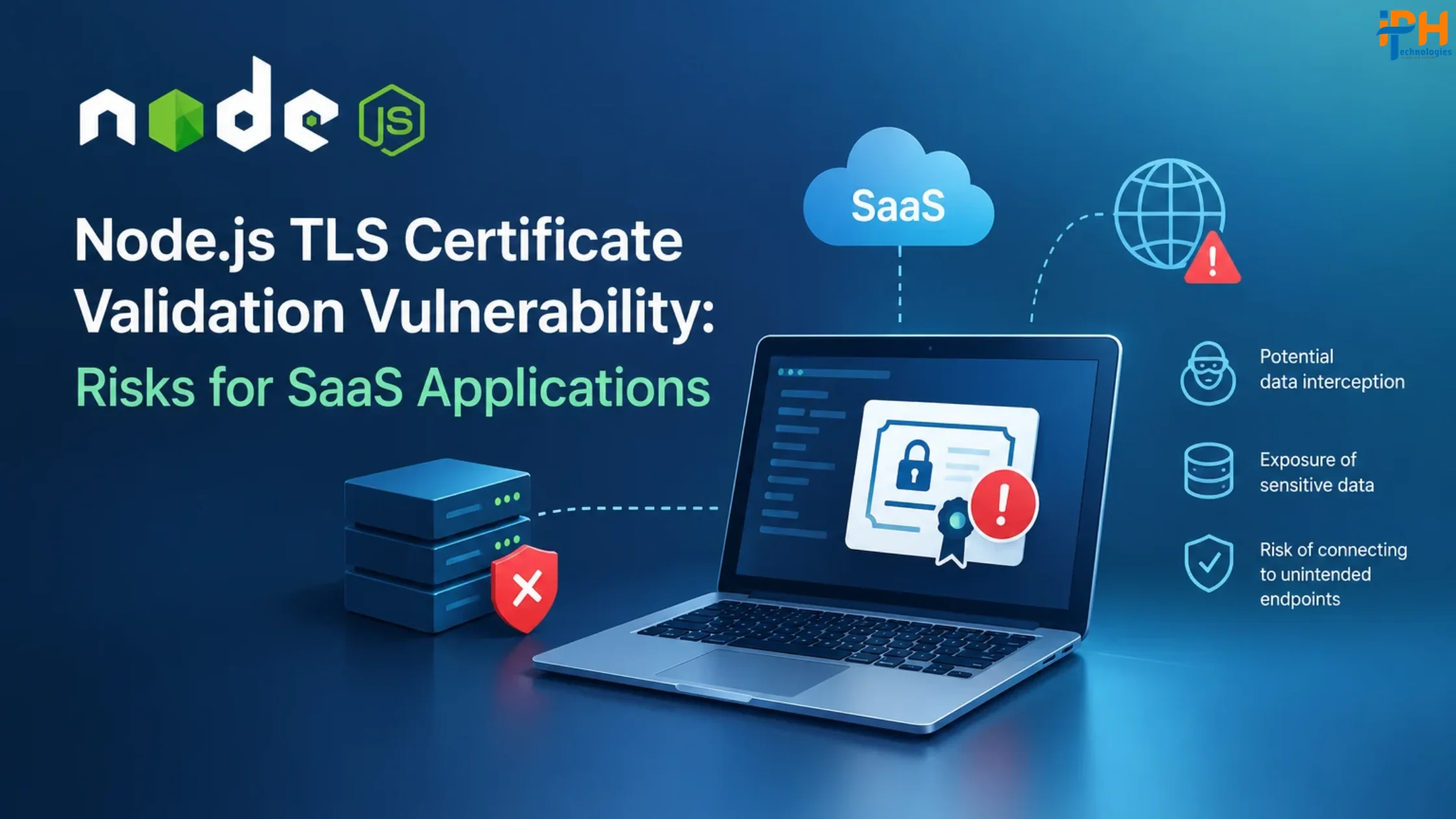
For example, a SaaS application might connect to a third-party API to retrieve customer records. If hostname verification incorrectly accepts the remote server’s certificate, the application could establish a connection with an unintended endpoint under exploitable circumstances.
The consequences depend on the vulnerability, application configuration, network environment, and data being transmitted.
Also Read: ASO vs SEO in 2026
What Changed in the October 2026 Node.js Security Updates?
The October 2026 security releases addressed multiple issues involving hostname verification and other components.
Two notable high-severity TLS issues include:
- CVE-2026-105483: Certain non-ASCII representations of IPv4 addresses could cause hostname verification to treat an IP endpoint as a DNS hostname.
- CVE-2026-106069: Certain non-canonical IPv4 representations, such as addresses containing leading zeros, could cause the certificate hostname check to evaluate a different IP address from the endpoint actually reached.
These issues affect specified Node.js release lines, including Node.js 24.x and 26.x for CVE-2026-105483, and Node.js 22.x, 24.x, and 26.x for CVE-2026-106069.
The same security announcement also identifies CVE-2026-106072, a medium-severity certificate validation issue involving alternative IPv4 representations.
Affected SaaS teams should consult the official advisory for the precise affected versions and install the applicable patched releases: Node.js October 2026 Security Releases.
How Can TLS Validation Issues Affect SaaS Applications?
1. Increased Risk to API Integrations
SaaS platforms frequently connect to payment gateways, CRM systems, analytics platforms, identity providers, and other third-party APIs.
If a vulnerable connection path accepts an improperly validated certificate, attackers may have an opportunity to interfere with communication under the right conditions. This could expose sensitive data or undermine the integrity of API responses.
2. Potential Exposure of Customer Information
Applications handling customer profiles, business records, financial transactions, or healthcare information require strong transport security.
A certificate validation failure could increase the risk of interception or communication with an unintended endpoint. The actual exposure depends on whether the vulnerability is exploitable and what protections exist elsewhere in the system.
3. Risks to Cloud and Microservices Architectures
Many U.S. SaaS providers use distributed services, containers, cloud infrastructure, and internal APIs.
A vulnerability in a shared HTTP client or TLS configuration can affect multiple services simultaneously. Without a clear dependency inventory, engineering teams may overlook vulnerable components running in background jobs, scheduled tasks, or separate deployment environments.
4. Compliance and Customer Trust Concerns
Organizations subject to contractual security requirements or frameworks such as SOC 2 may need to demonstrate that vulnerabilities are assessed, remediated, and documented.
Companies handling regulated information should also evaluate their applicable legal and compliance obligations. A vulnerability does not automatically mean a compliance violation has occurred, but inadequate remediation can create additional business risk.
Also Read: Secure Node.js Application: October 2026 Security Updates
6 Steps to Secure a Node.js SaaS Application
1. Upgrade to a Patched Node.js Release
Check the Node.js versions used in production, staging, development, and CI/CD environments.
Upgrade affected deployments to the appropriate patched release listed in the official security advisory. The October 21 announcement lists Node.js 22.23.4, 24.22.1, and 26.12.1 among the security releases.
Do not assume that every listed version fixes every issue across every release line. Verify the specific fix applicable to your deployed version.
2. Audit HTTP Clients and Dependencies
Review dependencies such as Undici and other HTTP clients that handle outbound HTTPS requests.
The Undici project also published an October 2026 advisory concerning TLS options being dropped in certain Agent configurations when custom certificate-verification callbacks are used. Patched versions include 6.29.1, 7.30.1, and 8.12.2 for the affected release branches.
Check the Undici security advisory and update affected dependencies where applicable.
3. Keep Certificate Verification Enabled
Avoid disabling certificate verification to bypass connection errors.
For example, Node.js documents that setting NODE_TLS_REJECT_UNAUTHORIZED=0 disables TLS certificate validation and makes TLS connections insecure.
Investigate certificate-chain problems, hostname mismatches, and trusted certificate authority configuration instead of suppressing verification errors.
4. Review Custom TLS Validation Logic
Inspect custom checkServerIdentity callbacks, certificate pinning, proxy configurations, and HTTP client agents.
Confirm that security options are preserved throughout the request path and that custom validation logic cannot be unintentionally bypassed.
5. Rebuild and Redeploy Application Artifacts
Updating a developer’s local Node.js installation is not enough.
Rebuild container images, serverless packages, and deployment artifacts using patched runtimes and dependencies. Review lockfiles and verify that production workloads are running the intended versions.
6. Strengthen Monitoring and Security Testing
Add automated dependency scanning, vulnerability alerts, TLS configuration tests, and deployment verification to your development pipeline.
Monitor unexpected TLS failures, certificate errors, and unusual outbound connections. Test security fixes in a controlled environment before deploying them broadly.
Also Read: PWA vs Native App
How IPH Technologies Can Help SaaS Businesses
Securing a SaaS platform requires more than patching a single dependency. Businesses need a coordinated approach to application architecture, API security, dependency management, deployment practices, and ongoing maintenance.
IPH Technologies helps businesses explore custom software and application development solutions designed around their technical requirements and business objectives.
For SaaS teams planning a new platform or modernizing an existing application, a security-focused development approach can help address risks earlier in the software lifecycle.
Explore IPH Technologies’ mobile and software development services to discuss your application requirements and development goals.
Final Thoughts on the Node.js TLS Certificate Validation Vulnerability
Node.js TLS certificate validation vulnerabilities highlight the importance of maintaining secure communication across SaaS applications. Even when a platform uses HTTPS, incorrect hostname verification or insecure client configuration can undermine expected security protections.
U.S. SaaS businesses should review the October 2026 Node.js security advisories, upgrade affected runtimes and dependencies, preserve certificate verification, and validate their deployment pipelines.
Proactive vulnerability management helps organizations reduce security exposure, protect customer information, and build more resilient software systems.
Security takeaway: Patch affected Node.js releases, audit outbound HTTPS connections, and verify that certificate validation remains effective throughout your application stack.