
































































































We Build Generative AI Solutions That Transform How Your Business Creates, Decides & Operates
From custom LLM integrations to enterprise-grade AI pipelines — IPH Technologies engineers production-ready Generative AI solutions that go beyond the demo, beyond the prototype, and directly into the workflows where your business creates real value.
Projects Delivered
Happy Clients
Years of Expertise
Countries Served

Clutch Top Developer 2024

4.9/5 Average Client Rating

Clients in 10+ Countries

On-Time Delivery Guaranteed

NDA-Protected Engagement
Most Businesses Know They Need Generative AI. Very Few Know How to Deploy It Right.
Millions Spent on AI Subscriptions That Don’t Move Business Metrics
ChatGPT Enterprise. Copilot. Jasper. Your teams are using them — individually, inconsistently, disconnected from your actual systems and data. Generative AI deployed as a collection of individual subscriptions is an expense, not an advantage.
Sensitive Business Data Flowing Into Public AI Models
Every employee who pastes proprietary customer data, internal strategy documents, or confidential financials into a public LLM is creating a data governance risk your legal and compliance teams haven’t approved. The answer isn’t to ban AI use — it’s to build a secure, controlled AI environment your team can actually use.
High-Value Workflows Still Running on Manual Effort
Content creation, document analysis, contract review, code generation, customer communication, research synthesis — your most skilled employees are still spending hours on work that Generative AI can handle in seconds when properly engineered and integrated into your existing systems.
AI Tools That Don’t Know Anything About Your Business
Generic LLMs don’t know your products, your processes, your customers, or your industry-specific terminology. Without fine-tuning, RAG architecture, and proper knowledge grounding — AI outputs require more time to review and correct than they save.
Competitors Moving Faster Than Your Internal Approval Cycles
While your organization debates AI strategy, your fastest competitors are already deploying custom Generative AI systems into their sales processes, their content operations, their customer service, and their product development. The window to move first is narrowing.


We Build Generative AI Systems That Run in Production.
At IPH Technologies, Generative AI development is a core engineering practice — not a service we added to a brochure because it’s trending. We’ve invested deeply in LLM integration architecture, RAG system design, prompt engineering methodology, fine-tuning pipelines, and the software engineering discipline required to take Generative AI from impressive prototype to reliable, maintainable production system.
We work with businesses that are serious about deploying Generative AI — not experimenting with it. Our clients come to us because they need a technical partner who can translate a business problem into an AI architecture decision, build it with production engineering standards, integrate it with the systems that already run their business, & stand behind it after it goes live.
What sets us apart:
- Production-first mindset — every solution is built to run reliably at scale
- LLM-agnostic architecture — GPT-4o, Claude, Gemini, Llama, Mistral
- Deep RAG and knowledge grounding expertise for domain-specific accuracy
- End-to-end delivery — strategy, architecture, engineering, and integration
- Responsible AI practices — bias evaluation, safety guardrails, compliance
- Full IP ownership and source code delivered at project close
Where Quality Meets Innovation








End-to-End Generative AI Development Services
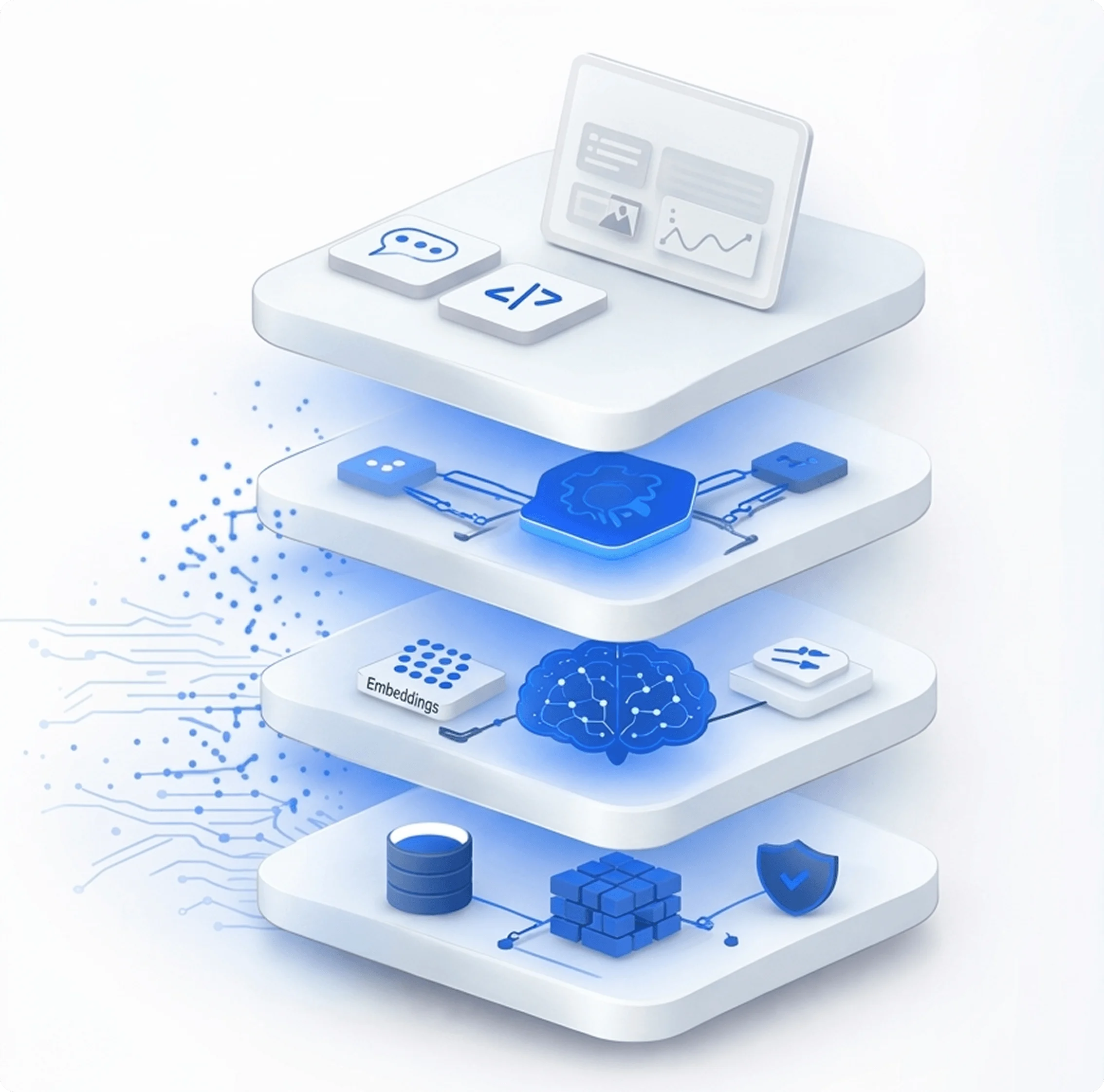
Every layer of the Generative AI stack — from foundation model selection and RAG architecture through application development, system integration, and production deployment.

Custom LLM Application Development

RAG System Design & Development

LLM Fine-Tuning & Domain Adaptation

AI Content Generation Platforms

Intelligent Document Processing & Analysis

AI-Powered Code Generation & Developer Tools

Multimodal AI Development

Generative AI Integration & API Development

AI Agent & Autonomous Workflow Development

Enterprise Generative AI Strategy & Architecture

Private & On-Premise LLM Deployment

AI Output Quality & Evaluation Systems
Where Generative AI Delivers the Highest Business Impact
Generative AI is not a single technology — it's a capability that reshapes multiple business functions simultaneously. Here are the highest-ROI deployment areas we build for:
Marketing & Content Operations
Generative AI transforms content from a bottleneck into a scalable operation. We build systems that generate on-brand blog posts, product descriptions, ad copy, email sequences, & social content — at scale, in your voice, integrated with your CMS — cutting content production time by 60–80% without sacrificing quality.
Sales Enablement & Pipeline Automation
AI systems that research prospects, personalize outreach at scale, generate tailored proposals, summarize CRM activity, and brief sales representatives before calls — giving your sales team the preparation and personalization of a dedicated analyst for every single prospect in their pipeline.
Customer Service & Support Intelligence
Beyond chatbots — AI systems that summarize support ticket history for agents, generate draft responses for human review, identify emerging product issues from ticket patterns, and create knowledge base articles from resolved tickets — making every support interaction faster and better informed.
Legal & Compliance Document Intelligence
Contract analysis systems that extract key clauses, flag non-standard terms, summarize obligations, and compare against template standards — reducing legal review time from days to hours while maintaining the accuracy and audit trail enterprise compliance demands.
Healthcare & Clinical AI Applications
Clinical note generation, medical literature synthesis, patient communication drafting, ICD code suggestion, and prior authorization support — built with HIPAA-compliant architecture and the clinical accuracy standards that healthcare AI demands above all other industries.
Financial Analysis & Reporting Automation
Earnings report summarization, risk analysis document generation, regulatory filing drafting, financial data narrative creation, and investment research synthesis — AI systems that turn structured financial data into clear, accurate, decision-ready written intelligence.
Engineering & Product Development
Requirements document generation from stakeholder conversations, user story creation, technical specification writing, automated code review summaries, and release note generation — AI embedded into the engineering workflow that accelerates delivery without cutting quality corners.
Knowledge Management & Enterprise Search
RAG-powered enterprise knowledge systems that let employees ask natural language questions and receive accurate, source-attributed answers from your internal documentation, Confluence pages, SharePoint libraries, and institutional knowledge — eliminating the 20% of work time employees spend searching for information they know exists somewhere.
The Engineering Depth That Makes Generative AI Work in Production
Production-Grade LLM Architecture
System design built for reliability, latency management, token cost optimization, and graceful degradation — because a Generative AI system that works in a demo but fails under production load or real-world input variation is not a solution, it’s a liability.
Advanced RAG Pipeline Engineering
Multi-stage retrieval pipelines with hybrid search (dense + sparse), reranking models, query expansion, context window optimization, and citation tracking — the engineering depth that separates RAG systems with 95%+ accuracy from the 60% accuracy systems that erode user trust.
Guardrails & Safety Systems
Input validation, output filtering, toxicity detection, PII redaction, prompt injection defense, and hallucination detection — the safety layer that makes Generative AI deployable in regulated industries and customer-facing products where output quality is non-negotiable.
Prompt Engineering & Optimization
Systematic prompt design, few-shot example curation, chain-of-thought structuring, and continuous prompt performance evaluation — treating prompts as production artifacts that are versioned, tested, and optimized with the same discipline as application code.
LLM Orchestration & Workflow Chaining
Multi-step AI pipelines that chain LLM calls, tool use, retrieval operations, and external API calls into coherent workflows — using LangChain, LlamaIndex, or custom orchestration frameworks engineered for the specific complexity of your use case.
Observability & Monitoring
End-to-end tracing of LLM calls, latency monitoring, cost tracking per request, output quality scoring, and anomaly detection — giving you complete visibility into your production AI system’s behavior, performance, and cost trajectory.
Data Privacy & Security Architecture
Private deployment options, data residency controls, encryption at rest and in transit, role-based access to AI capabilities, audit logging for all AI interactions, and GDPR/HIPAA/SOC 2 compatible architecture for compliance-sensitive deployments.
Multi-Model & Fallback Architecture
Intelligent model routing based on task type and complexity, automatic fallback to secondary models on primary model failure, cost-optimized model selection for different tiers of request complexity, and a resilient AI infrastructure that doesn’t have a single point of failure.
Feature Chips:
GPT-4o · Claude 3.5 · Gemini 1.5 · Llama 3 · Mistral · Fine-Tuning · RAG · Vector Search · LangChain · LlamaIndex · Pinecone · Weaviate · Embeddings · Semantic Search · Prompt Versioning · A/B Testing · Output Evaluation · RLHF · Streaming Responses · Function Calling · Tool Use · Agent Workflows · Multimodal · DALL·E 3 · Whisper · Stable Diffusion
How We Take Generative AI From Business Problem to Production System

Phase 01 — AI Discovery & Use Case Assessment
We begin with a structured business analysis — mapping your highest-value workflows, evaluating AI feasibility and ROI potential for each, assessing your data readiness, identifying compliance and security constraints, and producing a prioritized GenAI roadmap with honest effort and impact estimates for every proposed solution.
Phase 02 — AI Architecture Design & Model Selection
Based on discovery findings, we design the end-to-end technical architecture — LLM selection, RAG vs. fine-tuning decision, data pipeline design, integration architecture, security model, and infrastructure plan. Every architecture decision is documented with the rationale, the tradeoffs evaluated, and the alternatives considered.
Phase 03 — Data Preparation & Knowledge Engineering
For RAG systems — document collection, cleaning, chunking strategy design, embedding model selection, and vector database setup. For fine-tuning — dataset curation, quality validation, formatting, and training configuration. The quality of your AI output is directly determined by the quality of this phase.
Phase 04 — Development & Integration
Agile sprint-based development — LLM integration, prompt engineering, RAG pipeline implementation, API development, frontend or integration layer build, and connection to your existing business systems. Bi-weekly sprint reviews with working, testable AI functionality delivered throughout.
Phase 05 — Phase 05 — Evaluation, Testing & Safety Review
Systematic evaluation of output quality against defined benchmarks, adversarial testing for safety and guardrail effectiveness, performance testing under production load conditions, security review, and compliance validation — before a single user sees the system.
Phase 06 — Deployment, Monitoring & Iteration
Production deployment with full observability instrumentation, staged rollout, real-world performance monitoring, cost optimization, and a structured iteration cycle based on production data — because Generative AI systems that are not actively maintained and improved will degrade in quality as the world around them changes.
The Generative AI Technology Stack We Build On
Core AI & Intelligence
These are the models that power the actual logic and generation
- Primary LLMs: GPT-4o / GPT-4 Turbo, Claude 3.5 Sonnet / Opus, Gemini 1.5 Pro / Flash.
- Open-Source & Specialized: Llama 3, Mistral, Mixtral, Code Llama, DeepSeek Coder.
- Multimodal: DALL·E 3, Stable Diffusion XL (Images), Whisper, ElevenLabs (Audio).
Backend & Logic Layer
The “glue” code and APIs that handle requests and process data.
- Languages & Frameworks: Python, PyTorch, FastAPI, Node.js.
- LLM Orchestration: LangChain, LlamaIndex (these manage how the AI “thinks” through steps).
- Containerization: Docker, Kubernetes (for packaging and scaling the backend).
The Businesses Deploying Generative AI Today Are Building Advantages That Will Be Extremely Difficult to Replicate in 12 Months.
Data flywheels compound. Fine-tuned models improve. AI-augmented teams get faster. Every month of delay is a month of advantage your faster competitors are accumulating. The best time to start was last year. The second-best time is right now.
Generative AI Solutions Built for Your Industry

Healthcare & Life Sciences

Legal & Professional Services

Financial Services & Fintech

eCommerce & Retail

Manufacturing & Industrial

Education & eLearning

Enterprise & SaaS

Trusted by Industry Leaders
Esteemed Clients & Partners








The Generative AI Technology Stack We Build On
01
Production Engineering, Not Prototype Building
We build Generative AI systems designed to run reliably in production — with proper error handling, fallback logic, cost controls, latency management, and observability. A prototype that impresses in a demo but fails under real-world conditions is not something we deliver.
02
LLM-Agnostic Architecture
We are not aligned with any single AI provider. We evaluate every major LLM against your specific requirements and recommend the architecture that genuinely serves your use case — not the one with the best partnership incentives for us.
03
RAG Expertise That Goes Beyond the Tutorial
Anyone can build a basic RAG demo in an afternoon. Building a RAG system that delivers 95%+ accuracy on complex enterprise knowledge bases — with proper chunking strategy, reranking, query expansion, and citation tracking — requires engineering depth we’ve spent years developing.
04
We Understand AI Failure Modes
Hallucination, prompt injection, context window mismanagement, embedding drift, retrieval precision failures — we’ve encountered every production failure mode and built the guardrails, evaluation systems, and architecture patterns that prevent them. Experience with failure is the most valuable thing we bring.
05
Security & Compliance Are Foundational
Data sovereignty, PII protection, audit logging, role-based AI access controls, and private deployment options are designed into every solution from the architecture phase — not retrofitted when your compliance team asks questions before go-live.
06
Full Ownership. Zero Lock-In.
Every system we build is your source code, model weights, training data, documentation, and complete IP rights transferred at project close. You are never dependent on IPH Technologies to access, operate, or evolve your AI system.
What Our Clients Say About Us
Tam Ho, Owner at 7DC Interactive
Based in Brisbane, the client develops value-added mobile and web apps. They outsource to Indian firms, leveraging expertise to deliver innovative, customized solutions across industries, ensuring adaptability and client-focused results.


Priya Vrat Misra, Founder at reckoon
Exceptional quality of service, a great team. They developed the iOS version for reckoon and did a super job at it. Excellent suggestion were provided to improve the app and customer experience. I am already ready to hire them again for the hybrid app for reckoon”

Roy, Founder at TaskTime LLC
I’ve worked with the IPHS team for over a year. They are highly skilled, adaptable, and professional, consistently delivering quality results even when requirements change. I highly recommend them, especially when clear specifications are provided. I look forward to future collaborations.


Your Generative AI Advantage Starts With One Honest Conversation
Tell us the business problem you need Generative AI to solve. We’ll tell you the right architecture, the realistic timeline, the honest cost, and exactly what your system will be capable of when it’s built. No inflated demos. No technology for technology’s sake. Just serious engineering applied to real business outcomes.








.png)