









































































































Gold trading is no longer dictated by emotional factors. Behind every profitable trade is a complex algorithm, which analyzes the constant exchange rate fluctuations and interest rates, as well as geopolitical events occurring worldwide. This technological revolution in the market is what makes Bullion Software Development the most popular choice among numerous dealers, refiners, and trading platforms, which wish to remain ahead of the game.
This article covers the basics of analytics utilized to AI Gold Price Prediction fluctuations, discusses particularities of the software used in contemporary bullion trading, and highlights the criteria for selecting an offshore development partner capable of building such software. We will talk about the machine learning models used to train AI, data sources used for training and validation, the must-have and nice-to-have features, as well as address common pitfalls and deal-breakers in building a reliable Gold and Silver Software.
Key Takeaways
AI-based analytics harness machine learning, real-time spot price feeds, and macroeconomic data to predict short-term gold, silver price movements more accurately than traditional trend-line approaches.
Bullion Software Development now focuses on predictive pricing engines, automated spread management and multi-location inventory synchronization, not just point of sale systems.
Cloud-based, API-first architecture (AWS, Firebase, RESTful integrations) is the technical backbone that makes real-time precious metals pricing possible at scale.
AI forecasting is not always accurate, as data inaccuracies and thin-market securities’ manipulation can affect it, which is why humans are essential in trading.
Why Traditional Gold Price Forecasting Falls Short
Outdated gold forecasts are based on chart patterns, historical spot price averages, or a trader’s gut feeling on the desk. Although this approach is not wrong per se, it is not effective in current markets where any news – be it a tweet from the Fed chief, a traffic jam in the Red Sea, or a surprise spike in inflation – can drive prices up or down faster than a human trader can update his spreadsheet.
Traditional forecasting is also limited in terms of volume. A single coin dealer may be tracking the spot price of gold, silver, platinum, and palladium – across dozens of product SKUs – at the same time. Manually, with any degree of accuracy, that’s impossible. Bullion Software Development is designed to close that gap – systems that do not sleep or miss a beat.
The Rise of AI-Powered Bullion Trading Platforms
Over the past several years, precious metals dealers have undergone the same evolution as has been seen in retail and fintech more recently – their operations are no longer manual and heavily paper-based, but instead digitized and driven by software.
While platforms like Kitco and APMEX were some of the earliest to embrace the consumer-facing bullion e-commerce space, the innovation in the industry has since been focused on the underlying mechanisms at work.
A gold dealer using AI to price gold can reprice their entire inventory at the same time as a spot move in under a second, something that previously took someone on the staff around an hour. This has massive implications on their profit and loss.
What Is AI-Driven Analytics?
AI-driven analytics (the utilization of ML algorithms to mine large datasets for predictive signals) uses statistical modeling of historical and real-time market data to forecast probable price movements. In gold trading, this refers to algorithms trained on decades of spot price behavior, cross-referenced to macroeconomic variables to generate short-term directional signals.
How AI-Driven Analytics Actually Work in Gold Markets
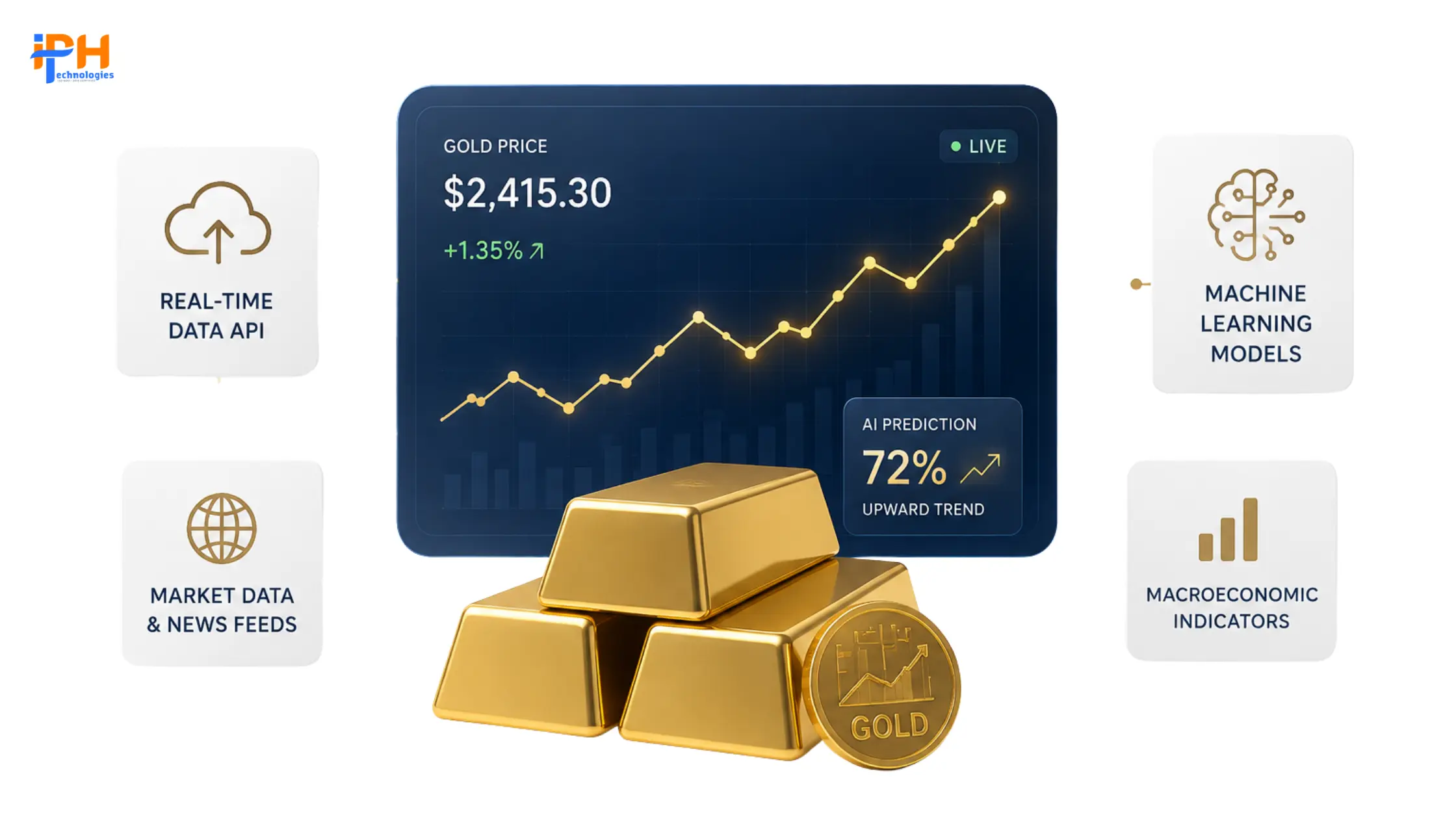
AI systems can predict future prices of gold by analyzing market trends. This involves constantly feeding fresh data into a learning model and comparing its solution with other data sets on the economy and market psychology, all in fractions of a second, resulting not in one prediction but a constantly updated probability distribution.
Real-Time Gold Price API and Live Spot Price Integration
Any AI’s pricing model implementation is only as good as the data that feeds it. For this reason, it’s crucial to implement a real-time gold price API, an algorithm that regularly updates itself on gold’s price per ounce from any given source, whether that be COMEX, LBMA, or an external provider.
Most modern platforms use multiple, redundant feeds, so that if one source freezes or becomes inaccurate, switching to the next one happens instantly, not letting traders (or customers) see an out-of-date price. That’s a detail that most dealers would not think about ahead of a volatile session in which a pricing error could cost them dearly.
Machine Learning Models Used in Precious Metals Pricing Engines
Several model classes are recurrent in pricing algorithms for precious metals: long short-term memory networks (LSTM) for time series forecasting, gradient boosted decision trees for short-term directional prediction, and sentiment analysis NLP models that ingest news/social data for market moving information extraction.
LSTM networks are good at predicting prices of gold since they can learn long-term patterns and dependencies, thus, being able to account for a decision made by the Fed three weeks ago which still affects the price today.
No single model gets it right consistently; the platforms that perform best blend several models and weight their outputs dynamically based on current market conditions. That ensemble approach is a hallmark of serious Bullion Software Development, not an afterthought bolted on later.
Market Data Feeds, News Sentiment, and Macroeconomic Indicators
Beyond spot prices, robust prediction models pull in third-party market data feeds covering currency exchange rates, bond yields, and central bank policy statements. News sentiment analysis scanning Reuters, Bloomberg, and financial Twitter/X for language patterns adds another layer, since gold is famously reactive to headline risk around inflation, war, and monetary policy.
Macroeconomic indicators worth tracking include the US Dollar Index (DXY), 10-year Treasury real yields, and global ETF holdings data, all of which have historically shown strong inverse or direct correlation with gold price movement. A well-built pricing engine doesn’t just track gold in isolation it tracks gold’s relationship to everything else.
Read More: How AI is Revolutionizing in Bullion Software Development in 2026
Core Features of AI-Powered Bullion Trading Software
The attributes of a dealership tracking software that matter most to car traders are predictive pricing engines, automated spread control, and inventory systems that are able to update in real time across all outlets and sales channels. All the rest are mere accessories.
Predictive Pricing Engines and Melt Value Calculators
A precious metals pricing engine (the software that automatically calculates buy and sell prices based on current spot prices, premiums and dealer-defined spreads) sits at the heart of any serious bullion platform. Combined with a melt value calculator (that determines the value of the metals contained in a coin or piece of jewelry based on purity and weight) it provides dealers with the pricing power that manual calculations simply can’t match, when it comes to mixed inventory of 22k, 18k and sterling silver.
Inventory Tracking and Multi-Location Inventory Sync
For dealers with multiple storefronts, or who split inventory between retail, vault, and online listings, multi-location inventory syncing is an essential tool to understand exactly where inventory is at any given time. Along with barcoding and lot-level tracking, it provides an accurate, real-time view of what inventory a dealer has on hand and at what cost basis.
Read More: Branded White Label Bullion Application
Benefits of AI-Driven Trend Prediction for Traders and Dealers
The main advantage of using AI systems for predicting trends is the ability to make calculations faster and at a bigger scale, thus optimizing inventory and reducing costs while being able to adapt to sudden changes in demand. These advantages add up throughout the whole trading season.
Improved Decision-Making for Coin Dealers and Bullion Brokers
When a coin dealer or bullion broker has access to a forecasting model which identifies weighted price direction over the next 24-72 hour period, it fundamentally changes the way they make buy and sell decisions; not just on the spot market, but with respect to how much inventory they want to carry in any given session.
Risk Reduction Through Predictive Inventory Management
The predictive nature of the system can be similarly applied to inventory management. It helps track imbalances in levels of a particular metal at a specific dealer, whether they are overexposed to the risk of depreciation or underexposed ahead of demand surges.
Bullion businesses using AI-assisted inventory forecasting have reported inventory carrying cost reductions in the double digits within the first year of deployment.
Faster Response to Market Volatility
Gold can move 2-3% in a single trading session during a genuine risk-off event – a currency crisis, a surprise rate decision, a geopolitical shock. Platforms with real-time gold price API integration and automated repricing respond to that volatility in seconds rather than the minutes or hours a manual process would take, protecting margin on both sides of the transaction.
Read More: Bullion ERP vs Traditional Accounting Software: What’s Better for Jewelers & Traders
Technical Architecture Behind AI Gold Price Prediction
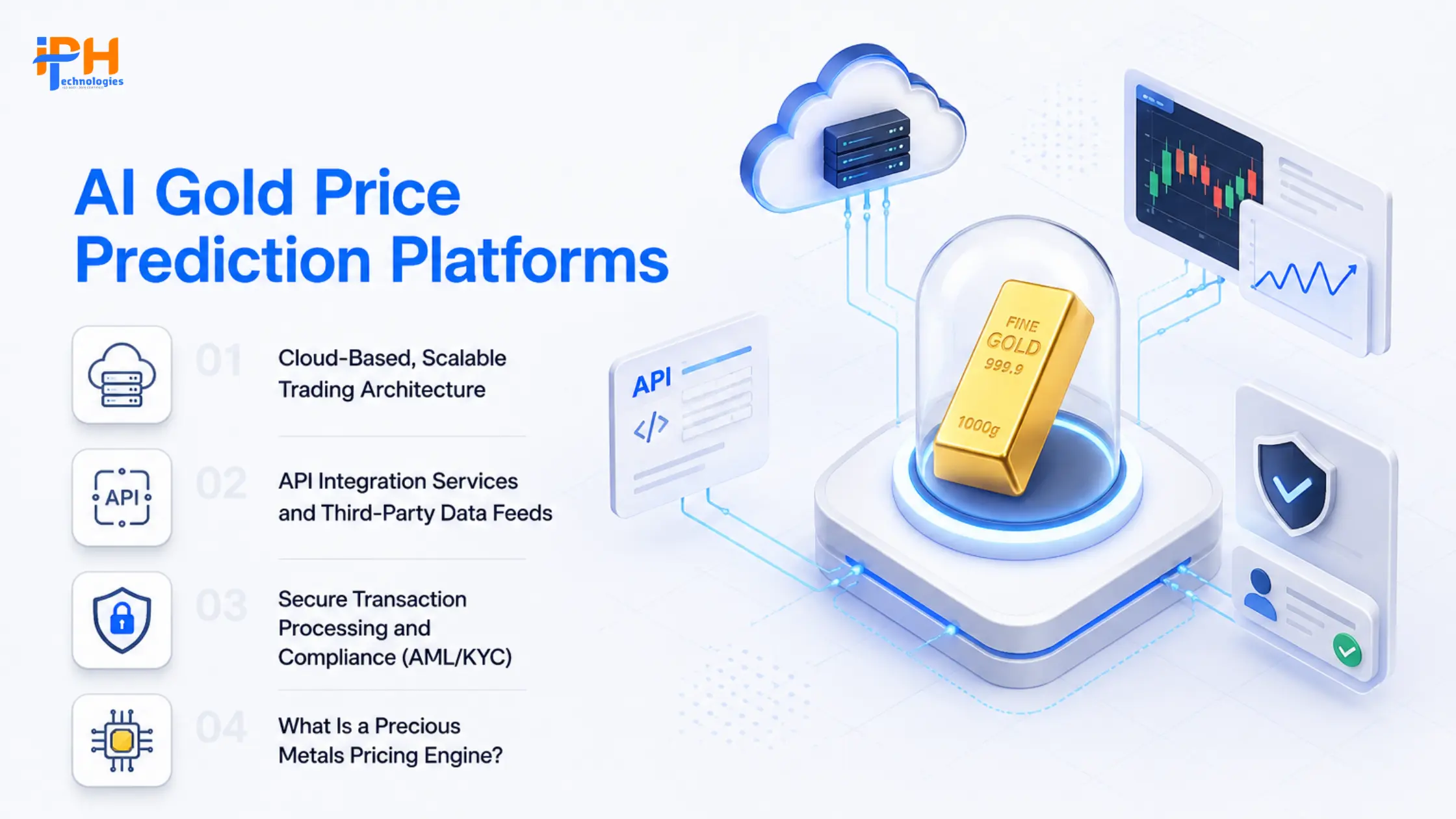
The technical foundation of any AI-driven bullion platform comes down to three things: cloud infrastructure that scales under load, reliable API connections to market data, and secure, compliant transaction processing. Get any one of these wrong and the whole system becomes a liability rather than an asset.
Cloud-Based, Scalable Trading Architecture
A cloud-based bullion platform built on infrastructure like AWS or Google Cloud can scale computing resources up during high-traffic trading windows (a gold price spike during a bank holiday weekend, for example) and back down during quiet periods, keeping costs proportional to actual usage. This scalable trading architecture matters more than most dealers realize until they hit a traffic spike their old on-premise server can’t handle.
API Integration Services and Third-Party Data Feeds
Good Bullion Software Development is fundamentally an integration exercise. The platform itself needs to talk to spot price feeds, payment gateways, shipping and insurance providers, and often a CRM or accounting system – all through API integration services that need to be reliable, well-documented, and built with failover in mind. This is one of the areas where experience really separates development firms; anyone can call an API once, but building for the times it fails is a different skill entirely.
Secure Transaction Processing and Compliance (AML/KYC)
Precious metals transactions above certain thresholds trigger regulatory obligations, which means secure transaction processing has to be built alongside AML (anti-money laundering) tracking and KYC (know your customer) verification software from day one – not added later as a compliance afterthought. Retrofitting compliance into an existing platform is dramatically more expensive and error-prone than building it in from the architecture stage.
Read More: AI Powered KYC for GOLD Dealers in USA
What Is a Precious Metals Pricing Engine?
A precious metals pricing engine is the core software module responsible for calculating live, accurate buy and sell prices for gold, silver, platinum, and palladium products based on real-time spot rates, applicable premiums, and dealer-configured margins. It’s the single most business-critical component of any bullion trading platform.
Challenges and Limitations of AI in Bullion Price Forecasting
AI forecasting improves decision speed and pattern recognition, but it isn’t a crystal ball – data quality problems, thin-market manipulation, and over-reliance on automation without human oversight can all undermine model accuracy. Being upfront about these limitations is part of building trust with traders who’ve seen “guaranteed” trading systems fail before.
Data Quality and Market Manipulation Risks
Machine learning models are only as reliable as the data they’re trained on. Gold markets, particularly in thinner trading sessions, are susceptible to spoofing and short-term manipulation that can generate misleading signals if a model isn’t designed to filter for anomalous volume spikes. A poorly built pricing engine can actually amplify a bad signal rather than catch it.
Even the most sophisticated forecasting model is vulnerable to garbage-in, garbage-out — data pipeline quality matters more than model sophistication. This is a genuine tradeoff worth acknowledging: a simpler model fed clean, well-validated data will often outperform a complex model fed noisy data.
Balancing Automation with Human Trading Expertise
The dealers getting the best results aren’t the ones who’ve fully automated every decision – they’re the ones using AI-driven analytics as a decision-support tool while keeping experienced traders in the loop for judgment calls the model can’t make (a sudden geopolitical event with no historical precedent, for example). Full automation without human oversight tends to work fine right up until the one scenario nobody trained the model on.
Read More: Innovations in Bullion Software Development You Should Know About
Choosing the Right AI-Driven Bullion Software Development Partner
The right partner to develop AI-driven bullion software would be one that has experience in financial or trading platforms, has the technical know-how to build an API-first solution, and a track-record of delivering compliant and scalable applications.
Key Features to Look for in Custom Software Development
When evaluating a partner for custom software development, look past the sales pitch and ask specific questions: What real-time gold price APIs have they integrated before? Do they have direct experience with AML/KYC compliance requirements for precious metals? Can they show a portfolio of similar fintech or trading platforms, not just generic e-commerce apps?
This is where a company like IPH Technologies often excels when it comes to talking to dealers: 500+ successfully executed projects and 430+ satisfied clients in the fields of mobile app development, web application development, and custom software engineering, with an agile approach that prioritizes iterative development and transparency over a black-box six-month build.
Their work on real-time gold and silver rate applications serves as a good reference for dealers looking to understand what a modern, live-pricing bullion platform should look like in practice.
The Future of AI and Gold Price Trend Prediction
The next stage in AI development in precious metals trading revolves around deeper blockchain integration for provenance/settlement and more sophisticated ERP systems that consolidate pricing, inventory, and compliance into a predictive, unified platform, versus disparate modules.
Blockchain and AI Convergence in Precious Metals Trading
Blockchain for precious metals is starting to intersect meaningfully with AI-driven trading platforms particularly around provenance verification for certified coins and allocated bullion storage, where an immutable record adds real trust value for buyers wary of counterfeit products.
What’s Next for Precious Metals ERP and Trading Platforms?
Expect precious metals ERP systems to keep absorbing functionality that used to live in separate tools – pricing, AML/KYC, multi-location inventory, and predictive analytics converging into unified platforms. Dealers still running five or six disconnected systems to manage one business are, functionally, competing with one hand tied behind their back against dealers running unified, AI-driven platforms.
Read More: How Bullion Software Development Is Transforming Precious Metals Trading in 2026
Conclusion
AI-driven analytics have fundamentally changed how gold price trends get predicted — from reactive, chart-based guesswork to real-time, multi-source forecasting that adjusts pricing and inventory decisions in seconds.
Getting that architecture right isn’t a weekend project, and it’s not something to hand off to a generalist developer who’s never touched financial data or compliance requirements. Whether you’re weighing SaaS versus a fully custom-built platform, or you already know you need a development partner with real fintech experience, this decision shapes everything downstream from how accurately your platform predicts price trends to how well it holds up under regulatory scrutiny.
Working with a team that’s shipped live bullion pricing applications like IPH Technologies, with its track record across 500+ projects and a portfolio that includes real-time gold and silver rate platforms makes that decision considerably less risky. If you’re serious about building or upgrading your bullion trading software, that’s the conversation worth having next.
Frequently Asked Questions (FAQs)
What is AI-driven analytics in gold trading?
AI-driven analyses apply machine learning to current and past market data, including prices of gold, economic indicators, news sentiment, and other factors, in order to forecast potential market movements.
How accurate is AI gold price prediction?
AI predictions may help analyze the short-term trends, but it cannot be considered accurate since it is only a theory. The most effective method of the two is using the probabilities and the human factor in the mix.
What's the difference between a real-time gold price API and a pricing engine?
A real-time gold price API differs from a pricing engine which employs the former’s data to determine bid and ask prices, incorporating spreads, margins, and adjustments.
How does AI help with precious metals inventory management?
AI predicts demand and price trends to help dealers identify inventory risks, lowering excess stock, carrying costs, and exposure to the market.
Is blockchain necessary for bullion software development?
No. Blockchain technology is optional but could enhance provenance of bullion, particularly certified or allocated bullion, as well as authentication and trust.
What compliance features should bullion trading software include?
Among key features to consider when selecting a crypto trading platform are anti-money laundering monitoring, KYC verification, tax reporting, and transaction tracking. It is better if these functions are built into the platform at its foundation.










.png)