



























































































RAG vs Fine-Tuning: Choosing the Right AI Architecture for Your Business
Why AI Architecture Decisions Matter in 2026
Let’s cut straight to the chase: if you’re a business leader, product manager, or startup founder who has been exploring AI integration, you’ve probably hit a wall.
Everyone says ‘use AI,’ but nobody tells you which AI approach actually fits your business problem.
Should you plug in a Retrieval-Augmented Generation (RAG) system? Should you fine-tune a large language model (LLM)? Should you do both?
These aren’t just technical questions — they’re strategic business decisions.
Choose the wrong architecture and you’ll burn money, frustrate users, and ship a product that doesn’t actually work in the real world.
Choose the right one, and you’ll build something that genuinely drives ROI.
In this guide, we’re going to break down RAG vs fine-tuning in plain English, give you a side-by-side comparison, walk you through real-world scenarios, and help you make the right call for your specific business needs.
Think of this as your AI architecture playbook for 2026.
What Is RAG (Retrieval-Augmented Generation)?
Retrieval-Augmented Generation — commonly known as RAG — is an AI architecture pattern that enhances a language model’s responses by pulling in relevant information from an external knowledge base at query time.
Instead of relying solely on what the model ‘memorized’ during training, RAG goes out and fetches fresh, relevant context before generating a response.
Think of it like this: RAG is the difference between a student who memorized the textbook (fine-tuned model) versus a student who walks into the exam with a stack of reference books (RAG).
One relies on what they already know; the other can look things up on the fly.
How RAG Works — Step by Step
The RAG pipeline follows a clear, logical flow that makes it both powerful and explainable:
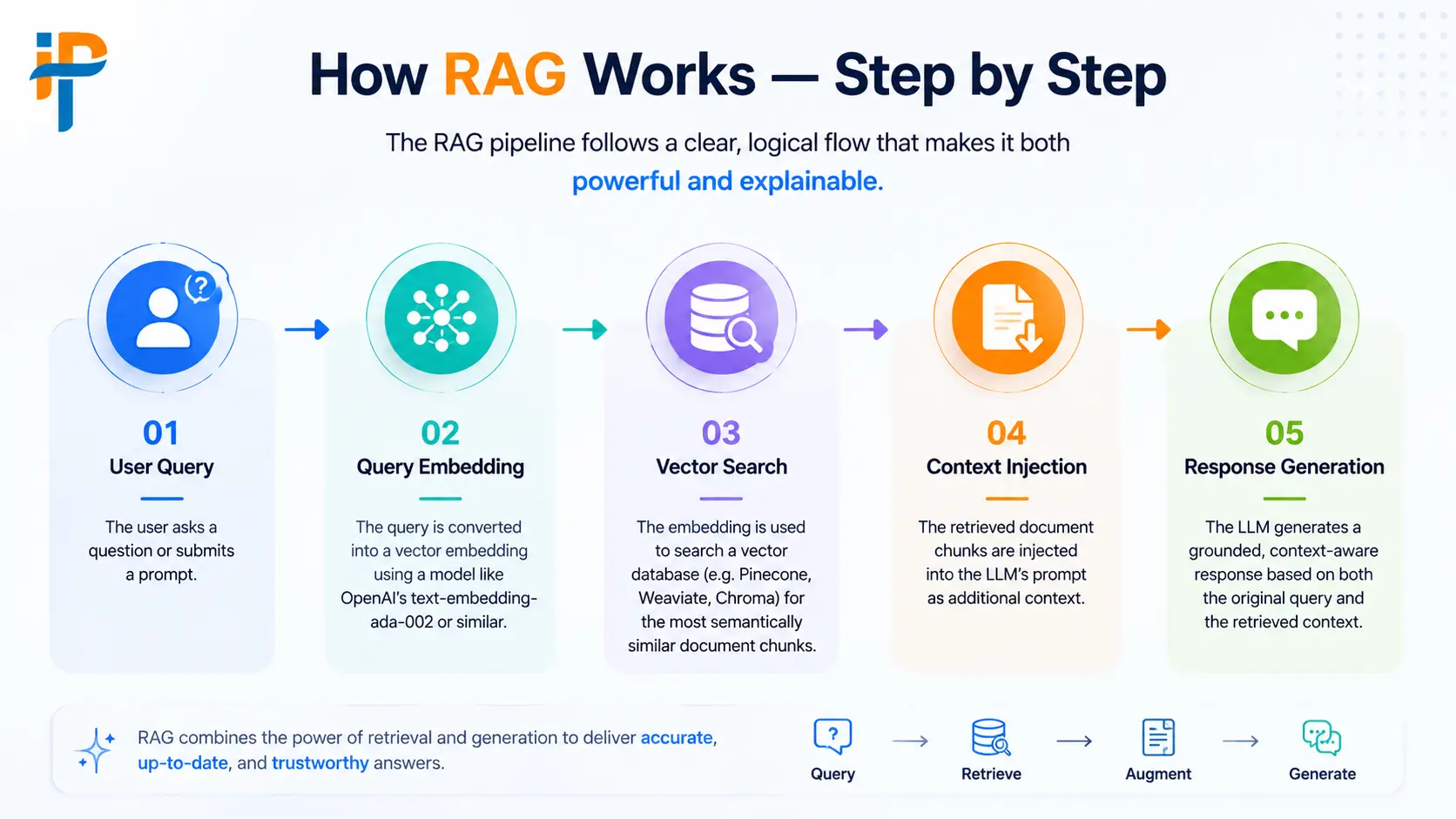
Step 1 — User Query: The user asks a question or submits a prompt.
Step 2 — Query Embedding: The query is converted into a vector embedding using a model like OpenAI’s text-embedding-ada-002 or similar.
Step 3 — Vector Search: The embedding is used to search a vector database (e.g., Pinecone, Weaviate, Chroma) for the most semantically similar document chunks.
Step 4 — Context Injection: The retrieved document chunks are injected into the LLM’s prompt as additional context.
Step 5 — Response Generation: The LLM generates a grounded, context-aware response based on both the original query and the retrieved context.
Core Components of a RAG Pipeline
A production-grade RAG system typically includes a document ingestion and chunking module, an embedding model, a vector database, a retrieval and re-ranking layer, and the LLM itself for final generation.
Each component plays a critical role, and the quality of your RAG output is only as good as your weakest link — usually the chunking strategy or retrieval quality.
What Is Fine-Tuning?
Fine-tuning is the process of taking a pre-trained large language model — like GPT-4, LLaMA 3, or Mistral — and continuing its training on a smaller, domain-specific dataset.
The goal is to shift the model’s internal weights so it better understands your specific terminology, tone, format, and task requirements.
If RAG is a student with reference books, fine-tuning is the process of a student studying one specific subject so intensively that they become a subject-matter expert.
The knowledge becomes part of them — they don’t need to look things up because they just know.
How Fine-Tuning Works
Fine-tuning begins with data preparation: you curate a dataset of input-output pairs specific to your domain.
This could be customer support conversations, internal documentation Q&A pairs, annotated legal contracts, or anything relevant to your use case.
This data is then used to continue training the base model using techniques like supervised fine-tuning (SFT) or reinforcement learning from human feedback (RLHF). The result is a model that speaks your language — literally.
Types of Fine-Tuning
There are several approaches businesses use today. Full Fine-Tuning updates all model parameters — powerful but expensive and compute-intensive.
Parameter-Efficient Fine-Tuning (PEFT) methods like LoRA (Low-Rank Adaptation) and QLoRA update only a fraction of parameters, making fine-tuning far more cost-effective for most businesses.
Instruction Fine-Tuning teaches the model to follow specific instruction formats, which is great for task-specific apps like form filling, summarization, or classification.
RAG vs Fine-Tuning — Head-to-Head Comparison
Let’s put both approaches side by side so you can see exactly what you’re working with:
| Criteria | RAG (Retrieval-Augmented Generation) | Fine-Tuning |
|---|---|---|
| Knowledge Source | External knowledge base/vector DB | Baked into model weights |
| Update Speed | Real-time (update docs instantly) | Days to weeks (retrain cycle) |
| Cost to Implement | Low–Medium | Medium–High |
| Hallucination Risk | Lower (grounded in retrieved docs) | Higher without careful tuning |
| Domain Customization | Moderate | Very High |
| Latency | Slightly higher (retrieval step) | Low |
| Best For | Dynamic, factual, document-heavy apps | Tone, style, specialized language tasks |
As you can see, RAG and fine-tuning aren’t competing technologies — they solve different problems.
RAG is your go-to for knowledge-intensive, dynamic, fact-based tasks.
Fine-tuning is your weapon of choice when you need deep behavioral customization, consistent style, or specialized language understanding.
When to Choose RAG for Your Business
RAG is the right choice in several clear scenarios. If your business data changes frequently — product catalogs, pricing, policies, research documents — RAG lets you update your knowledge base without retraining the model.
If your application involves factual, citation-worthy answers (think legal, medical, financial domains), RAG reduces hallucination risk by grounding responses in real documents.
And if you’re working with a budget-conscious team that needs to get to production quickly, RAG is typically faster and cheaper to implement than a full fine-tuning pipeline.
Use Cases Where RAG Shines
Enterprise knowledge management systems where employees query internal wikis, Slack histories, and SOPs are a natural fit.
Customer support chatbots that need to reference the latest product documentation without constant redeployment thrive on RAG.
Research and intelligence platforms that aggregate news, reports, and databases in real time are also ideal — the retrieval layer does the heavy lifting, and the LLM synthesizes and presents the findings cleanly.
When to Choose Fine-Tuning for Your Business
Fine-tuning makes sense when the task is about behavior, not just knowledge.
If you want your AI to sound a certain way — formal, casual, terse, verbose — or to follow a specific output schema consistently, fine-tuning is what gets you there.
It’s also the right choice when you’re working in a highly specialized domain with unique vocabulary that a general-purpose model handles poorly.
Use Cases Where Fine-Tuning Wins
A fintech startup building an AI that understands proprietary trading terminology should fine-tune.
A healthcare company that needs an AI to produce consistently structured clinical notes should fine-tune.
A SaaS platform that wants an AI to generate code in a company-specific framework or style guide should fine-tune. In all these cases, the requirement isn’t ‘find the right information’ — it’s ‘generate the right kind of output.
Can You Combine RAG and Fine-Tuning?
Absolutely — and in many production scenarios, the best answer is both. This hybrid approach is becoming increasingly popular in 2026.
Here’s how it works in practice: you fine-tune a base model on your domain data to give it the right vocabulary, tone, and task understanding. Then you layer RAG on top of it so it can retrieve live, up-to-date information at query time.
Imagine a legal AI assistant. You fine-tune it on thousands of contracts so it understands legal language and can draft clauses in the right style.
Then you connect it to a RAG pipeline that retrieves the latest case law, regulatory updates, and jurisdiction-specific precedents before generating advice.
The result? An assistant that writes like a lawyer and knows what happened in court last week. That’s a product people will actually pay for.
The key trade-off with a hybrid approach is cost and complexity.
You’re maintaining both a fine-tuned model and a retrieval pipeline, which means more infrastructure, more moving parts, and more maintenance overhead.
But for high-stakes, enterprise-grade applications, that investment typically pays off.
Cost Considerations — RAG vs Fine-Tuning
Let’s talk money, because ultimately that’s what shapes most business decisions. RAG systems typically have lower upfront costs.
Setting up a vector database (Pinecone’s starter tier is free; Weaviate is open-source), ingesting documents, and connecting to an LLM API can be done for a few hundred to a few thousand dollars, depending on scale. Ongoing costs are primarily API usage and storage.
Fine-tuning, on the other hand, requires training compute. Fine-tuning a 7B-parameter model using LoRA on a cloud GPU can cost anywhere from $50 to $500, depending on dataset size and training duration.
Fine-tuning a 70B model or going full fine-tuning (not PEFT) can cost thousands. Add to that the cost of data annotation, evaluation, and iteration, and you’re looking at a meaningful investment.
That said, once a fine-tuned model is deployed, inference can be cheaper per query than using a large proprietary model via API — especially if you self-host.
So the total cost of ownership calculation depends heavily on your query volume and whether you plan to self-host or use a managed service.
Business Use-Case Decision Matrix
Not sure which approach fits your specific scenario? Use this decision matrix as a starting point:
| Business Scenario | Recommended Approach | Reasoning |
|---|---|---|
| Customer support chatbot with live FAQs | RAG | FAQs change frequently; retrieval keeps answers fresh. |
| Legal contract drafting assistant | Fine-Tuning + RAG | Style via fine-tuning; accuracy via retrieval. |
| Medical diagnosis assistant | RAG | Critical facts must cite verified sources. |
| Brand-specific content generator | Fine-Tuning | Fixed tone and vocabulary; no real-time data needed. |
| Internal HR policy bot | RAG | Policy docs update frequently; retrieval is more maintainable. |
| Code auto-completion (domain-specific) | Fine-Tuning | Requires deep familiarity with proprietary codebase patterns. |
| News/research summarization tool | RAG | Must access the latest articles in real time. |
Remember: this matrix is a starting point, not a rigid rule. Your specific data quality, team expertise, latency requirements, and budget all influence the final architectural decision.
This is exactly where working with an experienced AI development partner like IPH Technologies makes a real difference.
How to Get Started — Practical Implementation Roadmap
Whether you’re going with RAG, fine-tuning, or a hybrid approach, here’s a practical roadmap to go from zero to production:
Phase 1 — Define the Problem Clearly
Before you write a single line of code, define exactly what your AI application needs to do. What are the inputs? What’s the ideal output? Who are the users? What does success look like? This phase saves you months of rework.
Phase 2 — Audit Your Data
Data is your foundation. For RAG, you need clean, well-structured documents that cover your domain. For fine-tuning, you need high-quality input-output pairs. Poor data quality is the single biggest reason AI projects fail — not model choice, not architecture, not budget.
Phase 3 — Prototype and Evaluate
Build a quick prototype with an off-the-shelf LLM and a basic RAG setup. Evaluate it against a set of benchmark questions. This gives you a baseline and helps identify where the model struggles — whether it’s a knowledge gap (RAG problem) or a behavior gap (fine-tuning problem).
Phase 4 — Iterate and Optimize
Improve your chunking strategy, try different embedding models, experiment with fine-tuning on your weakest areas. Measure everything. Use both automated evaluation metrics and human review to guide your iterations.
Phase 5 — Deploy, Monitor, and Maintain
Production AI is a living system. Monitor for drift, update your knowledge base regularly, and plan for model updates. The companies that win with AI aren’t the ones who build it once — they’re the ones who treat it as a continuous product.
Common Mistakes Businesses Make When Choosing AI Architecture
We’ve seen it all at IPH Technologies, and these are the mistakes that come up again and again:
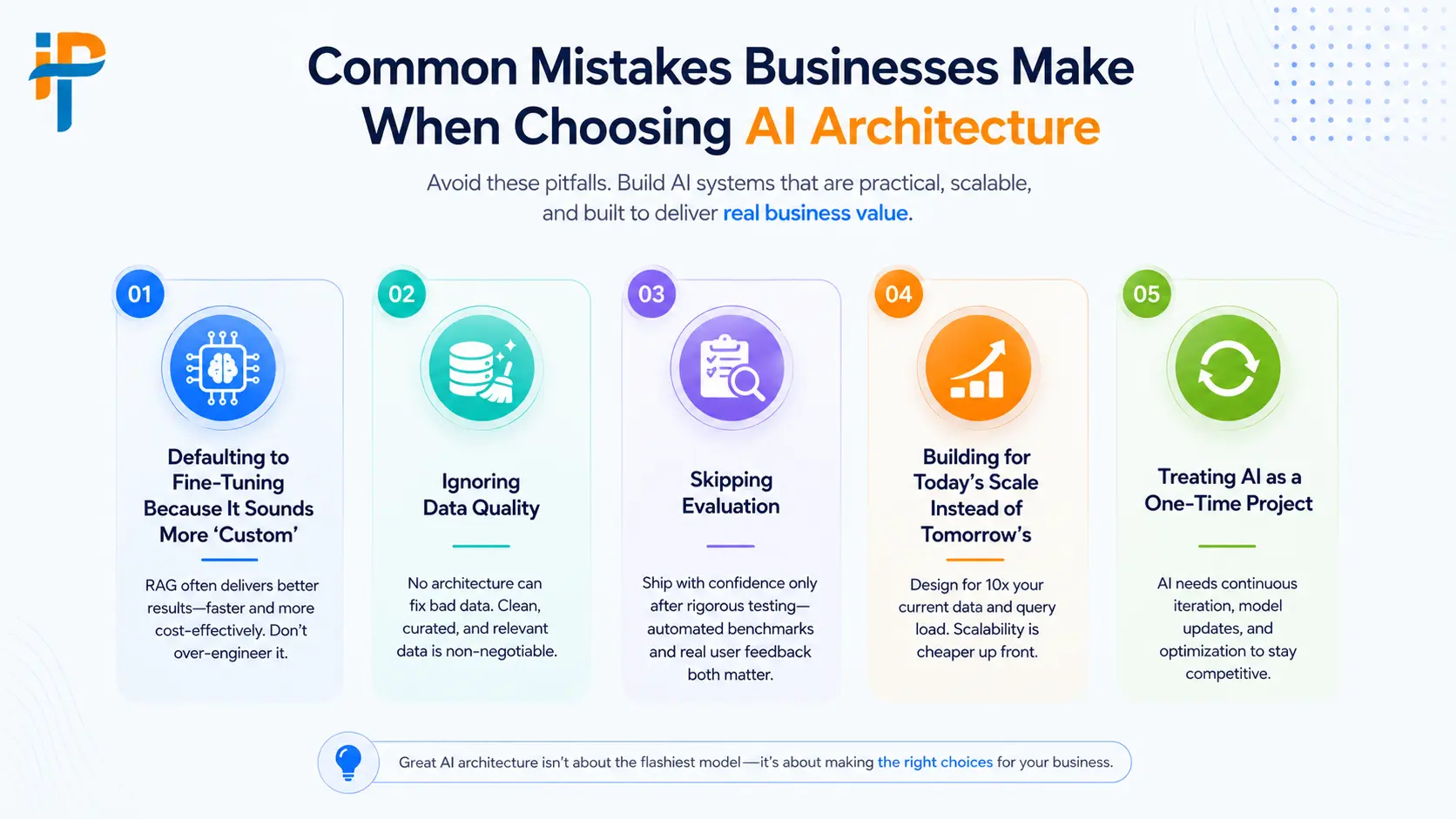
Mistake 1 — Defaulting to Fine-Tuning Because It Sounds More ‘Custom’: Fine-tuning may seem more impressive, but for most business problems, a well-designed RAG system delivers better results faster and more cheaply. Don’t over-engineer it.
Mistake 2 — Ignoring Data Quality: It doesn’t matter how sophisticated your architecture is if you’re feeding it garbage data. Clean, curated, representative data is non-negotiable.
Mistake 3 — Skipping Evaluation: Too many teams ship AI features without rigorous evaluation. You need both automated benchmarks and real user testing to understand where your system fails.
Mistake 4 — Building for Today’s Scale Instead of Tomorrow’s: Design your AI architecture with 10x your current data volume and query load in mind. Retrofitting scalability is expensive.
Mistake 5 — Treating AI as a One-Time Project: Your competitors aren’t going to stand still, and neither should your AI. Budget for iteration, model updates, and ongoing optimization.
IPH Technologies — Your AI Development Partner
At IPH Technologies, we specialize in turning visionary ideas into impactful AI-powered solutions.
With over 500 successful projects and 430+ satisfied clients across a decade in the industry, we’ve helped businesses navigate exactly the kind of architectural decisions covered in this guide.
Our team has deep expertise in building production-grade RAG pipelines, fine-tuning domain-specific models, and designing hybrid AI architectures that balance capability, cost, and maintainability.
We don’t just build AI features — we build AI systems that scale with your business and deliver measurable ROI.
Whether you’re a startup exploring your first AI integration or an enterprise looking to modernize your AI stack, IPH Technologies is the partner who’s dedicated to your success — not just your deployment.
From custom software solutions to end-to-end AI development, we’re here to help you stay ahead of the curve.
Conclusion
RAG and fine-tuning aren’t rivals — they’re tools in the same toolkit, each suited to different jobs. RAG gives your AI fresh, grounded, factual knowledge that stays current without retraining.
Fine-tuning gives your AI a personality, a style, and deep domain expertise baked into its very core. The smartest AI architectures in 2026 often combine both.
The real question isn’t ‘RAG or fine-tuning?’ — it’s ‘What does my specific business problem actually need?’ Start with a clear problem definition, audit your data, prototype fast, evaluate rigorously, and iterate relentlessly.
And if you want an experienced partner who’s navigated these decisions hundreds of times across dozens of industries, IPH Technologies is ready to help you build AI that works — not just AI that sounds impressive in a pitch deck.
Frequently Asked Questions
Is RAG or fine-tuning better for a small business?
Can I use RAG without fine-tuning at all?
How long does fine-tuning typically take?
What vector databases should I use for RAG?
Does fine-tuning prevent hallucinations?
How much data do I need to fine-tune a model?
What's the difference between RAG and a traditional search engine?
How does IPH Technologies approach AI architecture decisions for clients?

Next-Gen Business Innovation
Empower your business with cutting-edge technology and agile strategies to stay ahead of the curve.




)








.png)