





























































































AI Agent Mobile App Development: Features, Benefits & Business Use Cases in 2026
Let’s be honest — the phrase “AI-powered app” has been thrown around so much in the last few years that it’s almost lost its meaning. But 2026 is different.
This year, we’re not talking about a simple chatbot or a recommendation engine tucked into the corner of your screen. We’re talking about AI agents — autonomous, intelligent systems embedded directly into mobile applications that can think, plan, decide, and act on behalf of your business and your users.
According to Grand View Research , the global AI agents market was valued at USD 7.63 billion in 2025 and is projected to reach USD 182.97 billion by 2033, growing at a staggering CAGR of 49.6%.
If you’re a business owner or product leader and you haven’t started thinking about AI agent mobile app development yet, now is absolutely the time.
In this article, we’ll break down everything you need to know — features, benefits, real-world use cases, and what makes the right development partner for your journey.
What Is an AI Agent? (And Why Should You Care?)
Think of an AI agent as a super-smart digital employee inside your mobile app. Unlike a basic rule-based bot that follows a fixed script, an AI agent can perceive its environment, reason about what needs to be done, make independent decisions, and execute multi-step tasks — all without constant human intervention.
If a traditional chatbot is like a vending machine (you press a button, you get a fixed result), then an AI agent is more like a personal assistant who can interpret your mood, check your schedule, order your lunch, reschedule your meeting, and send a follow-up email — all from a single instruction.
How AI Agents Differ from Traditional Chatbots
The gap between a traditional chatbot and an AI agent is enormous, and it matters deeply for your mobile app strategy. Here’s a side-by-side look:
| Feature | Traditional Chatbot | AI Agent |
|---|---|---|
| Decision-Making | Rule-based, pre-scripted | Autonomous, context-aware |
| Task Complexity | Single-turn Q&A | Multi-step, cross-platform tasks |
| Learning Ability | Static | Continuously learns from interactions |
| Tool Integration | Limited | Can call APIs, databases, external tools |
| Memory | Session-only | Persistent, long-term memory |
| Personalisation | Generic responses | Deep, user-specific personalisation |
| Autonomy | Requires constant prompting | Acts proactively on goals |
The bottom line? Chatbots answer questions. AI agents solve problems.
Also read- What Is Multimodal AI? Business Leader’s Guide & Use Cases 2026
The Core Architecture Behind AI Agents in Mobile Apps
An AI agent in a mobile application is typically built around four core components: a perception layer (understanding inputs via voice, text, or data), a reasoning engine (usually a Large Language Model or LLM), a memory system (short-term and long-term context storage), and an action layer (APIs, device functions, external services).
These components work together in a continuous loop, allowing the agent to observe, plan, act, and reflect — much like a human would.
The AI Agent Mobile App Market: Numbers That Should Blow Your Mind
If you need a single reason to take this seriously, let the data do the talking.
According to Precedence Research , the global AI agents market is expected to grow from USD 11.55 billion in 2026 to approximately USD 294.66 billion by 2035, at a CAGR of 43.57%. Meanwhile, Gartner projects that by the end of 2026, 40% of enterprise applications will include task-specific AI agents — up from less than 5% just a year earlier. That’s one of the fastest enterprise technology transformations since cloud adoption.
On the mobile side, CMARIX reports that 63% of mobile app developers are already integrating AI features into their apps, and 70% of mobile apps use AI to improve the user experience.
The broader AI mobile app development market is estimated to reach USD 221.9 billion by 2034.
Perhaps most telling? Capgemini‘s research found that 93% of business leaders believe that organisations that successfully scale AI agents in the next 12 months will gain a decisive edge over their competitors. The race has already started.
Also Read- Cost of Generative AI Development in India in 2026: A Complete Guide
Key Features of AI Agent-Powered Mobile Apps
So what actually makes an AI agent mobile app different from everything else? Let’s dig into the features that matter.
Natural Language Processing (NLP) and Conversational Intelligence
The foundation of any great AI agent is its ability to truly understand human language — not just keywords, but intent, sentiment, context, and nuance.
Modern AI agents in mobile apps are built on advanced NLP models that can handle complex, multi-turn conversations, understand regional dialects and slang, process voice inputs with near-human accuracy, and switch seamlessly between languages.
This makes the user experience feel less like filling out a form and more like talking to a knowledgeable colleague.
Autonomous Task Execution and Decision-Making
This is where AI agents genuinely separate themselves from the pack.
Rather than waiting for a user to guide every step, an AI agent can autonomously break down a high-level goal into a series of sub-tasks, execute each one, handle errors along the way, and report back with results.
In a mobile app context, this could mean an agent that books travel, processes an expense report, and notifies your manager — all triggered by a single voice command.
Contextual Memory and Personalisation
Ever wished your app could remember that you always prefer morning delivery slots, or that you’re lactose intolerant, or that you never approve invoices over a certain amount without a second review? AI agents can do exactly this.
With persistent memory capabilities, they build a rich profile of each user over time, enabling hyper-personalised experiences that feel genuinely tailored — not just template-driven.
Research shows that 44% of mobile apps already use AI personalisation to deliver tailored content, and that number is climbing fast.
Multi-Agent Collaboration and Orchestration
Some of the most powerful AI agent architectures involve not one, but multiple agents working together.
Think of it as an internal team: one agent handles customer queries, another processes payments, a third manages inventory, and an orchestrator agent coordinates them all.
This is particularly valuable in enterprise mobile apps where different business functions need to interact seamlessly.
Single vs. Multi-Agent Systems: Which One Does Your Business Need?
| Criteria | Single Agent System | Multi-Agent System |
|---|---|---|
| Best For | Focused, well-defined tasks | Complex, cross-departmental workflows |
| Implementation Complexity | Low to Medium | Medium to High |
| Scalability | Moderate | High |
| Market Share (2026) | ~58% | ~42% (growing rapidly) |
| Cost | Lower | Higher, but ROI scales fast |
| Example Use Case | AI customer support agent | AI-powered ERP + CRM + logistics coordination |
For most SMEs starting their AI journey, a single-agent system is the right entry point.
For enterprise-level digital transformation, multi-agent systems unlock transformational value.
Also read- How AI Is Revolutionizing Bullion Software Development in 2026
Top Business Benefits of Integrating AI Agents Into Mobile Apps
Beyond the technical excitement, what does this actually do for your bottom line? Quite a lot, as it turns out.
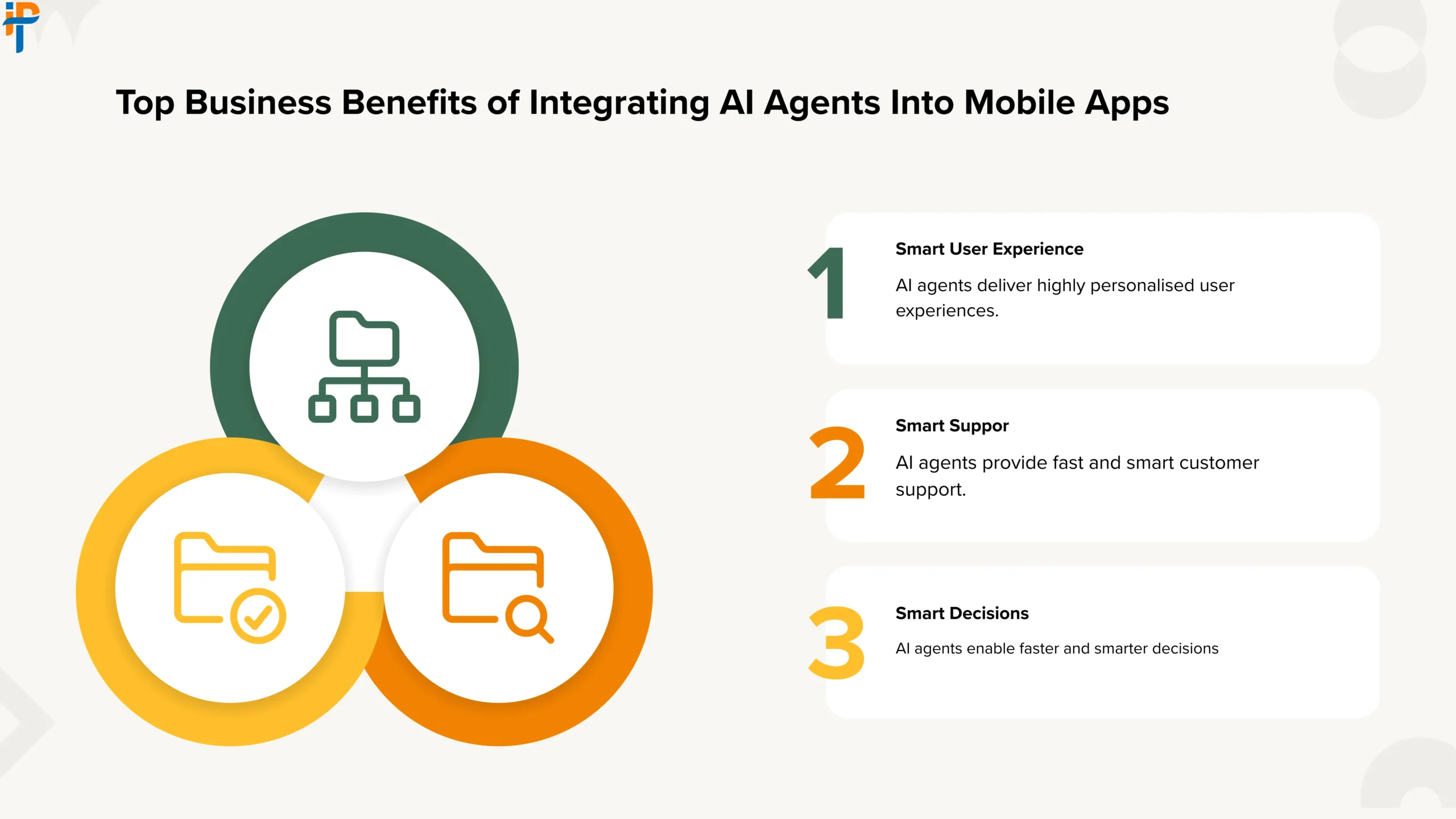
Supercharged Customer Experience
Customer experience is the new battleground, and AI agents are your secret weapon. They’re available 24/7 — no sick days, no lunch breaks, no grumpy Mondays. They respond instantly, personalise every interaction, and actually get better over time. Gartner predicts that by 2029, AI agents will autonomously resolve 80% of common customer service issues without human intervention. magine the loyalty that builds when your users get accurate, helpful, personalised support at 2 AM on a Saturday.
Drastic Cost Reduction Through Automation
The ROI case for AI agents is compelling. According to Master of Code Global , businesses using agentic AI in insurance reported cost reductions of 56%, improved staff efficiency of 61%, and enhanced customer service satisfaction of 48%. In logistics, AI-powered predictive maintenance achieved a 67% reduction in unplanned downtime and a 45% decrease in overall costs. These aren’t marginal gains — they’re business-model changing numbers.
Faster Go-to-Market for Enterprises
AI agents don’t just serve end-users; they accelerate internal processes too. From automating software QA to streamlining HR onboarding to generating and reviewing contracts, AI agents compress timelines dramatically. Research by IDC shows that agentic AI is on track to exceed 26% of global IT spending by 2029, reaching USD 1.3 trillion — a clear signal that enterprises are betting their competitive future on this technology.
Real-World Business Use Cases of AI Agent Mobile Apps in 2026
Theory is great, but let’s talk about where the rubber actually meets the road.
Healthcare and Telemedicine
AI agents are transforming healthcare mobile apps from simple appointment bookers into genuine health companions. They can monitor vitals from wearable integrations, triage symptoms, schedule specialists, send medication reminders, and flag anomalies to clinicians — all in real time. The healthcare industry already has a 68% AI usage rate among providers, and AI applications in healthcare could generate up to USD 150 billion in annual savings by 2026, according to Accenture.
eCommerce and Retail
In retail, AI agents are the ultimate personal shoppers.They analyse browsing behaviour, predict purchase intent, manage wishlist nudges, handle returns autonomously, and even negotiate prices in dynamic pricing environments. Amazon’s personalised recommendation engine — essentially an early AI agent use case — is credited with raising sales by 35% and boosting customer loyalty by 20%. Modern AI agent mobile apps take this several steps further with real-time voice commerce and autonomous re-ordering.
BFSI (Banking, Financial Services & Insurance)
The financial sector is one of the fastest adopters of AI agent technology. Think of a mobile banking app where an AI agent monitors your spending, alerts you to unusual transactions, suggests optimal savings plans, fills out loan applications based on your profile, and connects you with a human advisor only when truly needed. In 2026, agentic AI usage among insurance businesses rose to 48%, with reported benefits across staff efficiency, customer service, cost reduction, and business growth.
Logistics and Supply Chain
From warehouse management to last-mile delivery, AI agents are bringing intelligence to every node of the supply chain. An AI agent embedded in a logistics mobile app can re-route deliveries in real time based on traffic and weather, predict demand surges, automate purchase orders, and surface risk alerts before they become costly problems.53% of US businesses deploying AI agents are already using them in IT and supply chain management, per PwC .
HR and Enterprise Productivity
Enterprise HR apps powered by AI agents can screen CVs, schedule interviews, onboard new employees, answer policy questions, process leave requests, and surface performance insights — all without a single HR ticket needing human routing. With AI agents handling repetitive rule-based tasks, your HR team gets to focus on culture, strategy, and people — the parts that actually require a human touch.
Also Read- Best AI App Development Companies in India 2026 | Top Ranked List
Key Technologies Powering AI Agent Mobile App Development
Behind every great AI agent mobile app is a carefully chosen technology stack.
Large Language Models (LLMs)
LLMs like GPT-4, Claude, and Gemini are the brain of modern AI agents. They power natural language understanding, reasoning, and generation. Choosing the right LLM — or building a fine-tuned version for your domain — is one of the most important architectural decisions in AI agent app development.
Retrieval-Augmented Generation (RAG)
RAG is the technique that keeps AI agents grounded in your business data rather than just their training data. By connecting an LLM to your company’s knowledge base, product catalogue, or CRM in real time, RAG ensures the agent gives accurate, up-to-date, contextually relevant responses not hallucinated ones.
Model Context Protocol (MCP)
MCP is rapidly becoming the industry standard for connecting AI agents to external tools and services. Its adoption has been one of the most significant infrastructure stories of 2026, enabling agents to interact with databases, APIs, and third-party applications in a standardised, secure way. The right development team will know how to leverage MCP effectively for your app architecture.
How to Choose the Right AI Agent Mobile App Development Company
Building an AI agent mobile app is not a plug-and-play exercise. The quality of your development partner will make or break the project.
What to Look For in a Development Partner
You want a team that combines deep expertise in AI/ML with solid mobile development skills (iOS, Android, cross-platform), has experience integrating LLMs and RAG into production environments, understands your specific industry domain, follows agile development methodologies that allow for rapid iteration, and has a proven track record with real client success stories — not just impressive pitch decks.
Questions You Must Ask Before Signing the Contract
Before committing, ask your potential development partner these critical questions:
- What AI agent frameworks and LLMs have you worked with? (LangChain, AutoGen, CrewAI, Claude, GPT-4?)
- How do you handle data privacy and compliance? (GDPR, DPDP Act in India, HIPAA if healthcare?)
- Can you show me live examples of AI agent apps you’ve shipped?
- How do you approach agent safety and output quality control?
- What’s your post-launch support and continuous improvement process?
How IPH Technologies Builds AI Agent Mobile Apps That Deliver Results
At IPH Technologies, we don’t just build apps — we build intelligent, scalable digital products that move the needle for your business.
With a track record of 500+ successful projects and 430+ satisfied clients, we’ve spent years mastering the intersection of mobile app development, AI/ML integration, and custom software engineering.
Our approach to AI agent mobile app development is grounded in three principles:
- Strategy First — We start by deeply understanding your business goals, user journeys, and operational pain points. An AI agent that isn’t aligned with your actual business logic is just expensive noise.
- Agile by Default — We use agile methodologies that let us ship fast, iterate based on real user feedback, and course-correct before problems become expensive. You get working software early — not after a 12-month waterfall.
- Full-Stack AI Expertise — From LLM fine-tuning and RAG pipeline development to MCP integrations and mobile UI/UX design, our team covers the full spectrum. We work with the latest frameworks including LangChain, AutoGen, and vector databases like Pinecone and Weaviate, ensuring your AI agent app is built on a future-ready foundation.
Whether you’re looking to build a customer-facing AI assistant, an internal enterprise productivity agent, or a full multi-agent orchestration system for your operations, IPH Technologies has the expertise, the process, and the passion to make it happen. Ready to explore what’s possible? Connect with the IPH Technologies team today and let’s turn your vision into an intelligent mobile product.
Conclusion
2026 is the year that AI agents move from a futuristic concept to a competitive necessity. The market data is clear, the technology is mature, and the business ROI is real.
Whether you’re in healthcare, retail, finance, logistics, or enterprise software, there is an AI agent use case that could transform how your mobile app serves users and drives business outcomes.
The question isn’t really whether to invest in AI agent mobile app development. It’s how quickly you can get started — and who you choose to build it with.
The organisations that move fast and build smart will capture the advantage. Those that wait will find themselves playing catch-up in a game where the lead grows wider by the day.
At IPH Technologies, we’re ready to be your partner in that journey. Let’s build something extraordinary.
Also read- AI Software Development in Australia: Cost, Timeline & Strategy










.png)