












































































































Bullion App Development: The Complete 2026 Guide for Founders Who Can’t Afford to Get This Wrong
Bullion app development involves building a platform that can be used for trading, investing, or dealing in gold, silver and platinum. It also includes KYC/AML compliance and wallet or vault reconciliation. The cost of a simple MVP is usually between $60,000 and $350,000. It takes anywhere from 3 to 9 months depending on the scope. This is the short answer. This guide covers everything that the short answer does not — it’s the part which determines whether or not your app is profitable.
I have spent most of my career developing financial and precious metals software. I will start by stating an uncomfortable fact: the majority of bullion app briefs that I read are written entirely by people who are focused on launch. Live rates, buy/sell screens, wallets. It’s shipped. Retention is something that almost no one plans for when starting a business. It’s what determines whether it survives the first year. One bad quote can ruin a bullion app that has a great UI but a poor pricing feed. This is not a hypothetical. This is the most common reason why I’ve seen early users of precious-metals platforms leave.
This guide was built around not one, but two questions that every B2B founder should ask: What is required to build it? What does it take to make sure people use it?
What Bullion App Development Actually Involves
A bullion application is not a shopping app that has a gold-skin on it. It’s more like a light-weight trading exchange that is bolted to a logistics system. This is because the physical metal must be moved, stored, insured and reconciled with what the software says customers own.
The system must be able to perform at least five tasks well.
- Display live spot prices for gold, silver, platinum, and palladium with real-time market updates.
- Process buy and sell orders using dynamic pricing, custom spreads, and automated tax/GST calculations.
- Manage secure digital wallets linked to allocated or physical precious metal holdings.
- Maintain complete compliance with KYC/AML verification and detailed audit trails for every transaction.
- Convert digital vault holdings into physical vault inventory with seamless asset tracking and management.
If you miss any of these, you’re not just using a lighter version — you are actually using a riskier app. In this category, a pricing feed that is two seconds late can lead to a customer disputing the trade.
Core Feature Set: What Belongs in Version One
Every credible bullion platform I’ve reviewed — ours included — converges on roughly the same core modules. Here’s what they are and, more importantly, why each one matters more than it looks like it does on a feature list.
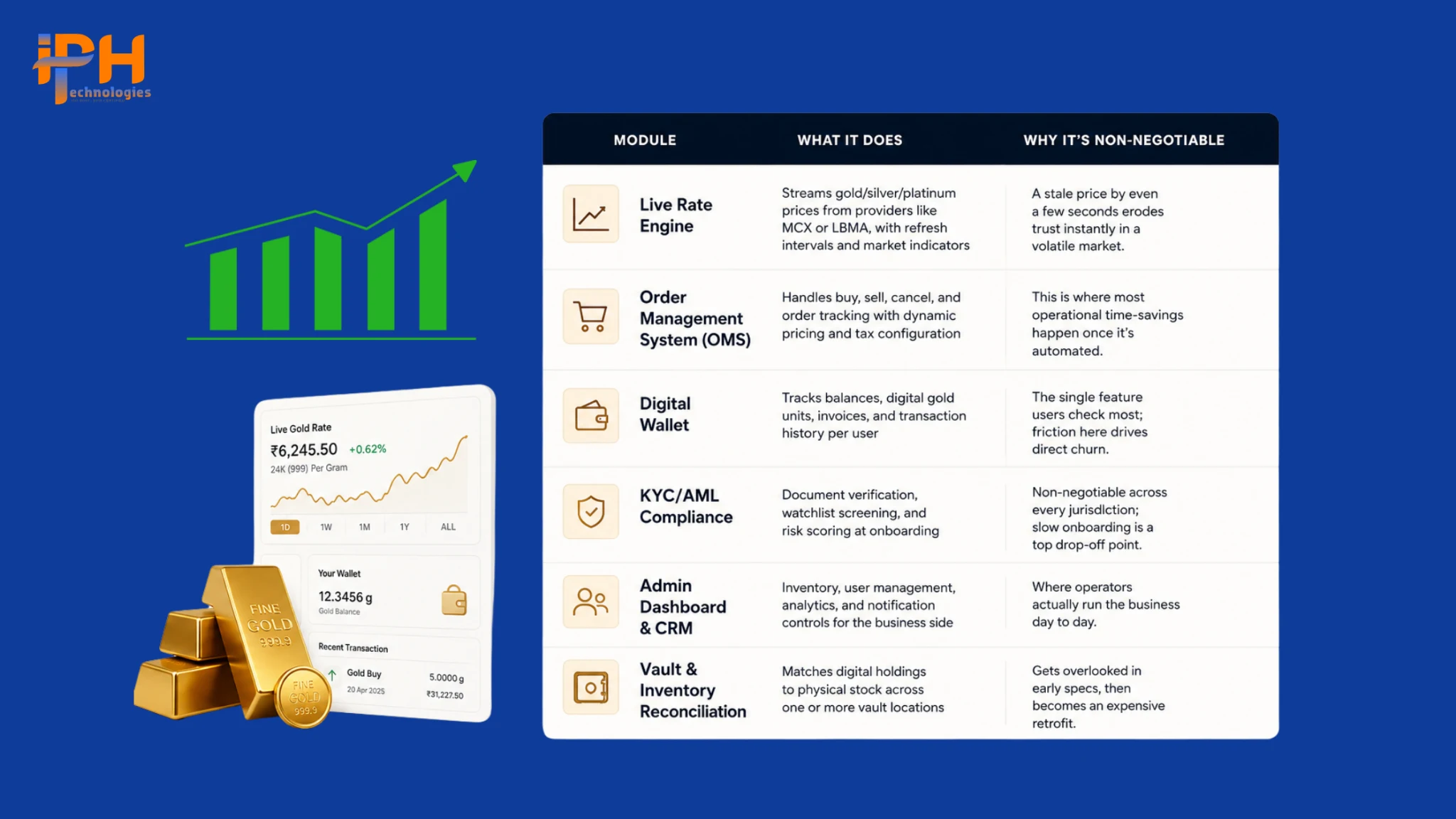
| Module | What It Does | Why It’s Non-Negotiable |
| Live Rate Engine | Streams real-time gold, silver, platinum, and palladium prices from providers like MCX or LBMA with automatic refresh intervals and market indicators. | Even a few seconds of price delay can reduce customer trust and impact trading accuracy in a volatile market. |
| Order Management System (OMS) | Processes buy, sell, cancel, and order tracking with dynamic pricing, spreads, and tax/GST configuration. | Automating order processing significantly improves operational efficiency and minimizes manual errors. |
| Digital Wallet | Tracks precious metal balances, digital gold units, invoices, and complete transaction history for every user. | Users rely on wallet accuracy daily, making it one of the most critical features for engagement and retention. |
| KYC/AML Compliance | Handles identity verification, document validation, watchlist screening, and customer risk assessment. | Essential for regulatory compliance and reducing fraud while ensuring a smooth onboarding experience. |
| Admin Dashboard & CRM | Provides user management, inventory control, analytics, notifications, and customer relationship management tools. | Serves as the operational hub where administrators monitor performance and manage daily business activities. |
| Vault & Inventory Reconciliation | Synchronizes digital metal holdings with physical inventory across one or multiple vault locations. | Ensures inventory accuracy, prevents stock mismatches, and simplifies audits and regulatory reporting. |
The majority of competitor guides simply list these modules. Most competitor guides do not mention the order in which these modules should be installed. This order is more important than just the list. The rate engine and OMS should be built first because of the downstream dependencies on reliable pricing. Even in an MVP build reconciliation, as later integrating vault logic into a production wallet is one of my most painful rebuilds. KYC can start with a semi-automated version, and then tighten it over time as the volume increases. Regulators care more about a process that is defendable than if it’s fully automatic on day one.
Cloud vs. On-Premise: The Decision Most Founders Get Backwards
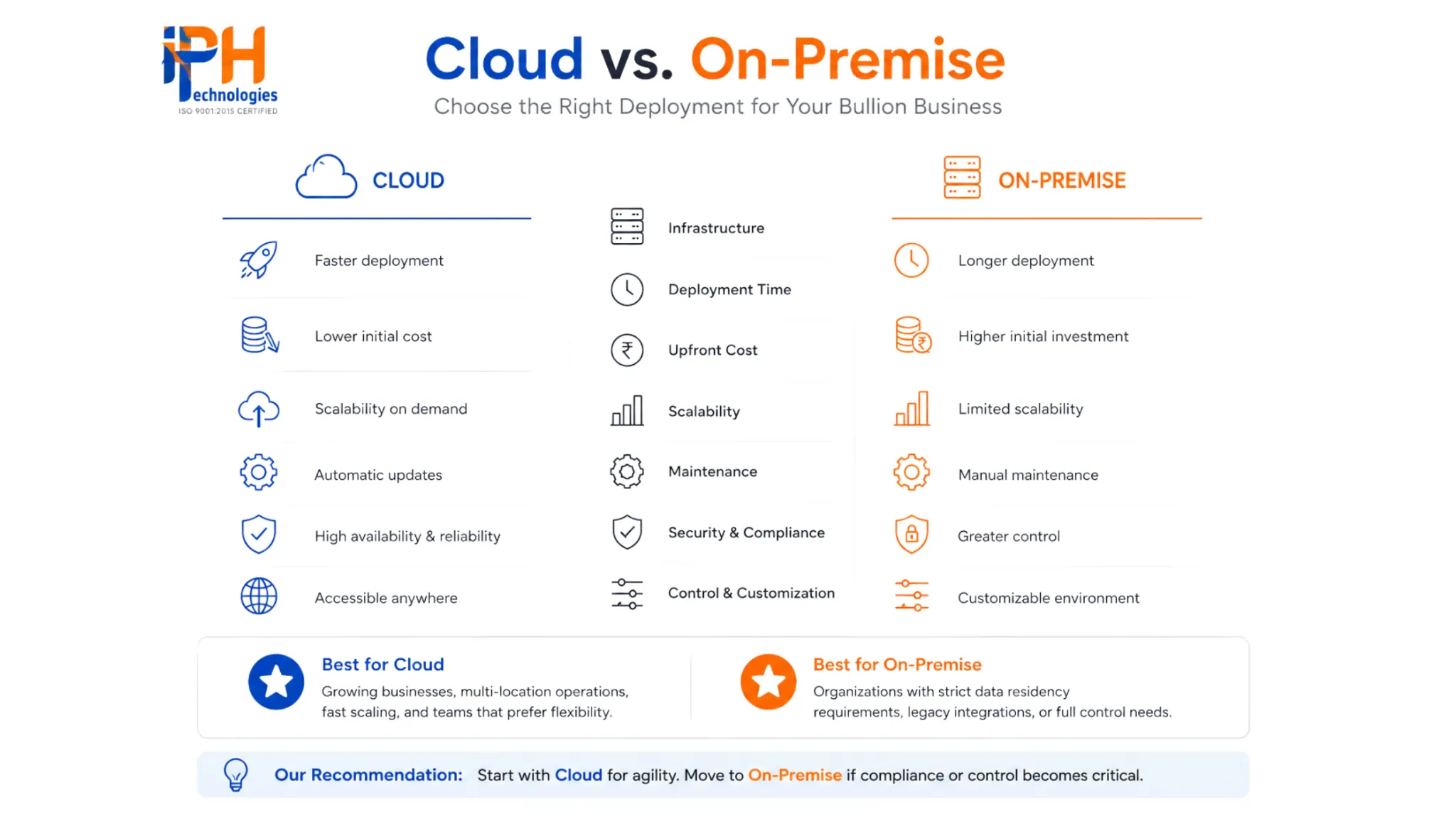
Most bullion dealers I speak to ask about features first, and infrastructure second. This is wrong, as your choice of infrastructure will constrain your feature roadmap over many years.
The overwhelming majority of bullion dealers and startups are better off with cloud-hosted platforms, built on modern stacks such as Node.js and React.js and deployed on AWS or Azure. These platforms are subscription-based, vendor-maintained and designed for remote teams. They also allow multi-user access. On-premise setups are still useful in certain cases, such as for institutions that have strict data-residency requirements or dealers who operate in areas where internet reliability is not reliable enough to support a real-time pricing feed. On-premise setups are usually an old habit and not a requirement for everyone else. They also make it difficult to add AI-driven features such as anomaly detection or predictive risk scoring.
What This Actually Costs: A Real Breakdown, Not a Single Number
This is where most competitor content either goes vague or gives you one number and moves on. Neither is useful when you’re the one signing the contract. Cost depends almost entirely on how many of the modules above you’re building and how deep the compliance requirements go.
| Build Type | Scope | Typical Cost Range | Typical Timeline |
| MVP / Lean Launch | Live pricing engine, digital wallet, basic buy/sell functionality, and a single-platform application. | $60,000 – $110,000 | 3 – 4 Months |
| Mid-Complexity Platform | Complete Order Management System (OMS), KYC/AML compliance, Admin CRM, and multi-platform support (iOS, Android & Web). | $110,000 – $220,000 | 5 – 7 Months |
| Full-Scale / Multi-Jurisdiction Exchange | AI-powered pricing forecasts, agentic trade execution, multi-vault reconciliation, multi-currency support, and advanced regulatory automation. | $220,000 – $400,000+ | 9 – 18 Months |
A few things can push a project to the next tier faster than its founders expected. It’s more cost-effective to plan ahead for multi-currency, multi-language, and compliance logic support than to retrofit them. If you are digitizing a bullion dealer, you can also budget for integration with an existing ERP or CRM.
Quotes that are dramatically lower than these ranges usually lack something — typically compliance depth, vault reconcilia-tion, or post launch support. Before asking what is included, ask what’s not included.
Scalable Architecture for Future-Ready Bullion Platforms
In addition to delivering accurate live precious metal rates, the platform was designed with a scalable architecture that supports future enhancements such as digital wallets, secure bullion transactions, portfolio management, and AI-powered market insights. Drawing on our expertise in Bullion App Development, we built a high-performance solution capable of handling real-time market fluctuations while maintaining excellent reliability and user experience. The application also follows modern fintech development practices, making it suitable for businesses looking to launch advanced Gold Trading Software or expand into AI-driven precious metals platforms. For businesses planning next-generation bullion solutions, our insights on AI Revolutionizing Bullion Software Development provide a roadmap for integrating intelligent automation and predictive analytics into trading applications.
Why AI Is No Longer Optional in This Category

After observing the changes in our client base, I wrote more about it, but here’s the gist: rule-based, static bullion software is losing its ground quickly. Traditional platforms monitor prices and react to orders. AI-powered platforms anticipate. This distinction is visible in three areas that directly impact retention.
Fraud detection with adaptive algorithms. Fraud detection systems that use rules only detect what has been previously told. This means that fraudsters will eventually learn to avoid the rules. Anomaly detection models learn to identify what is “normal” for each user, and then flag any deviations. This includes fraud patterns that have not yet been codified.
Scalable personalization.Most bullion platforms show the same dashboard to both a high-frequency institution trader and an initial retail buyer, even though they have very different needs. AI-driven personalized features — such as different alert thresholds and default views, or relevant recommendations based on actual portfolio data — were previously out of reach to anyone except the largest exchanges. It’s not anymore.
SCompliance that does not stifle growth Manual KYC reviews scale linearly with the headcount. AI-assisted watchlist and document verification doesn’t. This difference can be the difference between an onboarding that grows with the business, and one that becomes the end of it.
This does not mean that every MVP must have agentic trading agents from day one. This means that the architecture must be designed so that these capabilities can be added without having to rebuild.
The Real Reason Bullion Apps Lose Users (and It’s Rarely the UI)
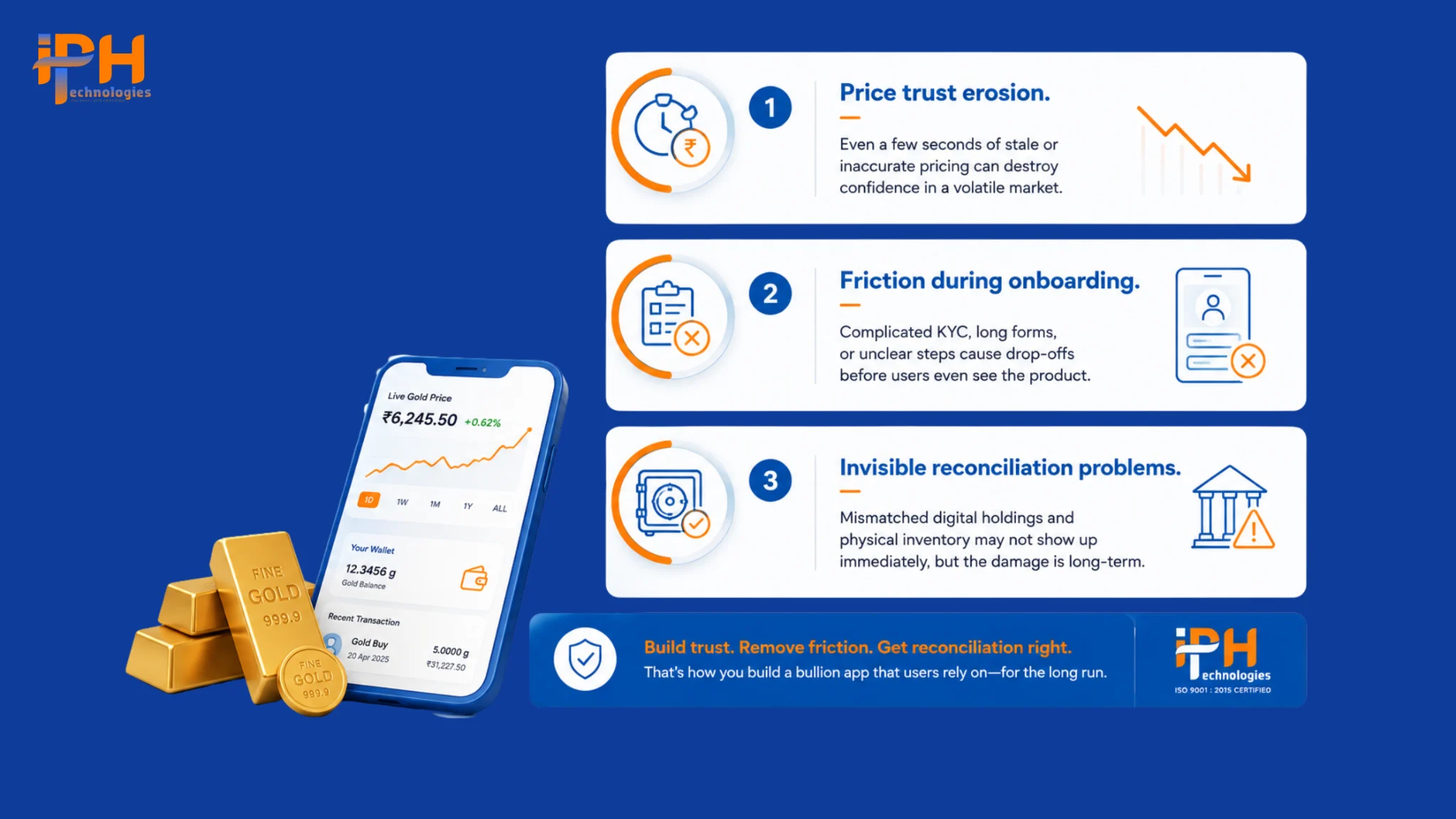
It’s important to be specific, as most bullion app developers only talk about the acquisition features, while mentioning retention hardly at all.
This category is prone to churning in three predictable ways:
- 1. Price Trust Erosion: Users who notice even a small difference between the displayed bullion price and the actual market price are likely to lose confidence. Instead of raising a support ticket, most customers simply stop trading. A reliable, real-time rate engine is the most critical component of any bullion trading platform.
- 2. Onboarding Friction During KYC: KYC delays are most damaging when users are ready to make their first purchase. A verification process that takes days during periods of high market activity can result in permanently lost customers rather than delayed transactions.
- 3. Invisible Reconciliation Issues: Digital bullion holdings must always remain synchronized with physical vault inventory. Even brief discrepancies can severely impact customer trust because bullion represents real financial wealth, and users expect complete accuracy and transparency.
Practically, this means that your retention strategy shouldn’t be a workstream of marketing added after launch. The retention strategy is baked into the three modules that you spend the most engineering time on during the build.
Choosing a Development Partner: What Actually Separates Capable From Ordinary
Bullion app development is at the intersection between fintech domain expertise, real-time system engineering, and regulatory knowledge. Few shops have a strong presence in all three areas. Most are good in one area and average in the other, but the difference will show up in production.
What I would check before signing any contract is based on the things that tend to go wrong if it’s not checked.
- Evaluate Their AI & ML Expertise: Ask whether the development team builds machine learning models in-house or simply integrates third-party APIs. If your platform requires fraud detection, predictive pricing, or intelligent analytics, this distinction is essential.
- Verify Compliance Knowledge: Ensure the company has practical experience with regulatory frameworks such as FATF, MiFID II, FinCEN, and local commodity trading regulations. They should provide clear, market-specific answers rather than generic compliance statements.
- Check Experience with Inventory Reconciliation: Confirm they have built systems that accurately reconcile physical bullion inventory with digital ownership records. This specialized capability is critical for bullion platforms and is often overlooked by general fintech developers.
- Understand Their Post-Launch Support: Ask about their long-term maintenance and support strategy. Bullion trading platforms require continuous updates as pricing providers, compliance regulations, security requirements, and fraud detection mechanisms evolve over time.










.png)