























































































Cost of Generative AI Development in India in 2026: A Complete Guide
If you’ve been considering building a Generative AI solution for your business, one of the first questions you’ve probably asked is: “How much is this going to cost me?”
It’s a fair question — and honestly, one that doesn’t have a single, simple answer. The cost of Generative AI Development in India in 2026 depends on a range of factors: the complexity of your solution, the type of AI model you need, your data readiness, and the team you choose to partner with. But here’s the good news — India remains one of the most cost-effective destinations in the world for high-quality AI development, and in 2026, that advantage has only grown stronger.
At IPH Technologies, we’ve spent over a decade helping businesses across industries build digital solutions that actually deliver results. We’ve watched the AI landscape evolve rapidly, and we know firsthand how confusing it can be to navigate cost estimates without a clear breakdown. So in this post, we’re pulling back the curtain — no fluff, no vague ranges — just a real, honest look at what Generative AI development costs in India today.
Why India Is the Smart Choice for Generative AI Development in 2026
Before we dive into numbers, it’s worth understanding why India continues to dominate the global AI development space.
India has one of the largest and fastest-growing pools of AI and machine learning talent in the world. According to a NASSCOM report on Data Science & AI Skills in India, the demand for AI professionals in the country is expected to exceed 1 million by 2026, with India ranking first globally in AI skill penetration and talent concentration. With thousands of engineers graduating from premier institutions every year and upskilling into cutting-edge technologies like large language models (LLMs), natural language processing (NLP), and computer vision, the talent supply is robust. Add to that the government’s strong push towards a digital and AI-first economy, and you have an ecosystem that’s genuinely built for innovation.
From a cost perspective, Indian AI development firms offer rates that are 60–80% lower than their counterparts in the US, the UK, or Western Europe — not because of lower quality, but due to lower operational costs and a highly competitive talent market. The technical expertise, the tools, the methodologies — they’re identical. The difference is purely economic, and that’s a significant advantage for businesses looking to build smart without burning through their budget.
Generative AI Development Cost in India: A Practical Breakdown
Let’s get into the actual numbers. In 2026, Generative AI development costs in India broadly fall into five categories based on project type.
1. Pre-Built API Integration (Basic Level)
Estimated Cost: ($3,500 – $18,000)
This is the entry point for most businesses exploring AI for the first time. Instead of building a model from scratch, you integrate an existing model — think GPT-4, Claude, or Gemini — into your product or workflow via API. The development work here focuses on prompt engineering, API configuration, UI/UX Design, and application logic.
This approach is ideal for businesses that want to add AI-powered chatbots, content generation tools, or intelligent search features to their existing platforms quickly and affordably. It’s a smart starting point, especially for startups and SMEs testing the waters.
2. Fine-Tuned AI Models
Estimated Cost: ($10,000 – $48,000)
If you need an AI system that’s tailored specifically to your business domain — say, a legal document classifier, a medical diagnosis assistant, or a customer support bot trained exclusively on your product data — you’ll need to fine-tune a foundation model on your own dataset.
This involves data preparation, cleaning, annotation, model training, testing, and deployment. Data preparation alone can account for 25–40% of the total project cost, so the quality and readiness of your data plays a major role in final pricing.
This is where businesses start seeing genuinely differentiated AI — solutions that understand the nuances of their industry rather than giving generic outputs.
3. Custom AI Agents & Automation Workflows
Estimated Cost: ($25,000 – $120,000)
AI agents are the next frontier. These aren’t systems that just talk — they act. Think of a sales agent that can qualify leads, send follow-up emails, update your CRM, and book meetings — all autonomously. Or an operations bot that can track inventory, raise purchase orders, and notify vendors without any human intervention.
Building multi-agent AI systems requires advanced architecture, integration with multiple platforms (CRM, ERP, databases), rigorous testing, and security layers. The complexity is higher, but so is the business value.
In 2026, AI Agents are rapidly becoming a competitive differentiator across industries like e-commerce, healthcare, finance, and manufacturing. Businesses that invest now are positioning themselves well ahead of the curve.
4. Enterprise-Grade Generative AI Platforms
Estimated Cost: ($100,000 – $500,000+)
This is where large organisations play. Enterprise AI platforms involve custom model development from scratch, large-scale data pipelines, advanced MLOps (machine learning operations), multi-layered security and compliance frameworks, and integration across complex technology stacks.
Industries like banking, insurance, healthcare, and government typically fall into this bracket, especially when compliance requirements — such as India’s Digital Personal Data Protection (DPDP) Act, 2023 or sector-specific regulations — add layers of engineering complexity. Expect to allocate an additional 20–40% on top of base estimates for regulated industry compliance.
These aren’t one-time builds, either. Enterprise AI platforms require continuous monitoring, retraining, and optimisation to maintain performance — which brings us to ongoing costs
5. AI Chatbots & Virtual Assistants (RAG-Based)
Estimated Cost: ₹15 Lakh – ₹80 Lakh ($18,000 – $100,000)
Retrieval-Augmented Generation (RAG) chatbots are the 2026 standard for intelligent customer-facing AI. Unlike basic chatbots that follow a script, RAG-based bots actually understand your business knowledge base and answer questions accurately by retrieving relevant information in real time.
Building a well-functioning RAG system requires skilled AI engineers, a properly indexed knowledge base, careful prompt design, hallucination prevention measures, and ongoing API cost management. It’s more sophisticated than it looks from the outside — and the quality difference between a poorly built RAG bot and a properly engineered one is enormous.
Also Read – How AI Is Revolutionizing Bullion Software Development in 2026
Not Sure Where Your Project Fits? Let’s Figure It Out Together.
The cost ranges above are a solid starting point — but every business is different. Your industry, your existing tech stack, your data maturity, and your end goals all influence what the right solution looks like for you specifically. A number on a page can only tell you so much.
That’s why we offer a free, no-obligation consulting call with our Generative AI experts at IPH Technologies.
In just 30 minutes, we’ll:
- Listen to your requirements — what you’re trying to build, solve, or automate
- Assess your current tech and data readiness — so we don’t give you a quote built on assumptions
- Map your idea to the right solution type — API integration, fine-tuning, custom agent, or enterprise platform
- Give you a tailored pricing estimate — a realistic, transparent range based on your actual scope, not a generic bracket
No sales pressure. No vague proposals. Just a clear, honest conversation about what’s possible and what it’ll take to get there.
Whether you’re in the early ideation stage or ready to kick off development next month, this call is designed to give you clarity — so you can make a confident, informed decision.
Key Factors That Affect the Cost of Generative AI Development in India
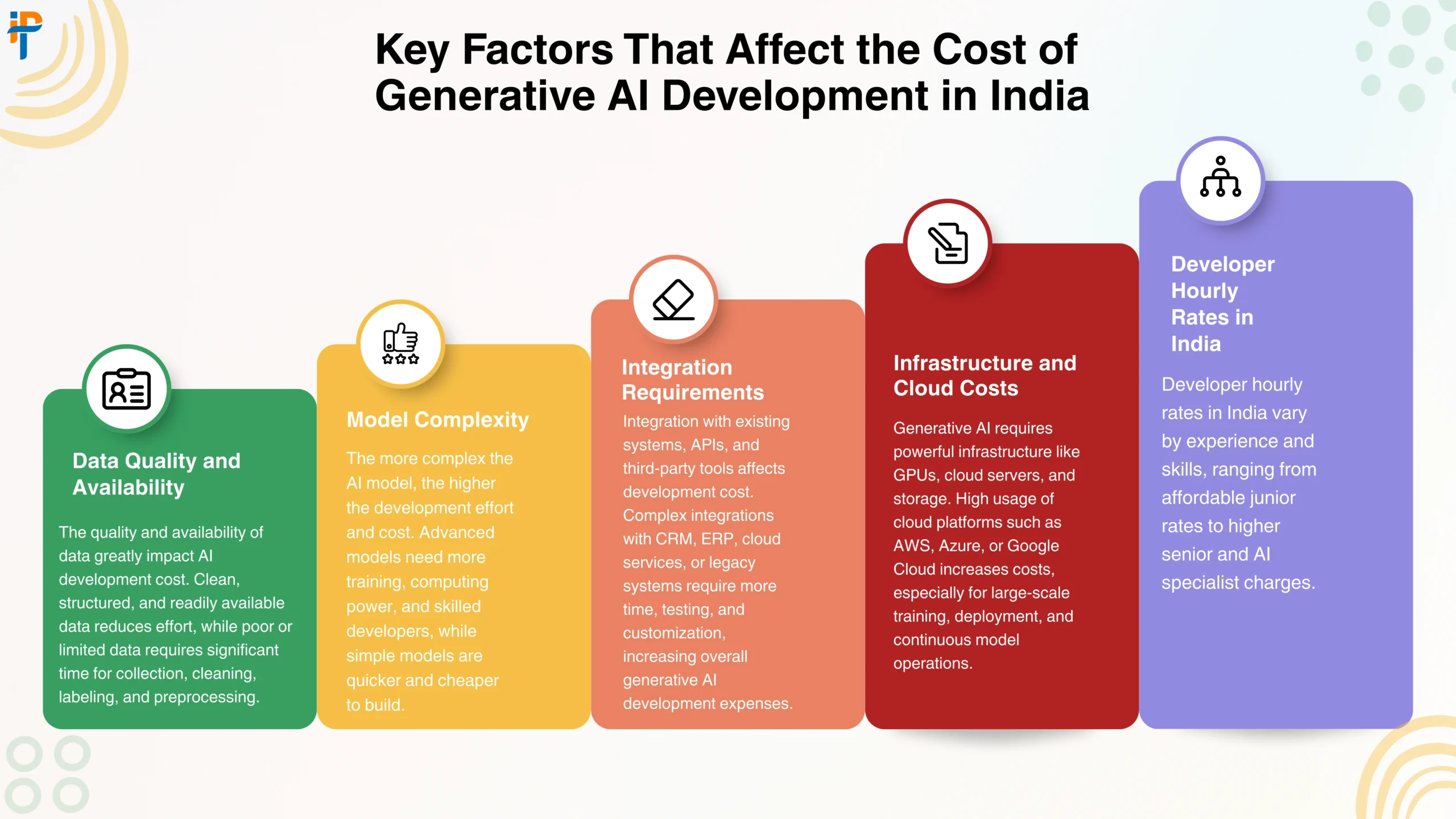
Data Quality and Availability
The single biggest cost driver that most businesses underestimate. If your data is clean, well-structured, and ready to use, you save significant time and money. If it’s scattered across legacy systems, incomplete, or unstructured, expect to spend heavily on data cleaning and annotation before any AI model training can begin. Budget carefully for this phase — cutting corners here leads to poor model performance down the line.
Model Complexity
A rule-based chatbot is fundamentally different from a multi-modal generative AI system that can process text, images, and audio simultaneously. The more sophisticated your requirements — real-time learning, multi-agent orchestration, contextual memory — the more engineering hours and infrastructure investment you’ll need.
Integration Requirements
Standalone AI tools are simpler and cheaper to build. The moment your AI system needs to plug into your existing CRM, ERP, payment gateway, legacy database, or third-party APIs, the engineering complexity increases. Every integration point adds development and testing time — especially when legacy systems don’t have clean, well-documented APIs.
Infrastructure and Cloud Costs
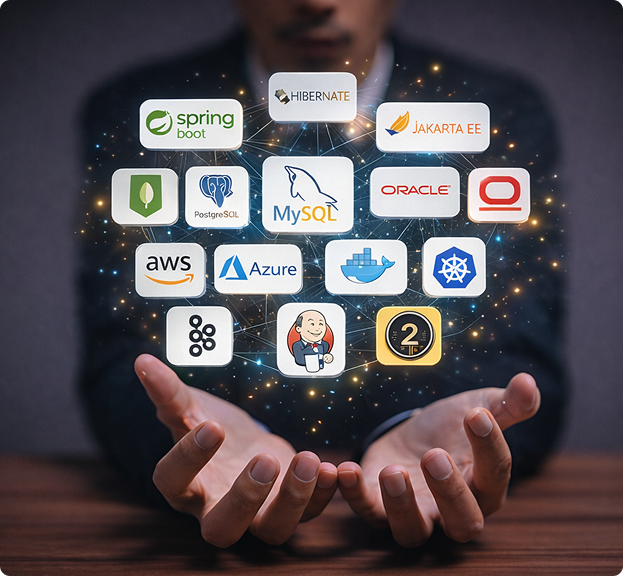
Generative AI is computationally intensive. Training and running AI models requires powerful GPUs and scalable cloud infrastructure (AWS, Google Cloud, or Microsoft Azure). These aren’t one-time costs — cloud compute bills are ongoing and can run anywhere from a few thousand rupees per month for basic deployments to several lakhs per month for large-scale enterprise systems.
Developer Hourly Rates in India
Here’s a quick reference for 2026 market rates:
- Junior AI Developer — $18 – $30/hour
- Mid-Level AI Engineer — $30 – $54/hour
- Senior AI Engineer / ML Architect — $54 – $96/hour
- AI Research Scientist / Specialist — $96 – $180/hour
Compare this to US or UK rates of $100–$200/hour for equivalent seniority — the cost advantage speaks for itself.
Post-Launch Maintenance
This is the cost that surprises most first-time AI buyers. AI models experience what’s known as “model drift” — over time, as the world changes, the model’s performance degrades if it isn’t retrained on fresh data. Plan to allocate 15–20% of your initial development cost annually for maintenance, retraining, monitoring, and improvements.
Generative AI Development Timelines in 2026
Generative AI development timelines and cost reference for 2026, covering 7 project types from API integration to enterprise platforms.
| Project Type | Timeline | Est. Cost (USD) | Typical Team |
|---|---|---|---|
|
API-based AI integration Plug-in GPT/Claude via REST | 4 – 8 wks | $10K – $40K |
|
|
Fine-tuned AI model Domain-specific training | 8 – 16 wks | $30K – $120K |
|
|
AI chatbot (RAG-based) Knowledge-grounded assistant | 2 – 4 mos | $40K – $150K |
|
|
Custom AI agent Autonomous multi-step tasks | 3 – 6 mos | $80K – $300K |
|
|
Multimodal AI app Vision + text + audio pipeline | 3 – 7 mos | $100K – $400K |
|
|
AI-powered SaaS product Multi-tenant, billing, auth | 4 – 9 mos | $150K – $600K |
|
|
Enterprise AI platform Org-wide infra + governance | 6 – 18 mos | $500K – $5M+ |
|
Build Custom vs. Use Off-the-Shelf: Which Makes More Sense?
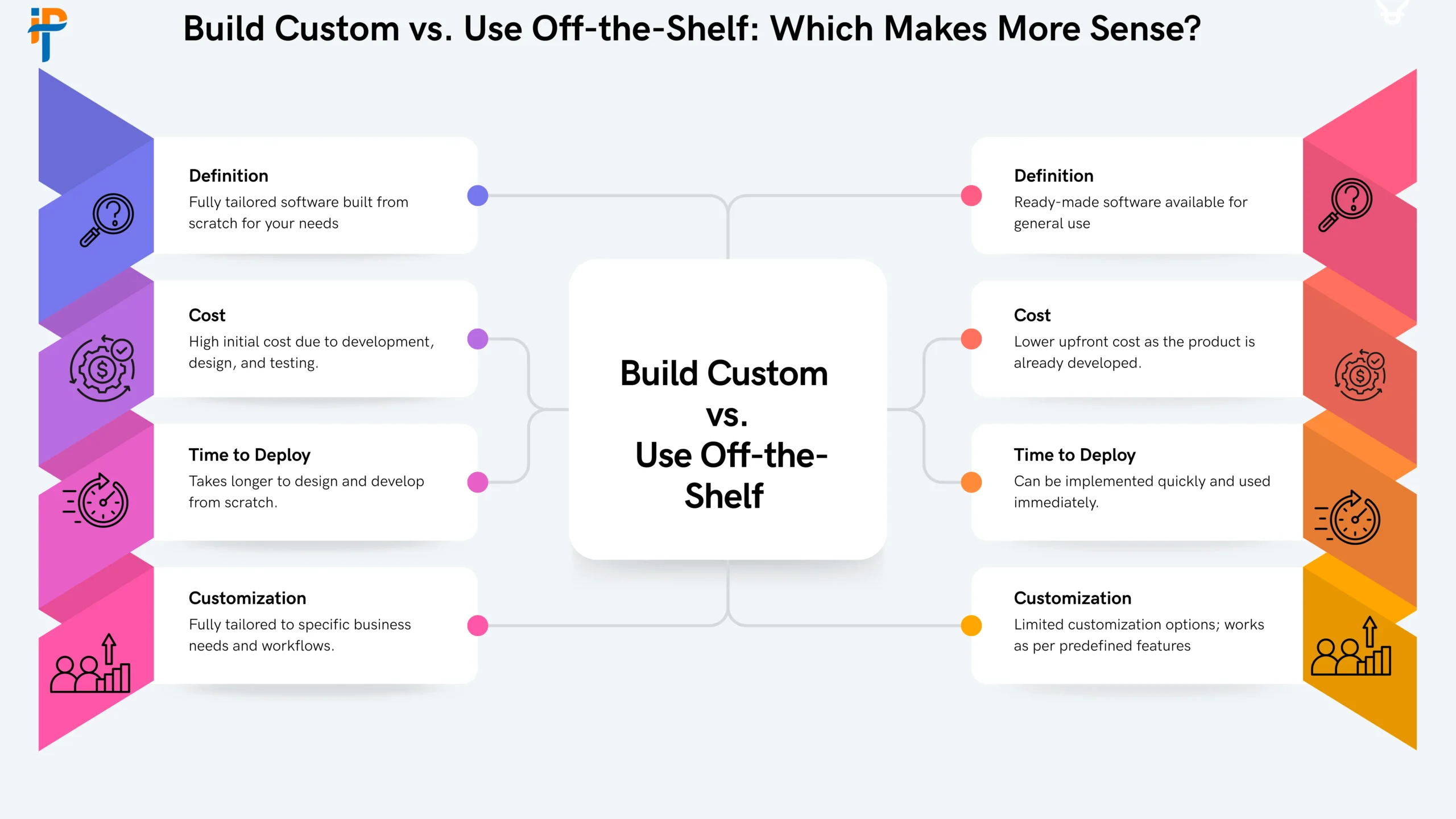
Off-the-shelf AI platforms (subscription-based tools) are great for getting started quickly. You pay a predictable monthly or per-seat fee and get access to powerful AI features without building anything. The trade-off is limited customisation — you’re working within the platform’s boundaries.
Custom AI development gives you complete ownership, full flexibility, and a genuine competitive advantage. It’s a larger upfront investment, but it’s built around your exact workflows, your data, and your business logic. Over time, the ROI is significantly higher — especially if AI becomes a core part of your product or service.
At IPH Technologies, we typically recommend starting with a well-scoped MVP (Minimum Viable Product) to validate your AI idea before scaling. It’s the smartest way to control costs, learn quickly, and make confident investment decisions.
Also Read – Best AI App Development Companies in India 2026 | Top Ranked List
How to Choose the Right Generative AI Development Partner in India
The partner you choose matters as much as the budget you set. Here are a few things to look for:
Transparency in pricing . Ask for a line-item breakdown — data preparation, model development, integration, testing, deployment, and post-launch support should each appear separately. A single-number quote is a red flag.
Relevant portfolio . Has the team built Generative AI solutions before? Ask for case studies, not just logos.
End-to-end capability . AI development isn’t just about writing code. Look for a team that handles the full lifecycle — data strategy, model architecture, engineering, deployment, and MLOps. Fragmented vendors mean fragmented accountability.
Communication and transparency. Agile, milestone-based delivery with regular check-ins keeps projects on track and prevents costly surprises.
Data Security & Compliance. Generative AI projects often involve sensitive business or user data. Ensure your partner follows strict data protection practices, complies with regulations, and offers secure data handling, storage, and access controls.
Scalability & Future Readiness. Your AI solution should grow with your business. Choose a partner who designs scalable architectures and keeps future upgrades in mind—whether it’s handling more users, integrating new features, or adapting to evolving AI models.
Post-Deployment Support & Optimization. AI models require continuous monitoring and improvement. A reliable partner should offer ongoing support, performance tuning, model retraining, and updates to keep your solution accurate and efficient over time.
Why IPH Technologies Is the Right Partner for Your Generative AI Journey
At IPH Technologies, we don’t just build AI solutions — we build AI solutions that work for your business. With over a decade of experience, 500+ successful projects, and 430+ satisfied clients across industries, we bring a rare combination of technical depth and business understanding to every engagement.
Whether you’re a startup exploring your first AI integration or an enterprise looking to build a sophisticated, custom Generative AI platform, we tailor our approach to fit your goals, your budget, and your timeline. We believe in milestone-based delivery, complete transparency in pricing, and building solutions that scale with your business — not just for the demo.
Our team of data scientists, ML engineers, NLP specialists, and AI architects has hands-on experience with the latest Generative AI technologies — from LLM fine-tuning and RAG pipelines to multi-agent systems and enterprise MLOps. And because we manage the entire AI lifecycle in-house, you’re never left coordinating between multiple vendors or dealing with accountability gaps.
Curious about what your Generative AI project might cost? Reach out to IPH Technologies for a detailed, no-obligation consultation. We’ll assess your requirements, walk you through realistic cost and timeline estimates, and help you make an informed decision — without the sales hype.
Also Read – Best AI App Development Companies in India 2026 | Top Ranked List
Final Thoughts
Generative AI is no longer a futuristic concept — it’s a present-day business imperative. In 2026, the question isn’t whether to invest in AI, but how to invest wisely. India offers the perfect combination of world-class talent, cost efficiency, and a mature development ecosystem to make that investment count.
Whether you’re looking at a ₹5 lakh chatbot integration or a ₹2 crore enterprise AI platform, the key is to go in with clear goals, good data, and the right development partner by your side.
At IPH Technologies, we’re ready to be that partner.
Ready to build something remarkable? Contact IPH Technologies today and let’s turn your Generative AI vision into reality.










.png)