


















































Highlights
UI/UX Design
User-first, visually engaging interfaces crafted to enhance usability, boost engagement, and deliver seamless digital experiences.
Branding
Strategic brand identities that communicate your vision, build trust, and create a memorable presence across all touchpoints.
Wireframing
Structured layouts and user flows that map the product journey clearly before development begins, saving time and cost.
Prototype Design
Interactive prototypes that simulate real user interactions, helping validate ideas and refine experiences early.
Design Systems
Scalable design frameworks and reusable components that ensure consistency, speed, and efficiency across your product.
UI/UX Design

We design intuitive, user-centric interfaces that enhance engagement, improve usability, and deliver seamless digital experiences across all devices.

UI UX Design
  • User research and wireframing for clear flows
  • Modern UI design using Figma and Adobe XD
  • Interactive prototypes for better user experience testing
  • Usability testing and performance optimization improvements
  • Responsive design across all devices and screens
  • Scalable design systems with reusable UI components
Branding & Identity

We craft strong brand identities that communicate your vision, build trust, and create a lasting impression across all digital and offline touchpoints.

Branding and Identity
  • Logo design and brand identity creation
  • Brand guidelines and visual consistency systems
  • Color palette and typography selection strategy
  • Marketing materials and brand asset design
  • Social media branding and creative direction
  • Rebranding and brand positioning strategies
Wireframing

We create structured wireframes that define layout, user flow, and functionality, helping visualize ideas and build a strong foundation before design and development.

Wireframing
  • Low fidelity wireframes for initial structure
  • High fidelity wireframes with detailed layouts
  • User flow mapping for better navigation
  • Content hierarchy and layout planning
  • Clickable wireframes for early feedback
  • Clear structure before UI design phase
Prototype Design

We design interactive prototypes that simulate real user experiences, helping validate ideas, test functionality, and refine products before development.

Prototype Design
  • Interactive prototypes for real user experience
  • Clickable designs to test product functionality
  • User journey simulation for better understanding
  • Rapid prototyping for faster design validation
  • Feedback driven improvements before development
  • High fidelity prototypes with smooth interactions
Design Systems

We build scalable design systems that ensure consistency, improve collaboration, and accelerate product development across all platforms and teams.

Design Systems
  • Reusable UI components for consistent design
  • Design tokens for colors typography spacing
  • Component libraries for faster development workflow
  • Consistent branding across all digital products
  • Documentation for design and development teams
  • Scalable systems for growing product ecosystems
Highlights
Mobile Apps Development
High-performance Android and iOS mobile applications built with modern technologies, delivering seamless user experiences and robust functionality.
Desktop Application Dev
Powerful and secure desktop applications tailored for Windows, macOS, and Linux, designed for performance, scalability, and reliability.
Web App Development
Scalable and responsive web applications using modern frameworks like React, Angular, and Vue for fast, dynamic, and engaging experiences.
Cross-Platform
Cost-effective cross-platform solutions using Flutter and React Native, enabling a single codebase for both iOS and Android platforms.
PWA Development
Progressive Web Apps that combine the best of web and mobile, offering offline access, fast loading, and app-like experiences directly in the browser.
Highlights
Mobile App

Android

iOS

Flutter

Hybrid

Optimize

Native

Swift

Firebase

Android App Development

We craft powerful, scalable Android applications with intuitive UX, high performance, and deep integration with Google services.

Android App
  • Custom Android app development
  • Native Kotlin & Java apps
  • Google Play Store deployment
  • Material Design UI implementation
Kotlin

Kotlin

Java

Java

Flutter

Flutter

Android Studio

Android

Jetpack

Jetpack

iOS App Development

We build high-quality, user-centric iOS apps combining performance, security, and seamless design for Apple devices.

iOS App
  • Custom iOS app development
  • Native Swift & SwiftUI apps
  • Seamless Apple service integration
  • App Store review & deployment
Swift

Swift

SwiftUI

SwiftUI

Obj-C

Obj-C

Xcode

Xcode

Flutter

Flutter

Cross-Platform Apps

We develop cross-platform mobile apps that run flawlessly on both iOS and Android from a single codebase, saving time and cost.

Cross-Platform App
  • Single codebase for iOS & Android
  • Flutter & React Native development
  • Native-like performance & UI
  • Faster time-to-market
React Native

React Native

TypeScript

TypeScript

Redux

Redux

Firebase

Firebase

Dart

Dart

Hybrid Apps

We build hybrid mobile apps that blend web technologies with native capabilities, delivering broad reach and cost-effective development.

Hybrid App
  • Web + native feature integration
  • Ionic & Cordova frameworks
  • Reduced development costs
  • Multi-platform publishing
Flutter

Flutter

Dart

Dart

Firebase

Firebase

SQLite

SQLite

App Optimization

We enhance existing mobile apps with performance tuning, crash fixes, battery efficiency, and faster load times for a superior user experience.

App Optimization
  • Performance profiling & tuning
  • Memory & battery optimization
  • Crash analysis & bug fixing
  • App size reduction & load speed
Xcode

Xcode

Android Studio

Android

Firebase

Firebase

Java

Java

Highlights
Desktop App

Windows

macOS

Linux

Desktop

Electron

Qt

WinForms

GTK

Windows Apps

We develop robust Windows desktop applications using modern Microsoft technologies, delivering powerful tools for enterprise and consumer use.

Windows App
  • Custom Windows desktop applications
  • WPF & WinForms development
  • Microsoft Store deployment
  • Windows API & system integration
C#

C#

.NET

.NET

Electron

Electron

Visual Studio

Visual Studio

SQL Server

SQL Server

macOS Apps

We create elegant, high-performance macOS applications that leverage Apple's native frameworks for a smooth and delightful desktop experience.

macOS App
  • Native macOS app development
  • SwiftUI & AppKit integration
  • Mac App Store submission
  • Apple Silicon optimization
Swift

Swift

SwiftUI

SwiftUI

Obj-C

Obj-C

Xcode

Xcode

Cross-Platform Desktop

We develop cross-platform desktop applications that run seamlessly on Windows, macOS, and Linux from a single shared codebase.

Cross-Platform Desktop
  • Single codebase for all platforms
  • Electron & Tauri frameworks
  • Flutter for desktop support
  • Consistent UI across OS environments
Flutter

Flutter

Electron

Electron

Node.js

Node.js

TypeScript

TypeScript

Docker

Docker

Electron Apps

We build feature-rich Electron desktop apps using web technologies, enabling cross-platform deployment with native OS capabilities.

Electron App
  • Electron framework development
  • Node.js & Chromium integration
  • Auto-updater & native notifications
  • Cross-OS packaging & distribution
Electron

Electron

Node.js

Node.js

React

React

Vue

Vue

TypeScript

TypeScript

Highlights
Web App

React

Node.js

PHP

Laravel

Python

MySQL

JavaScript

HTML

CSS

React Development

We build fast, component-driven React web applications with modern state management, reusable UI, and seamless API integration.

React Development
  • Custom React SPA development
  • Redux & Context API state management
  • Next.js SSR & SSG support
  • REST & GraphQL API integration
React

React

Next.js

Next.js

Redux

Redux

TypeScript

TypeScript

Tailwind

Tailwind

Angular Development

We develop enterprise-grade Angular applications with structured architecture, two-way data binding, and robust TypeScript foundations.

Angular Development
  • Custom Angular SPA development
  • RxJS & NgRx state management
  • Angular Material UI components
  • Lazy loading & performance tuning
Angular

Angular

TypeScript

TypeScript

HTML

HTML

CSS

CSS

NPM

NPM

Node.js Backend

We build scalable, event-driven Node.js backends with RESTful APIs, real-time capabilities, and seamless database integrations.

Node.js Backend
  • RESTful & GraphQL API development
  • Express.js & Fastify frameworks
  • WebSocket & real-time features
  • MongoDB, PostgreSQL integration
Node.js

Node.js

Express

Express

MongoDB

MongoDB

GraphQL

GraphQL

Docker

Docker

Cloud Web Apps

We design and deploy cloud-native web applications on AWS, Azure, and GCP — scalable, secure, and built for high availability.

Cloud Web Apps
  • AWS, Azure & GCP deployment
  • Serverless architecture development
  • Auto-scaling & load balancing
  • CI/CD pipeline configuration
AWS

AWS

Azure

Azure

GCP

GCP

Docker

Docker

Kubernetes

Kubernetes

Full-Stack Dev

We deliver complete full-stack web solutions — from pixel-perfect frontends to robust backends — as a unified, end-to-end product.

Full-Stack Dev
  • Frontend & backend development
  • MERN & MEAN stack expertise
  • Database design & API architecture
  • DevOps, hosting & deployment
React

React

Node.js

Node.js

MongoDB

MongoDB

PostgreSQL

PostgreSQL

Docker

Docker

Highlights
Cross Platform

Flutter

R. Native

Xamarin

Ionic

Reuse

Electron

NW.js

Framework7

SwiftUI

Flutter Development

We build beautiful, natively compiled Flutter applications for mobile, web, and desktop from a single Dart codebase with pixel-perfect UI.

Flutter Development
  • Flutter mobile & web apps
  • Dart language development
  • Custom widget & animation creation
  • Firebase & REST API integration
Flutter

Flutter

Dart

Dart

Firebase

Firebase

GetX

GetX

Riverpod

Riverpod

React Native

We develop high-performance React Native apps that deliver a truly native experience on both iOS and Android using JavaScript and React.

React Native
  • Cross-platform iOS & Android apps
  • React Native CLI & Expo development
  • Native module & bridge integration
  • Redux & MobX state management
React Native

React Native

Redux

Redux

TypeScript

TypeScript

Firebase

Firebase

Xamarin

We develop Xamarin-based cross-platform apps using C# and .NET, enabling shared business logic across iOS, Android, and Windows.

Xamarin
  • Xamarin.Forms & MAUI apps
  • Shared C# codebase development
  • Native API access via bindings
  • Enterprise app integration
Xamarin

Xamarin

C#

C#

.NET MAUI

.NET

Azure

Azure

Visual Studio

Visual Studio

Ionic Framework

We create stunning Ionic applications that combine the power of web technologies with native device features for a seamless mobile experience.

Ionic Framework
  • Ionic Angular & React apps
  • Capacitor native plugin integration
  • Responsive mobile-first UI
  • PWA & hybrid app deployment
Ionic

Ionic

Angular

Angular

React

React

Vue

Vue

Code Reusability

We build reusable app architectures, reducing duplication, accelerating development, and ensuring seamless cross-platform consistency.

Code Reusability
  • Shared component library creation
  • Monorepo architecture setup
  • Design system implementation
  • Platform-agnostic business logic
Turborepo

Turborepo

Storybook

Storybook

Flutter

Flutter

React Native

React Native

Highlights
PWA

PWA

Offline

Push

Fast

App-Like

IndexedDB

Installable

Sync

Progressive Web Apps

We build Progressive Web Apps that combine the best of web and mobile — installable, reliable, and fast across all devices and browsers.

Progressive Web Apps
  • PWA architecture & manifest setup
  • Service worker implementation
  • Installable & home screen support
  • Cross-browser compatibility
HTML5

HTML5

CSS3

CSS3

JavaScript

JavaScript

Workbox

Workbox

Lighthouse

Lighthouse

Offline Support

We implement robust offline capabilities in your web apps using service workers and smart caching so users stay productive without connectivity.

Offline Support
  • Service worker caching strategies
  • IndexedDB offline data storage
  • Background sync implementation
  • Graceful offline fallback pages
Service Worker

ServiceWorker

Workbox

Workbox

IndexedDB

IndexedDB

Cache API

Cache API

Background Sync

BackgroundSync

Push Notifications

We integrate web push notification systems into your PWA to re-engage users with timely, personalized alerts even when the app is not open.

Push Notifications
  • Web Push API implementation
  • VAPID key & subscription management
  • Notification scheduling & targeting
  • Cross-browser push support
Web Push

Web Push

Firebase FCM

Firebase

OneSignal

OneSignal

Node.js

Node.js

Workbox

Workbox

Fast Loading

We optimize PWAs for lightning-fast load times using code splitting, lazy loading, and caching to deliver exceptional Core Web Vitals scores.

Fast Loading
  • Code splitting & lazy loading
  • Image & asset optimization
  • Core Web Vitals improvement
  • CDN & caching configuration
Webpack

Webpack

Lighthouse

Lighthouse

Vite

Vite

Cloudflare

Cloudflare

Workbox

Workbox

App-Like Experience

We craft PWAs that feel and behave like native mobile apps — with smooth animations, full-screen mode, gestures, and seamless transitions.

App-Like Experience
  • Full-screen & standalone display mode
  • Touch gestures & swipe navigation
  • Smooth page transitions & animations
  • App shell architecture
Web Manifest

Web Manifest

CSS Animations

CSS

Framer Motion

FramerMotion

React

React

Vue

Vue

Highlights
Custom Software
Fully tailored software solutions designed to match your unique business processes, improving efficiency and driving long-term growth.
Backend Systems
Robust and secure backend architectures built for high performance, scalability, and seamless integration with your applications.
Database Design
Efficient and scalable database structures optimized for fast queries, data integrity, and reliable performance at scale.
Cloud-Native
Modern cloud-native solutions using microservices and serverless architecture on AWS, Azure, and GCP for maximum flexibility and scalability.
API Development
Secure and well-documented RESTful and GraphQL APIs that enable seamless communication between systems and third-party integrations.
Custom Software

We develop tailored software solutions that align with your business goals, streamline operations, and deliver scalable, high-performance digital systems.

Custom Software Development
  • Custom software tailored to business needs
  • Scalable architecture for long term growth
  • Secure and high performance application development
  • API integration with third party services
  • Cloud based and enterprise software solutions
  • Ongoing maintenance and system optimization support
Backend Systems

We build robust backend systems that power applications with secure, scalable architecture, efficient data handling, and seamless integrations.

Backend Systems
  • Secure backend architecture and system design
  • Database design and performance optimization
  • API development for seamless integrations
  • Authentication and authorization system implementation
  • Server side logic and business workflows
  • Scalable infrastructure for high traffic applications
Database Design

We design efficient database structures that ensure data integrity, optimize performance, and support scalable, reliable application systems.

Database Design
  • Structured database schema design and planning
  • Efficient data modeling for scalable systems
  • Database optimization for faster query performance
  • Relational and non relational database solutions
  • Secure data storage and access management
  • Backup strategies and data recovery solutions
Cloud-Native Apps

We build cloud-native applications designed for scalability, resilience, and flexibility using modern cloud infrastructure and microservices architecture.

Cloud Native Apps
  • Cloud first architecture for scalable applications
  • Microservices based system design and deployment
  • Containerization using Docker and Kubernetes tools
  • Auto scaling infrastructure for high availability
  • Continuous integration and continuous deployment pipelines
  • Secure cloud environments with monitoring and logging
API Development

We develop secure and scalable APIs that enable seamless communication between systems, applications, and third party services.

API Development
  • RESTful API development for web applications
  • Secure API authentication and authorization systems
  • Third party API integration and data exchange
  • Scalable APIs for high traffic applications
  • API documentation for easy developer integration
  • Performance optimization and API response tuning
Highlights
Manual Testing
Detailed human-driven testing to uncover edge cases, validate user flows, and ensure a seamless, intuitive user experience.
Test Automation
Automated testing frameworks using Selenium, Cypress, and Appium to accelerate regression cycles and improve release confidence.
Performance
Load, stress, and scalability testing to ensure your application performs reliably under high traffic and demanding conditions.
Security Testing
Comprehensive security assessments including penetration testing and vulnerability analysis to safeguard your application.
Mobile QA
End-to-end mobile application testing across devices and platforms to ensure consistent performance, usability, and stability.
Manual Testing

We perform detailed manual testing to ensure software quality, identify issues early, and deliver reliable, user-friendly applications.

Manual Testing
  • Functional testing for application core features
  • UI testing for consistent user experience
  • Cross browser and device compatibility testing
  • Test case creation and execution processes
  • Bug tracking and detailed issue reporting
  • Regression testing after feature updates
Test Automation

We implement automated testing solutions to improve efficiency, reduce manual effort, and ensure faster, reliable software delivery.

Test Automation
  • Automated test scripts for faster execution
  • Regression testing using automation frameworks
  • Continuous testing within CI CD pipelines
  • Test coverage improvement across application modules
  • Reusable automation scripts for long term scalability
  • Performance and load testing automation solutions
Performance Testing

We evaluate application performance to ensure speed, stability, and scalability under different workloads and real-world conditions.

Performance Testing
  • Load testing for high traffic scenarios
  • Stress testing to identify system limits
  • Performance benchmarking and response time analysis
  • Scalability testing for growing user demands
  • Memory and resource usage optimization checks
  • Bottleneck identification and performance improvements
Security Testing

We identify vulnerabilities and secure applications against threats, ensuring data protection, compliance, and safe user interactions.

Security Testing
  • Vulnerability assessment and risk analysis testing
  • Penetration testing to identify security gaps
  • Authentication and authorization security validation
  • Data protection and encryption testing processes
  • Secure code review and security best practices
  • Compliance testing with industry security standards
Mobile QA

We ensure mobile applications deliver flawless performance, usability, and compatibility across devices, platforms, and environments.

Mobile QA
  • Mobile app testing across multiple devices
  • iOS and Android platform compatibility testing
  • UI testing for consistent mobile experience
  • Network and performance testing on mobile
  • App usability and user experience validation
  • App store readiness and release testing
Highlights
CI/CD Pipelines
Automated pipelines for building, testing, and deploying code, enabling faster releases, fewer errors, and continuous delivery.
Infrastructure
Scalable infrastructure provisioning using Infrastructure as Code (IaC) with Terraform and CloudFormation for consistency and reliability.
Deployment
Zero-downtime deployment strategies including blue-green and rolling deployments to ensure smooth and reliable releases.
Containerisation
Container-based architectures using Docker and Kubernetes for portability, scalability, and efficient resource utilization.
Monitoring
Real-time monitoring and observability using tools like Grafana, Prometheus, and Datadog to ensure system health and performance.
CI/CD Pipelines

We implement CI/CD pipelines to automate build, testing, and deployment, enabling faster releases, improved quality, and continuous delivery.

CI CD Pipelines
  • Automated build and deployment pipeline setup
  • Continuous integration for faster code validation
  • Continuous delivery for seamless release cycles
  • Integration with Git version control systems
  • Automated testing within CI CD workflows
  • Monitoring and rollback strategies for deployments
Infrastructure

We design and manage reliable infrastructure to ensure scalability, security, and high availability for modern applications and systems.

Infrastructure
  • Cloud infrastructure setup and configuration services
  • Server management and deployment automation solutions
  • High availability and load balancing implementation
  • Monitoring and logging for system performance tracking
  • Security hardening and infrastructure access controls
  • Scalable environments for growing application demands
Deployment

We manage seamless deployment processes to ensure applications are delivered efficiently, securely, and ready for production environments.

Deployment
  • Application deployment to cloud and servers
  • Automated deployment workflows for faster releases
  • Environment configuration and setup management
  • Version control and release management processes
  • Rollback strategies for safe deployment updates
  • Post deployment monitoring and performance checks
Containerization

We use containerization to package applications for consistency, scalability, and efficient deployment across different environments.

Containerization
  • Application containerization using Docker technologies
  • Environment consistency across development and production
  • Container orchestration with Kubernetes platforms
  • Scalable container deployment for microservices architecture
  • Efficient resource utilization and system isolation
  • Integration with CI CD pipelines for automation
Monitoring

We monitor systems and applications in real time to ensure performance, reliability, and quick issue detection and resolution.

Monitoring
  • Real time system performance monitoring tools
  • Application health checks and uptime tracking
  • Error tracking and issue alerting systems
  • Log management and analysis for debugging
  • Resource usage monitoring across infrastructure layers
  • Proactive issue detection and incident response
Highlights
Roadmap Planning
Strategic product roadmaps aligned with business goals, helping prioritize features, manage timelines, and deliver maximum value.
Team Coordination
Efficient coordination across design, development, and QA teams to ensure smooth collaboration and on-time project delivery.
Growth Strategy
Data-driven product strategies focused on user acquisition, retention, and continuous improvement to drive sustainable growth.
Agile Sprints
Agile methodologies like Scrum and Kanban to deliver iterative releases, improve flexibility, and maintain predictable progress.
Stakeholder Mgmt
Clear communication and alignment with stakeholders through regular updates, reporting, and feedback loops to ensure project success.
Roadmap Planning

We create strategic roadmaps that align with your business goals, helping prioritize features, plan execution, and ensure long-term success.

Roadmap Planning
  • Product roadmap planning aligned with business objectives
  • Feature prioritization based on user and market needs
  • Timeline planning for efficient project execution phases
  • Technology stack selection for scalable solutions
  • Risk assessment and mitigation strategy planning
  • Continuous roadmap updates based on performance insights
Team Coordination

We ensure smooth collaboration across teams to improve productivity, streamline workflows, and deliver projects efficiently on time.

Team Coordination
  • Cross functional team collaboration and communication
  • Agile workflow management and sprint planning processes
  • Task tracking and project progress visibility tools
  • Clear role assignment and responsibility management
  • Regular updates and performance review meetings
  • Efficient coordination between design development teams
Growth Strategy

We develop data-driven growth strategies to scale your business, increase user acquisition, and maximize long-term revenue potential.

Growth Strategy
  • Market analysis and competitive growth planning strategies
  • User acquisition and retention optimization techniques
  • Data driven decision making and performance insights
  • Scalable business models for long term expansion
  • Conversion rate optimization across digital platforms
  • Continuous growth tracking and strategy refinement
Agile Sprints

We follow agile sprint methodologies to deliver faster iterations, improve collaboration, and ensure continuous product improvement.

Agile Sprints
  • Sprint planning and backlog prioritization processes
  • Daily standups for team alignment and progress tracking
  • Iterative development with continuous feedback cycles
  • Task management using agile tools and workflows
  • Regular sprint reviews and performance retrospectives
  • Faster delivery with incremental feature releases
Stakeholder Management

We ensure clear communication and alignment with stakeholders to drive project success, transparency, and informed decision making.

Stakeholder Management
  • Regular stakeholder communication and reporting processes
  • Requirement alignment with business goals and expectations
  • Feedback collection and continuous improvement strategies
  • Transparent project updates and progress visibility
  • Risk identification and stakeholder expectation management
  • Collaborative decision making for project success

Top 10 Trends in AI and Development to Watch at GITEX 2025

The technology landscape is evolving at breakneck speed, and there’s no better place to witness this transformation than GITEX Global 2025. As we stand on the cusp of a new era in artificial intelligence and app development, the question isn’t whether your business should adopt these technologies—it’s how quickly you can implement them before your competitors do. This comprehensive guide will walk you through the most groundbreaking trends that are reshaping the digital economy, and more importantly, show you how to turn these innovations into tangible business results.

Why is GITEX Global 2025 the Ultimate Technology Destination?

The Global Epicenter of Tech Innovation

Picture this: over 6,000 companies from 170+ countries converging in Dubai, all under one roof, showcasing technologies that will define the next decade. That’s GITEX Global 2025 for you. Unlike typical tech conferences where ideas remain theoretical, GITEX is where innovation becomes reality. It’s not just an exhibition—it’s a living laboratory where you can touch, test, and deploy solutions that solve real business problems.

Dubai has strategically positioned itself as the global hub for digital transformation, with government initiatives pouring billions into AI infrastructure and smart city projects. This creates a unique ecosystem where startups, enterprises, and governments collaborate to accelerate innovation at an unprecedented pace.

Numbers That Speak Volumes

Let’s talk about facts. According to PwC’s Middle East Economic Report, AI could contribute up to 14% of the UAE’s GDP by 2030, translating to approximately $96 billion in economic value. Similarly, McKinsey’s research suggests that AI technologies could unlock $150 billion annually across GCC economies by 2030, with generative AI adding another $21-35 billion to that figure.

GITEX 2025 Statistics Numbers
Participating Companies 6,000+
Countries Represented 170+
Expected Visitors 180,000+
Startup Exhibitors 1,500+
Investment Deals (Projected) $15+ Billion

What Makes GITEX 2025 Different?

Here’s what sets GITEX apart from other technology events: it’s not about what might happen in five years. It’s about what you can implement tomorrow. Whether you’re exploring AI agents for customer service, evaluating edge computing infrastructure, or seeking partners for blockchain integration, GITEX provides direct access to solution providers, live demonstrations, and proof-of-concept opportunities that compress months of research into five focused days.

Also Read – Launch a Loan Lending App MVP: Affordable Steps to Validate Your Idea

10 Emerging App Development Trends to Watch at GITEX 2025
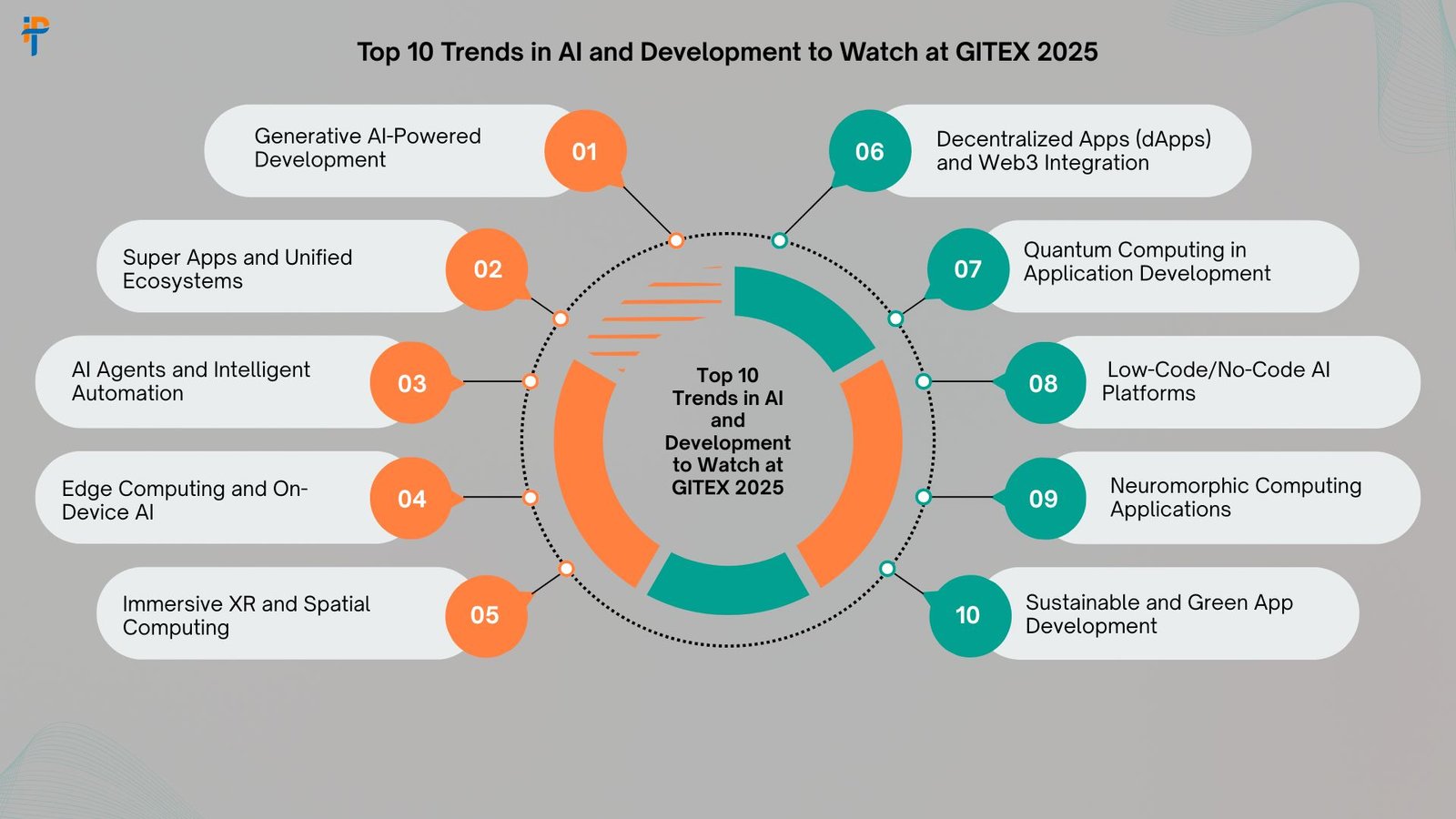
1. Generative AI-Powered Development

Generative AI has moved far beyond ChatGPT. At GITEX 2025, you’ll witness how AI is fundamentally changing software development itself. Developers are now partnering with AI assistants that write code, design user interfaces, generate test cases, and even debug applications in real-time. According to GitHub’s State of the Octoverse report, developers using AI coding assistants are 55% more productive, completing tasks up to twice as fast.

What does this mean for your business? Reduced development costs, faster time-to-market, and the ability to iterate on ideas without massive upfront investment. Imagine prototyping a new application in days instead of months—that’s the power of generative AI in development.

2. Super Apps and Unified Ecosystems

The era of single-purpose applications is ending. Super apps—comprehensive platforms that combine payments, social interaction, commerce, logistics, and entertainment—are becoming the new standard. Think of WeChat in China or Grab in Southeast Asia, but now expanding globally with even more sophisticated features.

For businesses, this trend presents a crucial decision: should you build your own super app ecosystem, or integrate your services into existing platforms? GITEX 2025 will showcase both approaches, with live demonstrations of modular architectures that make integration seamless.

3. AI Agents and Intelligent Automation

Move over, chatbots—AI agents are here. These aren’t simple rule-based systems; they’re intelligent entities that can understand context, make decisions, learn from interactions, and execute complex multi-step workflows autonomously. From scheduling meetings and managing customer inquiries to processing insurance claims and conducting financial analysis, AI agents are becoming the digital workforce of tomorrow.

The difference? Traditional automation follows scripts. AI agents adapt to situations, handle exceptions, and improve over time without human intervention.

4. Edge Computing and On-Device AI

Why send data to the cloud when you can process it right where it’s created? Edge computing brings computational power closer to data sources, dramatically reducing latency and enhancing privacy. Combined with on-device AI, this enables applications to run complex machine learning models directly on smartphones, IoT devices, and edge servers.

This trend is particularly transformative for industries requiring real-time responses: autonomous vehicles processing sensor data in milliseconds, healthcare devices analyzing patient vitals instantly, or retail systems providing personalized recommendations without internet connectivity.

5. Immersive XR and Spatial Computing

Extended Reality (XR)—encompassing augmented reality (AR), virtual reality (VR), and mixed reality (MR)—is finally crossing the chasm from experimental to essential. Apple’s Vision Pro and Meta’s Quest headsets have demonstrated that spatial computing isn’t science fiction; it’s the next computing platform.

At GITEX 2025, expect to see XR applications that go beyond gaming: virtual showrooms where customers examine products in 3D, immersive training programs that reduce workplace accidents by 70%, and collaborative workspaces where remote teams feel physically present together.

6. Decentralized Apps (dApps) and Web3 Integration

Blockchain technology has matured beyond cryptocurrency speculation. Decentralized applications (dApps) are now solving real business problems: supply chain transparency, digital identity verification, royalty distribution for creators, and transparent governance systems.

The key advantage? Trust without intermediaries. In industries plagued by fraud or requiring transparent audits—finance, healthcare, logistics, intellectual property—blockchain-based applications are becoming the preferred solution.

7. Quantum Computing in Application Development

While large-scale quantum computers remain years away from mainstream adoption, quantum-inspired algorithms are already being integrated into classical applications. These algorithms can optimize complex logistics networks, accelerate drug discovery, enhance cryptographic security, and solve problems that would take traditional computers years to process.

GITEX 2025 will feature quantum computing companies demonstrating hybrid quantum-classical systems that businesses can access via cloud services today, not tomorrow.

8. Low-Code/No-Code AI Platforms

Not every business can afford a team of data scientists and machine learning engineers. That’s where low-code and no-code AI platforms come in, democratizing artificial intelligence for non-technical users. These platforms allow business analysts, product managers, and domain experts to build sophisticated AI applications using visual interfaces and pre-trained models.

According to Gartner’s forecast, by 2026, developers outside formal IT departments will account for at least 80% of the user base for low-code development tools—a clear indication that citizen developers are becoming a force to reckon with.

9. Neuromorphic Computing Applications

Inspired by the human brain’s architecture, neuromorphic computing chips process information fundamentally differently than traditional processors. They excel at pattern recognition, sensor processing, and energy-efficient AI inference—making them ideal for edge devices, robotics, and autonomous systems.

While still emerging, companies like Intel (with Loihi chips) and IBM (with TrueNorth) are pushing neuromorphic computing from research labs into commercial applications. GITEX 2025 will showcase early adopters implementing these brain-inspired chips for real-world use cases.

10. Sustainable and Green App Development

Sustainability isn’t just a buzzword—it’s becoming a competitive requirement. Green app development focuses on energy-efficient code, carbon-aware cloud deployments, optimized data transfers, and resource-conscious architectures.

Here’s a surprising fact: data centers consume approximately 1-1.5% of global electricity, according to the International Energy Agency. As applications scale globally, their carbon footprint becomes significant. GITEX 2025 will feature tools and frameworks that help developers measure and minimize their applications’ environmental impact—turning sustainability into a measurable KPI.

App Development Trend Primary Benefit Industries Leading Adoption
Generative AI Development 55% faster development cycles Technology, Finance, Healthcare
Super Apps Unified user experience Retail, Banking, Transportation
AI Agents 70% reduction in operational costs Customer Service, Insurance, HR
Edge Computing 10x faster response times IoT, Automotive, Manufacturing
XR & Spatial Computing 40% improvement in training effectiveness Education, Real Estate, Healthcare
Web3 & dApps 100% transaction transparency Supply Chain, Finance, Media
Quantum-Inspired Algorithms Solutions to previously unsolvable problems Logistics, Pharmaceuticals, Finance
Low-Code/No-Code AI 80% faster deployment SMBs, Marketing, Operations
Neuromorphic Computing 100x energy efficiency Robotics, IoT, Autonomous Systems
Green Development 30% reduction in cloud costs All industries with ESG commitments

The Rise of AI-First Development: Transforming GITEX 2025

Why AI is No Longer Optional

Let me ask you this: would you hire an accountant who refuses to use spreadsheets? Probably not. Similarly, in 2025, building applications without AI integration is like developing software without databases—technically possible, but strategically foolish.

AI-first development means architecting applications from the ground up with artificial intelligence as a core component, not an afterthought. This approach enables applications that learn from user behavior, predict needs before they arise, automate routine decisions, and continuously improve without manual updates.

Machine Learning Infrastructure at Scale

The infrastructure powering AI has become as important as the algorithms themselves. GITEX 2025 will showcase next-generation ML infrastructure that addresses the biggest challenges organizations face: data pipeline management, model versioning, training at scale, deployment automation, and performance monitoring.

Companies like IPH Technologies have spent years building robust ML infrastructure that allows businesses to move from experimentation to production-grade AI applications in weeks instead of months.

Also Read – Top 15 Benefits of IT Staff Augmentation for Startups & Enterprises in 2025

Robotic Process Automation (RPA): Streamlining Business Processes

How RPA is Revolutionizing Operations

Robotic Process Automation has evolved from simple task automation to intelligent process orchestration. Modern RPA systems don’t just follow rules—they understand context, handle exceptions, and learn from human feedback.

Consider this scenario: A typical insurance claim requires data extraction from multiple sources, verification against policies, fraud detection screening, approval routing, and payment processing. Traditionally, this involves 5-7 different systems and multiple human touchpoints. With intelligent RPA, the entire workflow happens autonomously in minutes, with humans involved only for edge cases requiring judgment.

RPA Integration with AI and ML

The real magic happens when you combine RPA with artificial intelligence and machine learning. This creates “intelligent automation” that can:

  • Process unstructured data (emails, PDFs, images) using natural language processing
  • Make decisions based on patterns learned from historical data
  • Adapt to process variations without requiring reprogramming
  • Predict process bottlenecks and optimize workflows proactively

Real-World RPA Applications

At IPH Technologies, we’ve implemented RPA solutions across diverse industries with measurable impact:

Finance & Banking: Automated loan processing systems that reduced approval time from 5 days to 4 hours while improving accuracy by 94%.

Healthcare: Patient data reconciliation systems that process 50,000+ records daily with 99.7% accuracy, freeing clinical staff to focus on patient care.

Retail: Inventory management automation that predicts stock requirements 30 days in advance, reducing overstock by 35% and stockouts by 62%.

Manufacturing: Quality control systems that inspect products in real-time, detecting defects with 99.2% accuracy—better than human inspectors working in optimal conditions.

Beyond the Buzzwords – Real-World Impact

From Concept to Implementation

Here’s the uncomfortable truth about technology conferences: they’re often heavy on hype and light on execution. Vendors showcase impressive demos that fall apart in production. Startups promise revolutionary solutions that never ship. Consultants sell transformation without understanding your business constraints.

GITEX 2025 is different because it focuses on technologies that are production-ready today. These aren’t lab experiments or conceptual frameworks—they’re solutions being deployed at scale by real businesses solving actual problems.

Measurable Business Outcomes

Technology for technology’s sake is expensive theater. What matters are outcomes: increased revenue, reduced costs, improved customer satisfaction, faster time-to-market, and competitive advantage.

Let’s look at some real numbers from businesses that have implemented the trends we’ve discussed:

  • Generative AI: A financial services company reduced custom report generation time from 4 hours to 12 minutes—a 95% improvement.
  • Edge Computing: A logistics provider cut last-mile delivery costs by 18% through real-time route optimization processed at the edge.
  • RPA + AI: An insurance company decreased claims processing time by 67% while improving fraud detection rates by 43%.
  • XR Training: A manufacturing firm reduced workplace accidents by 52% after implementing immersive safety training.

These aren’t projections or theoretical benefits—they’re actual results achieved by businesses that moved decisively on emerging technologies.

How IPH Technologies Transforms GITEX Trends into Client Success Stories

At IPH Technologies, we’ve spent a decade turning cutting-edge trends into business-critical solutions. With over 500 successful projects, 430+ satisfied clients, and 284+ positive reviews on Clutch, we don’t just follow trends—we’ve often implemented them before they became mainstream. Let me share three examples that demonstrate our approach.

Case Study 1: Healthcare Digital Transformation

The Challenge: A regional healthcare network with 12 hospitals struggled with patient data scattered across incompatible systems. Doctors couldn’t access complete patient histories. Appointment scheduling was chaos. Lab results often got lost in administrative workflows.

Our Solution: We implemented a comprehensive AI-powered patient data platform that:

  • Unified data from 47 different legacy systems into a single, real-time view
  • Deployed natural language processing to extract insights from unstructured clinical notes
  • Created an intelligent appointment system that reduced wait times by 43%
  • Implemented edge computing for medical devices, enabling real-time vital sign monitoring
The Results:
  • Patient data access time reduced from 12 minutes to 8 seconds
  • Administrative costs decreased by 31%
  • Patient satisfaction scores improved by 38%
  • The system now processes 18000+ patient interactions daily

Case Study 2: Fintech Innovation

The Challenge: A growing fintech startup wanted to expand into Middle Eastern markets but faced regulatory compliance challenges, high transaction costs, and customer acquisition difficulties.

Our Solution: We developed a comprehensive digital banking platform featuring:

  • AI-driven KYC (Know Your Customer) automation that reduced onboarding from 3 days to 14 minutes
  • Blockchain-based transaction ledger ensuring regulatory compliance across 6 jurisdictions
  • Generative AI chatbot handling 78% of customer inquiries without human intervention
  • Predictive analytics for fraud detection, catching suspicious transactions before they complete
The Results:
  • Successfully launched in 4 new markets within 7 months
  • Transaction costs reduced by 54%
  • Customer acquisition cost dropped by 41%
  • Zero compliance violations in 18 months of operation
  • Platform now processes $120M+ in transactions monthly

Case Study 3: Retail Experience Revolution

The Challenge: A luxury retail chain with 85 stores across the GCC faced declining foot traffic, increasing customer acquisition costs, and intense competition from e-commerce giants.

Our Solution: We created an omnichannel retail experience platform combining:

  • AR-powered virtual try-on capabilities integrated with the mobile app
  • AI-driven personalized product recommendations are increasing average order value
  • Edge computing-enabled smart mirrors in fitting rooms showing complementary items
  • RPA-automated inventory management synced across online and physical channels
The Results:
  • In-store conversion rates increased by 67%
  • Average basket size grew by 52%
  • Inventory carrying costs reduced by 28%
  • Customer lifetime value increased by 91%
  • Online-to-offline traffic improved by 134%

These aren’t cherry-picked success stories—they represent our standard approach: understand the business problem, apply the right technology (whether it’s trending or not), measure results ruthlessly, and iterate until we exceed targets.

Industry-Specific Innovation Spotlight: Tailored Solutions for Your Sector

Not all industries benefit equally from every technology trend. What transforms healthcare might be irrelevant for logistics. What revolutionizes retail might not work in manufacturing. Here’s how GITEX 2025 trends apply to specific sectors:

Healthcare and Life Sciences

The healthcare industry is experiencing its most significant transformation since the introduction of electronic health records. Key technologies making impact:

AI-Powered Diagnostics: Machine learning models now detect certain cancers, cardiovascular conditions, and retinal diseases with accuracy matching or exceeding specialist physicians.

Telemedicine 2.0: Beyond simple video consultations, next-generation telehealth platforms use edge computing for real-time vital sign monitoring, AI for preliminary diagnosis, and XR for remote surgical guidance.

Drug Discovery Acceleration: Quantum-inspired algorithms and generative AI are reducing drug discovery timelines from 10+ years to 3-4 years, with significantly lower costs.

Patient Data Security: Blockchain-based health records ensure data sovereignty while enabling secure sharing across providers, solving the interoperability nightmare that has plagued healthcare for decades.

Financial Services and Fintech

Financial services are being rebuilt from first principles using technologies that enable new business models:

Embedded Finance: APIs and microservices architectures allow non-financial companies to offer banking services, creating super app ecosystems where finance becomes invisible but ubiquitous.

Real-Time Risk Assessment: Edge computing enables loan decisions in seconds, not days, by processing creditworthiness calculations at the point of application.

Fraud Detection 3.0: AI agents continuously monitor transaction patterns across millions of users, detecting sophisticated fraud schemes that traditional rule-based systems miss entirely.

Regulatory Technology (RegTech): RPA combined with AI ensures continuous compliance monitoring, automatically adapting to regulatory changes across multiple jurisdictions.

Retail and E-Commerce

Retail is being reimagined as the boundary between physical and digital experiences dissolves:

Hyper-Personalization: Generative AI creates unique shopping experiences for each customer, from personalized product recommendations to customized marketing content.

Inventory Intelligence: Machine learning predicts demand with unprecedented accuracy, reducing both overstock waste and lost sales from stockouts.

Immersive Shopping: XR technologies enable customers to visualize furniture in their homes, try on clothes virtually, or explore products in 3D before purchasing.

Sustainable Supply Chains: Blockchain provides complete transparency from raw materials to final delivery, allowing consumers to verify sustainability claims.

Logistics and Supply Chain

Supply chain disruptions during recent years proved that traditional logistics approaches are inadequate for modern complexity:

Predictive Logistics: AI analyzes weather, traffic, political events, and thousands of other variables to optimize routing and predict disruptions before they occur.

Autonomous Warehousing: Robots powered by edge computing and on-device AI handle picking, packing, and inventory management with 99.9% accuracy.

Smart Containers: IoT sensors combined with edge computing provide real-time location, condition monitoring, and predictive maintenance for shipping containers.

Blockchain Provenance: Complete supply chain visibility from manufacturer to consumer, eliminating counterfeits and ensuring authenticity.

Manufacturing and IoT

Industry 4.0 is transitioning to Industry 5.0, where humans and intelligent machines collaborate seamlessly:

Predictive Maintenance: Edge AI analyzes vibration, temperature, and sound patterns from machinery, predicting failures days or weeks before they occur.

Digital Twins: Virtual replicas of physical production lines allow manufacturers to test changes, optimize processes, and train staff in risk-free environments.

Quality Control Automation: Computer vision systems inspect products at speeds and accuracy levels impossible for human inspectors.

Energy Optimization: AI-driven systems reduce manufacturing energy consumption by 25-35% while maintaining or improving production output.

Why Connect with IPH Technologies

Our Decade of Innovation

Since our founding, IPH Technologies has been guided by a simple philosophy: technology should solve problems, not create them. Over the past ten years, we’ve developed this philosophy into a proven methodology that has delivered success across 500+ projects.

What makes us different? We don’t chase trends—we evaluate technologies based on business impact. We don’t sell solutions—we build partnerships. We don’t promise transformation—we deliver measurable results.

Our track record speaks clearly:

  • 500+ successful projects across 15 industries
  • 430+ satisfied clients ranging from startups to Fortune 500 companies
  • 284+ positive reviews on Clutch, averaging 4.9/5 stars
  • 10 years of continuous innovation and client success
  • 95% client retention rate, with most clients engaging us for multiple projects

Frequently Asked Questions (FAQs)

What is the main theme of GITEX Global 2025, and why is it significant?
GITEX Global 2025 focuses on “Powering the Future” through AI, emerging technologies, and digital transformation. It’s significant because it brings together 6,000+ companies from 170+ countries, showcasing production-ready solutions that businesses can implement immediately. Unlike typical conferences focused on theory, GITEX emphasizes practical applications with measurable business impact, particularly relevant as AI could contribute $150 billion annually to GCC economies by 2030.
How is generative AI changing application development?
Generative AI is revolutionizing development by automating code writing, UI design, testing, and debugging. According to GitHub’s research, developers using AI assistants are 55% more productive. This means businesses can prototype applications in days instead of months, significantly reducing development costs and time-to-market. At GITEX 2025, you’ll see live demonstrations of how generative AI accelerates the entire development lifecycle.
What are AI agents, and how do they differ from traditional chatbots?
AI agents are intelligent systems that understand context, make autonomous decisions, learn from interactions, and execute complex multi-step workflows without human intervention. Unlike rule-based chatbots that follow scripts, AI agents adapt to situations, handle exceptions, and improve over time. They can manage everything from customer service to insurance claims processing, typically reducing operational costs by 70% while improving accuracy and customer satisfaction.
Why should my business consider attending GITEX 2025?
GITEX 2025 offers direct access to cutting-edge technologies, live demonstrations, proof-of-concept opportunities, and partnerships that can accelerate your digital transformation. With 180,000+ expected visitors and $15+ billion in projected investment deals, it’s where businesses discover solutions, meet implementation partners, and compress months of research into five focused days. It’s particularly valuable for seeing how emerging trends apply specifically to your industry.
How does IPH Technologies help businesses implement GITEX trends?
IPH Technologies has a decade of experience transforming emerging technologies into business-critical solutions. With 500+ successful projects and a 95% client retention rate, we follow a proven methodology: understand your business problem, apply the right technology (trending or not), measure results rigorously, and iterate until we exceed targets. Our case studies show typical results including 67% faster processing times, 54% cost reductions, and 91% improvements in customer lifetime value.
What is edge computing, and why is it important for modern applications?
Edge computing processes data closer to where it’s created (on devices or local servers) rather than sending everything to distant cloud data centers. This dramatically reduces latency, enhances privacy, and enables real-time responses. It’s crucial for applications requiring instant decisions: autonomous vehicles, healthcare monitoring, retail personalization, and IoT systems. Combined with on-device AI, edge computing enables applications to function even without internet connectivity.
How can small and medium businesses benefit from AI and automation trends?
Low-code/no-code AI platforms have democratized access to artificial intelligence, allowing businesses without dedicated data science teams to build sophisticated AI applications. According to Gartner, by 2026, 80% of low-code users will be outside formal IT departments. This means SMBs can implement AI-powered customer service, predictive analytics, intelligent automation, and personalized marketing at a fraction of traditional costs—leveling the playing field with larger competitors.
What should I prepare before visiting IPH Technologies at GITEX 2025?
Come prepared with specific business challenges you’re facing, your current technology stack details, and clear objectives for what you hope to achieve. This allows our team to provide tailored recommendations during your visit. Consider scheduling a private technology assessment session in advance to ensure dedicated time with our experts. Bring decision-makers who can evaluate solutions and move forward quickly—GITEX’s compressed timeline rewards those ready to act decisively on opportunities.
Avatar
Deep Chaturvedi

Verified Process Manager

About the Author

Deep Chaturvedi is an experienced technology professional with over 12 years in software development and process management. Based in Lucknow, he currently serves as Process Manager, overseeing end-to-end project lifecycles in web, mobile, and AR app domains. Deep combines his technical background in full-stack development—including Laravel, Node.js, React, and Android—with strong skills in process optimization, quality assurance, and team leadership.


WhatsApp
Call us
Get a Call Back