
































































Highlights
UI/UX Design
User-first, visually engaging interfaces crafted to enhance usability, boost engagement, and deliver seamless digital experiences.
Branding
Strategic brand identities that communicate your vision, build trust, and create a memorable presence across all touchpoints.
Wireframing
Structured layouts and user flows that map the product journey clearly before development begins, saving time and cost.
Prototype Design
Interactive prototypes that simulate real user interactions, helping validate ideas and refine experiences early.
Design Systems
Scalable design frameworks and reusable components that ensure consistency, speed, and efficiency across your product.
UI/UX Design

We design intuitive, user-centric interfaces that enhance engagement, improve usability, and deliver seamless digital experiences across all devices.

UI UX Design
  • User research and wireframing for clear flows
  • Modern UI design using Figma and Adobe XD
  • Interactive prototypes for better user experience testing
  • Usability testing and performance optimization improvements
  • Responsive design across all devices and screens
  • Scalable design systems with reusable UI components
Branding & Identity

We craft strong brand identities that communicate your vision, build trust, and create a lasting impression across all digital and offline touchpoints.

Branding and Identity
  • Logo design and brand identity creation
  • Brand guidelines and visual consistency systems
  • Color palette and typography selection strategy
  • Marketing materials and brand asset design
  • Social media branding and creative direction
  • Rebranding and brand positioning strategies
Wireframing

We create structured wireframes that define layout, user flow, and functionality, helping visualize ideas and build a strong foundation before design and development.

Wireframing
  • Low fidelity wireframes for initial structure
  • High fidelity wireframes with detailed layouts
  • User flow mapping for better navigation
  • Content hierarchy and layout planning
  • Clickable wireframes for early feedback
  • Clear structure before UI design phase
Prototype Design

We design interactive prototypes that simulate real user experiences, helping validate ideas, test functionality, and refine products before development.

Prototype Design
  • Interactive prototypes for real user experience
  • Clickable designs to test product functionality
  • User journey simulation for better understanding
  • Rapid prototyping for faster design validation
  • Feedback driven improvements before development
  • High fidelity prototypes with smooth interactions
Design Systems

We build scalable design systems that ensure consistency, improve collaboration, and accelerate product development across all platforms and teams.

Design Systems
  • Reusable UI components for consistent design
  • Design tokens for colors typography spacing
  • Component libraries for faster development workflow
  • Consistent branding across all digital products
  • Documentation for design and development teams
  • Scalable systems for growing product ecosystems
Highlights
Mobile Apps Development
High-performance Android and iOS mobile applications built with modern technologies, delivering seamless user experiences and robust functionality.
Desktop Application Dev
Powerful and secure desktop applications tailored for Windows, macOS, and Linux, designed for performance, scalability, and reliability.
Web App Development
Scalable and responsive web applications using modern frameworks like React, Angular, and Vue for fast, dynamic, and engaging experiences.
Cross-Platform
Cost-effective cross-platform solutions using Flutter and React Native, enabling a single codebase for both iOS and Android platforms.
PWA Development
Progressive Web Apps that combine the best of web and mobile, offering offline access, fast loading, and app-like experiences directly in the browser.
Highlights
Mobile App

Android

iOS

Flutter

Hybrid

Optimize

Native

Swift

Firebase

Android App Development

We craft powerful, scalable Android applications with intuitive UX, high performance, and deep integration with Google services.

Android App
  • Custom Android app development
  • Native Kotlin & Java apps
  • Google Play Store deployment
  • Material Design UI implementation
Kotlin

Kotlin

Java

Java

Flutter

Flutter

Android Studio

Android

Jetpack

Jetpack

iOS App Development

We build high-quality, user-centric iOS apps combining performance, security, and seamless design for Apple devices.

iOS App
  • Custom iOS app development
  • Native Swift & SwiftUI apps
  • Seamless Apple service integration
  • App Store review & deployment
Swift

Swift

SwiftUI

SwiftUI

Obj-C

Obj-C

Xcode

Xcode

Flutter

Flutter

Cross-Platform Apps

We develop cross-platform mobile apps that run flawlessly on both iOS and Android from a single codebase, saving time and cost.

Cross-Platform App
  • Single codebase for iOS & Android
  • Flutter & React Native development
  • Native-like performance & UI
  • Faster time-to-market
React Native

React Native

TypeScript

TypeScript

Redux

Redux

Firebase

Firebase

Dart

Dart

Hybrid Apps

We build hybrid mobile apps that blend web technologies with native capabilities, delivering broad reach and cost-effective development.

Hybrid App
  • Web + native feature integration
  • Ionic & Cordova frameworks
  • Reduced development costs
  • Multi-platform publishing
Flutter

Flutter

Dart

Dart

Firebase

Firebase

SQLite

SQLite

App Optimization

We enhance existing mobile apps with performance tuning, crash fixes, battery efficiency, and faster load times for a superior user experience.

App Optimization
  • Performance profiling & tuning
  • Memory & battery optimization
  • Crash analysis & bug fixing
  • App size reduction & load speed
Xcode

Xcode

Android Studio

Android

Firebase

Firebase

Java

Java

Highlights
Desktop App

Windows

macOS

Linux

Desktop

Electron

Qt

WinForms

GTK

Windows Apps

We develop robust Windows desktop applications using modern Microsoft technologies, delivering powerful tools for enterprise and consumer use.

Windows App
  • Custom Windows desktop applications
  • WPF & WinForms development
  • Microsoft Store deployment
  • Windows API & system integration
C#

C#

.NET

.NET

Electron

Electron

Visual Studio

Visual Studio

SQL Server

SQL Server

macOS Apps

We create elegant, high-performance macOS applications that leverage Apple's native frameworks for a smooth and delightful desktop experience.

macOS App
  • Native macOS app development
  • SwiftUI & AppKit integration
  • Mac App Store submission
  • Apple Silicon optimization
Swift

Swift

SwiftUI

SwiftUI

Obj-C

Obj-C

Xcode

Xcode

Cross-Platform Desktop

We develop cross-platform desktop applications that run seamlessly on Windows, macOS, and Linux from a single shared codebase.

Cross-Platform Desktop
  • Single codebase for all platforms
  • Electron & Tauri frameworks
  • Flutter for desktop support
  • Consistent UI across OS environments
Flutter

Flutter

Electron

Electron

Node.js

Node.js

TypeScript

TypeScript

Docker

Docker

Electron Apps

We build feature-rich Electron desktop apps using web technologies, enabling cross-platform deployment with native OS capabilities.

Electron App
  • Electron framework development
  • Node.js & Chromium integration
  • Auto-updater & native notifications
  • Cross-OS packaging & distribution
Electron

Electron

Node.js

Node.js

React

React

Vue

Vue

TypeScript

TypeScript

Highlights
Web App

React

Node.js

PHP

Laravel

Python

MySQL

JavaScript

HTML

CSS

React Development

We build fast, component-driven React web applications with modern state management, reusable UI, and seamless API integration.

React Development
  • Custom React SPA development
  • Redux & Context API state management
  • Next.js SSR & SSG support
  • REST & GraphQL API integration
React

React

Next.js

Next.js

Redux

Redux

TypeScript

TypeScript

Tailwind

Tailwind

Angular Development

We develop enterprise-grade Angular applications with structured architecture, two-way data binding, and robust TypeScript foundations.

Angular Development
  • Custom Angular SPA development
  • RxJS & NgRx state management
  • Angular Material UI components
  • Lazy loading & performance tuning
Angular

Angular

TypeScript

TypeScript

HTML

HTML

CSS

CSS

NPM

NPM

Node.js Backend

We build scalable, event-driven Node.js backends with RESTful APIs, real-time capabilities, and seamless database integrations.

Node.js Backend
  • RESTful & GraphQL API development
  • Express.js & Fastify frameworks
  • WebSocket & real-time features
  • MongoDB, PostgreSQL integration
Node.js

Node.js

Express

Express

MongoDB

MongoDB

GraphQL

GraphQL

Docker

Docker

Cloud Web Apps

We design and deploy cloud-native web applications on AWS, Azure, and GCP — scalable, secure, and built for high availability.

Cloud Web Apps
  • AWS, Azure & GCP deployment
  • Serverless architecture development
  • Auto-scaling & load balancing
  • CI/CD pipeline configuration
AWS

AWS

Azure

Azure

GCP

GCP

Docker

Docker

Kubernetes

Kubernetes

Full-Stack Dev

We deliver complete full-stack web solutions — from pixel-perfect frontends to robust backends — as a unified, end-to-end product.

Full-Stack Dev
  • Frontend & backend development
  • MERN & MEAN stack expertise
  • Database design & API architecture
  • DevOps, hosting & deployment
React

React

Node.js

Node.js

MongoDB

MongoDB

PostgreSQL

PostgreSQL

Docker

Docker

Highlights
Cross Platform

Flutter

R. Native

Xamarin

Ionic

Reuse

Electron

NW.js

Framework7

SwiftUI

Flutter Development

We build beautiful, natively compiled Flutter applications for mobile, web, and desktop from a single Dart codebase with pixel-perfect UI.

Flutter Development
  • Flutter mobile & web apps
  • Dart language development
  • Custom widget & animation creation
  • Firebase & REST API integration
Flutter

Flutter

Dart

Dart

Firebase

Firebase

GetX

GetX

Riverpod

Riverpod

React Native

We develop high-performance React Native apps that deliver a truly native experience on both iOS and Android using JavaScript and React.

React Native
  • Cross-platform iOS & Android apps
  • React Native CLI & Expo development
  • Native module & bridge integration
  • Redux & MobX state management
React Native

React Native

Redux

Redux

TypeScript

TypeScript

Firebase

Firebase

Xamarin

We develop Xamarin-based cross-platform apps using C# and .NET, enabling shared business logic across iOS, Android, and Windows.

Xamarin
  • Xamarin.Forms & MAUI apps
  • Shared C# codebase development
  • Native API access via bindings
  • Enterprise app integration
Xamarin

Xamarin

C#

C#

.NET MAUI

.NET

Azure

Azure

Visual Studio

Visual Studio

Ionic Framework

We create stunning Ionic applications that combine the power of web technologies with native device features for a seamless mobile experience.

Ionic Framework
  • Ionic Angular & React apps
  • Capacitor native plugin integration
  • Responsive mobile-first UI
  • PWA & hybrid app deployment
Ionic

Ionic

Angular

Angular

React

React

Vue

Vue

Code Reusability

We build reusable app architectures, reducing duplication, accelerating development, and ensuring seamless cross-platform consistency.

Code Reusability
  • Shared component library creation
  • Monorepo architecture setup
  • Design system implementation
  • Platform-agnostic business logic
Turborepo

Turborepo

Storybook

Storybook

Flutter

Flutter

React Native

React Native

Highlights
PWA

PWA

Offline

Push

Fast

App-Like

IndexedDB

Installable

Sync

Progressive Web Apps

We build Progressive Web Apps that combine the best of web and mobile — installable, reliable, and fast across all devices and browsers.

Progressive Web Apps
  • PWA architecture & manifest setup
  • Service worker implementation
  • Installable & home screen support
  • Cross-browser compatibility
HTML5

HTML5

CSS3

CSS3

JavaScript

JavaScript

Workbox

Workbox

Lighthouse

Lighthouse

Offline Support

We implement robust offline capabilities in your web apps using service workers and smart caching so users stay productive without connectivity.

Offline Support
  • Service worker caching strategies
  • IndexedDB offline data storage
  • Background sync implementation
  • Graceful offline fallback pages
Service Worker

ServiceWorker

Workbox

Workbox

IndexedDB

IndexedDB

Cache API

Cache API

Background Sync

BackgroundSync

Push Notifications

We integrate web push notification systems into your PWA to re-engage users with timely, personalized alerts even when the app is not open.

Push Notifications
  • Web Push API implementation
  • VAPID key & subscription management
  • Notification scheduling & targeting
  • Cross-browser push support
Web Push

Web Push

Firebase FCM

Firebase

OneSignal

OneSignal

Node.js

Node.js

Workbox

Workbox

Fast Loading

We optimize PWAs for lightning-fast load times using code splitting, lazy loading, and caching to deliver exceptional Core Web Vitals scores.

Fast Loading
  • Code splitting & lazy loading
  • Image & asset optimization
  • Core Web Vitals improvement
  • CDN & caching configuration
Webpack

Webpack

Lighthouse

Lighthouse

Vite

Vite

Cloudflare

Cloudflare

Workbox

Workbox

App-Like Experience

We craft PWAs that feel and behave like native mobile apps — with smooth animations, full-screen mode, gestures, and seamless transitions.

App-Like Experience
  • Full-screen & standalone display mode
  • Touch gestures & swipe navigation
  • Smooth page transitions & animations
  • App shell architecture
Web Manifest

Web Manifest

CSS Animations

CSS

Framer Motion

FramerMotion

React

React

Vue

Vue

Highlights
Custom Software
Fully tailored software solutions designed to match your unique business processes, improving efficiency and driving long-term growth.
Backend Systems
Robust and secure backend architectures built for high performance, scalability, and seamless integration with your applications.
Database Design
Efficient and scalable database structures optimized for fast queries, data integrity, and reliable performance at scale.
Cloud-Native
Modern cloud-native solutions using microservices and serverless architecture on AWS, Azure, and GCP for maximum flexibility and scalability.
API Development
Secure and well-documented RESTful and GraphQL APIs that enable seamless communication between systems and third-party integrations.
Custom Software

We develop tailored software solutions that align with your business goals, streamline operations, and deliver scalable, high-performance digital systems.

Custom Software Development
  • Custom software tailored to business needs
  • Scalable architecture for long term growth
  • Secure and high performance application development
  • API integration with third party services
  • Cloud based and enterprise software solutions
  • Ongoing maintenance and system optimization support
Backend Systems

We build robust backend systems that power applications with secure, scalable architecture, efficient data handling, and seamless integrations.

Backend Systems
  • Secure backend architecture and system design
  • Database design and performance optimization
  • API development for seamless integrations
  • Authentication and authorization system implementation
  • Server side logic and business workflows
  • Scalable infrastructure for high traffic applications
Database Design

We design efficient database structures that ensure data integrity, optimize performance, and support scalable, reliable application systems.

Database Design
  • Structured database schema design and planning
  • Efficient data modeling for scalable systems
  • Database optimization for faster query performance
  • Relational and non relational database solutions
  • Secure data storage and access management
  • Backup strategies and data recovery solutions
Cloud-Native Apps

We build cloud-native applications designed for scalability, resilience, and flexibility using modern cloud infrastructure and microservices architecture.

Cloud Native Apps
  • Cloud first architecture for scalable applications
  • Microservices based system design and deployment
  • Containerization using Docker and Kubernetes tools
  • Auto scaling infrastructure for high availability
  • Continuous integration and continuous deployment pipelines
  • Secure cloud environments with monitoring and logging
API Development

We develop secure and scalable APIs that enable seamless communication between systems, applications, and third party services.

API Development
  • RESTful API development for web applications
  • Secure API authentication and authorization systems
  • Third party API integration and data exchange
  • Scalable APIs for high traffic applications
  • API documentation for easy developer integration
  • Performance optimization and API response tuning
Highlights
Manual Testing
Detailed human-driven testing to uncover edge cases, validate user flows, and ensure a seamless, intuitive user experience.
Test Automation
Automated testing frameworks using Selenium, Cypress, and Appium to accelerate regression cycles and improve release confidence.
Performance
Load, stress, and scalability testing to ensure your application performs reliably under high traffic and demanding conditions.
Security Testing
Comprehensive security assessments including penetration testing and vulnerability analysis to safeguard your application.
Mobile QA
End-to-end mobile application testing across devices and platforms to ensure consistent performance, usability, and stability.
Manual Testing

We perform detailed manual testing to ensure software quality, identify issues early, and deliver reliable, user-friendly applications.

Manual Testing
  • Functional testing for application core features
  • UI testing for consistent user experience
  • Cross browser and device compatibility testing
  • Test case creation and execution processes
  • Bug tracking and detailed issue reporting
  • Regression testing after feature updates
Test Automation

We implement automated testing solutions to improve efficiency, reduce manual effort, and ensure faster, reliable software delivery.

Test Automation
  • Automated test scripts for faster execution
  • Regression testing using automation frameworks
  • Continuous testing within CI CD pipelines
  • Test coverage improvement across application modules
  • Reusable automation scripts for long term scalability
  • Performance and load testing automation solutions
Performance Testing

We evaluate application performance to ensure speed, stability, and scalability under different workloads and real-world conditions.

Performance Testing
  • Load testing for high traffic scenarios
  • Stress testing to identify system limits
  • Performance benchmarking and response time analysis
  • Scalability testing for growing user demands
  • Memory and resource usage optimization checks
  • Bottleneck identification and performance improvements
Security Testing

We identify vulnerabilities and secure applications against threats, ensuring data protection, compliance, and safe user interactions.

Security Testing
  • Vulnerability assessment and risk analysis testing
  • Penetration testing to identify security gaps
  • Authentication and authorization security validation
  • Data protection and encryption testing processes
  • Secure code review and security best practices
  • Compliance testing with industry security standards
Mobile QA

We ensure mobile applications deliver flawless performance, usability, and compatibility across devices, platforms, and environments.

Mobile QA
  • Mobile app testing across multiple devices
  • iOS and Android platform compatibility testing
  • UI testing for consistent mobile experience
  • Network and performance testing on mobile
  • App usability and user experience validation
  • App store readiness and release testing
Highlights
CI/CD Pipelines
Automated pipelines for building, testing, and deploying code, enabling faster releases, fewer errors, and continuous delivery.
Infrastructure
Scalable infrastructure provisioning using Infrastructure as Code (IaC) with Terraform and CloudFormation for consistency and reliability.
Deployment
Zero-downtime deployment strategies including blue-green and rolling deployments to ensure smooth and reliable releases.
Containerisation
Container-based architectures using Docker and Kubernetes for portability, scalability, and efficient resource utilization.
Monitoring
Real-time monitoring and observability using tools like Grafana, Prometheus, and Datadog to ensure system health and performance.
CI/CD Pipelines

We implement CI/CD pipelines to automate build, testing, and deployment, enabling faster releases, improved quality, and continuous delivery.

CI CD Pipelines
  • Automated build and deployment pipeline setup
  • Continuous integration for faster code validation
  • Continuous delivery for seamless release cycles
  • Integration with Git version control systems
  • Automated testing within CI CD workflows
  • Monitoring and rollback strategies for deployments
Infrastructure

We design and manage reliable infrastructure to ensure scalability, security, and high availability for modern applications and systems.

Infrastructure
  • Cloud infrastructure setup and configuration services
  • Server management and deployment automation solutions
  • High availability and load balancing implementation
  • Monitoring and logging for system performance tracking
  • Security hardening and infrastructure access controls
  • Scalable environments for growing application demands
Deployment

We manage seamless deployment processes to ensure applications are delivered efficiently, securely, and ready for production environments.

Deployment
  • Application deployment to cloud and servers
  • Automated deployment workflows for faster releases
  • Environment configuration and setup management
  • Version control and release management processes
  • Rollback strategies for safe deployment updates
  • Post deployment monitoring and performance checks
Containerization

We use containerization to package applications for consistency, scalability, and efficient deployment across different environments.

Containerization
  • Application containerization using Docker technologies
  • Environment consistency across development and production
  • Container orchestration with Kubernetes platforms
  • Scalable container deployment for microservices architecture
  • Efficient resource utilization and system isolation
  • Integration with CI CD pipelines for automation
Monitoring

We monitor systems and applications in real time to ensure performance, reliability, and quick issue detection and resolution.

Monitoring
  • Real time system performance monitoring tools
  • Application health checks and uptime tracking
  • Error tracking and issue alerting systems
  • Log management and analysis for debugging
  • Resource usage monitoring across infrastructure layers
  • Proactive issue detection and incident response
Highlights
Roadmap Planning
Strategic product roadmaps aligned with business goals, helping prioritize features, manage timelines, and deliver maximum value.
Team Coordination
Efficient coordination across design, development, and QA teams to ensure smooth collaboration and on-time project delivery.
Growth Strategy
Data-driven product strategies focused on user acquisition, retention, and continuous improvement to drive sustainable growth.
Agile Sprints
Agile methodologies like Scrum and Kanban to deliver iterative releases, improve flexibility, and maintain predictable progress.
Stakeholder Mgmt
Clear communication and alignment with stakeholders through regular updates, reporting, and feedback loops to ensure project success.
Roadmap Planning

We create strategic roadmaps that align with your business goals, helping prioritize features, plan execution, and ensure long-term success.

Roadmap Planning
  • Product roadmap planning aligned with business objectives
  • Feature prioritization based on user and market needs
  • Timeline planning for efficient project execution phases
  • Technology stack selection for scalable solutions
  • Risk assessment and mitigation strategy planning
  • Continuous roadmap updates based on performance insights
Team Coordination

We ensure smooth collaboration across teams to improve productivity, streamline workflows, and deliver projects efficiently on time.

Team Coordination
  • Cross functional team collaboration and communication
  • Agile workflow management and sprint planning processes
  • Task tracking and project progress visibility tools
  • Clear role assignment and responsibility management
  • Regular updates and performance review meetings
  • Efficient coordination between design development teams
Growth Strategy

We develop data-driven growth strategies to scale your business, increase user acquisition, and maximize long-term revenue potential.

Growth Strategy
  • Market analysis and competitive growth planning strategies
  • User acquisition and retention optimization techniques
  • Data driven decision making and performance insights
  • Scalable business models for long term expansion
  • Conversion rate optimization across digital platforms
  • Continuous growth tracking and strategy refinement
Agile Sprints

We follow agile sprint methodologies to deliver faster iterations, improve collaboration, and ensure continuous product improvement.

Agile Sprints
  • Sprint planning and backlog prioritization processes
  • Daily standups for team alignment and progress tracking
  • Iterative development with continuous feedback cycles
  • Task management using agile tools and workflows
  • Regular sprint reviews and performance retrospectives
  • Faster delivery with incremental feature releases
Stakeholder Management

We ensure clear communication and alignment with stakeholders to drive project success, transparency, and informed decision making.

Stakeholder Management
  • Regular stakeholder communication and reporting processes
  • Requirement alignment with business goals and expectations
  • Feedback collection and continuous improvement strategies
  • Transparent project updates and progress visibility
  • Risk identification and stakeholder expectation management
  • Collaborative decision making for project success

Introduction: Why MVPs Matter in Fintech

Have you ever wondered why 90% of fintech startups fail within their first year? The answer often lies in overbuilding before validating. In the competitive world of digital lending, launching with a Minimum Viable Product (MVP) isn’t just smart—it’s essential for survival. Think of it like testing the waters before diving into the deep end of the pool.

The fintech lending market is experiencing unprecedented growth, with digital lending platforms expected to reach a market value of $20.5 billion by 2026. Yet, many entrepreneurs make the costly mistake of trying to build the perfect lending app from day one, burning through capital before proving their concept works. That’s where an MVP for loan lending apps becomes your secret weapon—allowing you to validate your innovative lending solution without breaking the bank.

Understanding MVP in the Context of Loan Lending Apps

What Makes a Lending App MVP Different

Creating an MVP for loan lending apps isn’t like building a simple e-commerce platform. You’re dealing with people’s financial lives, regulatory requirements, and the need for robust security from day one. It’s like building a house—you need a solid foundation even if you’re starting with just the essential rooms.

The unique challenge of lending app MVPs lies in balancing minimal features with mandatory compliance and security requirements. Unlike other apps where you can launch with basic functionality, lending apps must incorporate certain non-negotiable elements like secure data handling, basic credit assessment capabilities, and regulatory compliance features. These requirements make the MVP development process more complex but also more crucial for long-term success.

Core vs. Nice-to-Have Features

When developing your MVP for loan lending apps, distinguishing between essential and optional features can make or break your budget. Core features are those without which your lending app simply cannot function or meet basic user expectations. Nice-to-have features, while potentially valuable, can wait until you’ve validated your core concept and secured additional funding.

The key is understanding what your target users absolutely need versus what would merely delight them. For instance, while AI-powered credit scoring might sound impressive, a simpler rule-based system might suffice for your MVP phase. Remember, you’re not trying to compete with established players feature-for-feature; you’re trying to prove your unique value proposition works.

Also Read – AI App Development Cost in 2025: From MVPs to Full-Scale Solutions

Essential Features for Your Lending App MVP
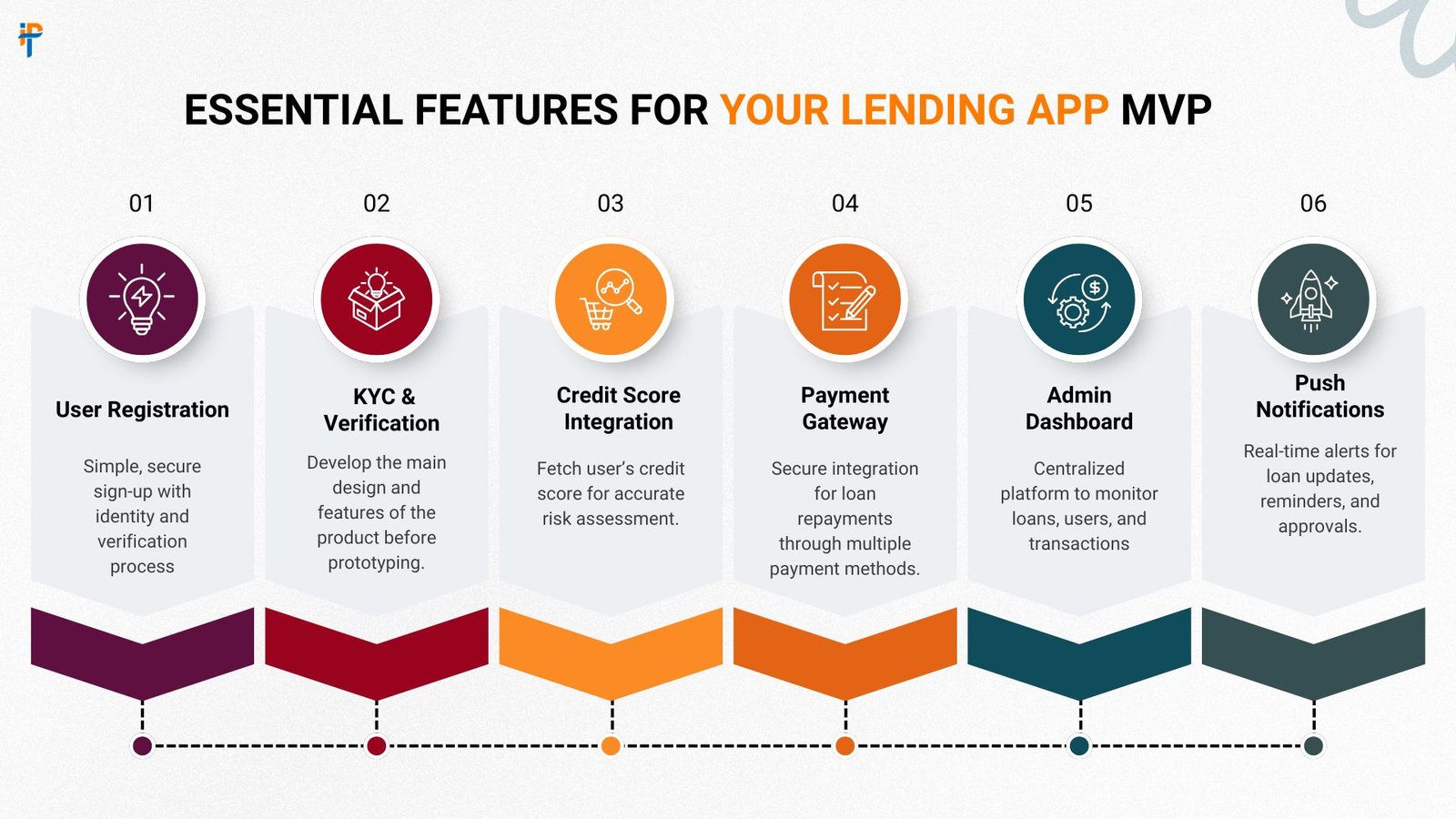
User Authentication and KYC

Security isn’t optional when you’re handling financial transactions. Your MVP must include robust user authentication and Know Your Customer (KYC) processes. This doesn’t mean building everything from scratch—leveraging third-party identity verification services can save months of development time and thousands of dollars.

Modern KYC solutions offer API integrations that can verify user identities within seconds, checking government databases, validating documents, and even performing facial recognition. By incorporating these pre-built solutions, you’re not just saving money; you’re also ensuring compliance with anti-money laundering (AML) regulations from the start. Think of it as renting a security system instead of building your own from scratch—equally effective but far more affordable.

Loan Application Process

The loan application flow is the heart of your MVP for loan lending apps. This process needs to be intuitive enough that users can complete it without assistance, yet comprehensive enough to gather all necessary information for credit decisions. Start with a streamlined application that captures essential data: personal information, employment details, loan amount, and purpose.

Consider implementing a progressive disclosure approach—asking for information in stages rather than overwhelming users with a lengthy form upfront. This approach not only improves user experience but also allows you to capture partial data from users who might abandon a longer form. Every abandoned application is a learning opportunity, telling you where your process might be too complex or demanding.

Credit Assessment Engine

Your credit assessment capability doesn’t need to rival sophisticated machine learning models used by major banks—at least not initially. For your MVP, focus on creating a reliable, rule-based scoring system that can make consistent lending decisions based on key criteria. This might include credit score thresholds, debt-to-income ratios, and employment verification.

Many successful lending app MVPs start with conservative lending criteria, approving only the most qualified applicants. This approach minimizes risk while you gather data to refine your credit models. As you accumulate performance data on your loans, you can gradually sophisticate your assessment criteria, potentially incorporating alternative data sources or more complex algorithms.

Payment Processing System

The ability to disburse loans and collect repayments is fundamental to any lending operation. Your MVP should include integrated payment processing that supports both ACH transfers for loan disbursement and automated repayment collection. This is another area where third-party services can dramatically reduce development complexity and costs.

Technical Architecture for Cost-Effective Development

Choosing the Right Tech Stack

Your technology choices can significantly impact both initial development costs and long-term scalability. For an MVP for loan lending apps, consider using established frameworks and languages that offer extensive libraries and community support. Popular choices include Node.js or Python for backend development, React Native or Flutter for cross-platform mobile apps, and PostgreSQL or MongoDB for databases.

The beauty of modern development

frameworks is their modularity—you can start simple and add complexity as needed. Don’t feel pressured to use cutting-edge technology just because it’s trendy. Sometimes, boring technology choices are the smartest ones, offering stability, extensive documentation, and a large pool of developers who can work with them.

Cloud Infrastructure Options

Cloud platforms have revolutionized how startups can launch technology products affordably. Services like AWS, Google Cloud, or Microsoft Azure offer pay-as-you-go pricing models perfect for MVPs with uncertain initial traffic. You might spend just hundreds of dollars monthly during your early stages, scaling up infrastructure only as your user base grows.

Consider using Platform-as-a-Service (PaaS) solutions like Heroku or Google App Engine for even simpler deployment and management. These platforms handle much of the infrastructure complexity, letting you focus on building features rather than managing servers. It’s like the difference between buying a car and using a ride-sharing service—both get you where you need to go, but one requires significantly less upfront investment and maintenance.

Third-Party Integrations vs. Custom Development

The build-versus-buy decision is crucial when developing your MVP for loan lending apps. Modern fintech infrastructure providers offer plug-and-play solutions for everything from identity verification to payment processing, credit bureau integration, and even loan management systems. These services typically charge on a per-transaction basis, making them extremely cost-effective for early-stage startups.

Build vs. Buy Comparison for Key Features

Feature Custom Build Cost Third-Party Solution Cost Time to Implement (Custom) Time to Implement (Third-Party)
KYC/Identity Verification $50,000-$100,000 $0.50-$3 per verification 3-6 months 1-2 weeks
Payment Processing $30,000-$75,000 2.9% + $0.30 per transaction 2-4 months 3-5 days
Credit Bureau Integration $25,000-$50,000 $0.25-$1 per credit pull 2-3 months 1 week
SMS/Email Notifications $5,000-$15,000 $0.01-$0.10 per message 2-3 weeks 1-2 days
Document Storage/Management $20,000-$40,000 $0.02-$0.10 per GB 1-2 months 3-5 days

Regulatory Compliance on a Budget

Essential Compliance Requirements

Navigating the regulatory landscape is perhaps the most daunting aspect of launching a lending app. Depending on your location and target market, you’ll need to comply with various regulations including Truth in Lending Act (TILA), Fair Credit Reporting Act (FCRA), and state-specific lending laws. Don’t let this overwhelm you—many successful lending startups began by focusing on a single state or working with lending partners who already hold necessary licenses.

The key is understanding which regulations apply to your specific model. Are you originating loans directly, or are you connecting borrowers with lenders? Different models have different regulatory requirements, and choosing the right approach can significantly impact your compliance costs and timeline to market.

Cost-Effective Compliance Strategies

Instead of trying to obtain lending licenses in multiple states immediately, consider partnering with licensed lenders or using a loan brokering model for your MVP. This approach, often called the “marketplace model,” allows you to validate your technology and user acquisition strategies without the heavy regulatory burden of direct lending.

Another strategy is to start in states with more favorable lending regulations. Some states have more straightforward licensing processes and lower regulatory barriers, making them ideal testing grounds for your MVP. Once you’ve proven your model in these initial markets, you can use your traction and revenue to fund expansion into more regulated territories.

Also Read – How to Patent a Mobile App: Step-by-Step Legal Guide

Building Your MVP: Step-by-Step Process

Market Research and Validation

Before writing a single line of code, invest time in understanding your target market deeply. Who are your ideal borrowers? What pain points do existing lending solutions fail to address? Conduct surveys, interviews, and analyze competitor offerings to identify gaps in the market. This research phase might feel slow, but it’s like aiming before shooting—it dramatically increases your chances of hitting the target.

Create user personas that represent your different customer segments. Are you targeting young professionals needing emergency funds, small business owners seeking working capital, or students looking for education loans? Each segment has unique needs, and your MVP should focus on serving one segment exceptionally well rather than trying to please everyone moderately.

Prototype Development

Start with low-fidelity prototypes—even paper sketches or simple wireframes can help validate your user flow before investing in development. Tools like Figma or Adobe XD allow you to create interactive prototypes that feel like real apps without any coding. Use these prototypes to gather feedback from potential users, iterating on your design before committing to development.

When you’re ready to build, consider using a phased approach. Begin with a web application before developing native mobile apps—web apps are generally faster and cheaper to develop and update. You can always add mobile apps once you’ve validated demand and refined your user experience.

Testing and Iteration

Testing your MVP for loan lending apps isn’t just about finding bugs—it’s about validating your entire business hypothesis. Start with a small beta group, perhaps 50-100 users, and closely monitor their behavior. Are they completing loan applications? What’s causing drop-offs? How long does it take them to complete key tasks?

Implement comprehensive analytics from day one. Tools like Mixpanel or Amplitude can track user behavior in detail, providing insights that guide your iteration process. Remember, your MVP is a learning tool—every user interaction teaches you something about what works and what doesn’t.

Cost Breakdown and Budget Planning

Let’s talk numbers—because understanding costs upfront can save you from painful surprises later. Developing an MVP for loan lending apps typically requires an investment between $50,000 and $200,000, depending on your approach and feature complexity. This might sound daunting, but remember, this is significantly less than the millions traditional financial institutions spend on technology development.

Typical MVP Development Cost Breakdown

Category Low-End Estimate High-End Estimate Percentage of Total Budget
Development Team (3-6 months) $30,000 $100,000 40-50%
Third-Party Service Integration $5,000 $15,000 5-10%
Compliance and Legal $10,000 $35,000 15-20%
Cloud Infrastructure (6 months) $1,000 $5,000 2-3%
Design and UX $5,000 $20,000 8-12%
Marketing and User Acquisition $5,000 $25,000 10-15%
Security Audits and Testing $3,000 $10,000 5-7%
Contingency Fund $5,000 $15,000 10%

Monetization Strategies for Early Stage

Your MVP needs a clear path to revenue, even if profitability isn’t immediate. The most straightforward monetization model for lending apps is the interest rate spread—charging borrowers a higher rate than your cost of capital. However, during the MVP phase, consider additional revenue streams like origination fees, late payment fees, or premium features for faster loan processing.

Some successful lending app MVPs have started with a freemium model, offering basic loan matching services for free while charging for premium features like instant approval or lower rates. This approach can help you build a user base quickly while still generating some revenue to reinvest in product development.

User Acquisition and Growth Hacking

Acquiring your first users is often the hardest challenge for any MVP. For loan lending apps, trust is paramount—people need to feel confident sharing their financial information with a new platform. Start by leveraging your personal network and targeting communities where you have credibility. Online communities, professional associations, and social media groups can be goldmines for early adopters.

Consider implementing a referral program from day one. Financial services have some of the highest customer lifetime values, justifying generous referral bonuses. Dropbox famously grew through referrals, and many successful lending apps have followed suit, offering cash bonuses or rate discounts for successful referrals.

Common Pitfalls to Avoid

The road to launching an MVP for loan lending apps is littered with potential pitfalls. One of the biggest mistakes is over-engineering your solution before validating market demand. Just because you can build a feature doesn’t mean you should—at least not in your MVP. Stay laser-focused on your core value proposition and resist the temptation to add “just one more feature.”

Another common error is underestimating the importance of user experience. While your MVP doesn’t need to be perfect, it needs to be good enough that users can complete their intended tasks without frustration. A clunky interface or confusing flow can kill your validation efforts before you truly test your business model.

Don’t neglect security and compliance, even in your eagerness to launch quickly. A data breach or regulatory violation can destroy your startup before it really begins. Build security and compliance into your development process from the start, rather than treating them as afterthoughts.

Scaling from MVP to Full Product

Success with your MVP is just the beginning of your journey. As you validate your concept and start generating revenue, you’ll need to plan for scaling. This doesn’t mean immediately adding every feature on your wishlist—it means strategically expanding based on user feedback and data-driven insights.

Your scaling strategy should focus on three key areas: technology infrastructure, team building, and geographic expansion. On the technology front, you might need to refactor some of your MVP’s quick-and-dirty solutions to handle increased load. Team-wise, you’ll likely need to hire specialists in areas like risk management, compliance, and customer service. Geographic expansion should be methodical, moving into new markets only after establishing strong operations in your initial territory.

Case Studies and Success Stories

Looking at successful examples can provide valuable insights for your own MVP journey. Companies like Affirm started with a focused MVP targeting specific e-commerce partnerships before expanding into a full-featured lending platform. Their initial product was remarkably simple—offering point-of-sale loans for online purchases—but it proved the concept and attracted both users and investors.

Another inspiring example is Kabbage, which began by focusing exclusively on small business loans using innovative data sources for credit decisions. Their MVP leveraged existing business data from platforms like QuickBooks and eBay to make rapid lending decisions, proving that alternative credit scoring methods could work. This focused approach helped them raise funding and eventually led to their acquisition by American Express for a reported $850 million.

Case Studies and Success Stories

Looking at successful examples can provide valuable insights for your own MVP journey. Companies like Affirm started with a focused MVP targeting specific e-commerce partnerships before expanding into a full-featured lending platform. Their initial product was remarkably simple—offering point-of-sale loans for online purchases—but it proved the concept and attracted both users and investors.

Another inspiring example is Kabbage, which began by focusing exclusively on small business loans using innovative data sources for credit decisions. Their MVP leveraged existing business data from platforms like QuickBooks and eBay to make rapid lending decisions, proving that alternative credit scoring methods could work. This focused approach helped them raise funding and eventually led to their acquisition by American Express for a reported $850 million.

Future-Proofing Your Lending App

While your MVP should focus on immediate validation, it’s wise to consider future trends in fintech and digital lending. Artificial intelligence and machine learning are becoming increasingly important for credit decisioning and fraud detection. Building your MVP with modular architecture allows you to incorporate these advanced technologies as you scale.

Open banking regulations are creating new opportunities for lending apps to access customer financial data with consent. Consider how your MVP might leverage these capabilities in the future, even if you don’t implement them initially.

Blockchain technology and decentralized finance (DeFi) are also emerging trends worth monitoring, though they may not be suitable for your MVP stage.

Measuring Success: KPIs and Metrics

You can’t improve what you don’t measure, and this is especially true for lending app MVPs. Key performance indicators should span the entire user journey, from acquisition to repayment. Critical metrics include application completion rate, approval rate, default rate, customer acquisition cost (CAC), and lifetime value (LTV).

During your MVP phase, focus on leading indicators that predict long-term success rather than just vanity metrics. For instance, user engagement and repeat usage might be more important than total downloads. The speed at which users complete loan applications and their likelihood to recommend your service (Net Promoter Score) can indicate product-market fit better than raw user numbers.

Track cohort performance religiously—understanding how different user groups behave over time helps you refine your credit models and marketing strategies. Modern analytics tools make it easier than ever to segment users and track their journey through your lending funnel, providing insights that guide both product development and business strategy.

Also Read- How Much Does It Cost to Hire an App Developer in Dubai 2025

Conclusion

Launching an MVP for loan lending apps is a challenging but rewarding journey that requires careful balance between speed and compliance, innovation and reliability. By focusing on core features, leveraging third-party services, and maintaining a laser focus on user validation, you can bring your lending app to market affordably while minimizing risk.

Remember, your MVP isn’t meant to be perfect—it’s meant to be good enough to test your hypotheses and learn from real users. Every successful lending platform started somewhere, often with far fewer features and resources than they have today. What matters is starting, learning, and iterating based on real market feedback.

The digital lending revolution is still in its early stages, with enormous opportunities for innovative solutions that address underserved markets or offer better user experiences. By following the strategies outlined in this guide, you’re positioning yourself to validate your idea efficiently, attract investors, and build a sustainable lending business that makes a real difference in people’s financial lives.

Your MVP for loan lending apps is more than just a product—it’s a learning laboratory that will teach you invaluable lessons about your market, your users, and your business model. Embrace the journey, stay focused on your core mission, and remember that today’s simple MVP could be tomorrow’s fintech unicorn.

FAQ

How long does it typically take to develop an MVP for a loan lending app?
Developing an MVP for loan lending apps typically takes between 3 to 6 months, depending on the complexity of features and whether you’re using third-party services or building custom solutions. Using pre-built integrations and focusing on core features can reduce this timeline to as little as 2-3 months, while more complex, custom-built solutions might extend development to 8-9 months.
Can I launch a lending app MVP without a lending license?
Yes, you can launch without a direct lending license by operating as a loan broker or marketplace that connects borrowers with licensed lenders. This model allows you to validate your technology and user acquisition strategies without the regulatory burden of direct lending. Many successful platforms like LendingTree and Credit Karma started this way before expanding into direct lending.
What's the minimum budget needed to create a viable lending app MVP?
While costs vary significantly based on your approach and location, a basic but viable MVP for loan lending apps can be developed with $50,000-$75,000. This assumes heavy use of third-party services, a small development team, and launching in a single market. However, having a buffer of at least $100,000 is recommended to cover unexpected costs and initial marketing expenses.
Should I build for web or mobile first?
Starting with a responsive web application is generally more cost-effective and faster to iterate than building native mobile apps. Web apps can be accessed from any device, are easier to update, and don’t require app store approval processes. Once you’ve validated your concept and have steady revenue, you can invest in native mobile apps for better user experience and engagement.
How do I compete with established lending apps as a new MVP?
Don’t try to compete on features—compete on focus. Established players serve broad markets, but they often underserve specific niches. Your MVP should target a specific customer segment with a unique value proposition, whether that’s faster approval, better rates for certain professions, or serving customers that traditional lenders overlook. Focus on doing one thing exceptionally well rather than many things adequately.
What are the most critical security features for a lending app MVP?
Essential security features include end-to-end encryption for data transmission, secure data storage with encryption at rest, multi-factor authentication, PCI DSS compliance for payment processing, and regular security audits. While you don’t need military-grade security from day one, you must protect user financial data adequately to maintain trust and avoid regulatory penalties.
How many users do I need to validate my lending app concept?
Quality matters more than quantity when validating your MVP. Having 100-500 engaged users who complete the entire loan cycle provides better validation than thousands of downloads with low engagement. Focus on metrics like loan completion rates, repayment performance, and user retention rather than pure user numbers. Even 50 satisfied, repeat customers can be enough to prove product-market fit and attract investor interest.
When should I start thinking about raising investment for my lending app?
Consider raising investment after you’ve demonstrated initial traction with your MVP—typically after 3-6 months of operation with proven metrics. Investors want to see validated learning: user acquisition costs, default rates, and evidence of product-market fit. Having 100-200 completed loan cycles with positive unit economics makes a much stronger case than just an idea or prototype. Remember, the later you raise funds, the less equity you’ll need to give up.
Avatar
Amit Verma

Verified Software Developer

About the Author

I'm Amit Verma, a seasoned Web Developer at IPH Technologies with over 8 years of hands-on experience crafting dynamic and scalable web solutions. I specialize in PHP, WordPress, Laravel, Bootstrap, CSS, and JavaScript, and I'm passionate about writing clean, efficient code that delivers real business results.


WhatsApp
Call us
Get a Call Back