










Your business probably doesn't need another software platform. It may simply need its existing applications to work better together.
Many businesses across the United States already rely on CRM platforms, ERP systems, accounting software, and customer management applications. Yet employees still spend hours transferring information between systems, preparing reports, responding to routine inquiries, and completing repetitive administrative tasks.
The challenge isn't necessarily outdated technology. It's often the lack of connectivity and intelligence between existing applications.
AI agent integration offers a practical way to address this problem. Instead of replacing your entire technology infrastructure, AI agents can work alongside existing software, retrieve relevant information, automate routine workflows, and support business decisions.
Working with an experienced AI agent development company can help businesses introduce these capabilities while maintaining control over their existing systems, operational processes, and sensitive information.
However, successful implementation requires more than connecting an AI model to enterprise software.
This guide explains how to integrate AI agents into existing enterprise applications, the technologies involved, estimated implementation costs, security considerations, and how US businesses can build a sustainable AI strategy in 2027.
What Is AI Agent Integration?
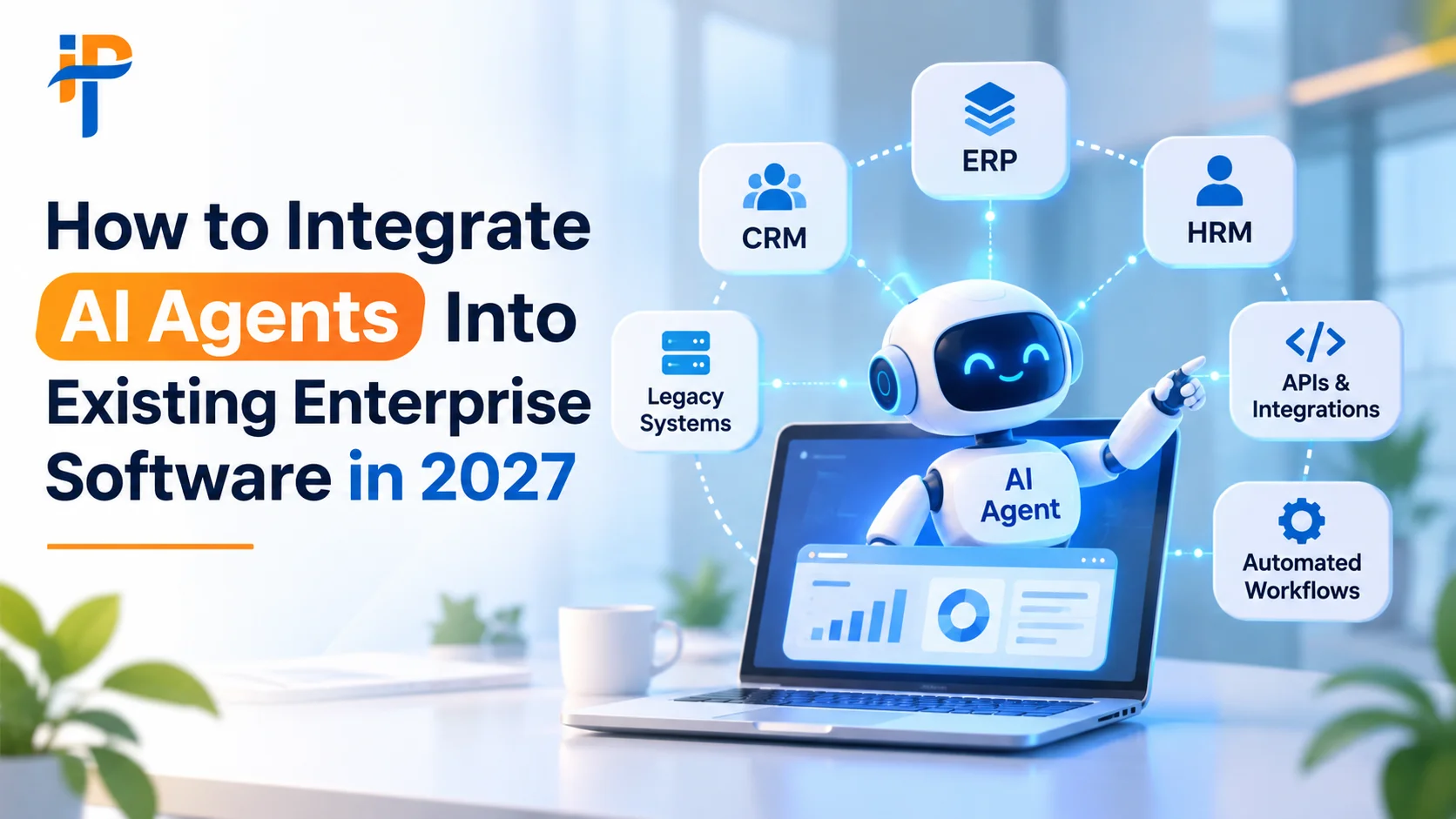
AI agent integration is the process of connecting intelligent software agents with existing enterprise applications, databases, APIs, and business workflows.
Unlike traditional automation systems that follow fixed instructions, AI agents can interpret information, understand context, select appropriate tools, and perform authorized tasks within defined business rules.
Consider a customer contacting your support team about a delayed shipment.
An employee might need to open the CRM, check the order management system, retrieve shipping information, and review company policies before responding.
An integrated AI agent could retrieve the relevant information from these systems and prepare a response. If the request involves a refund or another sensitive financial action, it can forward the decision to an authorized employee.
The objective is not to remove people from business processes. It is to reduce unnecessary manual work while maintaining appropriate human oversight.
Also read- Aso vs Seo
Why Businesses Are Integrating AI Agents Into Enterprise Software
Businesses invest in technology to make operations easier. However, when applications operate independently, employees often become responsible for connecting information manually.
Enterprise AI agent integration can help organizations overcome these challenges without rebuilding their entire software ecosystem.
Reduce Repetitive Manual Work
Employees frequently spend valuable time updating records, reviewing documents, processing requests, and preparing reports.
AI agents can assist with these routine activities, giving employees more time to focus on customer relationships, strategic planning, and complex business problems.
Improve Operational Efficiency
When information is distributed across multiple applications, completing a simple task can involve several unnecessary steps.
AI agents can retrieve authorized information and coordinate activities across connected systems, helping businesses reduce delays and improve workflow consistency.
Extend the Value of Existing Software
Replacing enterprise applications can be expensive and disruptive, particularly for organizations with established operational processes.
With the right AI integration services, businesses can introduce intelligent capabilities into existing applications while preserving the technology investments they have already made.
Improve Customer Experience
Customers expect timely responses and accurate information. Disconnected systems can make meeting those expectations difficult.
Integrated AI agents can assist customer support teams by retrieving account details, checking request statuses, and preparing relevant responses without repeatedly switching between platforms.
Support Sustainable Business Growth
As businesses grow, the volume of transactions, customer inquiries, and administrative responsibilities increases.
AI agents can help manage repetitive workloads, allowing organizations to expand their operational capacity without automating decisions that require human judgment.
How Do AI Agents Work With Existing Business Systems?
AI agents communicate with enterprise applications through APIs, middleware, secure connectors, and authorized databases.
A typical AI agent workflow begins with a user request or business event. The agent interprets the request, retrieves relevant information, selects a permitted action, and validates the result before completing the task or requesting human approval.
The integration layer determines which applications the agent can access and what actions it can perform.
| Enterprise Software | AI Agent Integration Capabilities |
|---|---|
| CRM systems | Lead qualification, customer support, sales follow-ups |
| ERP software | Inventory monitoring, procurement assistance, reporting |
| Accounting software | Invoice processing and reconciliation assistance |
| HR management systems | Employee onboarding and internal support |
| Supply chain platforms | Shipment tracking and inventory alerts |
| Healthcare applications | Appointment scheduling and administrative assistance |
| Custom enterprise software | Workflow automation and information retrieval |
The effectiveness of these integrations depends on data quality, system compatibility, and properly configured access permissions.
An AI agent should never receive unrestricted access to enterprise applications simply because it needs information from them.
Also read- PWA vs Native Apps
Types of AI Agents Used in Enterprise Software

Not every business process requires the same type of AI agent. Understanding the available options helps organizations choose an appropriate solution.
Customer Support AI Agents
Customer support agents can retrieve customer information, categorize support tickets, suggest responses, and escalate complex requests.
They are particularly useful for businesses handling large volumes of repetitive customer inquiries.
Workflow Automation Agents
These agents coordinate routine operational activities such as document processing, record updates, internal notifications, and approval requests.
They can help reduce administrative work across multiple departments.
Data Analysis Agents
Data analysis agents retrieve authorized business information, identify patterns, and prepare summaries that support management decisions.
Their outputs should be validated before being used for important financial or operational decisions.
Knowledge Management Agents
Knowledge management agents help employees find relevant information within company policies, product documentation, training materials, and internal knowledge bases.
Businesses can use generative AI development services to create knowledge assistants that generate context-aware responses using approved enterprise information.
Multi-Agent Systems
Multi-agent systems involve several specialized agents working together to complete complex tasks.
For example, one agent may collect documents, another may validate the information, and a third may prepare a report for employee review.
Although this architecture offers greater flexibility, businesses should consider its additional development and monitoring requirements before implementation.
How to Integrate AI Agents Into Existing Enterprise Software
Successful enterprise AI agent integration requires a structured approach. Rather than introducing AI across every department simultaneously, businesses should start with a specific problem and expand gradually.
Identify Business Problems and Define Objectives
Before choosing an AI model or development framework, determine what your organization wants to achieve.
Are employees spending too much time processing invoices? Are customer requests taking longer to resolve? Are disconnected applications creating unnecessary administrative work?
Identify workflows where AI can provide measurable improvements.
Establish performance benchmarks before development begins so that your organization can evaluate the results after implementation.
Assess Your Existing Technology Infrastructure
Conduct a technical assessment of your enterprise applications, databases, APIs, hosting environments, and security architecture.
Determine which applications support modern integration methods and which require additional development.
This assessment helps identify compatibility issues, technical limitations, potential security risks, and realistic implementation requirements.
Prepare and Organize Enterprise Data
AI agents depend on reliable information.
Duplicate records, outdated documents, incomplete customer profiles, and inconsistent data formats can lead to inaccurate responses.
Before integration, establish data ownership, remove inconsistencies, define access permissions, and create processes for maintaining information quality.
Choose the Right AI Model and Architecture
Not every business workflow requires a large or expensive AI model.
A document classification agent may operate effectively with a smaller model, while complex enterprise analysis may require more advanced reasoning capabilities.
Evaluate accuracy, processing costs, response times, privacy requirements, and scalability.
Businesses handling sensitive information should also consider private or hybrid deployment environments.
Also Read- Hire a Mobile Game Development Company In Usa
Connect AI Agents Through APIs and Middleware
APIs allow AI agents to communicate with existing enterprise applications without unnecessarily modifying their underlying architecture.
Using custom API development and integration services can help businesses establish secure connections between AI agents, CRM platforms, ERP systems, databases, and other operational applications.
Developers should define permitted actions, validate requests, and introduce approval mechanisms for sensitive operations.
Develop a Proof of Concept
Start with a limited implementation rather than building a complete enterprise AI platform immediately.
For example, a financial services company could introduce an agent that identifies missing documents in loan applications before expanding into more complex workflows.
A proof of concept allows businesses to evaluate technical feasibility, accuracy, employee adoption, and operational costs before committing to a larger investment.
Test Security, Performance, and Reliability
Testing should cover normal business workflows and situations where something goes wrong.
Evaluate how the agent responds when an API fails, information is unavailable, a request exceeds its permissions, or an external document contains misleading instructions.
Include employees who understand the actual business process. Their feedback can reveal operational challenges that technical testing alone may overlook.
Deploy, Monitor, and Improve
Introduce the AI agent gradually into production.
Monitor task completion rates, response accuracy, processing costs, system errors, and employee feedback.
AI integration is not a one-time development activity. Continuous evaluation helps ensure that the solution remains useful as business requirements change.
How to Integrate AI Agents With Legacy Enterprise Systems
Many established US businesses rely on applications developed years or even decades ago. Although these systems contain valuable operational information, they may lack modern integration capabilities.
Replacing them entirely is not always financially or operationally practical.
API-Based Integration
Custom APIs provide controlled access to information and functionality within legacy applications.
This approach works well when existing systems can be extended without significant architectural changes.
Middleware-Based Integration
Middleware acts as a communication bridge between AI agents and older enterprise applications.
It can manage authentication, data transformation, request routing, and communication between incompatible systems.
Retrieval-Augmented Generation (RAG)
RAG enables AI agents to retrieve relevant information from trusted enterprise documents, databases, and knowledge bases before generating responses.
This approach is useful for organizations that want AI agents to work with internal information without retraining an entire AI model.
Gradual Software Modernization
Some older applications may have security vulnerabilities, architectural limitations, or performance issues that prevent reliable AI integration.
In such cases, legacy application modernization services can help businesses improve system compatibility, strengthen security, and introduce modern functionality while keeping essential operations running.
Technology Stack for Enterprise AI Agent Integration
The right technology stack depends on existing infrastructure, workflow complexity, security requirements, and long-term operational costs.
| Technology Category | Common Technologies |
|---|---|
| AI models | GPT models, Claude, Gemini, Llama |
| Agent orchestration | LangGraph, Semantic Kernel |
| Backend development | Python, Node.js, Java, .NET |
| API integration | REST APIs, GraphQL, Webhooks |
| Enterprise databases | PostgreSQL, MySQL, SQL Server |
| Knowledge retrieval | RAG, pgvector, Pinecone, Weaviate |
| Cloud infrastructure | AWS, Microsoft Azure, Google Cloud |
| Deployment | Docker, Kubernetes, CI/CD |
| Authentication | OAuth 2.0, OpenID Connect |
| Monitoring | OpenTelemetry, Grafana, audit logging |
Businesses should prioritize compatibility, maintainability, security, and total cost of ownership rather than selecting technologies solely because they are popular.
How Much Does AI Agent Integration Cost in the USA in 2027?
The cost of integrating AI agents into enterprise software depends on project complexity, the number of connected applications, data preparation requirements, and security controls.
A customer support agent connected to a single CRM platform will generally require less investment than a multi-agent system operating across several enterprise departments.
Estimated AI Agent Integration Cost
| Integration Type | Estimated Development Cost | Estimated Timeline |
|---|---|---|
| AI proof of concept | 10, 000–25,000 | 2–6 weeks |
| Basic AI agent integration | 25, 000–50,000 | 1–3 months |
| Mid-level enterprise integration | 50, 000–120,000 | 3–6 months |
| Advanced enterprise integration | 120, 000–300,000 | 6–12 months |
| Complex multi-agent systems | 200, 000–500,000+ | 8–15+ months |
These are illustrative 2027 project planning estimates in US dollars rather than verified market averages. Actual costs and timelines depend on individual project requirements.
Factors That Influence AI Agent Integration Costs
Existing Software Complexity
Legacy applications may require custom APIs, middleware, and architectural improvements before they can support AI integration.
AI Model Selection
Different AI models have different processing, licensing, hosting, and infrastructure costs.
Selecting an unnecessarily powerful model can increase operational expenses without delivering meaningful business improvements.
Number of Connected Applications
Connecting multiple enterprise applications requires additional development, security assessments, and integration testing.
Security and Compliance Requirements
Organizations operating in regulated industries may require additional access controls, audit capabilities, compliance documentation, and security testing.
Ongoing Maintenance and Support
Businesses should also budget for model usage, infrastructure, monitoring, software updates, and technical support after deployment.
Evaluating the complete lifecycle cost provides a more accurate understanding of the investment than focusing exclusively on initial development expenses. Discuss Your AI Project
Industry-Specific AI Agent Integration Use Cases
AI agents can support a wide range of business activities. Their practical value depends on the operational challenges and regulatory requirements of each industry.
Healthcare
Healthcare organizations can use AI agents to assist with appointment scheduling, administrative documentation, medical billing, and authorized information retrieval.
Integrating these capabilities into healthcare software development solutions can help healthcare providers improve administrative workflows while maintaining appropriate patient privacy and access controls.
HIPAA obligations, where applicable, and clinical oversight must remain priorities throughout implementation.
Banking and Financial Services
Financial institutions can integrate AI agents into customer onboarding, document verification, digital lending, and financial reporting workflows.
For example, an AI agent could organize loan application documents and identify missing information before an authorized lending officer reviews the application.
Sensitive lending and financial decisions should remain subject to appropriate regulatory requirements and human oversight.
Retail and eCommerce
Retail businesses can connect AI agents with inventory management, order processing, customer support, and product information systems.
An integrated agent could identify inventory discrepancies, retrieve order updates, and assist customer service representatives with delivery-related inquiries.
Logistics and Supply Chain
Logistics businesses often manage information across warehouses, transportation systems, and delivery networks.
By incorporating AI agents into logistics software development solutions, organizations can improve shipment visibility, assist with dispatch coordination, manage delivery exceptions, and reduce repetitive administrative work.
Real Estate and Property Management
Property management companies can introduce AI agents into tenant management platforms, CRM applications, and maintenance management systems.
Potential applications include organizing maintenance requests, scheduling property visits, retrieving documentation, and assisting with routine tenant communication.
Manufacturing
Manufacturers can use AI agents to retrieve equipment maintenance information, summarize production reports, and coordinate inventory-related workflows.
These applications should complement existing operational procedures and industrial safety controls rather than bypass them.
Security and Compliance Requirements for Enterprise AI Integration
Connecting AI agents to existing business applications introduces additional responsibilities around data privacy, access management, and operational security.
Security should be part of the integration architecture from the beginning.
Implement Role-Based Access Control
AI agents should only receive the permissions necessary to perform their assigned tasks.
For example, an agent responsible for generating reports should not automatically receive permission to modify financial records.
Protect Sensitive Business Information
Use encryption, secure authentication, and appropriate data retention policies.
Organizations should also review how AI model providers process and store confidential enterprise information.
Maintain Human Oversight
Financial transactions, sensitive record modifications, and irreversible actions should require independent authorization.
Human approval mechanisms help prevent unintended actions and maintain accountability.
Prevent Prompt Injection Attacks
External documents, emails, and customer requests may contain misleading instructions.
Businesses should enforce execution restrictions and validate tool requests at the application level rather than relying exclusively on AI prompts.
Maintain Audit Logs and Continuous Monitoring
Record agent activities, system interactions, authorization events, and operational errors.
US businesses can refer to the NIST AI Risk Management Framework and the OWASP AI Agent Security Cheat Sheet when developing enterprise AI governance and security strategies.
Common AI Agent Integration Challenges and Solutions
Although enterprise AI integration offers significant opportunities, organizations should prepare for technical and operational challenges.
| Integration Challenge | Recommended Solution |
|---|---|
| Legacy software compatibility | Develop secure APIs and middleware |
| Poor data quality | Establish data validation and governance |
| Inaccurate AI responses | Use trusted data retrieval and output validation |
| Unauthorized system actions | Implement restricted permissions and approvals |
| High implementation costs | Begin with a focused proof of concept |
| Employee resistance | Provide training and introduce AI gradually |
| Integration failures | Establish fallback procedures |
| Increasing operational expenses | Monitor model usage and optimize workflows |
Addressing these challenges early can help businesses avoid unnecessary development work and build a more sustainable AI implementation strategy.
How to Measure AI Agent Integration ROI
The success of AI agent integration should be measured through business outcomes rather than the number of agents deployed.
Useful performance indicators include processing time, task completion accuracy, employee productivity, customer response times, and operational expenses.
Example of Enterprise AI Integration ROI
Consider a hypothetical US business introducing an AI agent to reduce repetitive administrative workloads.
| Performance Metric | Estimated Value |
|---|---|
| Employees supported | 25 |
| Weekly hours saved per employee | 4 hours |
| Average hourly labor cost | $40 |
| Annual gross productivity value | $208,000 |
| Initial integration investment | $80,000 |
| Annual operating expenses | $30,000 |
| Estimated first-year net value | $98,000 |
| Potential first-year ROI | 89.1% |
This example assumes 52 working weeks and that recovered employee time generates equivalent economic value. It represents a potential productivity benefit rather than guaranteed financial savings.
Businesses should also evaluate improvements in customer experience, processing accuracy, operational reliability, and employee satisfaction.
Also read- IPH Technologies Strengthens Global Reputation In Ai And Mobile App Development/
How to Choose the Right AI Agent Integration Partner
Choosing an AI development partner involves more than comparing development costs or evaluating technical certifications.
The right partner should understand your existing technology infrastructure, operational challenges, security requirements, and long-term business objectives.
When planning to hire AI engineers, prioritize experience in enterprise software architecture, API integration, data engineering, AI model evaluation, and production deployment.
An experienced development team should be able to explain how the integration will work, what risks exist, how performance will be measured, and how the solution will be maintained after deployment.
Equally important, your technology partner should be willing to recommend conventional automation when it offers a simpler and more cost-effective solution than AI.
How IPH Technologies Can Help With Enterprise AI Agent Integration
Every organization has different operational requirements. An AI solution designed for a healthcare provider may not be suitable for a logistics company or financial services business.
At IPH Technologies, we approach AI integration by understanding existing business processes, technology infrastructure, and operational challenges before recommending a solution.
Our capabilities include enterprise AI agent development, intelligent workflow automation, generative AI solutions, API integration, and legacy software modernization.
Whether your organization needs to introduce AI agents into an existing CRM, connect disconnected applications, or automate repetitive enterprise workflows, the focus remains on building technology that addresses meaningful business problems.
Explore our software development portfolio to learn more about our approach to developing digital solutions for different business requirements.
Conclusion
Integrating AI agents into existing enterprise software offers businesses an opportunity to improve operational efficiency without completely rebuilding their technology infrastructure.
However, successful implementation requires more than adopting the latest AI models or automation tools.
Businesses must identify meaningful use cases, prepare reliable data, establish secure integrations, and measure performance against clearly defined objectives.
For US organizations planning their AI investments in 2027, starting with a focused business problem and expanding based on measurable results can be more practical than implementing AI across every department simultaneously.
Ultimately, the value of enterprise AI comes from how effectively it supports employees, improves customer experiences, and strengthens business operations.
Planning to introduce AI agents into your existing enterprise applications? Connect with IPH Technologies to discuss your integration requirements and explore a solution aligned with your business goals.