








Running a business in Utah comes with plenty of opportunities, but growth also brings challenges. Customer inquiries increase, employees spend more time on administrative tasks, and managing information across multiple software platforms becomes increasingly difficult.
Hiring more employees may help, but it is not always the most practical solution.
This is where AI agents can make a difference.
Unlike traditional automation tools that follow predefined instructions, AI agents can interpret information, understand context, interact with software, and complete tasks within defined business rules.
Imagine a healthcare provider in Salt Lake City reducing appointment-related administrative work, a SaaS startup in Lehi automating customer onboarding, or a hospitality business in Park City managing seasonal customer inquiries more efficiently.
These are practical examples of how AI agents could support everyday business operations.
As businesses prepare for 2027, the question is no longer simply whether they should invest in AI. It is where AI can deliver meaningful business value without introducing unnecessary complexity.
Also Read- Ai development for utah businesses
Why Utah Businesses Should Consider AI Agents in 2027
Utah has developed a diverse business environment supported by technology companies, financial institutions, healthcare organizations, manufacturing businesses, and tourism-related enterprises.
The Silicon Slopes technology ecosystem, particularly around Lehi, Provo, and Salt Lake City, has also created opportunities for software innovation and entrepreneurship.
However, businesses across these industries face common operational challenges:
- Increasing customer service demands
- Repetitive administrative workloads
- Disconnected business applications
- Delays in accessing important information
- Rising operational costs
- Limited access to specialized technical resources
- Difficulty scaling existing processes
AI agents offer a practical way to address some of these challenges by connecting intelligent capabilities with existing business software.
Instead of replacing an entire system, businesses can introduce AI agents into specific workflows where automation can provide measurable improvements.
For a broader understanding of the state’s AI opportunities, explore our guide to AI development for Utah businesses.
What Are AI Agents and How Do They Work?
An AI agent is a software system designed to understand a task, evaluate relevant information, and take appropriate actions within defined permissions and operational boundaries.
Traditional AI applications may generate content, summarize information, or answer questions. AI agents can go a step further by interacting with approved tools and business systems to complete multi-step workflows.
For example, a customer service AI agent could:
- Receive a customer inquiry.
- Identify the customer’s request.
- Retrieve relevant information from a CRM.
- Check order or account details.
- Prepare an appropriate response.
- Escalate complex requests to a human employee.
- Update the customer support record.
The agent can perform these activities without requiring an employee to manually switch between multiple applications.
However, its effectiveness depends on the quality of its underlying information, integrations, permissions, and monitoring.
Main Components of an AI Agent
| Component | Purpose |
|---|---|
| Large Language Model (LLM) | Interprets instructions and evaluates information |
| Knowledge Base | Provides relevant business information |
| Planning and Orchestration | Organizes tasks and coordinates workflow steps |
| Tool Integration | Connects the agent to business applications |
| Memory and Context | Retains relevant information where permitted |
| Security Controls | Restricts data access and authorized actions |
| Human Oversight | Reviews sensitive or high-impact decisions |
| Monitoring System | Tracks performance, errors, and operating costs |
Businesses exploring intelligent software can learn more about these capabilities through our machine learning and AI development services.
AI Agents vs. Traditional Business Automation
Many Utah businesses already use automation tools for email campaigns, invoice generation, customer notifications, and employee workflows.
Traditional automation remains valuable, especially when tasks follow predictable rules.
However, it can struggle when processes involve unstructured information, changing requirements, or multiple connected decisions.
AI agents can complement these systems by handling workflows that require contextual interpretation.
| Feature | Traditional Automation | AI Agents |
|---|---|---|
| Task Execution | Predefined rules | Context-aware workflows |
| Decision-Making | Fixed conditions | Evaluates information within defined limits |
| Data Handling | Primarily structured inputs | Structured and unstructured information |
| Flexibility | Requires rule modifications | Can handle variations within tested boundaries |
| Workflow Complexity | Linear or predefined branching | Multi-step and tool-connected workflows |
| Predictability | Generally higher | Requires additional evaluation and oversight |
| Best Use Cases | Repetitive, predictable tasks | Context-dependent business processes |
For example, traditional automation can send payment reminders when an invoice becomes overdue.
An AI agent could review outstanding invoices, identify relevant customer communication, prepare a personalized reminder, and request approval before taking further action.
The most effective approach is often to combine deterministic automation with AI rather than replacing every existing workflow.
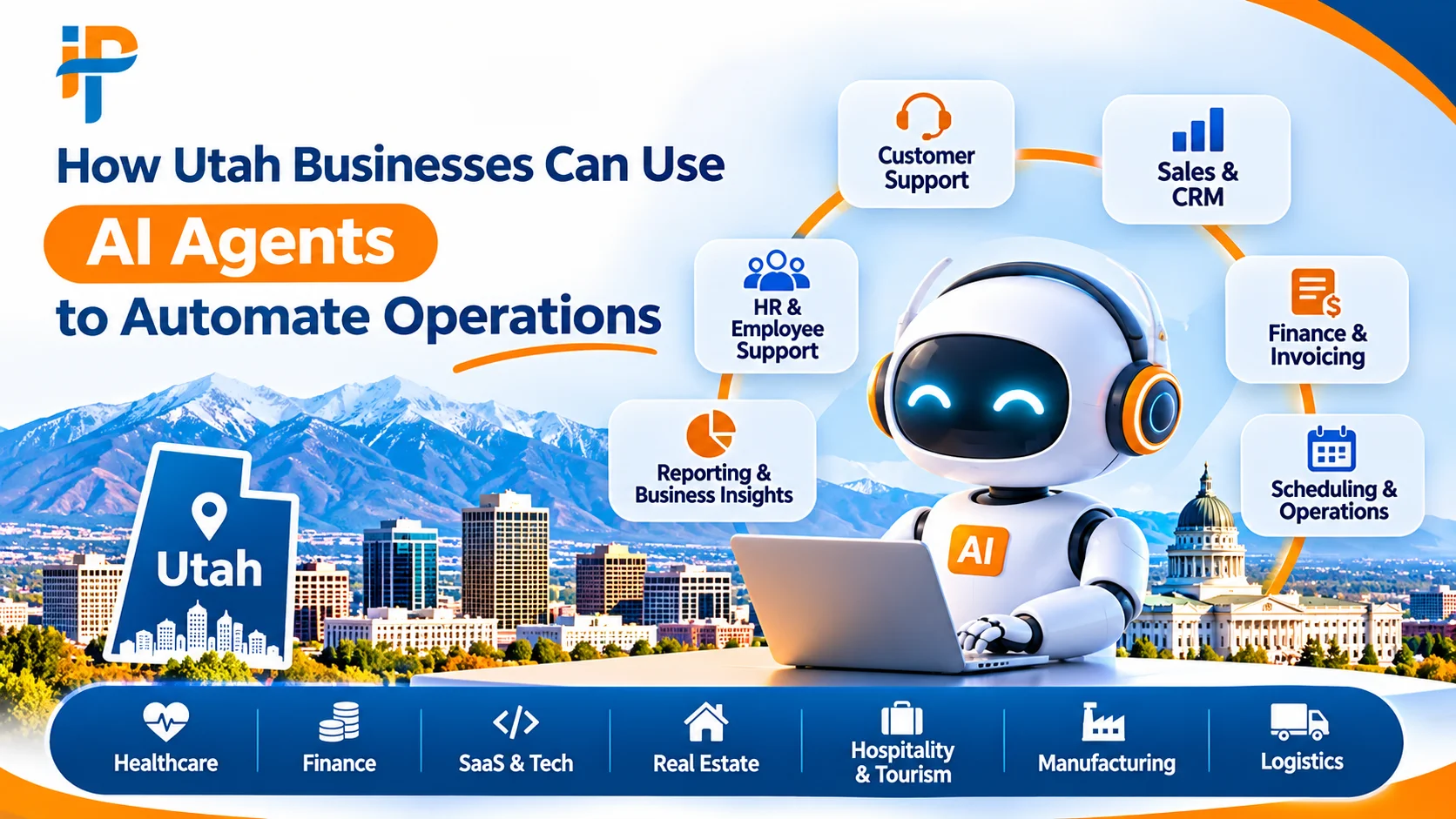
Practical AI Agent Use Cases for Utah Businesses
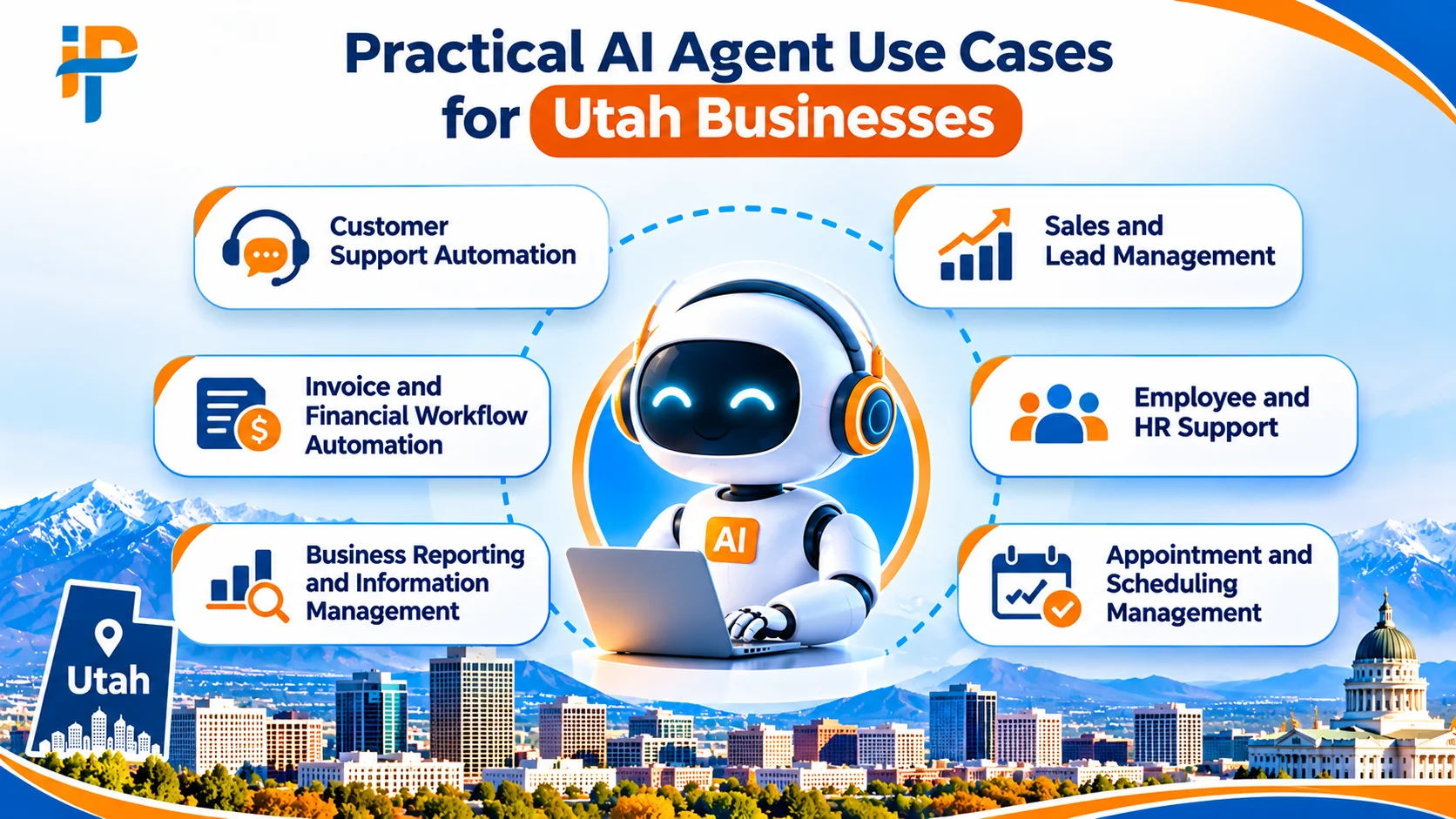
Businesses do not need to automate their entire organization at once. Starting with a specific operational challenge can make AI implementation easier to manage and evaluate.
1. Customer Support Automation
Customer support teams frequently handle similar questions about products, services, deliveries, appointments, and account information.
AI agents can retrieve information from approved knowledge bases, answer routine questions, classify support requests, and transfer complicated issues to employees.
For a growing business in Salt Lake City, this could reduce the time spent searching for information and allow employees to focus on customer issues that require personal attention.
2. Sales and Lead Management
Sales teams often spend considerable time updating CRM records, organizing inquiries, and preparing follow-up messages.
AI agents can assist with reviewing incoming leads, summarizing customer conversations, preparing follow-ups, and identifying records that require attention.
For B2B technology companies in Lehi, this can help sales representatives spend more time on meaningful customer conversations.
The agent should not independently make pricing commitments or send sensitive communications without appropriate authorization.
3. Invoice and Financial Workflow Automation
Financial teams regularly process invoices, expense records, purchase orders, and payment information.
AI agents can extract relevant document details, compare records, identify discrepancies, and route exceptions for employee review.
For example, a Utah manufacturing company could use an AI agent to organize supplier invoices and flag mismatches between purchase orders and received goods.
Final payment authorization should remain subject to established financial controls.
4. Employee and HR Support
Employees often need information about internal policies, leave procedures, onboarding documents, and company resources.
An internal AI agent can provide answers using approved company documentation, help employees locate forms, and route unresolved questions to HR representatives.
This can make internal information more accessible while reducing repetitive administrative work.
5. Business Reporting and Information Management
Important business information is often scattered across spreadsheets, CRMs, databases, and reporting platforms.
AI agents can retrieve relevant information from authorized systems and prepare summaries for employees and managers.
Instead of manually gathering data from multiple departments, business leaders can receive organized reports with references to the underlying information.
Critical figures should still be validated against authoritative business records.
6. Appointment and Scheduling Management
Businesses operating in healthcare, hospitality, professional services, and real estate often handle appointment requests, cancellations, and availability inquiries.
AI agents can help identify available time slots, prepare reminders, process routine scheduling requests, and escalate exceptions.
This can improve operational coordination without requiring employees to manage every routine interaction manually.
Also read- Aso vs Seo
How AI Agents Can Support Silicon Slopes Startups
Growing a startup is challenging when a small team must manage product development, customer acquisition, technical support, and daily operations at the same time.
For startups in Lehi, Provo, and other parts of Utah’s technology corridor, AI agents can provide additional operational capabilities without immediately expanding every department.
Automating SaaS Customer Onboarding
A SaaS company could introduce an AI agent that guides customers through account setup, explains product features, identifies common configuration problems, and routes technical issues to the appropriate team.
Supporting Product Development Teams
AI agents can help organize bug reports, summarize customer feedback, search internal documentation, and assist developers with routine technical tasks.
Code changes and production deployments should remain subject to established engineering review processes.
Improving Internal Knowledge Access
As startups grow, important information becomes distributed across project management tools, documents, and team communication platforms.
A knowledge agent can retrieve relevant approved information and help employees find answers without interrupting multiple colleagues.
Validating AI-Powered Product Features
Startups can begin with a limited AI-powered feature, test its usefulness with actual users, and expand functionality based on measurable outcomes.
Working with an experienced app development company serving Utah businesses can help startups evaluate the technical feasibility of introducing these capabilities into existing or new digital products.
AI Agent Applications Across Utah Industries
The value of AI agents depends on how well their capabilities align with the requirements of a specific industry.
The following examples illustrate potential applications across Utah’s business landscape. They are hypothetical implementation scenarios rather than documented client results.
Healthcare and Life Sciences in Salt Lake City
Healthcare organizations frequently manage large volumes of administrative information, appointments, insurance records, and patient communication.
AI agents may support:
- Appointment scheduling and reminders
- Administrative document classification
- Insurance information processing
- Internal knowledge retrieval
- Routine patient inquiries
Applications involving protected health information require appropriate safeguards and evaluation of applicable HIPAA obligations.
Clinical decisions should remain under qualified professional oversight unless a specific authorized arrangement permits otherwise.
Banking and Financial Services
Financial institutions and fintech businesses can use AI agents to support document collection, customer onboarding, internal information retrieval, and transaction-related administrative workflows.
For example, an agent could organize loan application documents and identify missing information before a qualified employee reviews the application.
Decisions involving lending eligibility, financial transactions, or customer rights require appropriate governance and regulatory review.
Real Estate and Property Management
Real estate businesses in Salt Lake City, Provo, and surrounding areas can explore AI agents for property inquiries, appointment scheduling, maintenance requests, and listing management.
A property management agent could classify tenant maintenance requests and route them to the appropriate employee or contractor.
Emergency requests should follow dedicated escalation procedures rather than relying entirely on AI interpretation.
Tourism and Hospitality in Park City
Seasonal tourism can create fluctuations in customer inquiries, reservations, and service requirements.
Hotels, resorts, and tourism-related businesses could use AI agents to provide information about facilities, manage common booking inquiries, and assist with customer communication.
An agent connected to an approved reservation system could also retrieve availability information without requiring employees to manually review multiple platforms.
Logistics and Manufacturing in Ogden
Manufacturers and logistics businesses often manage suppliers, production schedules, inventory records, and shipment updates.
AI agents can help organize supplier communications, summarize operational reports, flag information discrepancies, and assist with inventory-related workflows.
Safety-critical decisions and equipment controls should remain subject to qualified personnel and appropriate deterministic safeguards.
Industry-Wise AI Agent Use Cases
| Utah Industry | AI Agent Application | Potential Business Benefit |
|---|---|---|
| Healthcare | Scheduling and document processing | Reduced administrative workload |
| FinTech | Customer onboarding support | More organized financial workflows |
| SaaS | Customer onboarding and support | More efficient customer assistance |
| Real Estate | Property inquiry management | Faster customer communication |
| Hospitality | Reservation and visitor assistance | Better seasonal operational support |
| Manufacturing | Supplier document management | Reduced manual information processing |
| Logistics | Shipment status and exception reporting | Improved operational visibility |
| Retail | Product assistance and order inquiries | More efficient customer support |
Also read- PWA vs Native Apps
Key Benefits of Implementing AI Agents
Introducing AI agents into suitable business workflows can offer several advantages.
Reduced Repetitive Work
AI agents can assist with routine information retrieval, document organization, reporting, and customer communication.
This allows employees to dedicate more time to tasks requiring creativity, judgment, and interpersonal skills.
Improved Customer Responsiveness
AI-powered assistance can help businesses respond to common customer inquiries outside normal working hours, provided the system has access to accurate information and appropriate escalation procedures.
Better Operational Visibility
Agents connected to approved business systems can organize information from multiple sources, making it easier for employees to understand workflow progress and identify issues.
Greater Process Consistency
Well-designed AI workflows can follow standardized operational procedures while adapting to variations in incoming information.
Validation and monitoring remain necessary because AI-generated outputs are not always accurate.
More Flexible Business Operations
Businesses experiencing seasonal demand or rapid growth may benefit from AI-assisted workflows that support employees during periods of increased activity.
Potential Cost Savings
Reducing repetitive administrative work can create opportunities for cost optimization.
However, businesses should calculate total implementation, integration, monitoring, and ongoing AI usage expenses before expecting financial returns.
How Much Does AI Agent Development Cost in Utah?
There is no single price for building an AI agent.
Development costs depend on workflow complexity, integration requirements, security expectations, AI model selection, and ongoing operational needs.
The following estimates are illustrative USD planning ranges for custom AI projects serving US businesses. They are not verified Utah-specific market averages or official IPH Technologies quotations.
| AI Agent Project Type | Illustrative Budget |
|---|---|
| Proof of concept | 5, 000–15,000 |
| Basic knowledge or support agent | 10, 000–30,000 |
| Custom business workflow agent | 25, 000–75,000 |
| Multi-system AI agent solution | 60, 000–150,000 |
| Complex enterprise AI platform | 150, 000–300,000+ |
Factors That Influence AI Agent Development Costs
The main considerations include:
- Number of workflows being automated
- Complexity of CRM, ERP, and software integrations
- Existing data accessibility and quality
- AI model and infrastructure requirements
- Security and privacy controls
- Human approval and escalation mechanisms
- Evaluation and testing requirements
- Ongoing monitoring and maintenance
Understanding the Return on Investment
Consider a hypothetical Utah business where employees collectively spend 200 hours each month on repetitive administrative activities.
If an AI agent reduces that workload by 100 hours per month, and the average loaded labor cost is $40 per hour, the potential capacity value would be approximately $4,000 per month.
If ongoing AI operating costs reach $1,000 per month, the net monthly capacity value would be $3,000.
For an initial implementation investment of $30,000, the illustrative payback period would be around 10 months.
Actual financial savings depend on whether that recovered time is productively redeployed or results in avoidable expenses. Implementation delays, maintenance costs, and unexpected technical requirements can also change the outcome.
Also Read- Hire a Mobile Game Development Company In Usa
Challenges Utah Businesses Should Consider Before Implementing AI Agents
AI agents can offer practical benefits, but successful implementation requires more than selecting an AI model.
Poor Data Quality
An agent connected to outdated or inconsistent information can produce inaccurate results.
Businesses should organize relevant information and establish reliable data sources before allowing an AI agent to use them.
Disconnected Business Systems
Older software platforms may lack suitable APIs or integration capabilities.
In these situations, businesses may need middleware, software modernization, or custom integrations before introducing AI-powered workflows.
Data Security and Privacy
AI agents may require access to sensitive business and customer information.
Organizations should implement appropriate access controls, data retention policies, secure integrations, and monitoring procedures.
AI Hallucinations and Incorrect Actions
AI systems can generate inaccurate information or misunderstand instructions.
Retrieval-based architectures, deterministic validation rules, restricted permissions, and employee approvals can help reduce these risks.
Utah AI Regulations and Compliance
Utah has established AI-related legislation and an Office of Artificial Intelligence Policy.
Businesses introducing AI agents should review applicable state requirements, including consumer disclosures, data privacy obligations, and industry-specific responsibilities.
Organizations should consult qualified legal professionals before implementing AI in regulated or high-impact workflows, especially as requirements evolve.
Employee Adoption
Introducing AI without explaining its purpose can create uncertainty among employees.
Businesses should involve employees in workflow planning, communicate responsibilities clearly, and provide suitable training before implementation.
How to Integrate AI Agents Into Existing Business Software
Businesses do not necessarily need to replace their entire software infrastructure to introduce AI agents.
A controlled integration approach can help organizations evaluate AI capabilities while maintaining existing operational processes.
Step 1: Identify a Specific Business Problem
Start with a measurable challenge rather than a broad goal to adopt AI.
For example, reducing the time employees spend processing customer inquiries is a clearer objective than simply introducing an AI-powered platform.
Step 2: Evaluate Your Existing Software
Identify relevant business applications, databases, communication platforms, and available APIs.
Determine which information the agent requires and what restrictions should apply to its access.
Step 3: Select the Right AI Architecture
Choose an approach that matches your requirements.
This may include large language models, retrieval-augmented generation (RAG), workflow orchestration, secure APIs, and deterministic business rules.
Step 4: Connect AI With Existing Systems
Integrate the agent with approved CRM, ERP, customer service, or business management applications.
Our generative AI development services support custom AI applications and integrations designed around existing software requirements.
Step 5: Establish Human Approval and Security Controls
Define what the agent can do independently, which actions require approval, and when it must escalate to an employee.
Sensitive transactions and high-impact decisions require additional safeguards.
Step 6: Launch a Limited Pilot
Begin with one workflow or department.
Evaluate accuracy, failure rates, cost, employee experience, and operational improvements before expanding access.
Step 7: Monitor Performance and Scale Gradually
Track measurable outcomes and regularly review the agent’s behavior.
Useful performance indicators can include task completion rates, exception rates, response times, operating costs, and employee feedback.
Expand automation only when the initial implementation demonstrates reliable business value.
How IPH Technologies Can Help Utah Businesses Implement AI Agents
Every successful AI implementation begins with understanding the business problem.
At IPH Technologies, we help startups and enterprises evaluate opportunities for intelligent automation, develop custom software, and integrate AI capabilities into existing technology environments.
Our approach focuses on identifying workflows where AI can provide practical improvements rather than adding technology without a clear purpose.
We support businesses with:
- AI strategy and technical consulting
- Custom AI agent development
- LLM and RAG integration
- Enterprise workflow automation
- CRM and ERP connectivity
- AI-powered mobile and web applications
- Security-conscious software engineering
- Ongoing AI monitoring and optimization
Whether you are a SaaS startup in Lehi, a healthcare organization in Salt Lake City, a hospitality business in Park City, or a manufacturer in Ogden, we can help you evaluate suitable AI solutions around your business requirements.
Our custom software development capabilities can also support businesses that need to improve existing systems before introducing AI-powered automation.
Start with a conversation about your existing workflows, technical challenges, and business goals to identify where AI agents could make a meaningful difference.
Conclusion
For Utah businesses preparing for 2027, AI agents represent an opportunity to improve operations, reduce repetitive work, and make better use of existing business information.
However, adopting AI is not about automating everything.
It is about identifying tasks where intelligent assistance can genuinely improve productivity, customer experiences, and operational efficiency.
The most practical approach is to start with a clearly defined business problem, introduce a controlled AI workflow, measure the results, and gradually expand what works.
Businesses that combine AI capabilities with reliable software engineering, responsible governance, and human expertise will be better positioned to build sustainable digital operations.