


































































































Artificial intelligence is becoming increasingly common across U.S. healthcare. Physicians and hospitals are using AI for clinical documentation, research, patient communication, administrative tasks, predictive analytics, and other healthcare workflows.
According to the American Medical Association’s 2026 physician survey, 81% of surveyed physicians reported using AI professionally, more than double the rate reported in 2023.
However, introducing AI into a hospital is not simply a matter of purchasing an AI solution. Hospitals need to integrate new technologies with existing EHR systems, clinical processes, security controls, and staff workflows.
This is where healthcare IT consulting can help.
Why U.S. Hospitals Are Adopting AI?
U.S. hospitals already operate in highly digital environments. According to ONC data, more than 99% of non-federal acute care hospitals had adopted certified EHRs as of 2026.
This digital infrastructure provides an important foundation for AI applications. Hospitals can use AI to analyze healthcare data, automate repetitive processes, support clinicians, and improve operational efficiency.
Predictive AI adoption is also increasing. ONC reported that the share of U.S. hospitals using predictive AI increased from 66% in 2024 to 71% in 2025.
What Happens When AI Disrupts Clinical Workflows?
Even a technically capable AI solution can create problems if it does not fit naturally into clinical workflows.
For example, clinicians may have to switch between multiple applications, manually enter information, or review excessive alerts. Instead of reducing administrative work, poorly integrated AI can introduce additional steps.
Healthcare organizations therefore need to consider how AI will fit into existing workflows before implementation begins.
IOS Healthcare App Development USA
How Healthcare IT Consulting Supports AI Implementation
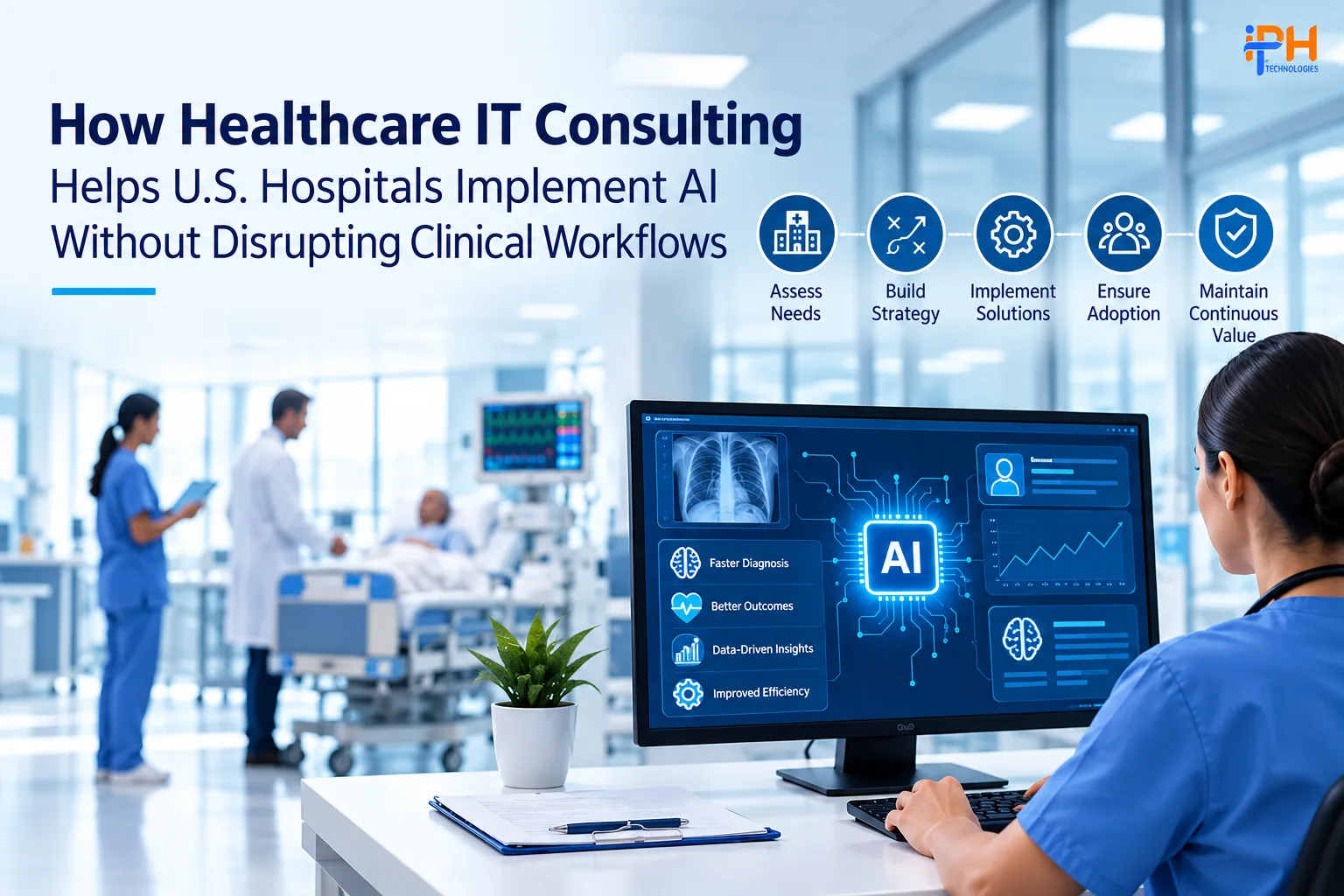
Healthcare IT consulting provides hospitals with technical and strategic guidance throughout the AI implementation process.
Consultants can evaluate existing infrastructure, identify suitable AI use cases, plan integrations, establish security requirements, and help organizations introduce AI gradually.
The goal is not simply to add AI technology. The goal is to integrate it into healthcare operations without unnecessarily changing how clinicians deliver care.
1. Identifying the Right AI Use Cases
Not every hospital process requires AI.
A healthcare IT consulting team can evaluate existing workflows and identify areas where AI may provide practical value.
Potential applications include:
- Clinical documentation
- Medical imaging support
- Patient scheduling
- Revenue cycle processes
- Patient communication
- Predictive analytics
- Care coordination
- Clinical decision support
- Administrative automation
ONC’s 2025 analysis found particularly strong growth in predictive AI applications for billing and scheduling between 2023 and 2024.
Starting with a clearly defined use case can make implementation easier to manage.
2. Integrating AI With Existing EHR Systems
EHR integration is one of the most important considerations when implementing AI in a U.S. hospital.
An AI solution may need access to clinical information stored within an EHR or other healthcare systems. Without appropriate integration, clinicians may need to manually transfer information between platforms.
Healthcare IT consultants can help plan API-based integrations and determine how information should move between systems.
FHIR-based APIs are becoming increasingly important for healthcare interoperability, and federal health IT initiatives continue to emphasize standardized data exchange.
3. Keeping Clinicians in the Workflow
AI should support clinicians rather than force them to completely change established processes.
Healthcare IT consultants can work with physicians, nurses, administrators, and other stakeholders to understand how work is actually performed.
This helps determine where AI outputs should appear, who should review them, and what actions should follow.
The AMA has emphasized the importance of involving physicians in the design, evaluation, and implementation of clinical AI tools.
4. Implementing AI in Phases
Hospitals do not necessarily need to deploy an AI solution across every department at once.
A phased approach can begin with a specific department, workflow, or use case. The organization can then evaluate performance and user feedback before expanding the implementation.
This approach can help hospital leadership identify technical problems and workflow issues before they affect a larger group of users.
5. Supporting AI Governance
AI implementation requires more than technical integration.
Hospitals need processes for evaluating AI tools, monitoring performance, managing access, documenting decisions, and addressing potential risks.
ONC’s HTI-1 Final Rule established transparency requirements for AI and predictive algorithms incorporated into certified health IT, including information intended to help assess factors such as validity, effectiveness, safety, and fairness.
Healthcare IT consulting can help organizations develop governance processes that align technology implementation with their operational and compliance requirements.
Pharmacy Software Systems USA
6. Protecting Healthcare Data
Healthcare AI systems often work with sensitive patient information.
Hospitals therefore need to consider privacy, security, access controls, data handling, and appropriate use of protected health information when implementing AI.
HHS has emphasized that AI adoption needs to be supported by secure data practices, interoperability, and appropriate protections for patient information.
Healthcare IT consultants can help organizations evaluate these requirements during technology selection and implementation.
7. Connecting AI With Healthcare Interoperability
AI becomes more useful when relevant healthcare data can move between authorized systems.
For U.S. hospitals, interoperability can involve EHRs, laboratories, imaging systems, health information exchanges, patient applications, and other healthcare platforms.
The TEFCA network continues to expand nationwide health information exchange. HHS announced in June 2026 that more than one billion health records had been exchanged through the network.
Healthcare IT consulting can help hospitals plan AI architectures that account for interoperability rather than treating AI as an isolated application.
8. Training Healthcare Staff
Technology implementation is also a people-related process.
Doctors, nurses, administrators, and other staff need to understand how an AI tool works within their workflow, what information it provides, and when human review is required.
Training can help staff understand the appropriate role of AI and reduce confusion during adoption.
9. Monitoring AI After Deployment
AI implementation does not end when the software goes live.
Hospitals should monitor system performance, user feedback, workflow impact, security, and other relevant indicators after deployment.
Healthcare IT consulting teams can support ongoing optimization and help organizations identify areas where an AI workflow needs adjustment.
Healthcare IT Consulting for Different Hospital AI Use Cases
Different hospital departments can have different AI requirements.
✓ AI for Clinical Documentation: AI-powered documentation tools can assist clinicians with administrative tasks and help reduce manual documentation workload.
✓ AI for Medical Imaging: AI can support certain diagnostic imaging workflows by analyzing images and providing information for clinical review.
✓ AI for Patient Engagement: AI-powered communication tools can support patient inquiries, appointment-related communication, and other digital engagement workflows.
✓ AI for Predictive Analytics: Hospitals can use predictive models to analyze healthcare data and support operational or clinical decision-making.
✓ AI for Administrative Operations: AI can also be applied to scheduling, billing, revenue cycle processes, and other administrative workflows.
How EHR Integration Work
How to Choose a Healthcare IT Consulting Partner?
Hospitals should evaluate consulting partners based on their healthcare technology experience and understanding of real-world clinical environments.
Look for experience with:
- EHR integration
- Healthcare APIs and interoperability
- AI and machine learning
- Healthcare cybersecurity
- HIPAA-related requirements
- Cloud healthcare infrastructure
- Healthcare data management
- Clinical workflow integration
- Software development and implementation
A consulting partner should also be able to understand the hospital’s existing technology environment instead of recommending AI as a standalone solution.
Why Healthcare IT Consulting Matters for AI Adoption?
AI adoption in healthcare is moving from experimentation toward broader operational use. At the same time, healthcare organizations need to manage workflow, data, interoperability, security, and governance requirements.
Current U.S. healthcare technology initiatives also place increasing attention on AI-enabled clinical care and interoperable health data.
Healthcare IT consulting can help hospitals connect these requirements into a structured implementation strategy.
Instead of asking only “What AI technology should we use?”, healthcare organizations can also ask “Where should AI fit into our existing clinical and operational workflows?”
That shift can make AI implementation more practical, measurable, and aligned with the needs of healthcare professionals.
How IPH Technologies Can Support Healthcare IT Initiatives?
IPH Technologies provides healthcare software development and technology solutions for organizations looking to modernize their digital infrastructure.
Our capabilities can support areas such as healthcare software development, AI-powered healthcare solutions, EHR integration, API development, cloud-based applications, and healthcare technology modernization.
For U.S. healthcare organizations planning an AI initiative, the right technology strategy can help connect AI capabilities with existing systems and workflows.
Looking for healthcare IT consulting support for your AI or healthcare software project?
Contact IPH Technologies to discuss your requirements.
Final Thought On Healthcare IT Consulting
AI can provide opportunities for U.S. hospitals across clinical, administrative, and operational workflows. However, successful implementation requires more than selecting an AI platform.
Hospitals need to consider EHR integration, interoperability, security, governance, staff training, and clinical workflow from the beginning.
Healthcare IT consulting can help organizations plan and implement AI solutions around their existing technology and clinical processes helping healthcare teams adopt new capabilities without unnecessarily disrupting patient care workflows.
Frequently Asked Questions (FAQs)
What is healthcare IT consulting?
Healthcare IT consulting involves providing technology and strategic guidance to healthcare organizations for areas such as software development, EHR integration, interoperability, cybersecurity, cloud infrastructure, data management, and AI implementation.
How can healthcare IT consulting help hospitals implement AI?
Healthcare IT consultants can help hospitals identify suitable AI use cases, evaluate existing infrastructure, plan EHR integrations, address security and governance requirements, and introduce AI into existing workflows.
Can AI be integrated with an existing EHR?
Yes. AI applications can be integrated with existing healthcare systems using appropriate APIs, interoperability standards, and integration architectures. The exact approach depends on the EHR, AI application, data requirements, and intended workflow.
Why is clinical workflow important for AI implementation?
Clinical workflows determine how physicians, nurses, and other healthcare professionals use technology during patient care. AI that does not fit the existing workflow can create additional steps or administrative burden.
Do hospitals need healthcare IT consulting for AI projects?
The need depends on the hospital’s internal technical capabilities and the complexity of the AI project. Consulting can be particularly useful for organizations dealing with complex integrations, interoperability, security, governance, or large-scale implementation requirements.










.png)