
































































































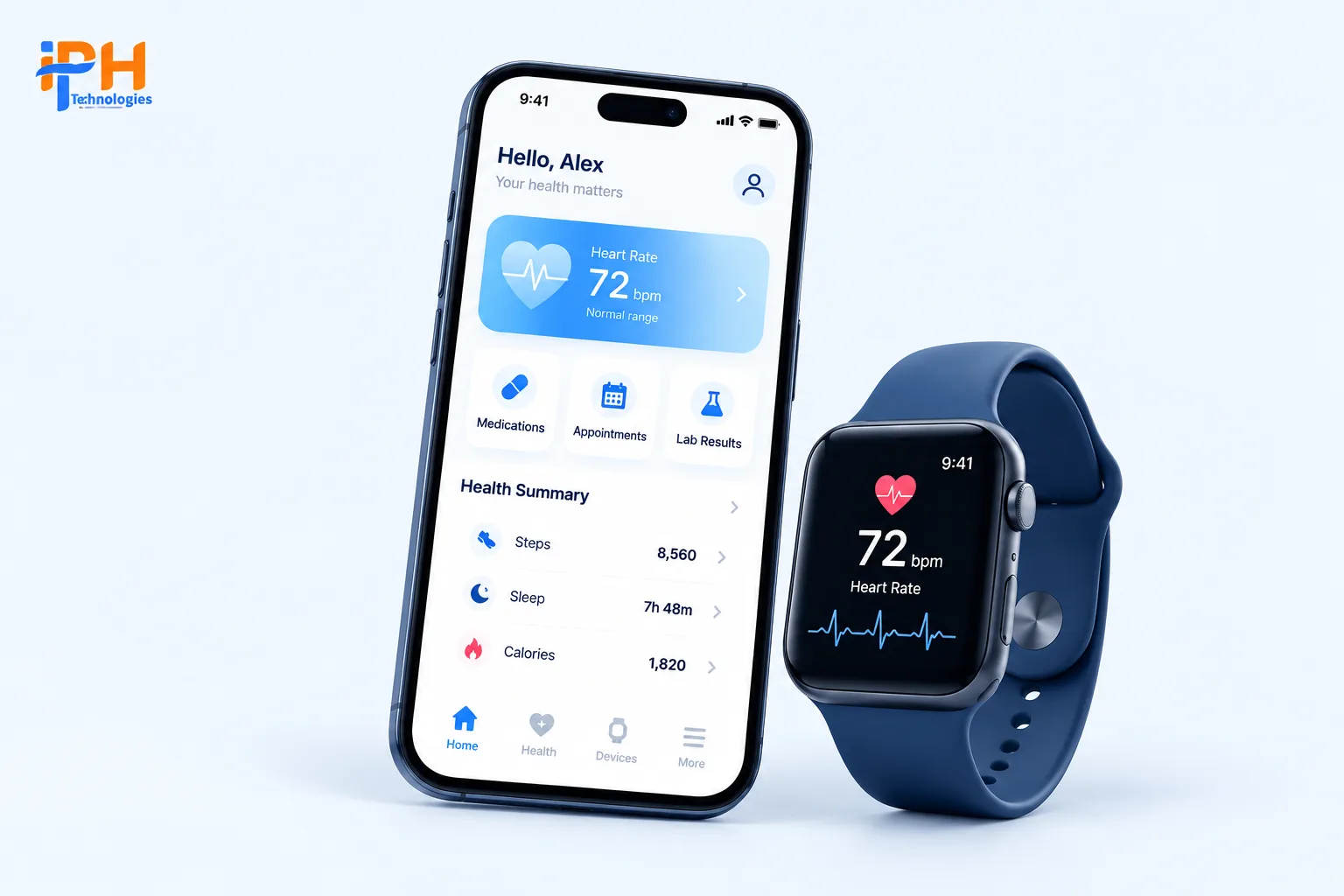
The Health System: An administrator reaches out to her IT director who wants to build patient portal features directly with Apple Watch metrics.
The Retail Pharmacy: A product manager needs to launch an effortless prescription to refill app with zero risk of HIPAA non-compliance.
The Healthtech Startup: With FDA clearance right around the corner, the startup needs an iPad-based tool ready for doctors to use.
In this post, we outline the architecture stack, expected cost ranges, the software development lifecycle, and how specialized pharmacy software integrates into the ecosystem. By the time you finish this, you’ll have the exact context needed to scope your build and separate real agency expertise from sales fluff.
Key Takeaways
- Native iOS healthcare apps depend on three Apple-specific frameworks: HealthKit, ResearchKit, and CareKit, each solving a different problem, from data storage to clinical trial onboarding.
- Costs range from $20,000 for a basic wellness MVP to $450,000+ for an enterprise clinical platform with SMART on FHIR integration and full HIPAA/GDPR audits.
- Compliance isn’t a final checkbox; it has to be architected from day one, through encryption, biometrics, and secure backend design.
- Pharmacy software has its own regulatory layer on top of standard HIPAA requirements, which changes how the app should be scoped from the start.
What Makes iOS the Right Platform for Healthcare Apps
When it comes to regulated health apps, iOS is the gold standard. Apple combines tight, hardware-level security like its Secure Enclave chip with strict App Store guidelines for medical software. That combination reduces the attack surface compared to fragmented Android hardware. Together, they offer a significantly smaller attack surface than Android’s fragmented ecosystem.
The Secure Enclave is a standalone security co-processor, hardware-based security vault, physically isolated subsystem built into every modern iPhone and iPad. It keeps biometric data and encryption keys isolated from the rest of the system. That means even if an app gets hacked, the sensitive health data beneath it stays completely locked down.
Apple’s App Store review process for healthcare apps is a lot tougher than most founders expect. Apps requesting HealthKit access go through additional scrutiny, which filters out a lot of low-effort submissions before they ever reach a patient’s device.
That said, this strictness cuts both ways. Review times for health apps can run longer than for a typical consumer app, so teams should build a generous buffer into their deployment schedule rather than assuming a rapid turnaround.
Read More: Pharmacy Software Systems in USA: What Hospital Leaders Actually Need to Know Before Choosing One
Core Apple Frameworks & Technical Stack
Building a secure iOS healthcare app comes down to three specialized Apple frameworks, paired with Swift and Xcode as the core development base. This stack provides the security, consistency, and hardware integration required for sensitive medical data.
HealthKit is Apple’s centralized, encrypted repository for health and fitness data across iPhone and Apple Watch. It enables apps to seamlessly exchange data from vital signs to medication schedules with granular, user-permissioned controls governing every data point.
ResearchKit is an open-source framework designed specifically for medical studies. It gives developers pre-built components for onboarding, active tasks, and informed consent flows, so research apps don’t have to reinvent standard clinical trial UX from scratch.
CareKit picks up right where ResearchKit leaves off, focused on ongoing care rather than research. It gives developers the foundation to build personalized care plans and track patient progress outside the clinic, and collect real-time survey feedback that flows straight to the care team.
Underneath it all are Swift, Apple’s native programming language, and Xcode, its core development environment. Going native development here isn’t a stylistic choice; it’s the only way to secure low battery consumption, high performance, and direct access to hardware-level security like the Secure Enclave that cross-platform tools simply can’t match.
Essential Features & What They Cost
In US healthcare, app development costs scale with clinical complexity, not how many screens you design. A basic wellness tracker and a clinical EMR-integrated platform are different orders of engineering effort, and their price tags reflect that reality.
| Project Scope | Estimated Cost Range | Key Specifications & Deliverables |
|---|---|---|
| Basic MVP / Wellness App | $20,000 – $40,000 | Simple health tracking, basic push notifications, minimal UI, standard App Store deployment |
| Mid-Tier Telehealth / Portal | $40,000 – $100,000 | Appointment scheduling, secure video chat (WebRTC), basic EHR integration, encrypted messaging |
| Enterprise Clinical Platform | $150,000 – $450,000+ | Advanced EMR/EHR sync (SMART on FHIR), multi-role access, custom IoT hardware/wearable telemetry, full HIPAA/GDPR audits |
SMART on FHIR is worth breaking down since it shows up at the top of that range: it’s a universal standard that lets your apps read and write data from a hospital’s electronic health record system in a structured, interoperable way, rather than through custom one-off integrations per hospital.
Most buyers completely underestimate what mid-tier and enterprise apps actually cost. A “simple” telehealth feature with real-time video and EHR sync will almost never stay under $40,000 once you factor in proper security testing and compliance audits.
Step-by-Step Development Workflow
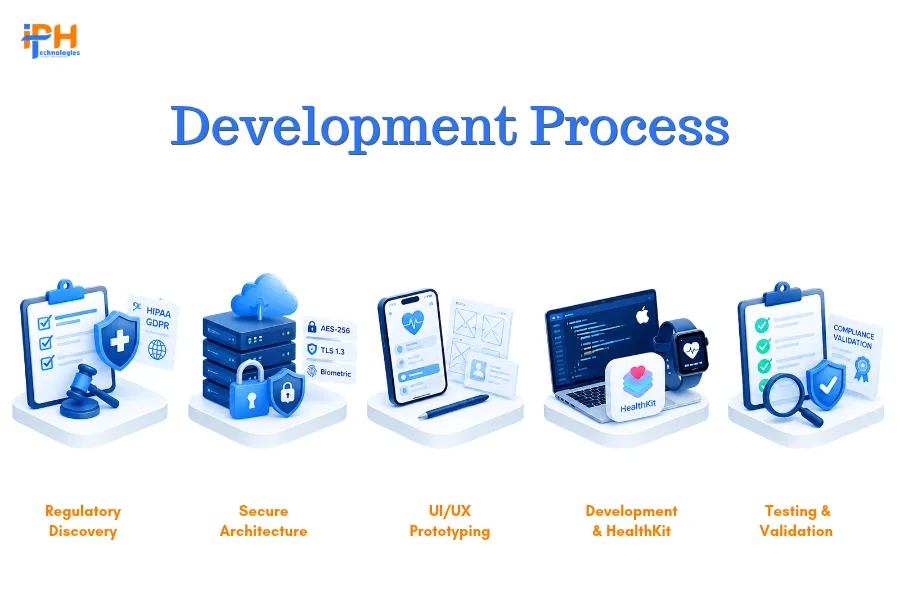
Building a compliant iOS healthcare app follows a strict five-stage roadmap, starting with regulatory mapping and ending in compliance audits, not the other way around.
Discovery & regulatory mapping comes first. This is where the team defines clinical workflows, draws a clear line between patient and clinician features, and identifies which regional regulations apply: HIPAA at minimum, GDPR if there’s any European user base.
Architecture & security setup follows immediately after, not as an afterthought. This stage locks in AES-256 encryption at rest, TLS 1.3 for data in transit, Face ID-based biometric login, and a secure cloud backend architecture.
UI/UX and prototyping come next, with a particular focus on low-friction onboarding. Patient consent screens, in particular, need to be legally sound and genuinely easy to understand — not just a wall of legal text.
Core coding and HealthKit integration is where Swift-based data controllers, API endpoints, and real-time device syncing actually get built. This is typically the longest phase, especially when wearable telemetry is involved.
Testing and compliance audits close out the process, including penetration testing, code profiling through Xcode’s built-in tools, and clinical accuracy validation before the app goes anywhere near the App Store.
Where Pharmacy Software Fits Into iOS Healthcare Development
Pharmacy app development in the US relies on the same core iOS healthcare framework but adds a regulatory layer specific to controlled substances and state pharmacy boards, on top of standard HIPAA compliance.
A pharmacy refill or e-prescribing app has to comply with DEA regulations around controlled substance tracking, not just general health data privacy. That means audit trails, mandatory two-factor verification for certain prescription categories, and integration with pharmacy management systems that a generic telehealth app never has to touch.
The best pharmacy software solutions in the US address compliance as a core architectural decision, rather than a feature tacked on later. Trying to retrofit DEA-compliant audit logging into an app that wasn’t architected for it usually costs more than building it in from the start.
“For a hospital system or pharmacy chain vetting vendors, the real question isn’t ‘can you build a pharmacy app?’ It’s ‘have you already factored in controlled substance tracking and state board rules before writing a single line of code?'”
Read More: How AI Is Transforming Healthcare Software Development Services in the USA?
Choosing the Right Development Partner
If you’re evaluating development partners for iOS healthcare app development, look beyond generic case studies and ask specific questions: which Apple frameworks have they actually shipped, how do they handle HIPAA audits, and can they provide verified SMART on FHIR integration?
A team that’s actually experienced developing native iPad apps or building native iPad application development services for clinical settings will have strong opinions, not just technical capabilities, on tablet-specific UX for nurses rounding on a busy floor. That presents vastly different requirements for patients at home.
It’s also worth asking directly whether you’re talking to iPad app developers in the US who understand US healthcare compliance, or an offshore team applying generic mobile experience to healthcare for the first time. Both can produce working code. Only one tends to catch the regulatory gaps before they become expensive.
Frequently Asked Questions (FAQs)
What's the difference between HealthKit and CareKit?
HealthKit as the vault; CareKit as the engine. HealthKit is the repository for heart rate, medications, and activity, while CareKit turns that information into actionable care plans and progress tracking that a patient or clinician can actually use day-to-day.
Is native iOS development necessary for HIPAA compliance, or can I use a cross-platform framework?
Native iOS development can technically satisfy HIPAA baseline, but it simplifies security implementation immensely. Direct access to the Secure Enclave and Apple’s biometric APIs is easier to secure natively than through cross-platform bridge layers, which is why most regulated health apps in the US treat native Swift as the default choice.
How long does it take to build a HIPAA-compliant iOS healthcare app?
Timelines range from roughly 3 months for a basic MVP to 9–12 months for an enterprise clinical platform. The variation comes mostly from EHR integration complexity and how many compliance audits and penetration testing cycles the app needs before submission.
Does Apple's App Store review process take longer for medical apps?
Yes, medical and health-data apps generally face longer and more detailed App Store reviews than standard consumer apps. Apps requesting HealthKit permissions get additional scrutiny, so it’s worth building a review buffer of at least two to three weeks into any launch timeline.










.png)