


































































































The growing popularity of smartphones, personalized digital services, and AI-powered applications has created increasing demand for astrology apps worldwide. Users can now access personalized horoscopes, birth charts, Kundli reports, compatibility analysis, planetary insights, and consultations directly from their mobile devices.
What Is Vedic Astrology?
Vedic astrology, also known as Jyotish or Indian astrology, is a traditional astrological system originating from ancient India. It studies the positions and movements of celestial bodies, including the Sun, Moon, planets, and lunar constellations, to interpret an individual’s personality, life events, relationships, career, and future possibilities.
Vedic astrology primarily uses the sidereal zodiac, which considers the actual astronomical position of the constellations. A Vedic astrology application uses the user’s birth date, exact birth time, and birthplace to generate a Kundli or birth chart and provide personalized astrological insights.
A modern Vedic astrology application can incorporate several traditional concepts, including Rashi (zodiac signs), Nakshatras (lunar constellations), Bhavas (houses), Dashas (planetary periods), Yogas, and planetary transits.
Also reads: Apple WWDC 2026 Announcements Explained
What Is Western Astrology?
Western astrology is an astrological system that originated in the Western world and is widely practiced across countries such as the United States, the United Kingdom, Canada, and parts of Europe. It studies the positions and movements of the Sun, Moon, planets, and other celestial bodies at the time of a person’s birth to interpret personality traits, life patterns, relationships, and potential future events.
Western astrology primarily uses the tropical zodiac, which is aligned with the Earth’s seasonal cycle and the position of the Sun relative to the equinoxes.
A Western astrology app generates a natal or birth chart using a user’s date, exact time, and place of birth. The chart maps the positions of the planets across the twelve zodiac signs and twelve houses.
Key Differences in Vedic vs Western Astrology App Development
Vedic and Western astrology apps may offer similar services, but their development requirements differ significantly. The main differences come from their zodiac systems, birth-chart calculations, features, content, and target audiences.
Zodiac System
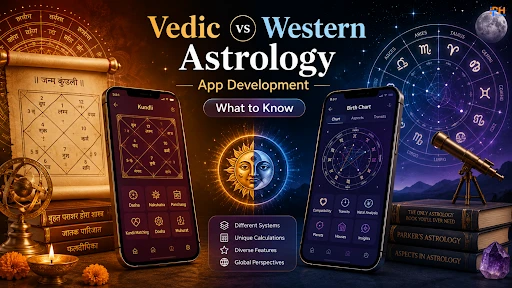
Vedic astrology apps primarily use the Sidereal Zodiac, while Western astrology apps generally follow the Tropical Zodiac.
Birth Chart
Vedic astrology apps generate a Kundli (Janam Kundli) based on the user’s birth details. Western astrology apps typically create a Natal or Birth Chart for interpretation.
Core Calculations
Vedic apps require calculations for Nakshatras, Dashas, Yogas, Bhavas, and planetary positions. Western astrology apps focus more on planetary aspects, houses, transits, and chart placements.
Key Features
Vedic astrology apps may include Kundli Matching, Dosha Analysis, Panchang, Muhurat, and Dasha predictions. Western astrology apps commonly offer compatibility analysis, transit tracking, natal chart readings, and personalized insights.
Target Market
Vedic astrology apps are particularly popular in India and South Asia, while Western astrology apps primarily target users across the US, Europe, and other global markets.
Consultation & Reports
Vedic apps often connect users with astrologers for Kundli analysis, consultations, and detailed reports. Western astrology apps generally focus on personal readings, compatibility reports, consultations, and customized interpretations.
Content & User Experience
Vedic apps provide Kundli-based predictions, planetary interpretations, and traditional Vedic guidance. Western astrology apps often emphasize personality traits, relationships, life events, planetary transits, and personal growth.
Examples of Vedic Astrology Apps
- AstroSage: One of the prominent Indian astrology platforms. Features include Kundli generation, horoscope, Kundli matching, Panchang, numerology, tarot, and astrologer consultations.
- Astroyogi: Focuses heavily on online astrologer consultations, along with horoscope, Kundli, tarot, numerology, and related services.
- Drik Panchang: Particularly useful as a reference for Panchang, Hindu calendars, festivals, Muhurat, Nakshatra and astronomical calculations.
- ClickAstro: Provides features around birth charts, horoscope reports, Kundli matching, predictions and astrology reports.
- AstroVed: Combines Vedic astrology, personalized readings, spiritual services, horoscope information and astrology-related content.
Also Read: AI Agent Mobile App Development 2026
Examples of Western Astrology Apps
- Co–Star — AI-powered personalized birth charts, daily horoscopes, compatibility, and social astrology features.
- The Pattern — Focuses on personality, relationships, and life-cycle insights based on birth data.
- CHANI — Offers birth charts, daily/weekly astrology, transits, and educational content.
- Astro-Seek — Provides detailed Western astrology charts, calculations, transits, synastry, and other tools.
- AstroMatrix — Provides natal charts, compatibility analysis, transits, and personalized interpretations.
- TimePassages — Known for detailed natal charts, planetary transits, aspects, and educational astrology content.
- Sanctuary Venture — Combines Western astrology with personalized readings and astrologer consultations.
Can One App Support Both Systems?
Yes, a single astrology app can support both Vedic and Western astrology by using a flexible, modular architecture. Instead of building two separate applications, developers can create a shared platform with a multi-astrology engine that allows users to select their preferred astrology system.
Separate calculation modules can handle the specific rules, zodiac systems, planetary calculations, birth charts, and prediction methods used by Vedic and Western astrology. At the same time, both systems can share common application infrastructure, including user accounts, profiles, payment gateways, subscriptions, notifications, consultation features, and content management.
This approach allows businesses to serve different audiences through one scalable application while maintaining the distinct calculation logic and user experience required by each astrology system. It can also make future expansion easier by allowing additional astrology systems, languages, AI-powered features, and personalized services to be integrated without rebuilding the entire application.
Also Reads: Best AI App Development Companies in India
AI in Astrology App Development
- AI Astrology Chatbot – Provides instant, personalized astrology guidance through natural conversations.
- Personalized Horoscope Generation – Uses users’ birth details and astrological data to create customized daily, weekly, or monthly horoscopes.
- Natural-Language Birth-Chart Explanations – Converts complex birth-chart data into simple, easy-to-understand insights.
- Compatibility Summaries – Analyzes two birth charts and provides an easy-to-understand overview of relationship compatibility.
- Conversational Recommendations – Uses user preferences and astrology insights to provide personalized suggestions, such as suitable activities, timing, or areas of focus.
Why Does AI Matter in Astrology App Development?
The combination of astrological calculation engines and AI can make astrology applications more interactive, personalized, and easier to understand. However, AI should generally act as an interpretation and conversational layer rather than replacing the underlying astronomical or astrological calculation engine.
For businesses developing an astrology app, the technology architecture should therefore separate accurate chart calculations, astrology rules, AI interpretation, user data, and conversational functionality. This approach can make the application easier to maintain, improve, and scale.
Key Factors Affecting Astrology App Development Cost
1. Astrology Calculation Engine
The astrology calculation engine is a major cost factor. Vedic apps may require Nakshatras, Dashas, Bhavas, Yogas, and Kundli calculations, while Western apps may need natal charts, planetary transits, aspects, and different house systems. Third-party APIs can reduce development time, whereas a custom engine requires more development and testing.
2. AI Integration
AI can turn an astrology app into a personalized digital astrology assistant. Features such as AI chatbots, birth-chart interpretation, personalized horoscopes, compatibility analysis, and automated recommendations can improve user engagement. Costs depend on the AI model, API usage, data processing, and customization requirements.
3. Online Astrology Consultation
Adding astrologer consultations increases development complexity. Features such as astrologer profiles, appointment booking, availability management, chat, voice and video calls, payments, ratings, and commission management require additional development and infrastructure.
4. Admin Panel
The admin panel allows businesses to manage users, astrologers, content, payments, subscriptions, consultations, notifications, and analytics. A basic admin panel costs less, while an advanced dashboard with detailed reporting and marketplace management requires more development resources.
5. Payment Gateway Integration
Payment integration is essential if the app offers consultations, premium reports, subscriptions, or virtual credits. Depending on the target market, businesses may need card payments, UPI, digital wallets, international payments, recurring subscriptions, or in-app purchases.
6. Cross-Platform Development
Developing separate native apps for Android and iOS can increase development costs. Frameworks such as Flutter and React Native can help launch on multiple platforms using a shared codebase, potentially reducing development time and resources.
7. UI/UX Design
A well-designed astrology app should make it easy for users to enter birth details, view charts, understand predictions, and book consultations. Advanced chart visualizations, animations, multilingual support, and personalized dashboards can increase the overall design and development cost.
8. Maintenance and Future Development
Post-launch maintenance is another important cost to consider. Businesses may need to budget for cloud hosting, third-party API charges, security updates, bug fixes, OS compatibility, AI usage, new features, performance optimization, and ongoing technical support.
How to Choose the Right Astrology App Development Approach?
Choosing the right astrology app development approach starts with identifying your target audience and market. If your primary users are from India, a Vedic astrology app with features such as Kundli, Nakshatra, Dasha, Kundli matching, and Panchang may be more suitable. For international audiences, Western astrology features such as natal charts, zodiac signs, planetary transits, and compatibility reports can be prioritized.
You should also consider the features and level of personalization required. A basic horoscope app may only need daily predictions and zodiac information, while an advanced platform can include birth-chart calculations, astrologer consultations, AI-powered astrology chatbots, personalized predictions, and compatibility analysis.
The technology and astrology calculation engine are equally important. The app should provide accurate planetary calculations and support a scalable backend that can handle growing users, content, payments, notifications, and third-party integrations.
Consider your business model and future growth. Decide whether the app will generate revenue through subscriptions, premium reports, paid consultations, advertisements, or in-app purchases. A scalable development approach allows you to introduce AI features, additional astrology systems, and new services as your user base grows.
Final Thought on Vedic vs Western Astrology App Development
Vedic and Western astrology apps serve different audiences and require different calculation methods, features, and user experiences. Vedic astrology applications focus on Kundli, Nakshatras, Dashas, compatibility, and traditional predictions, while Western astrology apps emphasize natal charts, zodiac signs, planetary transits, and personalized insights.
The right approach depends on your target market, business goals, required features, and level of personalization. Businesses can also consider combining both systems in one platform to reach a wider global audience.
With accurate astrology calculations, a scalable technology infrastructure, AI-powered personalization, and an intuitive user experience, an astrology app can become a strong digital product. Careful planning at the development stage helps ensure the app is reliable, engaging, and ready for future growth.
Frequently Asked Questions
What is the main difference between Vedic and Western astrology app development?
Vedic astrology apps generally focus on Kundli, Nakshatras, Dashas, planetary positions, and compatibility, while Western astrology apps commonly focus on natal charts, zodiac signs, houses, aspects, and planetary transits.
Can an astrology app support both Vedic and Western astrology?
Yes. A single app can support both systems by integrating separate calculation logic while using shared features such as user profiles, payments, notifications, consultations, and AI-powered tools.
What features should a Vedic astrology app include?
Important features can include Kundli generation, Nakshatra analysis, Dasha calculations, Kundli matching, Dosha analysis, Panchang, Muhurat, horoscope predictions, and astrologer consultations.
What features are important for a Western astrology app?
A Western astrology app can include natal chart generation, Sun/Moon/Rising sign analysis, planetary transits, compatibility reports, daily horoscopes, birth-chart interpretations, and personalized astrology insights.
How much does it cost to develop an astrology app?
The cost depends on the app’s features, platform, calculation engine, AI integration, design, backend complexity, payment systems, and third-party APIs. A simple horoscope app will generally require less investment than a full-featured astrology platform.








.png)