
























































































WWDC 2026 Full Recap: Everything Apple Announced — Keynote to Closing Sessions
Every June, Apple’s Worldwide Developers Conference turns into a week-long flood of headlines, hot takes, and half-explained jargon. By the time the dust settles, most people are left with a vague sense that “Siri got an AI upgrade” and not much else.
This recap is different. We sat through the keynote, the State of the Union, the developer sessions, and the follow-up Q&As — and pulled out everything that actually matters. Not just what Apple announced, but what it means for the apps on your phone, the business behind them, and what happens next.
The End of an Era — A Keynote Unlike Any Other
This year’s event opened under the tagline “All Systems Glow” — a not-so-subtle nod to the visual overhaul running through almost everything Apple showed off. But the bigger story wasn’t on a slide at all.
This was Tim Cook’s final keynote as Apple’s CEO. After 15 years at the helm, he closed his presentation with a simple, confident line about the company’s future — and confirmed that hardware chief John Ternus will officially take over as CEO on September 1.
Siri AI — The Headline Everyone Expected (And Then Some)
If there was one announcement that defined this year’s event, it was Siri AI — a complete, ground-up rebuild of Apple’s voice assistant.
The twist nobody saw coming: Siri AI runs on a custom version of Google’s Gemini model. After years of promising a smarter, more personal Siri that consistently missed its own deadlines, Apple decided the fastest way to close the gap with ChatGPT and Google Assistant was to partner with the very company many assumed it was racing against.
Here’s what the new Siri can actually do:
See what’s on your screen and act on it without you explaining the context first
Work across multiple apps in one go — for example, planning an evening around a message, checking your calendar, finding a restaurant, and setting a reminder, all from one request
Hold real conversations instead of one-off commands
Sound the way you want it to, with adjustable voice and pacing
There’s important fine print, though. Siri AI will not be available in the European Union or China when iOS 27 launches. Apple pointed to the EU’s Digital Markets Act as the reason, and developers in the EU won’t even be able to test the new Siri features during development.
This rollout also lands against a backdrop of real pressure — Apple recently settled a class action lawsuit tied to AI-powered Siri features that were promised years ago and never shipped on time. Siri AI is, in many ways, Apple finally delivering on that promise — just later, and with help.
iOS 27 and iPadOS 27 — Faster, Calmer, More Capable
iOS 27 is heading to compatible iPhones this September, and the two things you’ll notice first are speed and polish. Apple says everyday interactions — opening photos, switching apps, typing — feel noticeably snappier.
The other change a lot of people will appreciate: a Liquid Glass opacity slider. Last year’s translucent “Liquid Glass” design looked sleek in keynote demos but proved hard to read for plenty of real users. iOS 27 finally lets you tone it down to a level that works for you.
Apple Intelligence is woven more deeply into iOS 27 too, with smarter writing tools, more capable photo editing, and better-organized notifications in the Home app.
iPadOS 27 follows the same visual refresh and, for the first time, brings Siri AI and Visual Intelligence to the iPad. For anyone using an iPad for real work — writing, research, presentations — that’s a meaningful shift in how much you can do without touching a keyboard.
macOS Golden Gate — The Official End of Intel Macs
Apple’s next macOS release has a name: macOS Golden Gate, continuing the tradition of California landmark names.
The headline here is compatibility. macOS Golden Gate runs on Apple silicon only — M1 and later. If you’re still on an Intel-based Mac, this is the update that leaves you behind for good.
For everyone else, Golden Gate brings Siri AI into Spotlight, adds Visual Intelligence to the desktop, and positions the Mac as a genuinely AI-capable work machine rather than just a bigger iPhone.
Apple Intelligence Gets Noticeably Bigger
Apple Intelligence — the umbrella name for Apple’s on-device AI features — picked up a solid round of new abilities this year:
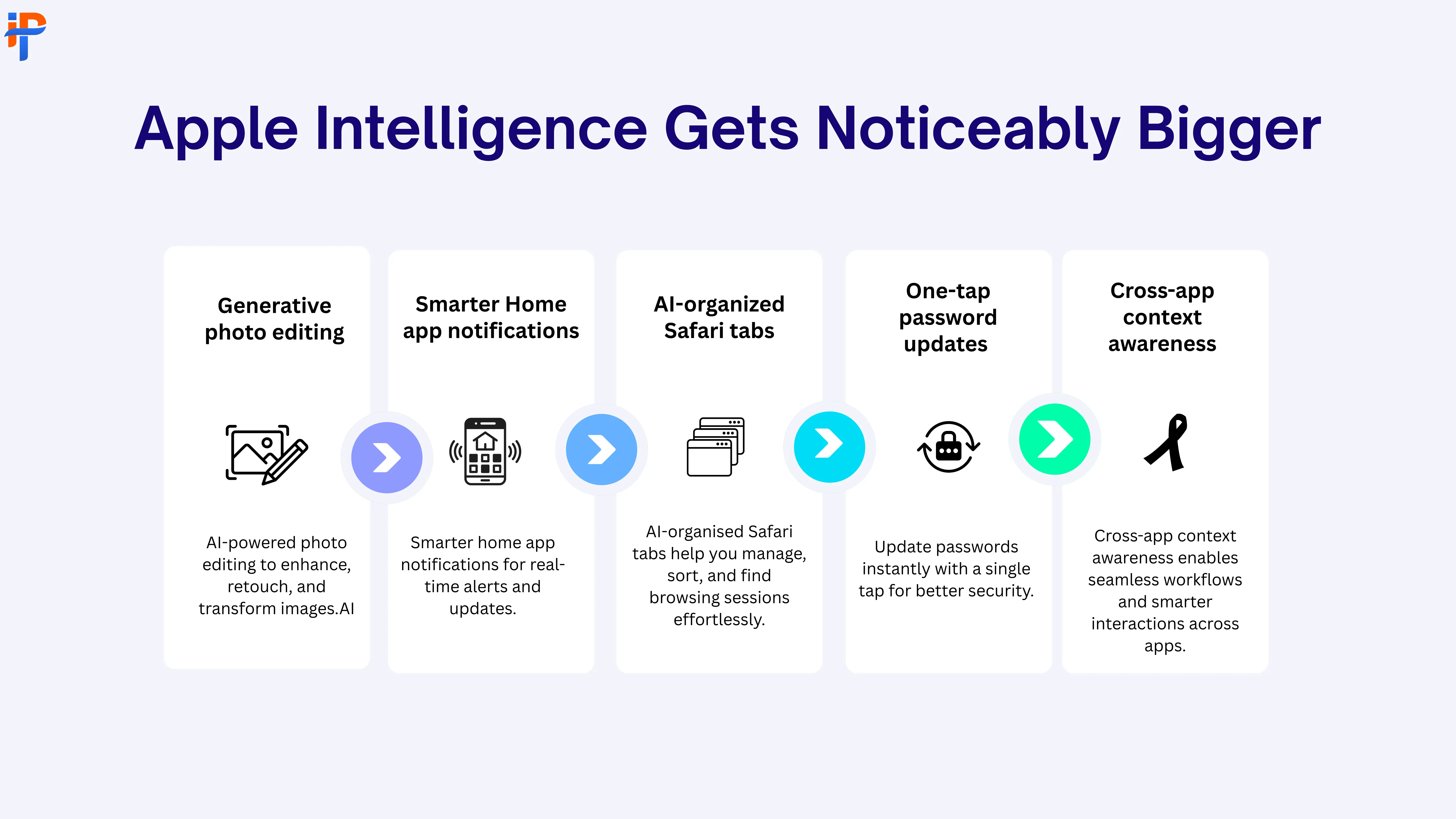
Generative photo editing — describe the change you want, and the edit happens automatically
Smarter Home app notifications — security camera alerts now come with useful context instead of just a ping
AI-organized Safari tabs — grouped automatically based on what you’re working on
One-tap password updates — when a site asks you to change your password, Apple Intelligence can update it across your accounts
Cross-app context awareness — Apple Intelligence can connect information across different apps without you manually copying anything over
Most of this still runs on-device, which remains a core part of Apple’s privacy pitch.
Also Read- AI MVP Development Cost in 2026: Complete Pricing Guide
The Quiet Bombshell — SiriKit’s Sunset and the App Intents Mandate
Buried in the afternoon’s Platforms State of the Union was the announcement that will keep app developers busy for the next two years: SiriKit has officially received a deprecation notice.
SiriKit has powered voice-assistant integrations for thousands of apps since 2016. Going forward, App Intents is the only framework through which Siri AI can talk to a third-party app. Apple is giving developers a window of roughly two to three years to migrate — putting the real deadline somewhere around the iOS 29 cycle in fall 2028.
This isn’t just a rebrand. The expanded App Intents framework now includes:
New App Schemas and App Entities that let your app’s content show up in Spotlight’s semantic search
A View Annotations API, which lets Siri understand and act on whatever is currently on screen — conversationally, not just through fixed commands
In plain terms: if your app currently relies on SiriKit for any voice features, shortcuts, or Spotlight integration, the clock has started on a migration that will affect how discoverable and “AI-ready” your app feels to users.
Under the Hood — What Changed for Developers
Beyond Siri, this was arguably the most AI-focused developer event Apple has ever run, with over 100 sessions and hands-on Group Labs running through the end of the week.
A few changes stood out:
Core AI replaces Core ML. It’s built on the same Foundation Models framework that powers the new Siri, giving developers access to the same on-device inference — pre-trained models, fine-tuning, larger context windows, and tool calling, all running on Apple silicon with private cloud compute as a fallback.
Foundation Models can now switch AI providers without code changes. Developers add a Swift Package Manager dependency for a given AI provider, and the rest of the app — session logic, tool calls, context handling — stays the same. That’s a big deal for any team that doesn’t want to be locked into a single AI vendor.
Xcode 27 ships with a dual-engine agentic coding system, pairing a local Neural Engine model for fast, everyday suggestions with more powerful cloud-based assistance for complex tasks.
If your app still depends on older Core ML pipelines, this is the point where the migration clock effectively starts.
Also Read- Apple’s AI Evolution: What Developers and Businesses Should Expect from WWDC 2026
What’s Coming Next — Foldables and New Security Guidance
Apple also used this WWDC to get ahead of hardware that hasn’t shipped yet. Developers got APIs for a foldable iPhone, including side-by-side app support, fold-state detection, and new layout tools — even though the device itself isn’t expected until later in the year. It’s the same approach Apple used with Vision Pro: get developers building before the hardware lands.
On the security side, Apple ran a dedicated session on the risks that come with apps acting more autonomously through Siri AI and App Intents — covering things like prompt injection, unintended actions, and the new authentication and confirmation steps developers will need to build in. For any business in a regulated space, this is the session worth paying attention to.
The Smaller Stuff Worth Knowing
A few additional updates rounded out the week:
AirPods now support a custom equalizer, so you can finally fix that bass-heavy or flat default sound profile
Parental controls got their biggest overhaul in years, giving parents far more granular control over what kids can access and for how long
The App Store picked up new developer flexibility around how apps are distributed and presented — one of the more significant policy shifts in several years
What This Means for Your Business
If you own or run a mobile app, this WWDC isn’t just interesting — it’s a checklist.
Siri AI changes how people will discover and interact with apps going forward. The App Intents mandate means any app still leaning on SiriKit needs a migration plan well before 2028 — and getting ahead of it means your app shows up in Siri AI and Spotlight results sooner than competitors who wait. The shift to Core AI and Foundation Models opens up real opportunities for AI features that used to require third-party SDKs. And if your business operates in finance, healthcare, or anywhere with compliance requirements, the new agentic security guidance is worth building into your roadmap now, not later.
At IPH Technologies, this is exactly the kind of shift we help businesses navigate — from App Intents migration and AI integration to full app modernization for iOS 27 and macOS Golden Gate. If you’re not sure where your app stands, we’re happy to walk through it with you.
Also Read- AI Agent Mobile App Development: Features, Benefits & Business Use Cases in 2026










.png)