

























































Highlights
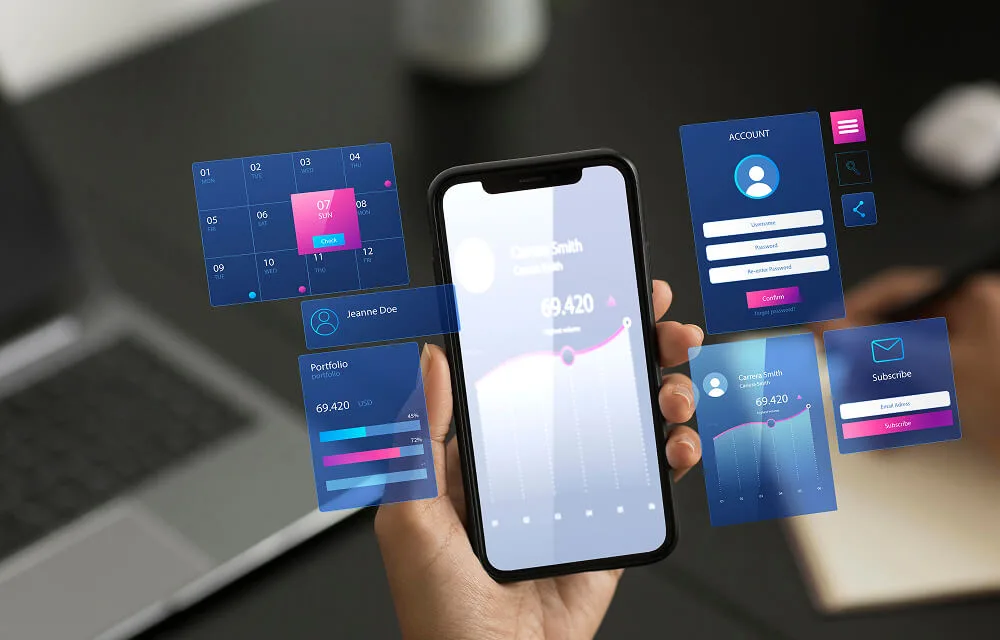
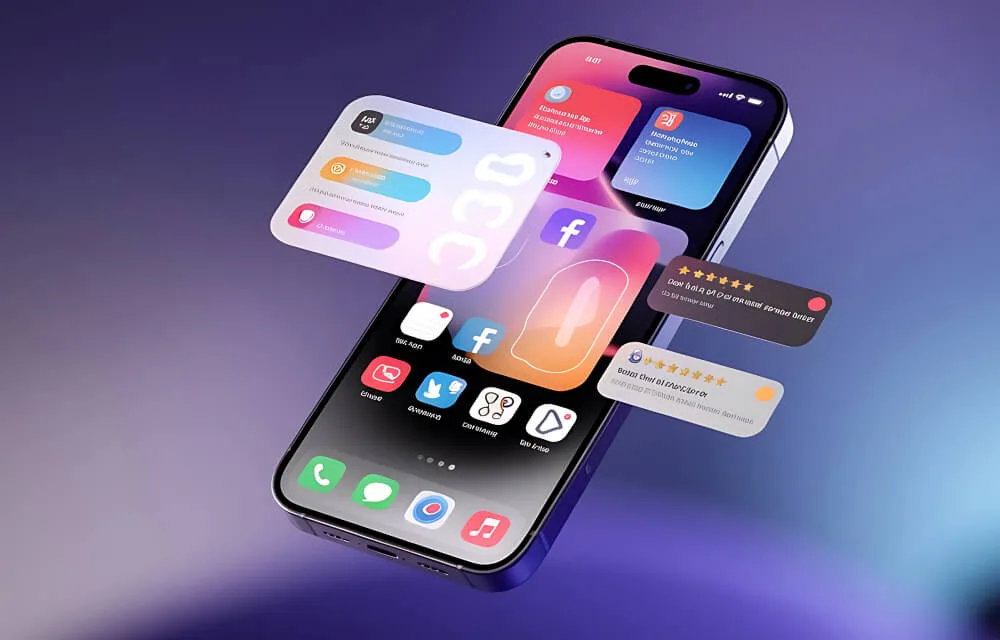
UI/UX Design
User-first, visually engaging interfaces crafted to enhance usability, boost engagement, and deliver seamless digital experiences.
Branding
Strategic brand identities that communicate your vision, build trust, and create a memorable presence across all touchpoints.
Wireframing
Structured layouts and user flows that map the product journey clearly before development begins, saving time and cost.
Prototype Design
Interactive prototypes that simulate real user interactions, helping validate ideas and refine experiences early.
Design Systems
Scalable design frameworks and reusable components that ensure consistency, speed, and efficiency across your product.
UI/UX Design

We design intuitive, user-centric interfaces that enhance engagement, improve usability, and deliver seamless digital experiences across all devices.

UI UX Design
  • User research and wireframing for clear flows
  • Modern UI design using Figma and Adobe XD
  • Interactive prototypes for better user experience testing
  • Usability testing and performance optimization improvements
  • Responsive design across all devices and screens
  • Scalable design systems with reusable UI components
Branding & Identity

We craft strong brand identities that communicate your vision, build trust, and create a lasting impression across all digital and offline touchpoints.

Branding and Identity
  • Logo design and brand identity creation
  • Brand guidelines and visual consistency systems
  • Color palette and typography selection strategy
  • Marketing materials and brand asset design
  • Social media branding and creative direction
  • Rebranding and brand positioning strategies
Wireframing

We create structured wireframes that define layout, user flow, and functionality, helping visualize ideas and build a strong foundation before design and development.

Wireframing
  • Low fidelity wireframes for initial structure
  • High fidelity wireframes with detailed layouts
  • User flow mapping for better navigation
  • Content hierarchy and layout planning
  • Clickable wireframes for early feedback
  • Clear structure before UI design phase
Prototype Design

We design interactive prototypes that simulate real user experiences, helping validate ideas, test functionality, and refine products before development.

Prototype Design
  • Interactive prototypes for real user experience
  • Clickable designs to test product functionality
  • User journey simulation for better understanding
  • Rapid prototyping for faster design validation
  • Feedback driven improvements before development
  • High fidelity prototypes with smooth interactions
Design Systems

We build scalable design systems that ensure consistency, improve collaboration, and accelerate product development across all platforms and teams.

Design Systems
  • Reusable UI components for consistent design
  • Design tokens for colors typography spacing
  • Component libraries for faster development workflow
  • Consistent branding across all digital products
  • Documentation for design and development teams
  • Scalable systems for growing product ecosystems
Highlights
Mobile Apps Development
High-performance Android and iOS mobile applications built with modern technologies, delivering seamless user experiences and robust functionality.
Desktop Application Dev
Powerful and secure desktop applications tailored for Windows, macOS, and Linux, designed for performance, scalability, and reliability.
Web App Development
Scalable and responsive web applications using modern frameworks like React, Angular, and Vue for fast, dynamic, and engaging experiences.
Cross-Platform
Cost-effective cross-platform solutions using Flutter and React Native, enabling a single codebase for both iOS and Android platforms.
PWA Development
Progressive Web Apps that combine the best of web and mobile, offering offline access, fast loading, and app-like experiences directly in the browser.
Highlights
Mobile App

Android

iOS

Flutter

Hybrid

Optimize

Native

Swift

Firebase

Android App Development

We craft powerful, scalable Android applications with intuitive UX, high performance, and deep integration with Google services.

Android App
  • Custom Android app development
  • Native Kotlin & Java apps
  • Google Play Store deployment
  • Material Design UI implementation
Kotlin

Kotlin

Java

Java

Flutter

Flutter

Android Studio

Android

Jetpack

Jetpack

iOS App Development

We build high-quality, user-centric iOS apps combining performance, security, and seamless design for Apple devices.

iOS App
  • Custom iOS app development
  • Native Swift & SwiftUI apps
  • Seamless Apple service integration
  • App Store review & deployment
Swift

Swift

SwiftUI

SwiftUI

Obj-C

Obj-C

Xcode

Xcode

Flutter

Flutter

Cross-Platform Apps

We develop cross-platform mobile apps that run flawlessly on both iOS and Android from a single codebase, saving time and cost.

Cross-Platform App
  • Single codebase for iOS & Android
  • Flutter & React Native development
  • Native-like performance & UI
  • Faster time-to-market
React Native

React Native

TypeScript

TypeScript

Redux

Redux

Firebase

Firebase

Dart

Dart

Hybrid Apps

We build hybrid mobile apps that blend web technologies with native capabilities, delivering broad reach and cost-effective development.

Hybrid App
  • Web + native feature integration
  • Ionic & Cordova frameworks
  • Reduced development costs
  • Multi-platform publishing
Flutter

Flutter

Dart

Dart

Firebase

Firebase

SQLite

SQLite

App Optimization

We enhance existing mobile apps with performance tuning, crash fixes, battery efficiency, and faster load times for a superior user experience.

App Optimization
  • Performance profiling & tuning
  • Memory & battery optimization
  • Crash analysis & bug fixing
  • App size reduction & load speed
Xcode

Xcode

Android Studio

Android

Firebase

Firebase

Java

Java

Highlights
Desktop App

Windows

macOS

Linux

Desktop

Electron

Qt

WinForms

GTK

Windows Apps

We develop robust Windows desktop applications using modern Microsoft technologies, delivering powerful tools for enterprise and consumer use.

Windows App
  • Custom Windows desktop applications
  • WPF & WinForms development
  • Microsoft Store deployment
  • Windows API & system integration
C#

C#

.NET

.NET

Electron

Electron

Visual Studio

Visual Studio

SQL Server

SQL Server

macOS Apps

We create elegant, high-performance macOS applications that leverage Apple's native frameworks for a smooth and delightful desktop experience.

macOS App
  • Native macOS app development
  • SwiftUI & AppKit integration
  • Mac App Store submission
  • Apple Silicon optimization
Swift

Swift

SwiftUI

SwiftUI

Obj-C

Obj-C

Xcode

Xcode

Cross-Platform Desktop

We develop cross-platform desktop applications that run seamlessly on Windows, macOS, and Linux from a single shared codebase.

Cross-Platform Desktop
  • Single codebase for all platforms
  • Electron & Tauri frameworks
  • Flutter for desktop support
  • Consistent UI across OS environments
Flutter

Flutter

Electron

Electron

Node.js

Node.js

TypeScript

TypeScript

Docker

Docker

Electron Apps

We build feature-rich Electron desktop apps using web technologies, enabling cross-platform deployment with native OS capabilities.

Electron App
  • Electron framework development
  • Node.js & Chromium integration
  • Auto-updater & native notifications
  • Cross-OS packaging & distribution
Electron

Electron

Node.js

Node.js

React

React

Vue

Vue

TypeScript

TypeScript

Highlights
Web App

React

Node.js

PHP

Laravel

Python

MySQL

JavaScript

HTML

CSS

React Development

We build fast, component-driven React web applications with modern state management, reusable UI, and seamless API integration.

React Development
  • Custom React SPA development
  • Redux & Context API state management
  • Next.js SSR & SSG support
  • REST & GraphQL API integration
React

React

Next.js

Next.js

Redux

Redux

TypeScript

TypeScript

Tailwind

Tailwind

Angular Development

We develop enterprise-grade Angular applications with structured architecture, two-way data binding, and robust TypeScript foundations.

Angular Development
  • Custom Angular SPA development
  • RxJS & NgRx state management
  • Angular Material UI components
  • Lazy loading & performance tuning
Angular

Angular

TypeScript

TypeScript

HTML

HTML

CSS

CSS

NPM

NPM

Node.js Backend

We build scalable, event-driven Node.js backends with RESTful APIs, real-time capabilities, and seamless database integrations.

Node.js Backend
  • RESTful & GraphQL API development
  • Express.js & Fastify frameworks
  • WebSocket & real-time features
  • MongoDB, PostgreSQL integration
Node.js

Node.js

Express

Express

MongoDB

MongoDB

GraphQL

GraphQL

Docker

Docker

Cloud Web Apps

We design and deploy cloud-native web applications on AWS, Azure, and GCP — scalable, secure, and built for high availability.

Cloud Web Apps
  • AWS, Azure & GCP deployment
  • Serverless architecture development
  • Auto-scaling & load balancing
  • CI/CD pipeline configuration
AWS

AWS

Azure

Azure

GCP

GCP

Docker

Docker

Kubernetes

Kubernetes

Full-Stack Dev

We deliver complete full-stack web solutions — from pixel-perfect frontends to robust backends — as a unified, end-to-end product.

Full-Stack Dev
  • Frontend & backend development
  • MERN & MEAN stack expertise
  • Database design & API architecture
  • DevOps, hosting & deployment
React

React

Node.js

Node.js

MongoDB

MongoDB

PostgreSQL

PostgreSQL

Docker

Docker

Highlights
Cross Platform

Flutter

R. Native

Xamarin

Ionic

Reuse

Electron

NW.js

Framework7

SwiftUI

Flutter Development

We build beautiful, natively compiled Flutter applications for mobile, web, and desktop from a single Dart codebase with pixel-perfect UI.

Flutter Development
  • Flutter mobile & web apps
  • Dart language development
  • Custom widget & animation creation
  • Firebase & REST API integration
Flutter

Flutter

Dart

Dart

Firebase

Firebase

GetX

GetX

Riverpod

Riverpod

React Native

We develop high-performance React Native apps that deliver a truly native experience on both iOS and Android using JavaScript and React.

React Native
  • Cross-platform iOS & Android apps
  • React Native CLI & Expo development
  • Native module & bridge integration
  • Redux & MobX state management
React Native

React Native

Redux

Redux

TypeScript

TypeScript

Firebase

Firebase

Xamarin

We develop Xamarin-based cross-platform apps using C# and .NET, enabling shared business logic across iOS, Android, and Windows.

Xamarin
  • Xamarin.Forms & MAUI apps
  • Shared C# codebase development
  • Native API access via bindings
  • Enterprise app integration
Xamarin

Xamarin

C#

C#

.NET MAUI

.NET

Azure

Azure

Visual Studio

Visual Studio

Ionic Framework

We create stunning Ionic applications that combine the power of web technologies with native device features for a seamless mobile experience.

Ionic Framework
  • Ionic Angular & React apps
  • Capacitor native plugin integration
  • Responsive mobile-first UI
  • PWA & hybrid app deployment
Ionic

Ionic

Angular

Angular

React

React

Vue

Vue

Code Reusability

We build reusable app architectures, reducing duplication, accelerating development, and ensuring seamless cross-platform consistency.

Code Reusability
  • Shared component library creation
  • Monorepo architecture setup
  • Design system implementation
  • Platform-agnostic business logic
Turborepo

Turborepo

Storybook

Storybook

Flutter

Flutter

React Native

React Native

Highlights
PWA

PWA

Offline

Push

Fast

App-Like

IndexedDB

Installable

Sync

Progressive Web Apps

We build Progressive Web Apps that combine the best of web and mobile — installable, reliable, and fast across all devices and browsers.

Progressive Web Apps
  • PWA architecture & manifest setup
  • Service worker implementation
  • Installable & home screen support
  • Cross-browser compatibility
HTML5

HTML5

CSS3

CSS3

JavaScript

JavaScript

Workbox

Workbox

Lighthouse

Lighthouse

Offline Support

We implement robust offline capabilities in your web apps using service workers and smart caching so users stay productive without connectivity.

Offline Support
  • Service worker caching strategies
  • IndexedDB offline data storage
  • Background sync implementation
  • Graceful offline fallback pages
Service Worker

ServiceWorker

Workbox

Workbox

IndexedDB

IndexedDB

Cache API

Cache API

Background Sync

BackgroundSync

Push Notifications

We integrate web push notification systems into your PWA to re-engage users with timely, personalized alerts even when the app is not open.

Push Notifications
  • Web Push API implementation
  • VAPID key & subscription management
  • Notification scheduling & targeting
  • Cross-browser push support
Web Push

Web Push

Firebase FCM

Firebase

OneSignal

OneSignal

Node.js

Node.js

Workbox

Workbox

Fast Loading

We optimize PWAs for lightning-fast load times using code splitting, lazy loading, and caching to deliver exceptional Core Web Vitals scores.

Fast Loading
  • Code splitting & lazy loading
  • Image & asset optimization
  • Core Web Vitals improvement
  • CDN & caching configuration
Webpack

Webpack

Lighthouse

Lighthouse

Vite

Vite

Cloudflare

Cloudflare

Workbox

Workbox

App-Like Experience

We craft PWAs that feel and behave like native mobile apps — with smooth animations, full-screen mode, gestures, and seamless transitions.

App-Like Experience
  • Full-screen & standalone display mode
  • Touch gestures & swipe navigation
  • Smooth page transitions & animations
  • App shell architecture
Web Manifest

Web Manifest

CSS Animations

CSS

Framer Motion

FramerMotion

React

React

Vue

Vue

Highlights
Custom Software
Fully tailored software solutions designed to match your unique business processes, improving efficiency and driving long-term growth.
Backend Systems
Robust and secure backend architectures built for high performance, scalability, and seamless integration with your applications.
Database Design
Efficient and scalable database structures optimized for fast queries, data integrity, and reliable performance at scale.
Cloud-Native
Modern cloud-native solutions using microservices and serverless architecture on AWS, Azure, and GCP for maximum flexibility and scalability.
API Development
Secure and well-documented RESTful and GraphQL APIs that enable seamless communication between systems and third-party integrations.
Custom Software

We develop tailored software solutions that align with your business goals, streamline operations, and deliver scalable, high-performance digital systems.

Custom Software Development
  • Custom software tailored to business needs
  • Scalable architecture for long term growth
  • Secure and high performance application development
  • API integration with third party services
  • Cloud based and enterprise software solutions
  • Ongoing maintenance and system optimization support
Backend Systems

We build robust backend systems that power applications with secure, scalable architecture, efficient data handling, and seamless integrations.

Backend Systems
  • Secure backend architecture and system design
  • Database design and performance optimization
  • API development for seamless integrations
  • Authentication and authorization system implementation
  • Server side logic and business workflows
  • Scalable infrastructure for high traffic applications
Database Design

We design efficient database structures that ensure data integrity, optimize performance, and support scalable, reliable application systems.

Database Design
  • Structured database schema design and planning
  • Efficient data modeling for scalable systems
  • Database optimization for faster query performance
  • Relational and non relational database solutions
  • Secure data storage and access management
  • Backup strategies and data recovery solutions
Cloud-Native Apps

We build cloud-native applications designed for scalability, resilience, and flexibility using modern cloud infrastructure and microservices architecture.

Cloud Native Apps
  • Cloud first architecture for scalable applications
  • Microservices based system design and deployment
  • Containerization using Docker and Kubernetes tools
  • Auto scaling infrastructure for high availability
  • Continuous integration and continuous deployment pipelines
  • Secure cloud environments with monitoring and logging
API Development

We develop secure and scalable APIs that enable seamless communication between systems, applications, and third party services.

API Development
  • RESTful API development for web applications
  • Secure API authentication and authorization systems
  • Third party API integration and data exchange
  • Scalable APIs for high traffic applications
  • API documentation for easy developer integration
  • Performance optimization and API response tuning
Highlights
Manual Testing
Detailed human-driven testing to uncover edge cases, validate user flows, and ensure a seamless, intuitive user experience.
Test Automation
Automated testing frameworks using Selenium, Cypress, and Appium to accelerate regression cycles and improve release confidence.
Performance
Load, stress, and scalability testing to ensure your application performs reliably under high traffic and demanding conditions.
Security Testing
Comprehensive security assessments including penetration testing and vulnerability analysis to safeguard your application.
Mobile QA
End-to-end mobile application testing across devices and platforms to ensure consistent performance, usability, and stability.
Manual Testing

We perform detailed manual testing to ensure software quality, identify issues early, and deliver reliable, user-friendly applications.

Manual Testing
  • Functional testing for application core features
  • UI testing for consistent user experience
  • Cross browser and device compatibility testing
  • Test case creation and execution processes
  • Bug tracking and detailed issue reporting
  • Regression testing after feature updates
Test Automation

We implement automated testing solutions to improve efficiency, reduce manual effort, and ensure faster, reliable software delivery.

Test Automation
  • Automated test scripts for faster execution
  • Regression testing using automation frameworks
  • Continuous testing within CI CD pipelines
  • Test coverage improvement across application modules
  • Reusable automation scripts for long term scalability
  • Performance and load testing automation solutions
Performance Testing

We evaluate application performance to ensure speed, stability, and scalability under different workloads and real-world conditions.

Performance Testing
  • Load testing for high traffic scenarios
  • Stress testing to identify system limits
  • Performance benchmarking and response time analysis
  • Scalability testing for growing user demands
  • Memory and resource usage optimization checks
  • Bottleneck identification and performance improvements
Security Testing

We identify vulnerabilities and secure applications against threats, ensuring data protection, compliance, and safe user interactions.

Security Testing
  • Vulnerability assessment and risk analysis testing
  • Penetration testing to identify security gaps
  • Authentication and authorization security validation
  • Data protection and encryption testing processes
  • Secure code review and security best practices
  • Compliance testing with industry security standards
Mobile QA

We ensure mobile applications deliver flawless performance, usability, and compatibility across devices, platforms, and environments.

Mobile QA
  • Mobile app testing across multiple devices
  • iOS and Android platform compatibility testing
  • UI testing for consistent mobile experience
  • Network and performance testing on mobile
  • App usability and user experience validation
  • App store readiness and release testing
Highlights
CI/CD Pipelines
Automated pipelines for building, testing, and deploying code, enabling faster releases, fewer errors, and continuous delivery.
Infrastructure
Scalable infrastructure provisioning using Infrastructure as Code (IaC) with Terraform and CloudFormation for consistency and reliability.
Deployment
Zero-downtime deployment strategies including blue-green and rolling deployments to ensure smooth and reliable releases.
Containerisation
Container-based architectures using Docker and Kubernetes for portability, scalability, and efficient resource utilization.
Monitoring
Real-time monitoring and observability using tools like Grafana, Prometheus, and Datadog to ensure system health and performance.
CI/CD Pipelines

We implement CI/CD pipelines to automate build, testing, and deployment, enabling faster releases, improved quality, and continuous delivery.

CI CD Pipelines
  • Automated build and deployment pipeline setup
  • Continuous integration for faster code validation
  • Continuous delivery for seamless release cycles
  • Integration with Git version control systems
  • Automated testing within CI CD workflows
  • Monitoring and rollback strategies for deployments
Infrastructure

We design and manage reliable infrastructure to ensure scalability, security, and high availability for modern applications and systems.

Infrastructure
  • Cloud infrastructure setup and configuration services
  • Server management and deployment automation solutions
  • High availability and load balancing implementation
  • Monitoring and logging for system performance tracking
  • Security hardening and infrastructure access controls
  • Scalable environments for growing application demands
Deployment

We manage seamless deployment processes to ensure applications are delivered efficiently, securely, and ready for production environments.

Deployment
  • Application deployment to cloud and servers
  • Automated deployment workflows for faster releases
  • Environment configuration and setup management
  • Version control and release management processes
  • Rollback strategies for safe deployment updates
  • Post deployment monitoring and performance checks
Containerization

We use containerization to package applications for consistency, scalability, and efficient deployment across different environments.

Containerization
  • Application containerization using Docker technologies
  • Environment consistency across development and production
  • Container orchestration with Kubernetes platforms
  • Scalable container deployment for microservices architecture
  • Efficient resource utilization and system isolation
  • Integration with CI CD pipelines for automation
Monitoring

We monitor systems and applications in real time to ensure performance, reliability, and quick issue detection and resolution.

Monitoring
  • Real time system performance monitoring tools
  • Application health checks and uptime tracking
  • Error tracking and issue alerting systems
  • Log management and analysis for debugging
  • Resource usage monitoring across infrastructure layers
  • Proactive issue detection and incident response
Highlights
Roadmap Planning
Strategic product roadmaps aligned with business goals, helping prioritize features, manage timelines, and deliver maximum value.
Team Coordination
Efficient coordination across design, development, and QA teams to ensure smooth collaboration and on-time project delivery.
Growth Strategy
Data-driven product strategies focused on user acquisition, retention, and continuous improvement to drive sustainable growth.
Agile Sprints
Agile methodologies like Scrum and Kanban to deliver iterative releases, improve flexibility, and maintain predictable progress.
Stakeholder Mgmt
Clear communication and alignment with stakeholders through regular updates, reporting, and feedback loops to ensure project success.
Roadmap Planning

We create strategic roadmaps that align with your business goals, helping prioritize features, plan execution, and ensure long-term success.

Roadmap Planning
  • Product roadmap planning aligned with business objectives
  • Feature prioritization based on user and market needs
  • Timeline planning for efficient project execution phases
  • Technology stack selection for scalable solutions
  • Risk assessment and mitigation strategy planning
  • Continuous roadmap updates based on performance insights
Team Coordination

We ensure smooth collaboration across teams to improve productivity, streamline workflows, and deliver projects efficiently on time.

Team Coordination
  • Cross functional team collaboration and communication
  • Agile workflow management and sprint planning processes
  • Task tracking and project progress visibility tools
  • Clear role assignment and responsibility management
  • Regular updates and performance review meetings
  • Efficient coordination between design development teams
Growth Strategy

We develop data-driven growth strategies to scale your business, increase user acquisition, and maximize long-term revenue potential.

Growth Strategy
  • Market analysis and competitive growth planning strategies
  • User acquisition and retention optimization techniques
  • Data driven decision making and performance insights
  • Scalable business models for long term expansion
  • Conversion rate optimization across digital platforms
  • Continuous growth tracking and strategy refinement
Agile Sprints

We follow agile sprint methodologies to deliver faster iterations, improve collaboration, and ensure continuous product improvement.

Agile Sprints
  • Sprint planning and backlog prioritization processes
  • Daily standups for team alignment and progress tracking
  • Iterative development with continuous feedback cycles
  • Task management using agile tools and workflows
  • Regular sprint reviews and performance retrospectives
  • Faster delivery with incremental feature releases
Stakeholder Management

We ensure clear communication and alignment with stakeholders to drive project success, transparency, and informed decision making.

Stakeholder Management
  • Regular stakeholder communication and reporting processes
  • Requirement alignment with business goals and expectations
  • Feedback collection and continuous improvement strategies
  • Transparent project updates and progress visibility
  • Risk identification and stakeholder expectation management
  • Collaborative decision making for project success

Healthcare App Development Compliance Checklist for 2026: A Practical Guide for Founders

Building a healthcare app is nothing like building a food delivery app or a to-do list tool. One mishandled data field, one missing consent screen, one skipped encryption layer — and you’re not just looking at a bad review. You’re looking at a federal investigation.

That sounds dramatic. It isn’t. It’s just 2026.

If you’re planning to build (or already building) a healthcare app this year, this checklist is your reality check.

We’ll walk through every layer of compliance you need — privacy law, medical device regulation, security certifications, AI governance — and turn it into something you can actually act on, not just admire in a PDF.

Why Compliance Can’t Be an Afterthought in 2026

Here’s the thing about healthcare apps: they sit at the intersection of two worlds that don’t forgive mistakes. Medicine doesn’t forgive mistakes. And neither does regulation.

The mHealth market itself tells you why the stakes keep climbing. Industry estimates put the global mHealth apps market at roughly $45 billion in 2026, growing at a compound annual rate north of 11–12% through the early 2030s.

More apps, more patient data, more attack surface. It’s basic math — the bigger the pie, the bigger the target on your back.

And regulators know this. That’s why 2026 has already brought updated HIPAA penalty structures, a new FDA cybersecurity guidance, and fresh Quality Management System rules for medical device software.

None of this happened by accident. It happened because healthcare data breaches remain, for the fourteenth year running, the most expensive kind of breach any industry can suffer.

So no, compliance isn’t paperwork you bolt on before launch. It’s architecture. It has to be baked in from your very first Figma frame.

Also Read – Healthcare App Development Trends 2026: Complete Guide

The Regulatory Landscape Healthcare Apps Must Navigate

Let’s break down the frameworks that actually matter, because “healthcare compliance” isn’t one law — it’s a stack of them, and which ones apply depends entirely on what your app does and where your users live.

HIPAA and the 2026 Security Rule Overhaul

If your app touches Protected Health Information (PHI) in the US — even indirectly, even through a vendor — HIPAA applies. Full stop.

HHS finalized updated inflation-adjusted penalty tiers effective January 28, 2026, and 2026 also brings mandatory Security Rule updates including multi-factor authentication, network segmentation, encryption of ePHI at rest and in transit, and a 72-hour breach notification requirement to OCR (Medcurity). Miss these, and you’re not looking at a warning letter — you’re looking at Tier 2 or Tier 3 penalties right out of the gate.

Here’s a detail most founders miss: HIPAA doesn’t just apply to hospitals. OCR has fined solo practitioners and small clinics between $30,000 and $250,000 for the same violations that sink hospital systems — missing risk assessments, absent Business Associate Agreements, delayed patient record access (BayArea Compliance). If you’re a startup thinking “we’re too small to matter,” think again. Small is exactly who OCR is watching now.

GDPR and International Data Protection Rules

Planning to launch in the UK, EU, Canada, or Australia? HIPAA won’t save you there. GDPR treats health data as a “special category” requiring explicit consent, strict purpose limitation, and the right to erasure. Penalties can reach up to 4% of global annual revenue — a number that makes HIPAA’s fines look almost quaint by comparison.

The practical takeaway: design your consent flows, data retention policies, and deletion mechanisms for the strictest applicable jurisdiction, then apply that baseline everywhere.

It’s far cheaper to build once correctly than to maintain five regional variants.

FDA’s Software as a Medical Device (SaMD) Framework

This is where many health app founders get tripped up. Not every health app is a “medical device” in the FDA’s eyes — but plenty are, and the line has actually gotten clearer (and in some cases, more lenient) in 2026.

In January 2026, the FDA published guidance narrowing oversight for low-risk digital health products — fitness wearables, general wellness trackers, and clinical decision support tools that don’t make autonomous clinical decisions may not require FDA clearance at all.

But if your app diagnoses, triages, or recommends specific treatment based on patient data, you’re likely in SaMD territory — and that means 510(k) clearance, De Novo classification, or full premarket approval, depending on risk class.

The FDA’s AI-enabled device list has also exploded — from roughly 950 authorized devices in August 2024 to over 1,250 by mid-2025.

If your app uses AI/ML for anything diagnostic, budget time and money for this pathway early — it’s not something you retrofit after launch.

Also Read – Step-by-Step Guide to Building a Successful Mobile App in 2026

HITRUST, SOC 2, and ISO 27001 — Do You Need All Three?

Short answer: probably not all three at once, but you’ll likely need at least one, especially if you’re courting enterprise health system clients or payers.

  • HITRUST CSF is the gold standard health systems and insurers ask for by name.
  • SOC 2 Type II proves your operational security controls over time — a common ask from B2B healthcare SaaS buyers.
  • ISO 27001 is the international baseline, especially relevant if you’re expanding beyond the US.

Think of these certifications less as badges and more as a shared vocabulary. They let a hospital’s procurement team trust you without auditing your codebase line by line.

The Real Cost of Getting Compliance Wrong

Let’s talk numbers, because nothing focuses a founder’s mind like a dollar figure.

HIPAA Penalty Tiers, Explained in Plain English

TierCulpability LevelPenalty Range (Per Violation, 2026)Annual Cap (Per Category)
Tier 1No knowledge — couldn’t reasonably have known$145 – $73,011$2,190,294
Tier 2Reasonable cause — not willful neglect$1,461 – $73,011$2,190,294
Tier 3Willful neglect, corrected within 30 days$14,602 – $73,011$2,190,294
Tier 4Willful neglect, not corrected$73,011 – $2,190,294$2,190,294

Figures reflect the January 28, 2026 inflation-adjusted HHS penalty schedule (Accountable HQ; Medcurity).

Notice something? Even the “lowest” tier — where you genuinely had no idea a violation occurred — can still cost you over $2 million annually per category if the violations pile up.

That’s the equivalent of your seed round evaporating because someone forgot to encrypt a backup.

And here’s the part that should really worry you: criminal penalties exist too, separate from OCR’s civil fines.

Knowingly obtaining or disclosing PHI can result in up to 1 year in prison; doing so for personal gain or with malicious intent escalates to 10 years and a $250,000 fine — and these penalties apply to individuals, not just companies.

What a Healthcare Data Breach Actually Costs You

Beyond regulatory fines, there’s the breach itself. IBM’s 2025 Cost of a Data Breach Report found healthcare breaches averaged $7.42 million in the US — the most expensive of any industry studied, for the fourteenth consecutive year.

Healthcare breaches also took the longest to detect and contain of any sector — about 279 days, roughly five weeks longer than the cross-industry average.

Think about that for a second. Nine months of an attacker quietly sitting inside your systems before anyone notices.

That’s not a technical failure — that’s a monitoring and governance failure, and it’s entirely preventable with the checklist below.

The Complete 2026 Healthcare App Compliance Checklist

Here’s where we get tactical. Break this down into five workstreams and treat each one as a sprint deliverable, not a launch-week scramble.

Data Privacy & Security Checklist

  • Encrypt PHI/ePHI at rest and in transit (AES-256 minimum)
  • Implement mandatory multi-factor authentication for all admin and clinician accounts
  • Apply network segmentation between patient data systems and general app infrastructure
  • Build role-based access controls with the principle of least privilege
  • Set up automated audit logging for every PHI access event
  • Establish a 72-hour breach notification workflow to regulators and affected users
  • Define and enforce data retention and secure deletion policies

Regulatory Classification Checklist

  • Determine whether your app qualifies as SaMD under FDA’s current framework
  • Map every data type you collect against HIPAA, GDPR, and relevant state laws (e.g., CCPA)
  • Identify your regulatory pathway early — 510(k), De Novo, or enforcement discretion
  • Document your intended use statement precisely — vague claims invite regulatory scrutiny

Technical Architecture Checklist

  • Choose HIPAA-eligible cloud infrastructure (AWS, Azure, GCP all offer compliant configurations)
  • Sign Business Associate Agreements (BAAs) with every cloud and infrastructure vendor
  • Build a Software Bill of Materials (SBOM) to track every third-party component and its vulnerabilities
  • Design for “secure by design” — threat modeling and penetration testing before launch, not after
  • Implement automatic session timeouts and device-level security checks

Third-Party & Vendor Management Checklist

  • Vet every SDK, analytics tool, and API integration for PHI exposure risk
  • Confirm BAAs are in place with all subcontractors who touch patient data
  • Avoid third-party trackers and ad SDKs on any screen that touches health data
  • Review vendor SOC 2 or HITRUST reports annually, not just at onboarding

Documentation & Governance Checklist

  • Conduct and document an enterprise-wide HIPAA risk assessment — update it annually
  • Maintain workforce HIPAA training records for every employee with data access
  • Create a formal incident response plan and test it at least twice a year
  • Assign a named Privacy Officer and Security Officer, even in a small startup
  • Keep a change-control log for every material update to app functionality or data flows

Where AI Features Add a New Compliance Layer

AI is everywhere in healthcare apps now — symptom checkers, triage assistants, personalized treatment nudges. But every AI feature you add is also a new regulatory surface.

If your model makes or influences a clinical decision, you likely need a Predetermined Change Control Plan (PCCP) under FDA’s finalized December 2024 guidance, covering exactly how your model can evolve post-launch without triggering a fresh submission every time you retrain it.

You’ll also need documented Good Machine Learning Practices — think of it as version control, but for clinical trust.

There’s also a quieter risk: AI governance gaps are now directly tied to higher breach costs.

IBM found that organizations without formal AI governance policies paid noticeably more when breached, and breaches involving “shadow AI” tools added roughly $670,000 to the average incident cost.

If your team is quietly feeding patient data into ChatGPT to draft a feature spec, that’s not innovation — that’s an incident waiting to happen.

Building Compliance Into Your Development Timeline

Compliance works best when it’s a parallel track, not a final gate. Here’s roughly how we’d sequence it across a typical build:

Development PhaseCompliance ActivityOwner
Discovery & PlanningRegulatory classification, data mapping, risk assessmentProduct + Legal
Architecture DesignHIPAA-eligible infra selection, BAA sign-off, threat modelingEngineering
DevelopmentEncryption, access controls, audit logging, SBOM trackingEngineering + Security
QA & TestingPenetration testing, vulnerability scanning, access control auditsSecurity
Pre-LaunchIncident response plan, staff training, privacy policy finalizationCompliance Officer
Post-LaunchContinuous monitoring, annual risk assessment, vendor reviewOperations

Notice how little of this sits at the very end. That’s intentional. A compliance review two weeks before launch is a fire drill, not a strategy.

Common Compliance Mistakes Healthcare Startups Make

We’ve seen the same handful of mistakes sink otherwise promising healthcare apps, again and again:
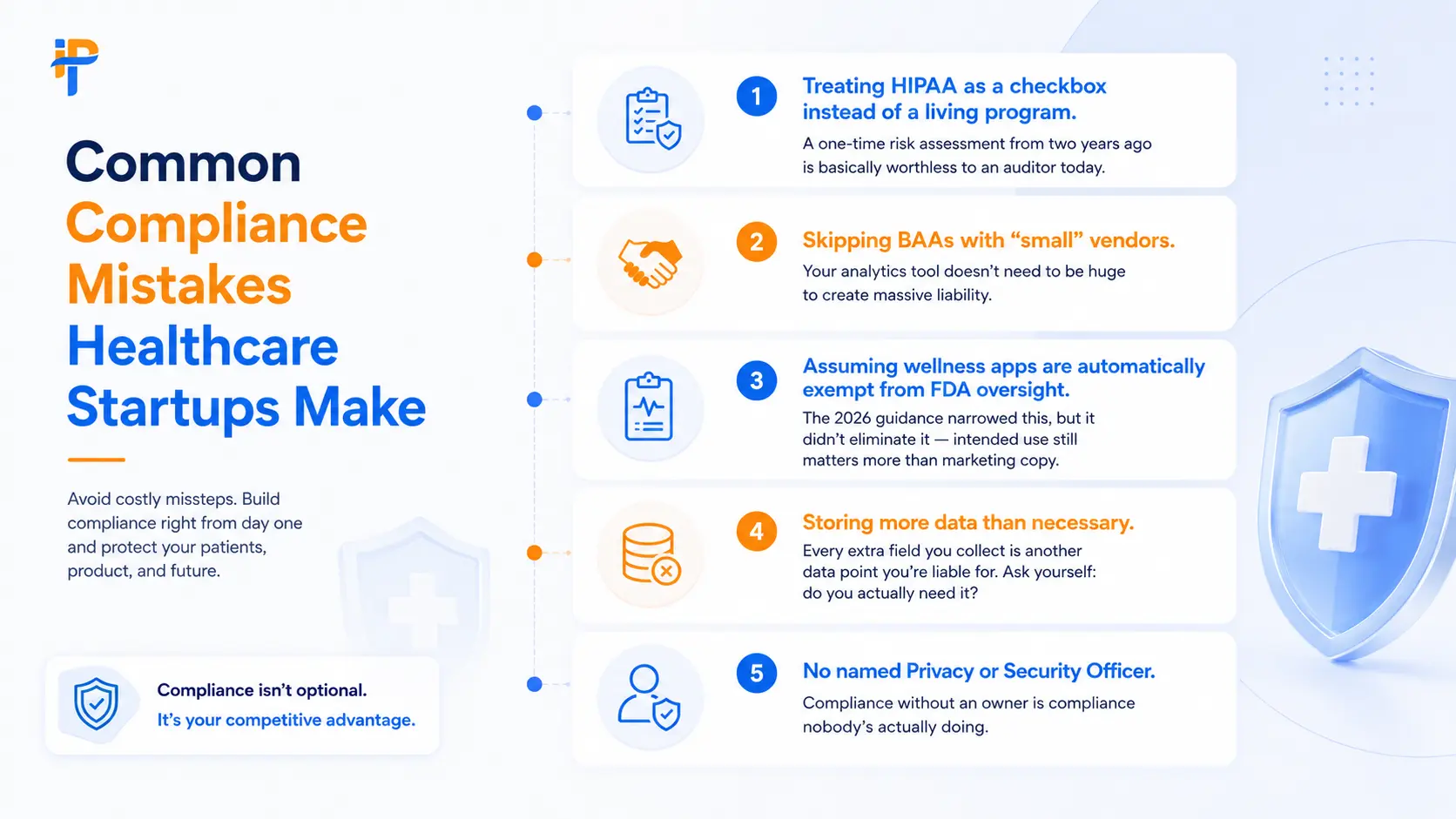
common Compliance Mistake Healthcare

  1. Treating HIPAA as a checkbox instead of a living program. A one-time risk assessment from two years ago is basically worthless to an auditor today.
  2. Skipping BAAs with “small” vendors. Your analytics tool doesn’t need to be huge to create massive liability.
  3. Assuming wellness apps are automatically exempt from FDA oversight. The 2026 guidance narrowed this, but it didn’t eliminate it — intended use still matters more than marketing copy.
  4. Storing more data than necessary. Every extra field you collect is another data point you’re liable for. Ask yourself: do you actually need it?
  5. No named Privacy or Security Officer. Compliance without an owner is compliance nobody’s actually doing.

Sound familiar? If even two of these hit close to home, it’s worth pausing your roadmap for a week to fix them before you build further on shaky ground.

Also Read – 2026 Mobile App Compliance Guide: GDPR, HIPAA & App Store Rules

How IPH Technologies Builds Compliance-Ready Healthcare Apps

At IPH Technologies, we’ve spent over a decade shipping app development, web development, and custom software solutions across 500+ projects and 430+ clients — and healthcare has consistently been one of the domains where “move fast” has to be balanced with “don’t get sued.”

Our approach treats compliance as a design constraint from day one, not a post-launch audit.

We build on HIPAA-eligible infrastructure, implement encryption and access controls at the architecture level, and structure our development sprints so security and regulatory reviews run alongside feature work — not after it.

Whether you’re building an mHealth wellness app, a remote patient monitoring platform, or an AI-powered diagnostic tool that needs FDA clearance, our team helps you map the right regulatory pathway before a single line of code gets written.

We’re not just developers who happen to touch healthcare. We’re a partner who understands that in this space, the code and the compliance are the same conversation.

Conclusion

Building a healthcare app in 2026 means accepting a simple truth: your product’s success depends as much on your compliance posture as it does on your UX.

HIPAA penalties are climbing, the FDA’s AI oversight is maturing fast, and data breaches in this sector remain the costliest of any industry, year after year. None of that is going away.

But here’s the encouraging part — none of it is unmanageable either.

Every item on this checklist is achievable with the right planning, the right partners, and the discipline to treat compliance as architecture rather than an afterthought.

Get it right from the start, and you’re not just avoiding fines.

You’re building the kind of trust that gets hospitals, patients, and investors to actually say yes.

Frequently Asked Questions (FAQs)

Does every healthcare app need to be HIPAA compliant?
Only if it collects, stores, or transmits Protected Health Information (PHI) on behalf of a covered entity or business associate. A general fitness tracker with no clinical data may fall outside HIPAA’s scope, but the moment you add features like symptom logging tied to a real identity, you’re likely in HIPAA territory.
What's the difference between HIPAA and HITRUST?
HIPAA is a US federal law with legal penalties for non-compliance. HITRUST CSF is a voluntary certification framework that demonstrates you meet (and exceed) HIPAA’s requirements in a way that’s independently verifiable — many enterprise health systems require it as a vendor prerequisite.
How do I know if my app qualifies as a medical device (SaMD)?
It generally comes down to intended use. If your app diagnoses, treats, or makes autonomous clinical recommendations, it likely qualifies. If it simply displays information or supports general wellness without clinical claims, it may fall under FDA’s enforcement discretion. When in doubt, consult a regulatory affairs specialist before development, not after.
What happens if I launch without full compliance and fix it later?
This is a common but risky approach. Retrofitting compliance after launch is significantly more expensive than building it in from the start, and you’re exposed to penalties the entire time you’re non-compliant — even if no breach occurs.
Do international users change my compliance requirements?
Yes, significantly. Serving EU users triggers GDPR obligations regardless of where your company is based. The safest approach is designing for the strictest applicable regulation and applying it globally rather than maintaining multiple compliance tracks.
How much does HIPAA-compliant app development typically add to a project?
It varies by app complexity, but budgeting for compliant infrastructure, security testing, and documentation typically adds 15–30% to development costs — a fraction of what a single HIPAA fine or breach could cost.
Who should own compliance inside a healthcare startup?
Ideally, a named Privacy Officer and Security Officer — even if that’s one person wearing two hats in an early-stage startup. Compliance without a clear owner tends to fall through the cracks exactly when it matters most.
Avatar
Lekha Mishra

Verified CEO

About the Author

I'm Lekha Mishra, Co-Founder of IPH Technologies, a 6x award-winning software and mobile solutions provider. My mission is to empower global entrepreneurs by transforming visionary ideas into powerful, market-ready products. We move beyond code to provide strategic insights and a competitive edge, specializing in intelligent solutions powered by AI and ML. I believe in leveraging these technologies to unlock new possibilities, drive growth, and deliver unparalleled value. Let's connect and turn your vision into a lasting legacy.


WhatsApp
Call us
Get a Call Back