









































Highlights
UI/UX Design
User-first, visually engaging interfaces crafted to enhance usability, boost engagement, and deliver seamless digital experiences.
Branding
Strategic brand identities that communicate your vision, build trust, and create a memorable presence across all touchpoints.
Wireframing
Structured layouts and user flows that map the product journey clearly before development begins, saving time and cost.
Prototype Design
Interactive prototypes that simulate real user interactions, helping validate ideas and refine experiences early.
Design Systems
Scalable design frameworks and reusable components that ensure consistency, speed, and efficiency across your product.
UI/UX Design

We design intuitive, user-centric interfaces that enhance engagement, improve usability, and deliver seamless digital experiences across all devices.

UI UX Design
  • User research and wireframing for clear flows
  • Modern UI design using Figma and Adobe XD
  • Interactive prototypes for better user experience testing
  • Usability testing and performance optimization improvements
  • Responsive design across all devices and screens
  • Scalable design systems with reusable UI components
Branding & Identity

We craft strong brand identities that communicate your vision, build trust, and create a lasting impression across all digital and offline touchpoints.

Branding and Identity
  • Logo design and brand identity creation
  • Brand guidelines and visual consistency systems
  • Color palette and typography selection strategy
  • Marketing materials and brand asset design
  • Social media branding and creative direction
  • Rebranding and brand positioning strategies
Wireframing

We create structured wireframes that define layout, user flow, and functionality, helping visualize ideas and build a strong foundation before design and development.

Wireframing
  • Low fidelity wireframes for initial structure
  • High fidelity wireframes with detailed layouts
  • User flow mapping for better navigation
  • Content hierarchy and layout planning
  • Clickable wireframes for early feedback
  • Clear structure before UI design phase
Prototype Design

We design interactive prototypes that simulate real user experiences, helping validate ideas, test functionality, and refine products before development.

Prototype Design
  • Interactive prototypes for real user experience
  • Clickable designs to test product functionality
  • User journey simulation for better understanding
  • Rapid prototyping for faster design validation
  • Feedback driven improvements before development
  • High fidelity prototypes with smooth interactions
Design Systems

We build scalable design systems that ensure consistency, improve collaboration, and accelerate product development across all platforms and teams.

Design Systems
  • Reusable UI components for consistent design
  • Design tokens for colors typography spacing
  • Component libraries for faster development workflow
  • Consistent branding across all digital products
  • Documentation for design and development teams
  • Scalable systems for growing product ecosystems
Highlights
Mobile Apps Development
High-performance Android and iOS mobile applications built with modern technologies, delivering seamless user experiences and robust functionality.
Desktop Application Dev
Powerful and secure desktop applications tailored for Windows, macOS, and Linux, designed for performance, scalability, and reliability.
Web App Development
Scalable and responsive web applications using modern frameworks like React, Angular, and Vue for fast, dynamic, and engaging experiences.
Cross-Platform
Cost-effective cross-platform solutions using Flutter and React Native, enabling a single codebase for both iOS and Android platforms.
PWA Development
Progressive Web Apps that combine the best of web and mobile, offering offline access, fast loading, and app-like experiences directly in the browser.
Highlights
Mobile App

Android

iOS

Flutter

Hybrid

Optimize

Native

Swift

Firebase

Android App Development

We craft powerful, scalable Android applications with intuitive UX, high performance, and deep integration with Google services.

Android App
  • Custom Android app development
  • Native Kotlin & Java apps
  • Google Play Store deployment
  • Material Design UI implementation
Kotlin

Kotlin

Java

Java

Flutter

Flutter

Android Studio

Android

Jetpack

Jetpack

iOS App Development

We build high-quality, user-centric iOS apps combining performance, security, and seamless design for Apple devices.

iOS App
  • Custom iOS app development
  • Native Swift & SwiftUI apps
  • Seamless Apple service integration
  • App Store review & deployment
Swift

Swift

SwiftUI

SwiftUI

Obj-C

Obj-C

Xcode

Xcode

Flutter

Flutter

Cross-Platform Apps

We develop cross-platform mobile apps that run flawlessly on both iOS and Android from a single codebase, saving time and cost.

Cross-Platform App
  • Single codebase for iOS & Android
  • Flutter & React Native development
  • Native-like performance & UI
  • Faster time-to-market
React Native

React Native

TypeScript

TypeScript

Redux

Redux

Firebase

Firebase

Dart

Dart

Hybrid Apps

We build hybrid mobile apps that blend web technologies with native capabilities, delivering broad reach and cost-effective development.

Hybrid App
  • Web + native feature integration
  • Ionic & Cordova frameworks
  • Reduced development costs
  • Multi-platform publishing
Flutter

Flutter

Dart

Dart

Firebase

Firebase

SQLite

SQLite

App Optimization

We enhance existing mobile apps with performance tuning, crash fixes, battery efficiency, and faster load times for a superior user experience.

App Optimization
  • Performance profiling & tuning
  • Memory & battery optimization
  • Crash analysis & bug fixing
  • App size reduction & load speed
Xcode

Xcode

Android Studio

Android

Firebase

Firebase

Java

Java

Highlights
Desktop App

Windows

macOS

Linux

Desktop

Electron

Qt

WinForms

GTK

Windows Apps

We develop robust Windows desktop applications using modern Microsoft technologies, delivering powerful tools for enterprise and consumer use.

Windows App
  • Custom Windows desktop applications
  • WPF & WinForms development
  • Microsoft Store deployment
  • Windows API & system integration
C#

C#

.NET

.NET

Electron

Electron

Visual Studio

Visual Studio

SQL Server

SQL Server

macOS Apps

We create elegant, high-performance macOS applications that leverage Apple's native frameworks for a smooth and delightful desktop experience.

macOS App
  • Native macOS app development
  • SwiftUI & AppKit integration
  • Mac App Store submission
  • Apple Silicon optimization
Swift

Swift

SwiftUI

SwiftUI

Obj-C

Obj-C

Xcode

Xcode

Cross-Platform Desktop

We develop cross-platform desktop applications that run seamlessly on Windows, macOS, and Linux from a single shared codebase.

Cross-Platform Desktop
  • Single codebase for all platforms
  • Electron & Tauri frameworks
  • Flutter for desktop support
  • Consistent UI across OS environments
Flutter

Flutter

Electron

Electron

Node.js

Node.js

TypeScript

TypeScript

Docker

Docker

Electron Apps

We build feature-rich Electron desktop apps using web technologies, enabling cross-platform deployment with native OS capabilities.

Electron App
  • Electron framework development
  • Node.js & Chromium integration
  • Auto-updater & native notifications
  • Cross-OS packaging & distribution
Electron

Electron

Node.js

Node.js

React

React

Vue

Vue

TypeScript

TypeScript

Highlights
Web App

React

Node.js

PHP

Laravel

Python

MySQL

JavaScript

HTML

CSS

React Development

We build fast, component-driven React web applications with modern state management, reusable UI, and seamless API integration.

React Development
  • Custom React SPA development
  • Redux & Context API state management
  • Next.js SSR & SSG support
  • REST & GraphQL API integration
React

React

Next.js

Next.js

Redux

Redux

TypeScript

TypeScript

Tailwind

Tailwind

Angular Development

We develop enterprise-grade Angular applications with structured architecture, two-way data binding, and robust TypeScript foundations.

Angular Development
  • Custom Angular SPA development
  • RxJS & NgRx state management
  • Angular Material UI components
  • Lazy loading & performance tuning
Angular

Angular

TypeScript

TypeScript

HTML

HTML

CSS

CSS

NPM

NPM

Node.js Backend

We build scalable, event-driven Node.js backends with RESTful APIs, real-time capabilities, and seamless database integrations.

Node.js Backend
  • RESTful & GraphQL API development
  • Express.js & Fastify frameworks
  • WebSocket & real-time features
  • MongoDB, PostgreSQL integration
Node.js

Node.js

Express

Express

MongoDB

MongoDB

GraphQL

GraphQL

Docker

Docker

Cloud Web Apps

We design and deploy cloud-native web applications on AWS, Azure, and GCP — scalable, secure, and built for high availability.

Cloud Web Apps
  • AWS, Azure & GCP deployment
  • Serverless architecture development
  • Auto-scaling & load balancing
  • CI/CD pipeline configuration
AWS

AWS

Azure

Azure

GCP

GCP

Docker

Docker

Kubernetes

Kubernetes

Full-Stack Dev

We deliver complete full-stack web solutions — from pixel-perfect frontends to robust backends — as a unified, end-to-end product.

Full-Stack Dev
  • Frontend & backend development
  • MERN & MEAN stack expertise
  • Database design & API architecture
  • DevOps, hosting & deployment
React

React

Node.js

Node.js

MongoDB

MongoDB

PostgreSQL

PostgreSQL

Docker

Docker

Highlights
Cross Platform

Flutter

R. Native

Xamarin

Ionic

Reuse

Electron

NW.js

Framework7

SwiftUI

Flutter Development

We build beautiful, natively compiled Flutter applications for mobile, web, and desktop from a single Dart codebase with pixel-perfect UI.

Flutter Development
  • Flutter mobile & web apps
  • Dart language development
  • Custom widget & animation creation
  • Firebase & REST API integration
Flutter

Flutter

Dart

Dart

Firebase

Firebase

GetX

GetX

Riverpod

Riverpod

React Native

We develop high-performance React Native apps that deliver a truly native experience on both iOS and Android using JavaScript and React.

React Native
  • Cross-platform iOS & Android apps
  • React Native CLI & Expo development
  • Native module & bridge integration
  • Redux & MobX state management
React Native

React Native

Redux

Redux

TypeScript

TypeScript

Firebase

Firebase

Xamarin

We develop Xamarin-based cross-platform apps using C# and .NET, enabling shared business logic across iOS, Android, and Windows.

Xamarin
  • Xamarin.Forms & MAUI apps
  • Shared C# codebase development
  • Native API access via bindings
  • Enterprise app integration
Xamarin

Xamarin

C#

C#

.NET MAUI

.NET

Azure

Azure

Visual Studio

Visual Studio

Ionic Framework

We create stunning Ionic applications that combine the power of web technologies with native device features for a seamless mobile experience.

Ionic Framework
  • Ionic Angular & React apps
  • Capacitor native plugin integration
  • Responsive mobile-first UI
  • PWA & hybrid app deployment
Ionic

Ionic

Angular

Angular

React

React

Vue

Vue

Code Reusability

We build reusable app architectures, reducing duplication, accelerating development, and ensuring seamless cross-platform consistency.

Code Reusability
  • Shared component library creation
  • Monorepo architecture setup
  • Design system implementation
  • Platform-agnostic business logic
Turborepo

Turborepo

Storybook

Storybook

Flutter

Flutter

React Native

React Native

Highlights
PWA

PWA

Offline

Push

Fast

App-Like

IndexedDB

Installable

Sync

Progressive Web Apps

We build Progressive Web Apps that combine the best of web and mobile — installable, reliable, and fast across all devices and browsers.

Progressive Web Apps
  • PWA architecture & manifest setup
  • Service worker implementation
  • Installable & home screen support
  • Cross-browser compatibility
HTML5

HTML5

CSS3

CSS3

JavaScript

JavaScript

Workbox

Workbox

Lighthouse

Lighthouse

Offline Support

We implement robust offline capabilities in your web apps using service workers and smart caching so users stay productive without connectivity.

Offline Support
  • Service worker caching strategies
  • IndexedDB offline data storage
  • Background sync implementation
  • Graceful offline fallback pages
Service Worker

ServiceWorker

Workbox

Workbox

IndexedDB

IndexedDB

Cache API

Cache API

Background Sync

BackgroundSync

Push Notifications

We integrate web push notification systems into your PWA to re-engage users with timely, personalized alerts even when the app is not open.

Push Notifications
  • Web Push API implementation
  • VAPID key & subscription management
  • Notification scheduling & targeting
  • Cross-browser push support
Web Push

Web Push

Firebase FCM

Firebase

OneSignal

OneSignal

Node.js

Node.js

Workbox

Workbox

Fast Loading

We optimize PWAs for lightning-fast load times using code splitting, lazy loading, and caching to deliver exceptional Core Web Vitals scores.

Fast Loading
  • Code splitting & lazy loading
  • Image & asset optimization
  • Core Web Vitals improvement
  • CDN & caching configuration
Webpack

Webpack

Lighthouse

Lighthouse

Vite

Vite

Cloudflare

Cloudflare

Workbox

Workbox

App-Like Experience

We craft PWAs that feel and behave like native mobile apps — with smooth animations, full-screen mode, gestures, and seamless transitions.

App-Like Experience
  • Full-screen & standalone display mode
  • Touch gestures & swipe navigation
  • Smooth page transitions & animations
  • App shell architecture
Web Manifest

Web Manifest

CSS Animations

CSS

Framer Motion

FramerMotion

React

React

Vue

Vue

Highlights
Custom Software
Fully tailored software solutions designed to match your unique business processes, improving efficiency and driving long-term growth.
Backend Systems
Robust and secure backend architectures built for high performance, scalability, and seamless integration with your applications.
Database Design
Efficient and scalable database structures optimized for fast queries, data integrity, and reliable performance at scale.
Cloud-Native
Modern cloud-native solutions using microservices and serverless architecture on AWS, Azure, and GCP for maximum flexibility and scalability.
API Development
Secure and well-documented RESTful and GraphQL APIs that enable seamless communication between systems and third-party integrations.
Custom Software

We develop tailored software solutions that align with your business goals, streamline operations, and deliver scalable, high-performance digital systems.

Custom Software Development
  • Custom software tailored to business needs
  • Scalable architecture for long term growth
  • Secure and high performance application development
  • API integration with third party services
  • Cloud based and enterprise software solutions
  • Ongoing maintenance and system optimization support
Backend Systems

We build robust backend systems that power applications with secure, scalable architecture, efficient data handling, and seamless integrations.

Backend Systems
  • Secure backend architecture and system design
  • Database design and performance optimization
  • API development for seamless integrations
  • Authentication and authorization system implementation
  • Server side logic and business workflows
  • Scalable infrastructure for high traffic applications
Database Design

We design efficient database structures that ensure data integrity, optimize performance, and support scalable, reliable application systems.

Database Design
  • Structured database schema design and planning
  • Efficient data modeling for scalable systems
  • Database optimization for faster query performance
  • Relational and non relational database solutions
  • Secure data storage and access management
  • Backup strategies and data recovery solutions
Cloud-Native Apps

We build cloud-native applications designed for scalability, resilience, and flexibility using modern cloud infrastructure and microservices architecture.

Cloud Native Apps
  • Cloud first architecture for scalable applications
  • Microservices based system design and deployment
  • Containerization using Docker and Kubernetes tools
  • Auto scaling infrastructure for high availability
  • Continuous integration and continuous deployment pipelines
  • Secure cloud environments with monitoring and logging
API Development

We develop secure and scalable APIs that enable seamless communication between systems, applications, and third party services.

API Development
  • RESTful API development for web applications
  • Secure API authentication and authorization systems
  • Third party API integration and data exchange
  • Scalable APIs for high traffic applications
  • API documentation for easy developer integration
  • Performance optimization and API response tuning
Highlights
Manual Testing
Detailed human-driven testing to uncover edge cases, validate user flows, and ensure a seamless, intuitive user experience.
Test Automation
Automated testing frameworks using Selenium, Cypress, and Appium to accelerate regression cycles and improve release confidence.
Performance
Load, stress, and scalability testing to ensure your application performs reliably under high traffic and demanding conditions.
Security Testing
Comprehensive security assessments including penetration testing and vulnerability analysis to safeguard your application.
Mobile QA
End-to-end mobile application testing across devices and platforms to ensure consistent performance, usability, and stability.
Manual Testing

We perform detailed manual testing to ensure software quality, identify issues early, and deliver reliable, user-friendly applications.

Manual Testing
  • Functional testing for application core features
  • UI testing for consistent user experience
  • Cross browser and device compatibility testing
  • Test case creation and execution processes
  • Bug tracking and detailed issue reporting
  • Regression testing after feature updates
Test Automation

We implement automated testing solutions to improve efficiency, reduce manual effort, and ensure faster, reliable software delivery.

Test Automation
  • Automated test scripts for faster execution
  • Regression testing using automation frameworks
  • Continuous testing within CI CD pipelines
  • Test coverage improvement across application modules
  • Reusable automation scripts for long term scalability
  • Performance and load testing automation solutions
Performance Testing

We evaluate application performance to ensure speed, stability, and scalability under different workloads and real-world conditions.

Performance Testing
  • Load testing for high traffic scenarios
  • Stress testing to identify system limits
  • Performance benchmarking and response time analysis
  • Scalability testing for growing user demands
  • Memory and resource usage optimization checks
  • Bottleneck identification and performance improvements
Security Testing

We identify vulnerabilities and secure applications against threats, ensuring data protection, compliance, and safe user interactions.

Security Testing
  • Vulnerability assessment and risk analysis testing
  • Penetration testing to identify security gaps
  • Authentication and authorization security validation
  • Data protection and encryption testing processes
  • Secure code review and security best practices
  • Compliance testing with industry security standards
Mobile QA

We ensure mobile applications deliver flawless performance, usability, and compatibility across devices, platforms, and environments.

Mobile QA
  • Mobile app testing across multiple devices
  • iOS and Android platform compatibility testing
  • UI testing for consistent mobile experience
  • Network and performance testing on mobile
  • App usability and user experience validation
  • App store readiness and release testing
Highlights
CI/CD Pipelines
Automated pipelines for building, testing, and deploying code, enabling faster releases, fewer errors, and continuous delivery.
Infrastructure
Scalable infrastructure provisioning using Infrastructure as Code (IaC) with Terraform and CloudFormation for consistency and reliability.
Deployment
Zero-downtime deployment strategies including blue-green and rolling deployments to ensure smooth and reliable releases.
Containerisation
Container-based architectures using Docker and Kubernetes for portability, scalability, and efficient resource utilization.
Monitoring
Real-time monitoring and observability using tools like Grafana, Prometheus, and Datadog to ensure system health and performance.
CI/CD Pipelines

We implement CI/CD pipelines to automate build, testing, and deployment, enabling faster releases, improved quality, and continuous delivery.

CI CD Pipelines
  • Automated build and deployment pipeline setup
  • Continuous integration for faster code validation
  • Continuous delivery for seamless release cycles
  • Integration with Git version control systems
  • Automated testing within CI CD workflows
  • Monitoring and rollback strategies for deployments
Infrastructure

We design and manage reliable infrastructure to ensure scalability, security, and high availability for modern applications and systems.

Infrastructure
  • Cloud infrastructure setup and configuration services
  • Server management and deployment automation solutions
  • High availability and load balancing implementation
  • Monitoring and logging for system performance tracking
  • Security hardening and infrastructure access controls
  • Scalable environments for growing application demands
Deployment

We manage seamless deployment processes to ensure applications are delivered efficiently, securely, and ready for production environments.

Deployment
  • Application deployment to cloud and servers
  • Automated deployment workflows for faster releases
  • Environment configuration and setup management
  • Version control and release management processes
  • Rollback strategies for safe deployment updates
  • Post deployment monitoring and performance checks
Containerization

We use containerization to package applications for consistency, scalability, and efficient deployment across different environments.

Containerization
  • Application containerization using Docker technologies
  • Environment consistency across development and production
  • Container orchestration with Kubernetes platforms
  • Scalable container deployment for microservices architecture
  • Efficient resource utilization and system isolation
  • Integration with CI CD pipelines for automation
Monitoring

We monitor systems and applications in real time to ensure performance, reliability, and quick issue detection and resolution.

Monitoring
  • Real time system performance monitoring tools
  • Application health checks and uptime tracking
  • Error tracking and issue alerting systems
  • Log management and analysis for debugging
  • Resource usage monitoring across infrastructure layers
  • Proactive issue detection and incident response
Highlights
Roadmap Planning
Strategic product roadmaps aligned with business goals, helping prioritize features, manage timelines, and deliver maximum value.
Team Coordination
Efficient coordination across design, development, and QA teams to ensure smooth collaboration and on-time project delivery.
Growth Strategy
Data-driven product strategies focused on user acquisition, retention, and continuous improvement to drive sustainable growth.
Agile Sprints
Agile methodologies like Scrum and Kanban to deliver iterative releases, improve flexibility, and maintain predictable progress.
Stakeholder Mgmt
Clear communication and alignment with stakeholders through regular updates, reporting, and feedback loops to ensure project success.
Roadmap Planning

We create strategic roadmaps that align with your business goals, helping prioritize features, plan execution, and ensure long-term success.

Roadmap Planning
  • Product roadmap planning aligned with business objectives
  • Feature prioritization based on user and market needs
  • Timeline planning for efficient project execution phases
  • Technology stack selection for scalable solutions
  • Risk assessment and mitigation strategy planning
  • Continuous roadmap updates based on performance insights
Team Coordination

We ensure smooth collaboration across teams to improve productivity, streamline workflows, and deliver projects efficiently on time.

Team Coordination
  • Cross functional team collaboration and communication
  • Agile workflow management and sprint planning processes
  • Task tracking and project progress visibility tools
  • Clear role assignment and responsibility management
  • Regular updates and performance review meetings
  • Efficient coordination between design development teams
Growth Strategy

We develop data-driven growth strategies to scale your business, increase user acquisition, and maximize long-term revenue potential.

Growth Strategy
  • Market analysis and competitive growth planning strategies
  • User acquisition and retention optimization techniques
  • Data driven decision making and performance insights
  • Scalable business models for long term expansion
  • Conversion rate optimization across digital platforms
  • Continuous growth tracking and strategy refinement
Agile Sprints

We follow agile sprint methodologies to deliver faster iterations, improve collaboration, and ensure continuous product improvement.

Agile Sprints
  • Sprint planning and backlog prioritization processes
  • Daily standups for team alignment and progress tracking
  • Iterative development with continuous feedback cycles
  • Task management using agile tools and workflows
  • Regular sprint reviews and performance retrospectives
  • Faster delivery with incremental feature releases
Stakeholder Management

We ensure clear communication and alignment with stakeholders to drive project success, transparency, and informed decision making.

Stakeholder Management
  • Regular stakeholder communication and reporting processes
  • Requirement alignment with business goals and expectations
  • Feedback collection and continuous improvement strategies
  • Transparent project updates and progress visibility
  • Risk identification and stakeholder expectation management
  • Collaborative decision making for project success

Top 7 Use Cases of RAG in Mobile & Web Applications for 2025

Introduction: Why RAG Technology Matters in 2025

Imagine asking your mobile banking app a complex question about investment strategies and receiving an answer that’s not just accurate but also tailored to your financial history and current market conditions. This isn’t a distant fantasy—it’s the power of Retrieval-Augmented Generation (RAG) technology that’s transforming how we interact with web and mobile applications in 2025. As artificial intelligence continues to evolve at a breathtaking pace, RAG has emerged as a critical architecture that bridges the gap between static AI knowledge and dynamic, real-world information needs.

In today’s digital landscape, users demand more than just pre-programmed responses from their applications. They want intelligent, context-aware interactions that understand their unique needs and provide accurate, up-to-date information. Traditional AI models face significant limitations here—they’re constrained by their training data, which quickly becomes outdated, and they often struggle with domain-specific knowledge. This is where RAG shines brightly, combining the best of information retrieval systems with the generative capabilities of large language models (LLMs) to create experiences that feel genuinely intelligent and responsive .

The market impact of RAG technology is already substantial and growing rapidly. According to Grand View Research, the RAG market size is expected to increase from USD 1.96 billion in 2025 to USD 40.34 billion by 2035 . This explosive growth isn’t just hype—it’s driven by tangible benefits that businesses are experiencing across industries. From healthcare to e-commerce, organizations are discovering that RAG-powered applications can deliver unprecedented levels of personalization, accuracy, and efficiency in customer interactions.

As we explore the top use cases of RAG in mobile and web applications for 2025, you’ll discover how this technology is reshaping digital experiences across industries. Whether you’re a developer looking to implement RAG in your next project or a business leader seeking competitive advantages, understanding these applications will help you harness the full potential of this transformative technology.

What Exactly is Retrieval-Augmented Generation (RAG)?

At its core, Retrieval-Augmented Generation is an AI framework that elegantly combines two powerful components: a retrieval system that fetches relevant information from knowledge sources, and a generative model that produces natural language responses based on this retrieved content. Think of it as giving AI models a supercharged research assistant that can quickly look up relevant information before answering your questions, much like how a knowledgeable expert might consult reference materials before providing advice.

The traditional approach to AI-powered applications relied solely on what the model had learned during its training phase. This meant that if you asked about events that occurred after the model’s training cut-off date, or sought information about specialized domains not well-covered in the training data, you’d often receive incomplete, outdated, or sometimes completely fabricated responses (a phenomenon known as “hallucination”). RAG revolutionizes this dynamic by allowing applications to access current, verified information from designated knowledge sources at the moment of query processing.

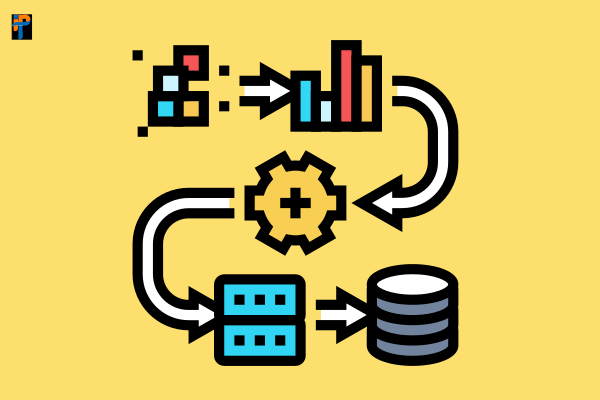
Here’s how the RAG process works in practice: When a user submits a query, the system first converts this question into a numerical representation (embedding) and searches through a knowledge base—often a vector database—to find the most relevant information. This retrieved content is then combined with the original query and fed to the generative model, which synthesizes both elements to produce a coherent, accurate response. This entire process happens in near-real time, creating the seamless experience users expect from modern applications.

What makes RAG particularly exciting for mobile and web applications is its flexibility. The knowledge base can be updated independently of the AI model, meaning applications can stay current without expensive retraining processes. This is especially valuable in fast-moving industries where information changes frequently, such as healthcare, finance, and technology.

Also Read – AI App Development Cost in 2025: From MVPs to Full-Scale Solutions

How Does RAG Work? The Technology Behind the Magic

Understanding the technical underpinnings of RAG helps appreciate why it’s becoming indispensable for sophisticated web and mobile applications. The RAG architecture operates through a sophisticated yet elegant pipeline that combines several AI technologies to deliver its impressive capabilities.

The first critical component is the retriever system. When a user submits a query through a mobile app or web interface, this query is converted into a vector embedding—a numerical representation that captures its semantic meaning. This embedding is then compared against a database of document embeddings using similarity search algorithms. The system identifies and retrieves the most relevant text chunks from knowledge sources, which could include product databases, internal documentation, or current web content .

Next comes the augmentation phase, where the retrieved information is combined with the original query to form an enriched prompt. This step is crucial because it provides the generative model with the specific context needed to produce an accurate response. Advanced RAG systems often employ techniques like reranking and query expansion to ensure the most relevant information is prioritized.

The final stage is generation, where a large language model processes the augmented prompt to produce a coherent, natural language response. What makes this different from standard LLM usage is that the model is working with freshly retrieved, relevant information rather than relying solely on its internal knowledge. This approach significantly reduces hallucinations and improves factual accuracy.

For mobile applications, RAG implementations often include additional optimizations to account for variable network conditions and device capabilities. Some sophisticated apps use on-device processing for certain retrieval tasks, while others leverage cloud resources for more computationally intensive operations. The best implementations maintain a seamless user experience regardless of connectivity challenges.
RAG vs Traditional Generative AI

Most people are familiar with traditional generative AI — large language models (LLMs) like GPT that produce text based on patterns they learned during training. While powerful, these models have some clear weaknesses when used in mobile and web apps.

Where Traditional Generative AI Falls Short

  • Stale knowledge: A model is only as current as the data it was last trained on. If your app needs today’s pricing, updated policies, or breaking news, a static model won’t cut it.
  • Hallucinations: LLMs sometimes generate “plausible but wrong” answers, which can harm user trust.
  • Limited transparency: Users and regulators increasingly want to know why an AI gave a particular answer. Traditional LLMs can’t easily show their sources.

How RAG Changes the Game

Retrieval-Augmented Generation solves these issues by adding a retrieval step before generation. That means the model doesn’t rely only on its frozen training but can pull fresh, domain-specific knowledge into every response.
With RAG, apps:

  • Stay up-to-date by connecting to live knowledge sources (databases, knowledge bases, APIs).
  • Produce fact-grounded answers with citations, reducing hallucinations.
  • Offer auditability and compliance because retrieved passages can be stored and shown to end users.

Quick Comparison Table

Feature Traditional Generative AI RAG (Retrieval-Augmented Generation)
Knowledge freshness Limited to the training cutoff Always current with retrievable data
Risk of hallucinations High Lower (grounded in sources)
Transparency Opaque Source citations & provenance
Cost of updating knowledge High (retrain or fine-tune) Low (re-embed and re-index)
Best for Creative text, brainstorming Enterprise apps, support, compliance, search

In short, think of traditional generative AI as a talented storyteller with a great memory — but it can’t look up new facts. RAG is like giving that storyteller a library card and internet access.

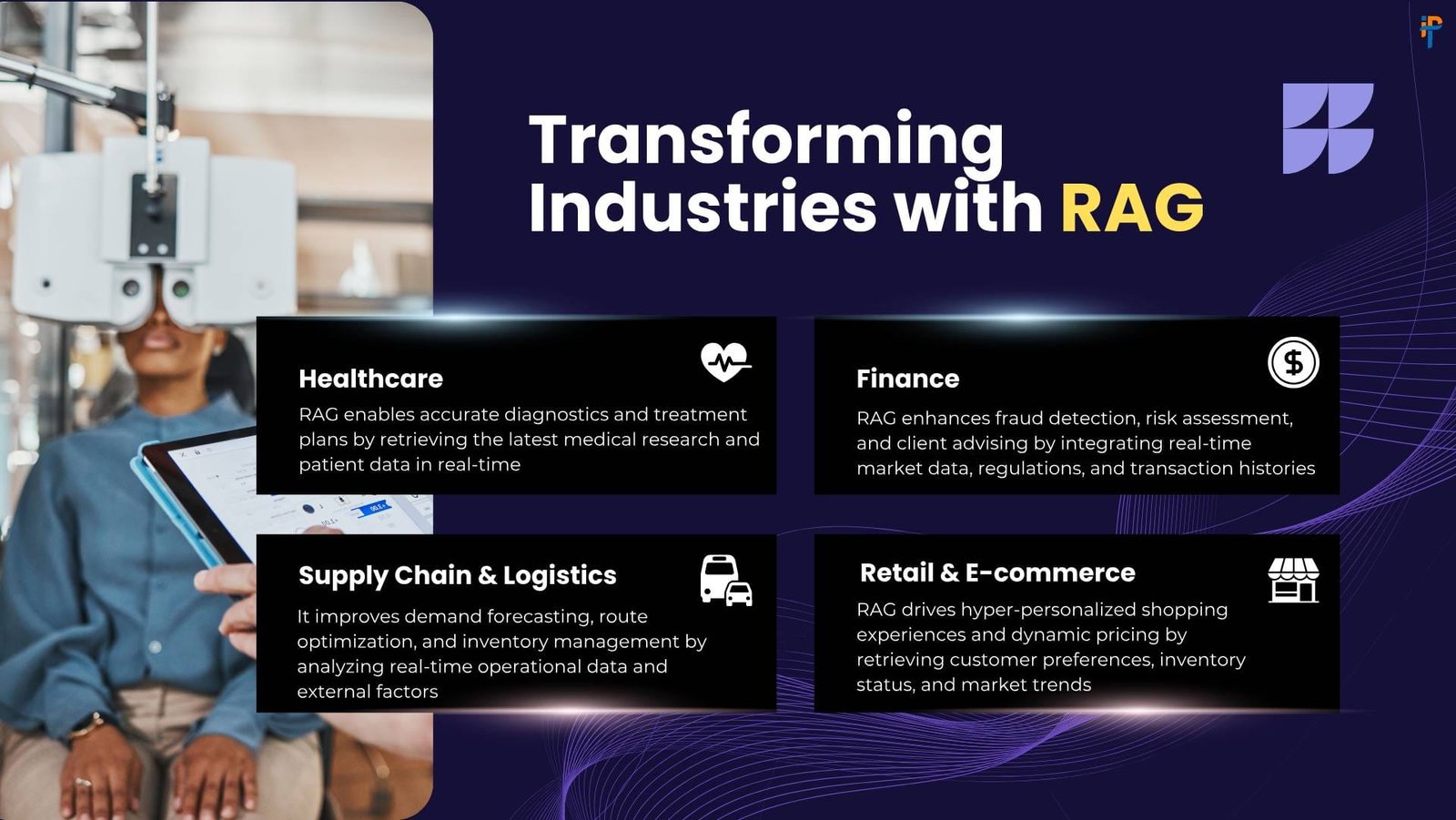
First and foremost, RAG delivers dramatically improved accuracy and relevance in application responses. By grounding generated content in specific retrieved documents, RAG systems produce responses that are more factually correct and contextually appropriate. This is particularly valuable in domains where precision matters, such as healthcare information, financial advice, or technical support. For instance, IBM Watson Health uses RAG to provide medical insights by retrieving accurate information from patient records and medical literature .

Cost efficiency represents another significant advantage. Traditional approaches to keeping AI applications current required periodic retraining of models—an expensive and computationally intensive process. With RAG, organizations can maintain accuracy simply by updating their knowledge bases, which is far more cost-effective. This makes sophisticated AI capabilities accessible to smaller organizations and enables more sustainable implementation patterns.

Real-time knowledge integration is perhaps one of the most compelling benefits for contemporary applications. In our fast-moving world, information can become outdated rapidly—whether we’re talking about product inventories, news developments, or medical research. RAG-powered applications can incorporate the latest information simply by updating their knowledge sources, ensuring users always receive current and relevant responses.

Enhanced user trust naturally follows from these improvements. When applications provide accurate, verifiable information with source attribution (a capability many RAG systems include), users develop greater confidence in the system. This is particularly important in domains where AI advice influences significant decisions, such as healthcare, finance, or legal matters.

Finally, RAG systems offer greater developer control and flexibility. Developers can curate and manage knowledge sources, implement permission systems for sensitive information, and troubleshoot inaccuracies by modifying specific documents rather than retraining entire models. This level of control is essential for enterprise applications where accuracy, security, and compliance matter.

Also Read – AI Agents Explained: Why They Matter and Real-World Use Cases

Top 7 Use Cases of RAG in Mobile & Web Applications for 2025

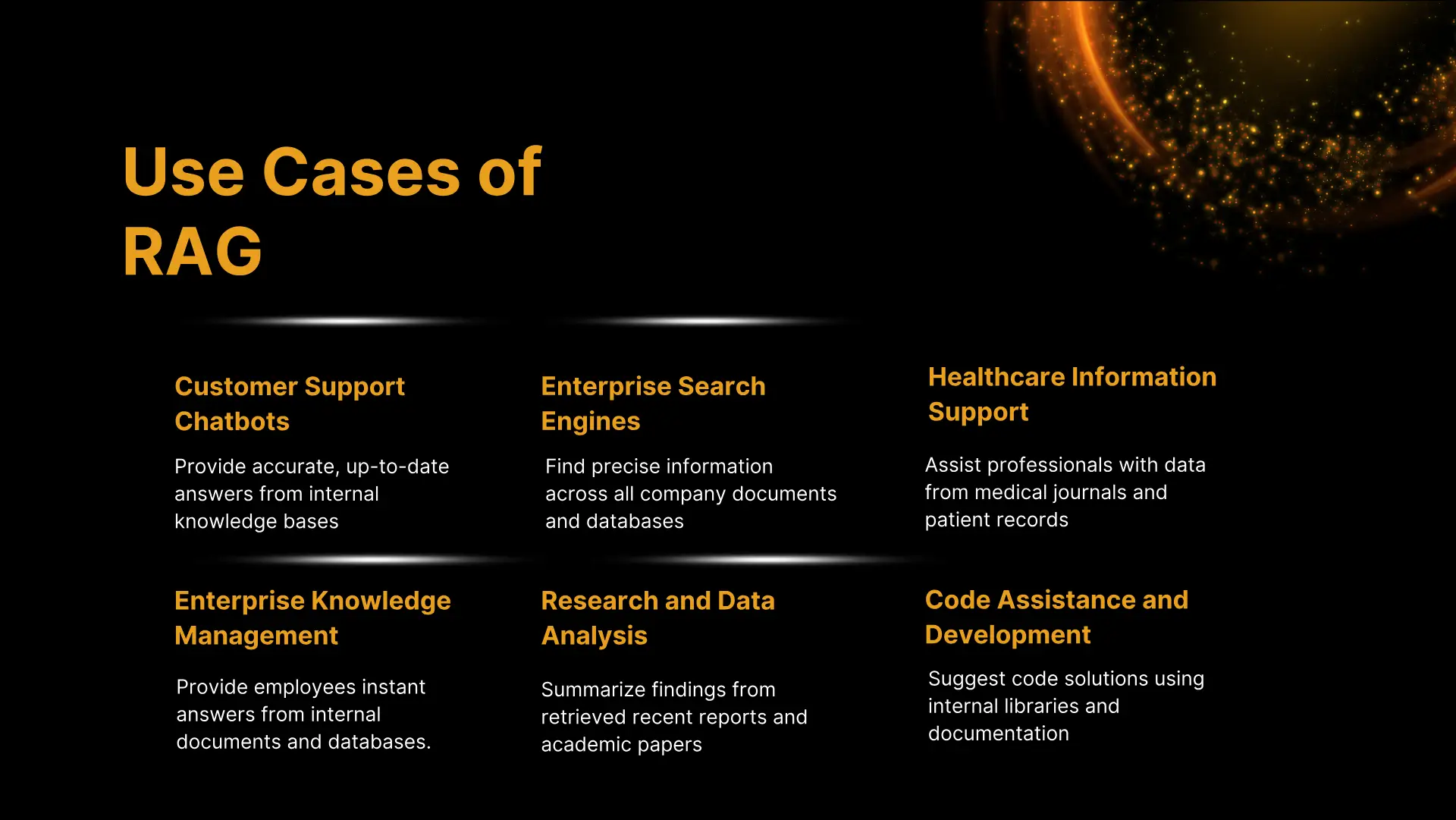
1. Intelligent Customer Support Chatbots

Customer support has been transformed by RAG technology, moving far beyond the limited scripted responses of earlier chatbot generations. Modern RAG-powered support assistants can retrieve information from vast knowledge bases, including product manuals, FAQ documents, internal guidelines, and even specific customer interaction histories to provide personalized, accurate responses to complex queries.

Consider how Shopify’s Sidekick chatbot implements RAG technology to deliver superior customer service. When a merchant asks a question about their store, Sidekick automatically retrieves relevant information from that specific store’s data—including inventory levels, order histories, and policy documents—to provide tailored responses that address both the general question and the specific context of that business.

The implementation advantages for mobile applications are particularly noteworthy. Support chatbots powered by RAG can deliver consistent, high-quality assistance across web and mobile platforms, with the added benefit of being able to push relevant documentation and follow-up information through mobile notifications. This creates a seamless omnichannel support experience that today’s consumers expect .

Beyond basic query response, advanced RAG systems in customer support can perform multi-step troubleshooting guides, proactively suggest solutions based on similar resolved cases, and even escalate to human agents when necessary—with full context preservation to minimize customer repetition. The results are tangible: companies implementing RAG-powered support systems report significant reductions in resolution times and increases in customer satisfaction metrics.
2. Enhanced E-Commerce Product Recommendations

E-commerce has entered a new era of personalization with RAG technology. Rather than relying solely on collaborative filtering or generic recommendation algorithms, RAG-powered systems can retrieve information from detailed product catalogs, current inventory data, real-time trend information, and individual customer preferences to create highly tailored shopping suggestions that feel genuinely personalized.

Amazon’s implementation of RAG techniques exemplifies this approach. Their systems combine customer behavior data with comprehensive product information retrieved from knowledge graphs to generate contextually relevant suggestions that go beyond “customers who bought this also bought…” to something more like “based on your recent search for outdoor gardening solutions and your climate zone, you might find these drought-resistant plants interesting” .

For mobile shopping applications, RAG enables particularly innovative experiences. Imagine pointing your phone’s camera at a product in the physical world and immediately receiving detailed information, availability data, and complementary product suggestions—all generated in real-time by retrieving relevant information from multiple knowledge sources. This blending of physical and digital retail experiences represents the future of commerce.

The business impact of these advanced recommendation systems is substantial. Retailers implementing RAG-powered recommendations report higher conversion rates, increased average order values, and improved customer loyalty. By delivering genuinely helpful and relevant suggestions rather than generic promotions, these systems create shopping experiences that feel less like transactions and more like personalized service.

3. Healthcare Diagnosis and Medical Research Assistance

In healthcare applications, where accuracy can literally be a matter of life and death, RAG technology is proving invaluable. Medical professionals using RAG-powered applications can access synthesized information from vast knowledge bases, including medical journals, drug databases, clinical guidelines, and patient records to support diagnostic accuracy and treatment decisions.

IBM Watson Health demonstrates RAG’s potential in medical settings. Their system analyzes patient data against extensive medical literature, retrieving relevant studies and clinical guidelines to assist doctors in diagnosing complex cases and determining personalized treatment options. In oncology, this approach has shown remarkable results—matching treatment recommendations with expert oncologists 96% of the time, according to a study in the Journal of Clinical Oncology.

For mobile health applications, RAG enables powerful new capabilities. Doctors can use tablet-based applications during patient consultations to quickly retrieve information about drug interactions, recent research on specific conditions, or treatment protocols. Patients themselves can benefit from medically accurate information retrieval systems that provide reliable health information rather than the questionable content often found through general web searches.

The research acceleration aspects shouldn’t be overlooked either. Medical researchers using RAG-powered applications can quickly synthesize information across vast corpora of scientific literature, identifying connections and insights that might otherwise remain hidden in specialized publications. This knowledge retrieval capability is accelerating medical advances and helping healthcare professionals stay current with the rapidly expanding body of medical knowledge.

4. Personalized Learning and Educational Support

Educational technology has embraced RAG to create truly adaptive learning experiences that respond to individual student needs. Rather than offering one-size-fits-all content, RAG-powered educational applications can retrieve information from diverse learning materials—textbooks, research papers, multimedia content, and previous interaction data—to provide personalized learning pathways and explanations.

RAMO (Retrieval-Augmented Generation for MOOCs) represents an innovative implementation in this space. It addresses the “cold start” problem in course recommendations by utilizing LLMs to generate personalized course suggestions through conversational interfaces. The system understands learner preferences and career goals to offer relevant course options, dramatically enhancing the online learning experience.

For mobile learning applications, RAG enables particularly powerful capabilities. Students can ask questions in natural language and receive explanations drawn from multiple educational sources, formatted appropriately for their learning level and style. The applications can adapt in real-time based on student comprehension, retrieving additional examples when needed or advancing more quickly when concepts are mastered.

Corporate training applications similarly benefit from RAG implementations. New employees can interact with intelligent tutoring systems that retrieve information from company manuals, process documentation, and best practices guides to provide consistent, accurate training experiences. This approach significantly reduces onboarding time while ensuring all employees receive the same high-quality information.

5. Enterprise Knowledge Management Systems

Large organizations often struggle with knowledge management—critical information becomes siloed in different departments, stored in various formats, and is difficult to find when needed. RAG-powered knowledge management systems transform this dynamic by creating intelligent interfaces that allow employees to retrieve information from disparate internal systems through natural language queries.

Siemens provides an excellent example of RAG implementation for enterprise knowledge. They’ve integrated RAG technology into their digital assistance platform, allowing employees to retrieve information from various internal documents and databases quickly. When faced with technical questions, users can input queries and receive relevant documents alongside contextual summaries, dramatically improving information discovery and collaboration.

Mobile implementations of these systems are particularly valuable for organizations with field staff or distributed workforces. Field technicians can use mobile applications to access repair manuals, safety procedures, and technical specifications without needing to carry physical documents or return to office locations. The RAG system can even retrieve information based on images or sensor data captured through mobile devices.

The compliance and auditing benefits shouldn’t be overlooked either. RAG systems can be configured to retrieve information from approved sources only, ensuring that responses align with organizational policies and regulatory requirements. This controlled access to knowledge is particularly valuable in highly regulated industries like finance and healthcare, where inaccurate information can have serious consequences.

6. Financial Services and Fraud Detection

Financial institutions handle enormous volumes of complex, rapidly changing information—from market data to regulatory requirements to transaction records. RAG-powered applications in this sector can retrieve and synthesize information from diverse sources to support everything from investment decisions to fraud detection to compliance reporting.

JPMorgan Chase’s implementation of AI-driven fraud detection showcases RAG’s potential in financial services. Their systems continuously retrieve and analyze real-time data from various sources to monitor transactions and detect potential fraud. By combining transaction data with external fraud reports and blocklists, these systems can flag suspicious activities with greater precision while reducing false positives that traditionally overwhelmed rule-based approaches.

For mobile banking applications, RAG enables sophisticated financial advice capabilities. Users can ask complex questions about investment strategies, retirement planning, or loan options and receive responses grounded in current market data, regulatory information, and their personal financial history. This creates a personalized banking experience that was previously only available to high-net-worth individuals with dedicated financial advisors.

Wealth management firms like Morgan Stanley have implemented RAG technology to enhance their services. They’ve partnered with OpenAI to create a solution that enables financial advisors to quickly access and synthesize vast ranges of internal insights related to companies, sectors, and market trends. This system not only retrieves data but also generates explanatory text, ensuring advisors receive precise answers to complex client questions.

7. Intelligent Content Creation and Optimization

Content creation represents another domain where RAG technology is proving transformative. Rather than starting from blank pages, content creators using RAG-powered applications can retrieve relevant information, statistics, and examples from vast knowledge bases to enhance their writing with accurate, up-to-date information.

Journalists and writers benefit from systems that can retrieve background information, factual data, and related content to support their storytelling. For instance, a writer covering climate change can use a RAG-powered tool to retrieve the latest research statistics, policy developments, and historical context to create more comprehensive and accurate articles.

Marketing content creation is particularly enhanced by RAG technology. Marketing professionals can use these systems to generate campaign ideas, slogans, and content outlines informed by current market trends, consumer sentiment analysis, and successful campaign archives. The resulting content is both creative and data-informed, likely to resonate more effectively with target audiences.

Search engine optimization represents another valuable application area. RAG-powered tools can analyze top-performing content for specific queries, retrieve information about current search trends, and generate optimization suggestions that help content rank better while maintaining quality and relevance. This combination of creative generation and information retrieval is proving far more effective than earlier-generation SEO tools.

Implementing RAG in Your Applications: Key Considerations

Successfully implementing RAG technology in web and mobile applications requires careful planning across several dimensions. While the benefits are substantial, realizing them depends on thoughtful execution that considers everything from knowledge base design to user experience optimization.

First and foremost, knowledge base quality determines RAG system performance. Your applications will only be as good as the information they can retrieve, so investing in comprehensive, well-structured knowledge sources is essential. This involves not just gathering relevant documents but also implementing effective chunking strategies (breaking documents into semantically meaningful segments), adding appropriate metadata, and establishing processes for regular updates.

Retrieval optimization represents another critical consideration. Basic vector similarity search sometimes returns irrelevant results, so sophisticated implementations often employ techniques like hybrid search (combining semantic and keyword-based approaches), reranking (using a secondary model to reorder results by relevance), and query expansion (adding synonyms or related terms to the original query).

User experience design for RAG-powered applications requires particular attention. Unlike traditional search interfaces that return lists of results, RAG applications typically provide synthesized answers, which means users can’t easily scan multiple sources to verify information. This makes features like source attribution and confidence indicators particularly important for building user trust.

Mobile-specific implementations present additional considerations. Network variability, screen size constraints, and processing limitations mean mobile applications often benefit from optimized RAG approaches—sometimes performing initial retrieval on device for speed and privacy, while leveraging cloud resources for more complex operations. The best implementations maintain responsive experiences regardless of connectivity challenges.

Finally, evaluation frameworks are essential for measuring and improving RAG system performance. Traditional metrics like latency and uptime remain important, but RAG systems also require evaluation on dimensions like groundedness (how well responses align with retrieved facts), relevance, and usefulness. Establishing these measurements early ensures continuous improvement.

The Future of RAG in Application Development

As we look beyond 2025, RAG technology continues to evolve in exciting directions that will further expand its capabilities and applications. Understanding these emerging trends helps developers and businesses prepare for the next wave of innovation in AI-powered applications.

Agentic systems represent one of the most significant evolutionary directions for RAG technology. Rather than simply responding to individual queries, RAG is increasingly being integrated into AI agents that can perform multi-step processes, make decisions, and take actions based on retrieved information. These systems use RAG to ground their decisions in accurate, current knowledge, dramatically expanding their capabilities.

Multimodal retrieval is another important frontier. While current RAG systems primarily work with text, next-generation implementations can retrieve and reason across multiple modalities—images, audio, video, and structured data. This enables applications that can, for example, retrieve product information based on images captured through mobile cameras or find relevant research papers based on charts and diagrams.

Efficiency improvements will make RAG technology accessible to a broader range of applications and organizations. Techniques like contextual prompt compression, better caching strategies, and optimized embedding models are reducing the computational costs of RAG systems, making them viable for applications with stricter latency or budget constraints.

Personalization capabilities are also advancing rapidly. Future RAG systems will better understand individual user contexts, preferences, and histories to retrieve and generate increasingly tailored responses. This hyper-personalization will make applications feel more intuitive and helpful, anticipating user needs rather than simply responding to explicit queries.

As these advancements mature, RAG technology will become increasingly invisible to users—not because it’s disappearing, but because it’s becoming so seamlessly integrated into our digital experiences that we take its capabilities for granted, much like we now take internet search for granted. The applications that leverage these capabilities most effectively will define the next generation of digital experiences.

Conclusion: Embracing RAG for Transformative Applications

Retrieval-Augmented Generation has fundamentally changed what’s possible in web and mobile applications, bridging the gap between generative AI’s creative capabilities and the precise, current information users demand. As we’ve explored through these seven use cases, this technology is already delivering tangible value across industries—from healthcare to e-commerce, education to finance.

What makes RAG particularly exciting is its democratizing potential. While developing custom AI models remains complex and expensive for most organizations, RAG provides an accessible path to sophisticated AI capabilities by leveraging existing knowledge resources. This accessibility means organizations of all sizes can harness cutting-edge AI to create more intelligent, responsive applications.

As we move forward through 2025 and beyond, the distinction between “traditional” applications and AI-powered experiences will continue to blur. Users will increasingly expect applications that understand their needs, provide accurate information, and adapt to their contexts—expectations that RAG technology is uniquely positioned to address.

The organizations that thrive in this evolving landscape will be those that strategically integrate technologies like RAG into their application development roadmaps. By starting with specific use cases where accurate, current information delivers significant value, then expanding these capabilities over time, businesses can create digital experiences that genuinely stand out in increasingly competitive markets.

IPH Technologies harnesses the power of Retrieval-Augmented Generation (RAG) to build the next generation of intelligent applications and AI-powered solutions. We transform businesses by embedding hyper-personalized, accurate, and data-driven AI directly into your mobile and web platforms. Our bespoke software development and seamless integration of RAG systems help you move beyond generic chatbots and unlock true innovation, scalable growth, and a competitive edge with IPH—where cutting-edge technology meets tangible business results.

Ultimately, RAG represents more than just a technical approach—it embodies a shift toward applications that work with humans rather than simply for them, augmenting our capabilities with vast knowledge retrieval and synthesis abilities. As this technology continues to evolve and mature, its potential to transform how we interact with digital information remains limited only by our imagination in applying it to real-world challenges.

Frequently Asked Question

What exactly is RAG in mobile and web applications?
RAG, or Retrieval-Augmented Generation, is an AI approach that combines the power of real-time information retrieval with natural language generation. In practical terms, this means your mobile or web application can pull the most relevant and updated data from a trusted source before responding to a user query. Instead of guessing or relying on outdated training data, RAG ensures that every answer is accurate, fresh, and grounded in facts, which makes applications far more reliable and useful in 2025.
How is RAG different from traditional generative AI?
The key difference lies in the ability to fetch updated information. Traditional generative AI relies solely on its training data, which can quickly become outdated. RAG, on the other hand, retrieves real-time knowledge from databases, APIs, or documents before generating a response. If traditional AI is like a professor who only remembers past lectures, RAG is that same professor who also has instant access to a digital library. This makes RAG a superior choice for apps that demand both accuracy and relevance.
What makes IPH Technologies a reliable partner for RAG app development?
At IPH Technologies, we combine our decade of experience in app and software development with cutting-edge AI capabilities like Retrieval-Augmented Generation (RAG). With over 500 successful projects and 430+ satisfied clients, our team has a proven track record of building intelligent applications that scale. When businesses partner with us, they don’t just get developers—they get strategic thinkers who understand how to apply RAG effectively to solve real-world challenges.
How does IPH Technologies implement RAG differently than other app developers?
Many developers focus only on building the retrieval and generation pipeline. At IPH Technologies, we go beyond that. We carefully design the architecture, optimize latency, ensure security, and customize RAG integration based on the client’s industry—whether it’s healthcare, finance, e-commerce, or education. Our agile approach and expertise in integrating APIs, vector databases, and cloud-native tools make our RAG solutions not only powerful but also reliable in production environments.
Can IPH Technologies upgrade my existing app with RAG features?
Yes, and that’s one of our strengths. You don’t need to rebuild your application from scratch to leverage RAG. Our team can integrate RAG into your existing app architecture by connecting it with your databases, APIs, and content sources. For example, if you already have a customer support chatbot, we can enhance it with RAG so it retrieves accurate answers directly from your company’s knowledge base, instantly improving customer experience without disrupting your current workflows.
Is RAG app development with IPH Technologies affordable for startups?
Absolutely. We understand that startups often work with limited budgets. That’s why we offer scalable solutions where businesses can start with a small RAG implementation and expand as they grow. Whether it’s a basic AI-powered FAQ assistant for a website or a full-fledged RAG-enabled mobile app, IPH Technologies provides cost-effective packages designed to meet both short-term needs and long-term goals.
How does IPH Technologies ensure data security in RAG-powered applications?
Data privacy and security are top priorities at IPH Technologies. For sensitive industries like healthcare and finance, we implement strict compliance measures such as data encryption, role-based access controls, and private vector databases. Unlike generic AI tools that may rely on external, uncontrolled sources, our RAG implementations retrieve information only from your secure and approved datasets. This ensures that your users receive accurate and safe responses every time.
What industries does IPH Technologies focus on for RAG solutions?
Our expertise spans multiple industries. We’ve worked on projects in healthcare, where RAG improves patient education with evidence-backed answers. In finance, we help companies deliver real-time insights on investment and compliance. For e-commerce businesses, we create personalized shopping assistants that pull live product data. In education, we build AI tutors that provide curriculum-aligned, fact-checked guidance. Each solution is tailored to the unique challenges of the industry we serve.
Why should I choose IPH Technologies for my RAG project instead of freelancers or small agencies?
Choosing IPH Technologies means working with a company that has both scale and depth. While freelancers might deliver a prototype, we bring full-stack expertise, security compliance, post-launch support, and a strong reputation backed by hundreds of client reviews. We don’t just build apps—we become long-term partners in innovation. Our team ensures that your RAG solution is not only functional but also future-proof, scalable, and aligned with your business goals.
How does IPH Technologies see the future of RAG in app development?
We believe RAG will become the foundation of intelligent apps in the next five years. At IPH Technologies, we’re already preparing for that future by combining RAG with other advanced technologies like multimodal AI, real-time analytics, and custom APIs. Our mission is to help businesses stay ahead of the curve, and by partnering with us, clients gain early access to the very innovations that will define mobile and web applications in 2025 and beyond.
Avatar
Lekha Mishra

Verified CEO

About the Author

I'm Lekha Mishra, Co-Founder of IPH Technologies, a 6x award-winning software and mobile solutions provider. My mission is to empower global entrepreneurs by transforming visionary ideas into powerful, market-ready products. We move beyond code to provide strategic insights and a competitive edge, specializing in intelligent solutions powered by AI and ML. I believe in leveraging these technologies to unlock new possibilities, drive growth, and deliver unparalleled value. Let's connect and turn your vision into a lasting legacy.


WhatsApp
Call us
Get a Call Back