


















































Highlights
UI/UX Design
User-first, visually engaging interfaces crafted to enhance usability, boost engagement, and deliver seamless digital experiences.
Branding
Strategic brand identities that communicate your vision, build trust, and create a memorable presence across all touchpoints.
Wireframing
Structured layouts and user flows that map the product journey clearly before development begins, saving time and cost.
Prototype Design
Interactive prototypes that simulate real user interactions, helping validate ideas and refine experiences early.
Design Systems
Scalable design frameworks and reusable components that ensure consistency, speed, and efficiency across your product.
UI/UX Design

We design intuitive, user-centric interfaces that enhance engagement, improve usability, and deliver seamless digital experiences across all devices.

UI UX Design
  • User research and wireframing for clear flows
  • Modern UI design using Figma and Adobe XD
  • Interactive prototypes for better user experience testing
  • Usability testing and performance optimization improvements
  • Responsive design across all devices and screens
  • Scalable design systems with reusable UI components
Branding & Identity

We craft strong brand identities that communicate your vision, build trust, and create a lasting impression across all digital and offline touchpoints.

Branding and Identity
  • Logo design and brand identity creation
  • Brand guidelines and visual consistency systems
  • Color palette and typography selection strategy
  • Marketing materials and brand asset design
  • Social media branding and creative direction
  • Rebranding and brand positioning strategies
Wireframing

We create structured wireframes that define layout, user flow, and functionality, helping visualize ideas and build a strong foundation before design and development.

Wireframing
  • Low fidelity wireframes for initial structure
  • High fidelity wireframes with detailed layouts
  • User flow mapping for better navigation
  • Content hierarchy and layout planning
  • Clickable wireframes for early feedback
  • Clear structure before UI design phase
Prototype Design

We design interactive prototypes that simulate real user experiences, helping validate ideas, test functionality, and refine products before development.

Prototype Design
  • Interactive prototypes for real user experience
  • Clickable designs to test product functionality
  • User journey simulation for better understanding
  • Rapid prototyping for faster design validation
  • Feedback driven improvements before development
  • High fidelity prototypes with smooth interactions
Design Systems

We build scalable design systems that ensure consistency, improve collaboration, and accelerate product development across all platforms and teams.

Design Systems
  • Reusable UI components for consistent design
  • Design tokens for colors typography spacing
  • Component libraries for faster development workflow
  • Consistent branding across all digital products
  • Documentation for design and development teams
  • Scalable systems for growing product ecosystems
Highlights
Mobile Apps Development
High-performance Android and iOS mobile applications built with modern technologies, delivering seamless user experiences and robust functionality.
Desktop Application Dev
Powerful and secure desktop applications tailored for Windows, macOS, and Linux, designed for performance, scalability, and reliability.
Web App Development
Scalable and responsive web applications using modern frameworks like React, Angular, and Vue for fast, dynamic, and engaging experiences.
Cross-Platform
Cost-effective cross-platform solutions using Flutter and React Native, enabling a single codebase for both iOS and Android platforms.
PWA Development
Progressive Web Apps that combine the best of web and mobile, offering offline access, fast loading, and app-like experiences directly in the browser.
Highlights
Mobile App

Android

iOS

Flutter

Hybrid

Optimize

Native

Swift

Firebase

Android App Development

We craft powerful, scalable Android applications with intuitive UX, high performance, and deep integration with Google services.

Android App
  • Custom Android app development
  • Native Kotlin & Java apps
  • Google Play Store deployment
  • Material Design UI implementation
Kotlin

Kotlin

Java

Java

Flutter

Flutter

Android Studio

Android

Jetpack

Jetpack

iOS App Development

We build high-quality, user-centric iOS apps combining performance, security, and seamless design for Apple devices.

iOS App
  • Custom iOS app development
  • Native Swift & SwiftUI apps
  • Seamless Apple service integration
  • App Store review & deployment
Swift

Swift

SwiftUI

SwiftUI

Obj-C

Obj-C

Xcode

Xcode

Flutter

Flutter

Cross-Platform Apps

We develop cross-platform mobile apps that run flawlessly on both iOS and Android from a single codebase, saving time and cost.

Cross-Platform App
  • Single codebase for iOS & Android
  • Flutter & React Native development
  • Native-like performance & UI
  • Faster time-to-market
React Native

React Native

TypeScript

TypeScript

Redux

Redux

Firebase

Firebase

Dart

Dart

Hybrid Apps

We build hybrid mobile apps that blend web technologies with native capabilities, delivering broad reach and cost-effective development.

Hybrid App
  • Web + native feature integration
  • Ionic & Cordova frameworks
  • Reduced development costs
  • Multi-platform publishing
Flutter

Flutter

Dart

Dart

Firebase

Firebase

SQLite

SQLite

App Optimization

We enhance existing mobile apps with performance tuning, crash fixes, battery efficiency, and faster load times for a superior user experience.

App Optimization
  • Performance profiling & tuning
  • Memory & battery optimization
  • Crash analysis & bug fixing
  • App size reduction & load speed
Xcode

Xcode

Android Studio

Android

Firebase

Firebase

Java

Java

Highlights
Desktop App

Windows

macOS

Linux

Desktop

Electron

Qt

WinForms

GTK

Windows Apps

We develop robust Windows desktop applications using modern Microsoft technologies, delivering powerful tools for enterprise and consumer use.

Windows App
  • Custom Windows desktop applications
  • WPF & WinForms development
  • Microsoft Store deployment
  • Windows API & system integration
C#

C#

.NET

.NET

Electron

Electron

Visual Studio

Visual Studio

SQL Server

SQL Server

macOS Apps

We create elegant, high-performance macOS applications that leverage Apple's native frameworks for a smooth and delightful desktop experience.

macOS App
  • Native macOS app development
  • SwiftUI & AppKit integration
  • Mac App Store submission
  • Apple Silicon optimization
Swift

Swift

SwiftUI

SwiftUI

Obj-C

Obj-C

Xcode

Xcode

Cross-Platform Desktop

We develop cross-platform desktop applications that run seamlessly on Windows, macOS, and Linux from a single shared codebase.

Cross-Platform Desktop
  • Single codebase for all platforms
  • Electron & Tauri frameworks
  • Flutter for desktop support
  • Consistent UI across OS environments
Flutter

Flutter

Electron

Electron

Node.js

Node.js

TypeScript

TypeScript

Docker

Docker

Electron Apps

We build feature-rich Electron desktop apps using web technologies, enabling cross-platform deployment with native OS capabilities.

Electron App
  • Electron framework development
  • Node.js & Chromium integration
  • Auto-updater & native notifications
  • Cross-OS packaging & distribution
Electron

Electron

Node.js

Node.js

React

React

Vue

Vue

TypeScript

TypeScript

Highlights
Web App

React

Node.js

PHP

Laravel

Python

MySQL

JavaScript

HTML

CSS

React Development

We build fast, component-driven React web applications with modern state management, reusable UI, and seamless API integration.

React Development
  • Custom React SPA development
  • Redux & Context API state management
  • Next.js SSR & SSG support
  • REST & GraphQL API integration
React

React

Next.js

Next.js

Redux

Redux

TypeScript

TypeScript

Tailwind

Tailwind

Angular Development

We develop enterprise-grade Angular applications with structured architecture, two-way data binding, and robust TypeScript foundations.

Angular Development
  • Custom Angular SPA development
  • RxJS & NgRx state management
  • Angular Material UI components
  • Lazy loading & performance tuning
Angular

Angular

TypeScript

TypeScript

HTML

HTML

CSS

CSS

NPM

NPM

Node.js Backend

We build scalable, event-driven Node.js backends with RESTful APIs, real-time capabilities, and seamless database integrations.

Node.js Backend
  • RESTful & GraphQL API development
  • Express.js & Fastify frameworks
  • WebSocket & real-time features
  • MongoDB, PostgreSQL integration
Node.js

Node.js

Express

Express

MongoDB

MongoDB

GraphQL

GraphQL

Docker

Docker

Cloud Web Apps

We design and deploy cloud-native web applications on AWS, Azure, and GCP — scalable, secure, and built for high availability.

Cloud Web Apps
  • AWS, Azure & GCP deployment
  • Serverless architecture development
  • Auto-scaling & load balancing
  • CI/CD pipeline configuration
AWS

AWS

Azure

Azure

GCP

GCP

Docker

Docker

Kubernetes

Kubernetes

Full-Stack Dev

We deliver complete full-stack web solutions — from pixel-perfect frontends to robust backends — as a unified, end-to-end product.

Full-Stack Dev
  • Frontend & backend development
  • MERN & MEAN stack expertise
  • Database design & API architecture
  • DevOps, hosting & deployment
React

React

Node.js

Node.js

MongoDB

MongoDB

PostgreSQL

PostgreSQL

Docker

Docker

Highlights
Cross Platform

Flutter

R. Native

Xamarin

Ionic

Reuse

Electron

NW.js

Framework7

SwiftUI

Flutter Development

We build beautiful, natively compiled Flutter applications for mobile, web, and desktop from a single Dart codebase with pixel-perfect UI.

Flutter Development
  • Flutter mobile & web apps
  • Dart language development
  • Custom widget & animation creation
  • Firebase & REST API integration
Flutter

Flutter

Dart

Dart

Firebase

Firebase

GetX

GetX

Riverpod

Riverpod

React Native

We develop high-performance React Native apps that deliver a truly native experience on both iOS and Android using JavaScript and React.

React Native
  • Cross-platform iOS & Android apps
  • React Native CLI & Expo development
  • Native module & bridge integration
  • Redux & MobX state management
React Native

React Native

Redux

Redux

TypeScript

TypeScript

Firebase

Firebase

Xamarin

We develop Xamarin-based cross-platform apps using C# and .NET, enabling shared business logic across iOS, Android, and Windows.

Xamarin
  • Xamarin.Forms & MAUI apps
  • Shared C# codebase development
  • Native API access via bindings
  • Enterprise app integration
Xamarin

Xamarin

C#

C#

.NET MAUI

.NET

Azure

Azure

Visual Studio

Visual Studio

Ionic Framework

We create stunning Ionic applications that combine the power of web technologies with native device features for a seamless mobile experience.

Ionic Framework
  • Ionic Angular & React apps
  • Capacitor native plugin integration
  • Responsive mobile-first UI
  • PWA & hybrid app deployment
Ionic

Ionic

Angular

Angular

React

React

Vue

Vue

Code Reusability

We build reusable app architectures, reducing duplication, accelerating development, and ensuring seamless cross-platform consistency.

Code Reusability
  • Shared component library creation
  • Monorepo architecture setup
  • Design system implementation
  • Platform-agnostic business logic
Turborepo

Turborepo

Storybook

Storybook

Flutter

Flutter

React Native

React Native

Highlights
PWA

PWA

Offline

Push

Fast

App-Like

IndexedDB

Installable

Sync

Progressive Web Apps

We build Progressive Web Apps that combine the best of web and mobile — installable, reliable, and fast across all devices and browsers.

Progressive Web Apps
  • PWA architecture & manifest setup
  • Service worker implementation
  • Installable & home screen support
  • Cross-browser compatibility
HTML5

HTML5

CSS3

CSS3

JavaScript

JavaScript

Workbox

Workbox

Lighthouse

Lighthouse

Offline Support

We implement robust offline capabilities in your web apps using service workers and smart caching so users stay productive without connectivity.

Offline Support
  • Service worker caching strategies
  • IndexedDB offline data storage
  • Background sync implementation
  • Graceful offline fallback pages
Service Worker

ServiceWorker

Workbox

Workbox

IndexedDB

IndexedDB

Cache API

Cache API

Background Sync

BackgroundSync

Push Notifications

We integrate web push notification systems into your PWA to re-engage users with timely, personalized alerts even when the app is not open.

Push Notifications
  • Web Push API implementation
  • VAPID key & subscription management
  • Notification scheduling & targeting
  • Cross-browser push support
Web Push

Web Push

Firebase FCM

Firebase

OneSignal

OneSignal

Node.js

Node.js

Workbox

Workbox

Fast Loading

We optimize PWAs for lightning-fast load times using code splitting, lazy loading, and caching to deliver exceptional Core Web Vitals scores.

Fast Loading
  • Code splitting & lazy loading
  • Image & asset optimization
  • Core Web Vitals improvement
  • CDN & caching configuration
Webpack

Webpack

Lighthouse

Lighthouse

Vite

Vite

Cloudflare

Cloudflare

Workbox

Workbox

App-Like Experience

We craft PWAs that feel and behave like native mobile apps — with smooth animations, full-screen mode, gestures, and seamless transitions.

App-Like Experience
  • Full-screen & standalone display mode
  • Touch gestures & swipe navigation
  • Smooth page transitions & animations
  • App shell architecture
Web Manifest

Web Manifest

CSS Animations

CSS

Framer Motion

FramerMotion

React

React

Vue

Vue

Highlights
Custom Software
Fully tailored software solutions designed to match your unique business processes, improving efficiency and driving long-term growth.
Backend Systems
Robust and secure backend architectures built for high performance, scalability, and seamless integration with your applications.
Database Design
Efficient and scalable database structures optimized for fast queries, data integrity, and reliable performance at scale.
Cloud-Native
Modern cloud-native solutions using microservices and serverless architecture on AWS, Azure, and GCP for maximum flexibility and scalability.
API Development
Secure and well-documented RESTful and GraphQL APIs that enable seamless communication between systems and third-party integrations.
Custom Software

We develop tailored software solutions that align with your business goals, streamline operations, and deliver scalable, high-performance digital systems.

Custom Software Development
  • Custom software tailored to business needs
  • Scalable architecture for long term growth
  • Secure and high performance application development
  • API integration with third party services
  • Cloud based and enterprise software solutions
  • Ongoing maintenance and system optimization support
Backend Systems

We build robust backend systems that power applications with secure, scalable architecture, efficient data handling, and seamless integrations.

Backend Systems
  • Secure backend architecture and system design
  • Database design and performance optimization
  • API development for seamless integrations
  • Authentication and authorization system implementation
  • Server side logic and business workflows
  • Scalable infrastructure for high traffic applications
Database Design

We design efficient database structures that ensure data integrity, optimize performance, and support scalable, reliable application systems.

Database Design
  • Structured database schema design and planning
  • Efficient data modeling for scalable systems
  • Database optimization for faster query performance
  • Relational and non relational database solutions
  • Secure data storage and access management
  • Backup strategies and data recovery solutions
Cloud-Native Apps

We build cloud-native applications designed for scalability, resilience, and flexibility using modern cloud infrastructure and microservices architecture.

Cloud Native Apps
  • Cloud first architecture for scalable applications
  • Microservices based system design and deployment
  • Containerization using Docker and Kubernetes tools
  • Auto scaling infrastructure for high availability
  • Continuous integration and continuous deployment pipelines
  • Secure cloud environments with monitoring and logging
API Development

We develop secure and scalable APIs that enable seamless communication between systems, applications, and third party services.

API Development
  • RESTful API development for web applications
  • Secure API authentication and authorization systems
  • Third party API integration and data exchange
  • Scalable APIs for high traffic applications
  • API documentation for easy developer integration
  • Performance optimization and API response tuning
Highlights
Manual Testing
Detailed human-driven testing to uncover edge cases, validate user flows, and ensure a seamless, intuitive user experience.
Test Automation
Automated testing frameworks using Selenium, Cypress, and Appium to accelerate regression cycles and improve release confidence.
Performance
Load, stress, and scalability testing to ensure your application performs reliably under high traffic and demanding conditions.
Security Testing
Comprehensive security assessments including penetration testing and vulnerability analysis to safeguard your application.
Mobile QA
End-to-end mobile application testing across devices and platforms to ensure consistent performance, usability, and stability.
Manual Testing

We perform detailed manual testing to ensure software quality, identify issues early, and deliver reliable, user-friendly applications.

Manual Testing
  • Functional testing for application core features
  • UI testing for consistent user experience
  • Cross browser and device compatibility testing
  • Test case creation and execution processes
  • Bug tracking and detailed issue reporting
  • Regression testing after feature updates
Test Automation

We implement automated testing solutions to improve efficiency, reduce manual effort, and ensure faster, reliable software delivery.

Test Automation
  • Automated test scripts for faster execution
  • Regression testing using automation frameworks
  • Continuous testing within CI CD pipelines
  • Test coverage improvement across application modules
  • Reusable automation scripts for long term scalability
  • Performance and load testing automation solutions
Performance Testing

We evaluate application performance to ensure speed, stability, and scalability under different workloads and real-world conditions.

Performance Testing
  • Load testing for high traffic scenarios
  • Stress testing to identify system limits
  • Performance benchmarking and response time analysis
  • Scalability testing for growing user demands
  • Memory and resource usage optimization checks
  • Bottleneck identification and performance improvements
Security Testing

We identify vulnerabilities and secure applications against threats, ensuring data protection, compliance, and safe user interactions.

Security Testing
  • Vulnerability assessment and risk analysis testing
  • Penetration testing to identify security gaps
  • Authentication and authorization security validation
  • Data protection and encryption testing processes
  • Secure code review and security best practices
  • Compliance testing with industry security standards
Mobile QA

We ensure mobile applications deliver flawless performance, usability, and compatibility across devices, platforms, and environments.

Mobile QA
  • Mobile app testing across multiple devices
  • iOS and Android platform compatibility testing
  • UI testing for consistent mobile experience
  • Network and performance testing on mobile
  • App usability and user experience validation
  • App store readiness and release testing
Highlights
CI/CD Pipelines
Automated pipelines for building, testing, and deploying code, enabling faster releases, fewer errors, and continuous delivery.
Infrastructure
Scalable infrastructure provisioning using Infrastructure as Code (IaC) with Terraform and CloudFormation for consistency and reliability.
Deployment
Zero-downtime deployment strategies including blue-green and rolling deployments to ensure smooth and reliable releases.
Containerisation
Container-based architectures using Docker and Kubernetes for portability, scalability, and efficient resource utilization.
Monitoring
Real-time monitoring and observability using tools like Grafana, Prometheus, and Datadog to ensure system health and performance.
CI/CD Pipelines

We implement CI/CD pipelines to automate build, testing, and deployment, enabling faster releases, improved quality, and continuous delivery.

CI CD Pipelines
  • Automated build and deployment pipeline setup
  • Continuous integration for faster code validation
  • Continuous delivery for seamless release cycles
  • Integration with Git version control systems
  • Automated testing within CI CD workflows
  • Monitoring and rollback strategies for deployments
Infrastructure

We design and manage reliable infrastructure to ensure scalability, security, and high availability for modern applications and systems.

Infrastructure
  • Cloud infrastructure setup and configuration services
  • Server management and deployment automation solutions
  • High availability and load balancing implementation
  • Monitoring and logging for system performance tracking
  • Security hardening and infrastructure access controls
  • Scalable environments for growing application demands
Deployment

We manage seamless deployment processes to ensure applications are delivered efficiently, securely, and ready for production environments.

Deployment
  • Application deployment to cloud and servers
  • Automated deployment workflows for faster releases
  • Environment configuration and setup management
  • Version control and release management processes
  • Rollback strategies for safe deployment updates
  • Post deployment monitoring and performance checks
Containerization

We use containerization to package applications for consistency, scalability, and efficient deployment across different environments.

Containerization
  • Application containerization using Docker technologies
  • Environment consistency across development and production
  • Container orchestration with Kubernetes platforms
  • Scalable container deployment for microservices architecture
  • Efficient resource utilization and system isolation
  • Integration with CI CD pipelines for automation
Monitoring

We monitor systems and applications in real time to ensure performance, reliability, and quick issue detection and resolution.

Monitoring
  • Real time system performance monitoring tools
  • Application health checks and uptime tracking
  • Error tracking and issue alerting systems
  • Log management and analysis for debugging
  • Resource usage monitoring across infrastructure layers
  • Proactive issue detection and incident response
Highlights
Roadmap Planning
Strategic product roadmaps aligned with business goals, helping prioritize features, manage timelines, and deliver maximum value.
Team Coordination
Efficient coordination across design, development, and QA teams to ensure smooth collaboration and on-time project delivery.
Growth Strategy
Data-driven product strategies focused on user acquisition, retention, and continuous improvement to drive sustainable growth.
Agile Sprints
Agile methodologies like Scrum and Kanban to deliver iterative releases, improve flexibility, and maintain predictable progress.
Stakeholder Mgmt
Clear communication and alignment with stakeholders through regular updates, reporting, and feedback loops to ensure project success.
Roadmap Planning

We create strategic roadmaps that align with your business goals, helping prioritize features, plan execution, and ensure long-term success.

Roadmap Planning
  • Product roadmap planning aligned with business objectives
  • Feature prioritization based on user and market needs
  • Timeline planning for efficient project execution phases
  • Technology stack selection for scalable solutions
  • Risk assessment and mitigation strategy planning
  • Continuous roadmap updates based on performance insights
Team Coordination

We ensure smooth collaboration across teams to improve productivity, streamline workflows, and deliver projects efficiently on time.

Team Coordination
  • Cross functional team collaboration and communication
  • Agile workflow management and sprint planning processes
  • Task tracking and project progress visibility tools
  • Clear role assignment and responsibility management
  • Regular updates and performance review meetings
  • Efficient coordination between design development teams
Growth Strategy

We develop data-driven growth strategies to scale your business, increase user acquisition, and maximize long-term revenue potential.

Growth Strategy
  • Market analysis and competitive growth planning strategies
  • User acquisition and retention optimization techniques
  • Data driven decision making and performance insights
  • Scalable business models for long term expansion
  • Conversion rate optimization across digital platforms
  • Continuous growth tracking and strategy refinement
Agile Sprints

We follow agile sprint methodologies to deliver faster iterations, improve collaboration, and ensure continuous product improvement.

Agile Sprints
  • Sprint planning and backlog prioritization processes
  • Daily standups for team alignment and progress tracking
  • Iterative development with continuous feedback cycles
  • Task management using agile tools and workflows
  • Regular sprint reviews and performance retrospectives
  • Faster delivery with incremental feature releases
Stakeholder Management

We ensure clear communication and alignment with stakeholders to drive project success, transparency, and informed decision making.

Stakeholder Management
  • Regular stakeholder communication and reporting processes
  • Requirement alignment with business goals and expectations
  • Feedback collection and continuous improvement strategies
  • Transparent project updates and progress visibility
  • Risk identification and stakeholder expectation management
  • Collaborative decision making for project success

Introduction – Why This Decision Can Make or Break Your Jewelry Business

Let’s be honest — running a jewelry or bullion trading business is nothing like running a regular retail shop. You’re juggling real-time gold and silver prices, hallmarking compliance, intricate inventory of SKUs with varying karats, making charges, and a client base that expects precision at every step. One pricing error, one miscalculated weight, one missed compliance requirement — and you’re not just losing money, you’re losing trust.

So when it comes to software, the stakes are unusually high. Many founders still swear by traditional accounting tools like Tally, QuickBooks, or even Excel-based systems. And sure, they get the job done — up to a point. But as your business scales, those “good enough” tools start showing cracks.

That’s where Bullion ERP steps in. Designed specifically for the unique operational demands of jewelers, bullion dealers, and precious metals traders, a Bullion ERP isn’t just accounting software with a gold sticker on it. It’s a full-stack business management system built around the nuances of your industry.

In this founder’s guide, we’re going to break down the real differences between Bullion ERP and traditional accounting software — feature by feature, cost by cost, use case by use case — so you can make the right call for your business.

Understanding the Basics – What Is Traditional Accounting Software?

Traditional accounting software refers to tools designed to manage general financial transactions, including ledger entries, accounts payable, accounts receivable, payroll, and tax calculations. These tools were not built with any specific industry in mind — they were designed to serve the broadest possible market.

Think of it like a Swiss Army knife. It has everything you need for general use, but when you need to perform surgery, you need a scalpel — not a penknife.

Key Features of Traditional Accounting Software
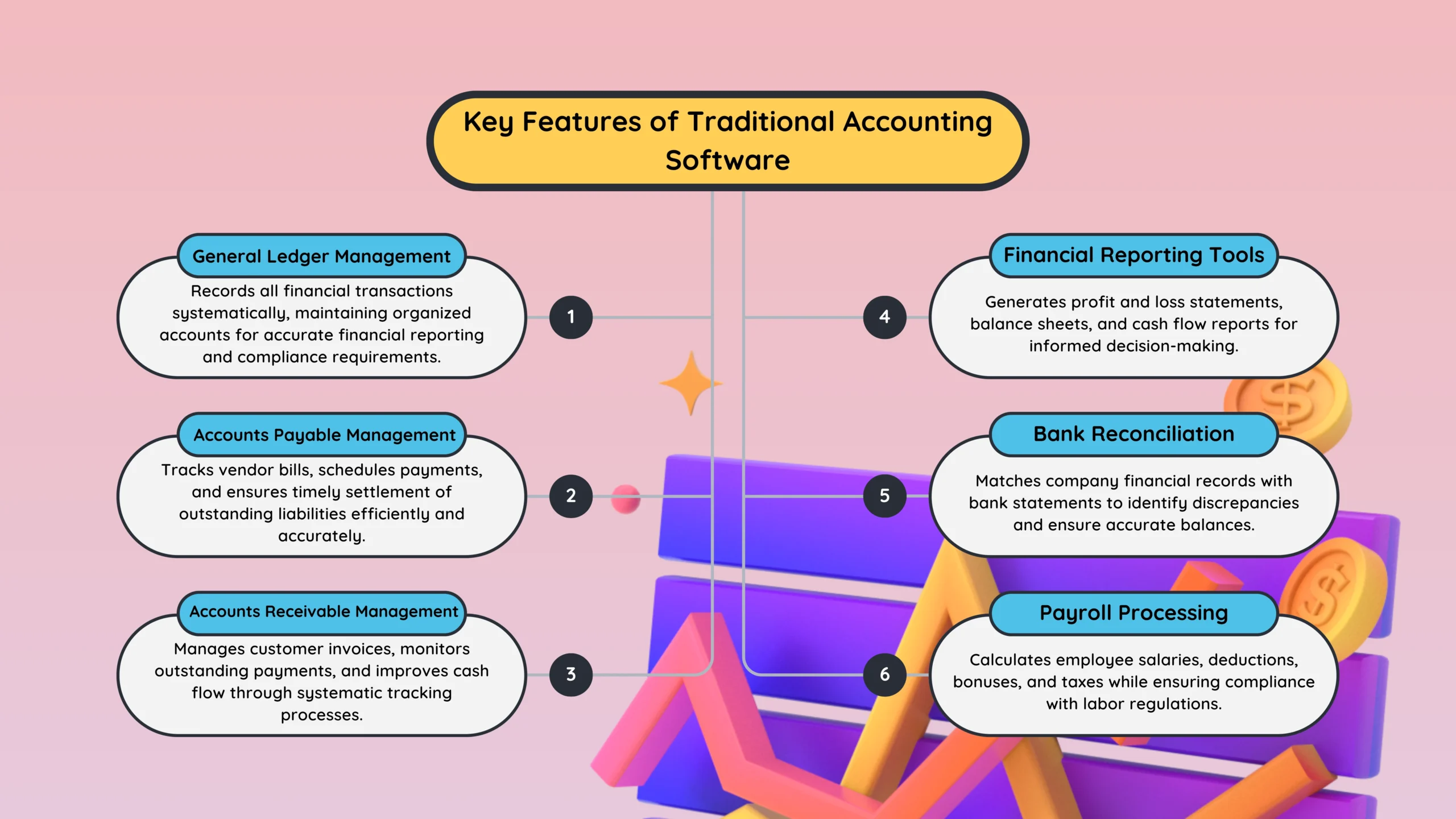
Traditional accounting software typically includes the following capabilities:

  • General ledger management
  • Invoicing and billing
  • Tax computation (GST, VAT, etc.)
  • Bank reconciliation
  • Basic inventory management
  • Payroll processing
  • Financial reporting (P&L, balance sheet, cash flow)

These features are genuinely useful. For a startup jeweler or a one-store operation, they might cover the basics reasonably well.

Common Examples Used by Small Jewelers

Software like Tally ERP 9, QuickBooks, Zoho Books, and FreshBooks are among the most popular traditional accounting tools. Many small to mid-sized jewelry businesses use these because they’re affordable, widely supported, and easy to learn. However, as the business grows and the complexity of operations increases, limitations start to emerge rapidly.

Also Read – 15 Top AI Consulting Companies in 2026 | Expert Guide & Rankings

What Is Bullion ERP and How Is It Different?

Bullion ERP is an Enterprise Resource Planning (ERP) system purpose-built for jewelry manufacturers, retailers, wholesalers, and bullion traders. Unlike traditional accounting software, a Bullion ERP integrates every operational function of your business — from procurement and inventory to sales, CRM, compliance, and live pricing — into a single unified platform.

Think of it as the central nervous system of your jewelry business. Every department, every process, every transaction flows through it.
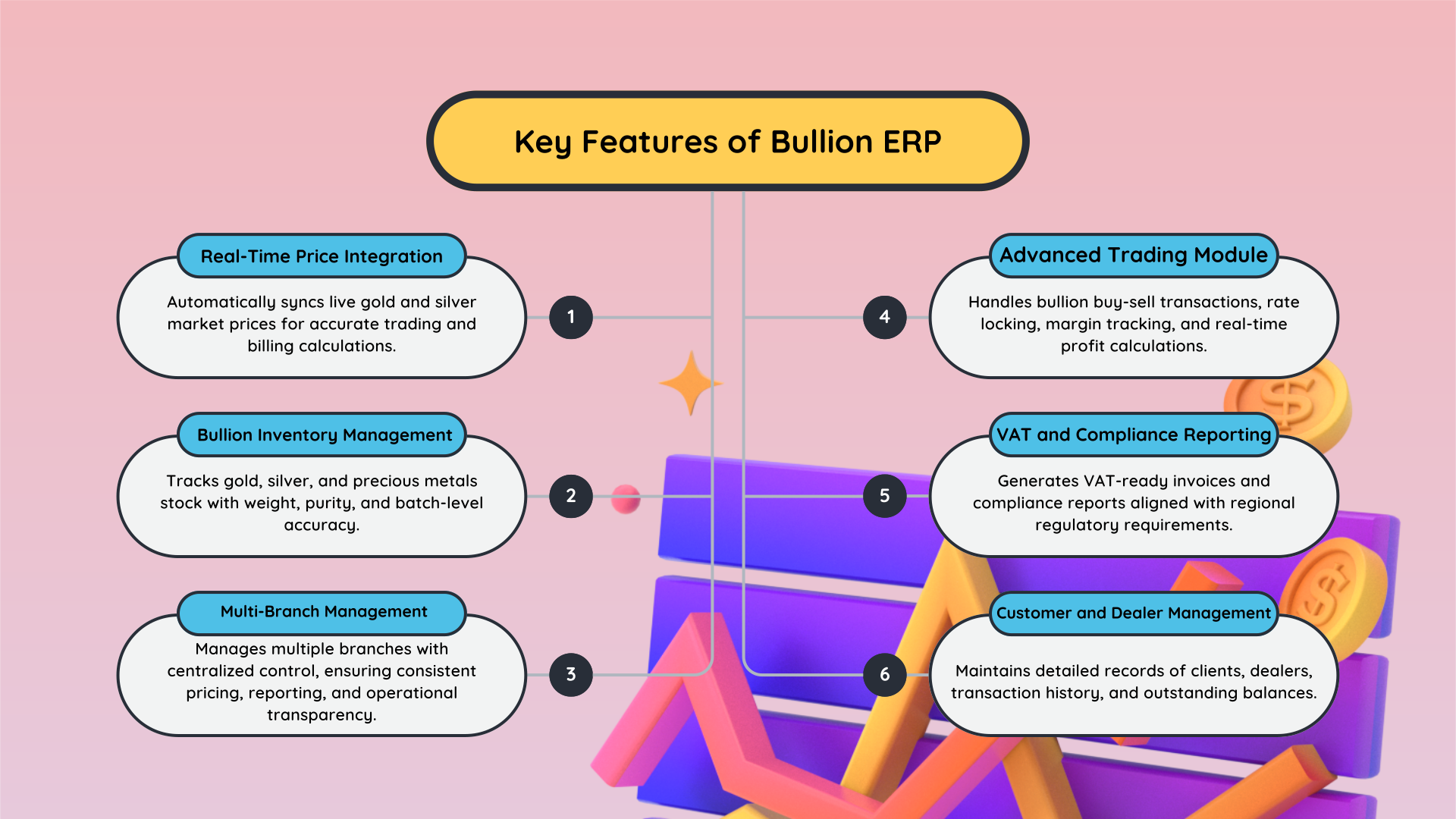
Core Modules of a Bullion ERP System

A robust Bullion ERP typically includes the following modules:

  • Live Metal Rate Integration (gold, silver, platinum pricing via MCX/COMEX)
  • Karatage & Weight-based Inventory Management
  • Job Work / Karigar Management
  • Hallmarking & Certification Tracking
  • Customer Relationship Management (CRM)
  • Order & Quotation Management
  • Billing, Invoicing & GST Compliance
  • Vendor & Supplier Management
  • Barcode / RFID Tagging for Jewellery
  • Multi-branch & Multi-currency Support
  • Analytics & Business Intelligence Dashboards

How Bullion ERP Was Built for the Jewelry & Precious Metals Industry

The jewelry and bullion industry operates on unique parameters. Gold pricing changes by the minute. Inventory is valued not just by quantity but by purity, weight, and design. Labour costs vary by artisan, by piece, and by job. These complexities simply cannot be handled efficiently by a generic accounting tool. Bullion ERP systems are engineered to handle all of this natively, without the need for complicated workarounds or third-party plugins.

Also Read – AI Statistics 2026: 77% Are Ahead—Are You Behind?

Bullion ERP vs Traditional Accounting Software – A Feature-by-Feature Breakdown

Let’s get into the heart of the matter. Below is a comprehensive comparison that every jewelry business founder needs to see before making a software decision.

FeatureTraditional Accounting SoftwareBullion ERP
Inventory ManagementBasic quantity-basedWeight, karatage, purity, design-based
Live Metal PricingNot availableReal-time MCX/COMEX integration
Job Work / Karigar TrackingNot availableFull module with labour cost tracking
Hallmarking ComplianceManual/externalBuilt-in compliance tracking
GST & Tax FilingBasic GST supportAdvanced GST with jewellery-specific rules
Multi-branch ManagementLimitedFull multi-branch, multi-warehouse support
Customer Loyalty & CRMNoneIntegrated CRM with loyalty programs
Barcode/RFID TaggingNot applicableNative support
Reporting & BIStandard financial reportsIndustry-specific dashboards & analytics
ScalabilityLimitedEnterprise-grade scalability

Inventory & Stock Management

In the jewelry business, “inventory management” is not as simple as counting units. A single piece of jewellery could have multiple attributes — gold weight (in grams), stone weight (in carats), making charges (per gram or per piece), wastage allowance, purity percentage, and design code. Traditional accounting software tracks inventory as simple units with a fixed price. It has no understanding of these layered attributes.

Bullion ERP, on the other hand, allows you to define inventory at a granular level. You can track net weight vs. gross weight, manage stones separately, apply different pricing for different karatages, and even track pieces through their entire manufacturing lifecycle from raw material to finished product.

Live Metal Pricing & Rate Integration

This is arguably the most critical differentiator. Gold prices fluctuate multiple times a day. A system that can’t reflect real-time rates is not just inconvenient — it’s a liability.

Why Real-Time Bullion Pricing Is a Game-Changer

Traditional accounting software requires manual rate updates. You’d need to check the MCX or spot price, log in to your software, update the rate, and then generate invoices. In a busy retail environment, this creates costly delays and potential pricing errors.

Bullion ERP integrates directly with live market data feeds. The moment gold prices change, your billing, inventory valuation, and purchase orders update automatically. According to data from the World Gold Council, global gold demand in 2023 reached approximately 4,448 tonnes — and in such a high-volume market, even a 0.1% pricing error can result in significant financial losses.

Also Read – Build a Fundable MVP in 2026: The Ultimate Founder’s Guide

Financial Management & Reporting

Accounting Capabilities Compared

Both traditional software and Bullion ERP offer core accounting features. However, the depth and industry relevance of those features differ dramatically.

Traditional accounting software gives you a solid double-entry bookkeeping framework. You get your standard ledgers, bank reconciliation, and financial statements. For a purely administrative perspective, this is fine.

Bullion ERP goes further by integrating financial data with operational data. So instead of just seeing “Sales: ₹50,00,000,” you see a breakdown by product category, by metal type, by store branch, by salesperson, and by customer segment — all in real time.

Compliance, Taxation & Audit Trails

The jewelry sector in India and globally is heavily regulated. In India alone, jewelers must comply with BIS hallmarking norms, GST regulations, PMLA (Prevention of Money Laundering Act), and PAN-based transaction rules for high-value purchases.

Traditional accounting software handles basic GST calculations but is not equipped for the specific compliance requirements of the jewelry sector — like capturing customer PAN details for purchases above ₹2 lakh, generating proper hallmarking records, or maintaining item-level audit trails required by regulatory bodies.

Bullion ERP has these compliance requirements baked in. It automatically flags transactions that require documentation, maintains tamper-proof audit logs, and generates compliance-ready reports.

Scalability & Business Growth

Can Traditional Software Keep Up with Growth?

Here’s a scenario many jewelry founders know too well: you start with one store, use Tally or QuickBooks, and things work fine. Then you open a second location. Suddenly, you’re maintaining two separate books, manually reconciling inter-branch transfers, and dealing with consolidated reporting nightmares.

Add a manufacturing unit to the mix, and you’ve essentially created three or four separate operational silos that your accounting software was never designed to bridge.

How Bullion ERP Adapts to Your Expanding Business

Bullion ERP is designed for scale from day one. Whether you’re operating one boutique store or a chain of 50 retail outlets with a centralised manufacturing facility, the system grows with you. Multi-branch management, centralised inventory visibility, role-based access control, and consolidated financial reporting are all part of the package.

According to a Gartner report on ERP adoption, businesses that implement ERP solutions see an average improvement of 23% in process efficiency and a 22% reduction in operational costs within the first two years of deployment. For a margin-sensitive business like jewelry retail, this translates directly to the bottom line.

Also Read – In-House vs. Outsourcing Development 2026: Full Cost-Benefit Guide

Operational Efficiency & Automation

Manual Processes vs Automated Workflows

Time is money — and nowhere is that truer than in a busy jewelry store during peak season. With traditional accounting software, a significant portion of daily operations remains manual: updating metal rates, raising purchase orders, calculating making charges, issuing repair receipts, and generating customer-specific quotations.

Every manual step is a potential point of error. Every error in a jewellery invoice — wrong weight, wrong purity, wrong GST rate — can turn into a customer dispute or a compliance issue.

Bullion ERP automates these workflows. Metal rates update automatically. Making charges are calculated based on predefined rules. Purchase orders are generated when stock falls below threshold levels. Customer quotations are generated in seconds based on current market rates.

Order Management, Billing & Invoicing

ProcessTraditional SoftwareBullion ERP
Quotation GenerationManual, time-consumingAuto-generated from live rates
Making Charges CalculationManual spreadsheetRule-based automation
Repair & Job OrdersManual trackingDedicated module with status updates
Barcode-based BillingNot supportedNative support
Old Gold Exchange CalculationsManualAutomated with purity-based rates
Customer-wise PricingNot availableScheme and discount management
E-Invoice & E-Way BillBasic / plugin requiredBuilt-in integration

Bullion ERP can reduce the time taken to generate a single invoice from 5–8 minutes to under 60 seconds. Multiply that by hundreds of transactions a day across multiple branches, and the efficiency gain is enormous.

Data Security & Cloud Accessibility

Data security in the jewelry business is non-negotiable. You’re dealing with customer personal data, high-value transaction records, and sensitive business intelligence. Traditional accounting software, especially desktop-based versions, stores data locally — which means a hardware failure, theft, or malware attack could wipe out years of records.

Modern Bullion ERP systems are cloud-based or hybrid-cloud deployments. Your data is encrypted, backed up in real-time, and accessible from anywhere — whether you’re at the store, at a trade fair, or reviewing performance from your home at midnight. Multi-factor authentication, role-based access control, and session-based security ensure that only authorised personnel can access sensitive data.

Cloud ERP solutions also allow your team to collaborate across branches in real-time, something that’s simply not possible with a traditional desktop accounting tool.

Cost Comparison – What’s the Real Investment?

Let’s address the elephant in the room: cost. Traditional accounting software wins on upfront price — no question. A Tally subscription might cost you ₹18,000–₹25,000 per year. QuickBooks or Zoho could be similar. Bullion ERP solutions, on the other hand, typically range from ₹1,00,000 to ₹5,00,000+, depending on the number of modules, users, and customisation requirements.

But here’s the thing — cost comparison must include the cost of not having the right tool.

Consider the cumulative cost of:

  • Manual pricing errors leading to customer disputes
  • Non-compliance penalties from tax authorities
  • Lost sales due to poor inventory visibility
  • Employee hours spent on manual data entry
  • IT costs to maintain legacy desktop software
  • The cost of data loss from a non-cloud system

When you factor in all of these hidden costs, the ROI on a well-implemented Bullion ERP typically pays for itself within 12–18 months for a mid-sized operation.

Also Read – AI App Development Cost in 2025: From MVPs to Full-Scale Solutions

Who Should Choose What? Decision Guide for Founders

Not every business needs a full Bullion ERP on day one. Here’s a simple framework to help you decide:

Choose Traditional Accounting Software if:

  • You’re a single-store operation with fewer than 5 staff members
  • Your monthly transaction volume is under 200 bills
  • You deal in limited SKUs and don’t manufacture in-house
  • You’re in the early stage of your business with limited capital

Choose Bullion ERP if:

  • You manage multiple branches or are planning to expand
  • You have an in-house manufacturing unit or work with karigar networks
  • You deal in high transaction volumes (500+ bills per month)
  • You want real-time metal rate integration and automated billing
  • You’re facing compliance challenges with GST or BIS hallmarking
  • You want deep analytics and data-driven decision-making
  • You’re planning to integrate e-commerce or B2B portals

The decision ultimately comes down to where you are today versus where you want to be in three years. If your growth ambitions are serious, building your operations on traditional accounting software is like laying the foundation of a skyscraper with brick and mortar — it might hold for a while, but it won’t scale.

Real-World Use Cases: How Jewelry Businesses Transformed with ERP

Across the jewelry industry, businesses that have transitioned from traditional accounting tools to Bullion ERP report transformative results:

A multi-branch jewellery chain in Rajasthan with 12 outlets was using Tally across all branches. Inventory reconciliation at month-end took a full week and required a team of 4 accountants. After implementing Bullion ERP, real-time inventory visibility was established across all branches, and month-end reconciliation was reduced to a single day.

A diamond jewellery manufacturer in Surat struggled with karigar payment reconciliation and job order tracking. Bullion ERP’s job work module gave them complete visibility into piece-wise labour costs, wastage tracking, and karigar dues — resulting in a 15% reduction in manufacturing cost leakage.

These are not isolated success stories. They represent a pattern of measurable business transformation that occurs when the right technology is matched to the right industry problem.

Also Read – AI Agents Explained: Why They Matter and Real-World Use Cases

How IPH Technologies Can Help You Build the Right Solution

At IPH Technologies, we understand that no two jewelry businesses are alike. With over 500 successful projects and 430+ satisfied clients, we’ve helped businesses across industries make the leap from legacy systems to modern, scalable digital solutions.

Whether you need a custom-built Bullion ERP from scratch, want to integrate existing accounting software with advanced jewellery-specific modules, or need a mobile-first platform for your sales team in the field, our team has the expertise to deliver.

Our approach is simple: we start with your business goals, understand your operational workflows, and build technology that aligns with your specific needs — not the other way around.

We leverage agile methodologies, the latest tech stack, and deep domain expertise to deliver solutions that are not just functional but genuinely transformative.

From initial consultation to deployment and beyond, we’re your technology partner at every stage of the journey.

Our expertise spans mobile app development, web applications, and custom software engineering — giving us the flexibility to build integrated ecosystems that cover your entire business operations.

If you’re ready to explore what the right ERP solution could mean for your jewelry or bullion trading business, our team is just a conversation away.

Conclusion

The debate between Bullion ERP and traditional accounting software isn’t really about features on a spec sheet — it’s about your vision for your business. If you’re content managing a small, stable operation, traditional tools might still serve you adequately. But if you’re a founder with ambitions to grow, scale, and compete in an increasingly digital marketplace, clinging to traditional accounting software is a strategic liability.

Bullion ERP isn’t just software — it’s infrastructure. It’s the operational backbone that allows jewelry businesses to move faster, make smarter decisions, maintain tighter compliance, and deliver better experiences to their customers. In an industry as competitive and margin-sensitive as jewelry and bullion trading, that backbone can be the difference between thriving and merely surviving.

The question isn’t whether you can afford to invest in a Bullion ERP. The real question is: can you afford not to?

Frequently Asked Questions (FAQs)

What is the main difference between Bullion ERP and traditional accounting software for jewelers?
Traditional accounting software handles general financial transactions but lacks industry-specific features. Bullion ERP is purpose-built for the jewelry and bullion sector, offering live metal pricing, weight-based inventory, karigar management, hallmarking compliance, and advanced analytics — all in one integrated platform.
Is Bullion ERP suitable for small jewelry shops or only large enterprises?
While Bullion ERP is most impactful for mid-to-large jewelry businesses, scalable solutions exist for smaller operations too. If you’re experiencing growth pain points — like manual rate updates, inventory discrepancies, or compliance challenges — it may be the right time to consider an ERP regardless of your current size.
How does Bullion ERP handle live gold and silver price updates?
Bullion ERP integrates directly with live market data feeds such as MCX (Multi-Commodity Exchange) or COMEX. Prices are updated in real-time, and all billing, inventory valuation, and purchase orders automatically reflect the current rates — eliminating manual rate entry and associated errors.
Can Bullion ERP help with GST compliance for jewelry businesses?
Yes. Bullion ERP has built-in GST compliance features tailored for the jewelry industry, including item-level tax calculation, HSN code mapping, e-invoice generation, e-way bill integration, and automatic capture of customer PAN details for high-value transactions as required by Indian tax law.
How long does it take to implement a Bullion ERP system?
Implementation timelines vary based on the size of the business and the complexity of the required customisation. A standard deployment for a mid-sized jewelry business typically takes 4–12 weeks, including data migration, staff training, and go-live support.
What happens to my existing data if I migrate from traditional software to Bullion ERP?
A professional ERP implementation partner will manage data migration as part of the onboarding process. Historical transaction data, customer records, inventory data, and financial ledgers can typically be migrated from formats supported by tools like Tally, QuickBooks, or Excel.
Does Bullion ERP work for bullion traders, or only for retail jewelers?
Bullion ERP is designed to serve the entire precious metals value chain — including bullion traders, refinery operators, wholesalers, manufacturers, and retail jewelers. Modules can be configured based on your specific business model.
How is Bullion ERP different from a generic ERP like SAP or Oracle?
Generic ERP solutions like SAP or Oracle can be customised for the jewelry sector, but require expensive, time-consuming implementation and industry-specific customisation. Bullion ERP systems are built natively for this industry, meaning they come pre-configured with jewellery-specific workflows, pricing logic, compliance modules, and reporting frameworks — significantly reducing both implementation time and cost.
Avatar
Deep Chaturvedi

Verified Process Manager

About the Author

Deep Chaturvedi is an experienced technology professional with over 12 years in software development and process management. Based in Lucknow, he currently serves as Process Manager, overseeing end-to-end project lifecycles in web, mobile, and AR app domains. Deep combines his technical background in full-stack development—including Laravel, Node.js, React, and Android—with strong skills in process optimization, quality assurance, and team leadership.


WhatsApp
Call us
Get a Call Back