









































































The Software Dilemma Every Business Faces
Imagine you’re setting up a new office. You could buy a generic desk from a big-box store — it works, it’s cheap, and you get it tomorrow. Or you could commission a custom-built workstation designed around exactly how you work. One fits everyone adequately; the other fits you perfectly. That’s precisely the choice businesses face when selecting software in 2026.
The debate between custom software development and off-the-shelf software solutions isn’t new — but it’s never been more critical. With digital transformation accelerating at a breakneck pace, the software you choose today will directly determine how competitive, agile, and secure your business is tomorrow. According to a Gartner report, global enterprise software spending is projected to exceed $1 trillion in 2025, underscoring just how much is at stake.
So, which path should you take? Let’s dig in — step by step — and help you make the smartest decision for your unique business situation.
What Is Custom Software Development?
Custom software is exactly what it sounds like: software built from scratch specifically for your business, your workflows, your users, and your goals. It’s not recycled code with your logo slapped on top — it’s purpose-built, tailored, and uniquely yours.
How Custom Software Is Built
The custom development process typically follows an agile methodology — breaking work into sprints, gathering continuous feedback, and iterating until the product matches your vision precisely. A dedicated development team works alongside your stakeholders to map out requirements, design user flows, write code, test rigorously, and deploy the final product. At IPH Technologies, for instance, every engagement starts with a deep-dive discovery phase to ensure the solution we build aligns with your actual business objectives, not a generic template.
Who Needs Custom Software?
Not every business needs custom software, but if any of these sound familiar, you probably do:
- Your workflows are too unique for any standard product to handle
- You’ve stitched together five or six tools that still don’t quite work together
- You’re scaling rapidly and your current software can’t keep pace
- Compliance or data regulations demand a specific technical approach
- You want a competitive advantage that your rivals simply can’t copy-paste
Also Read – LLM vs RAG vs Agentic AI vs AI Agents: Which AI Architecture Is Right for Your Next Project?
What Are Off-the-Shelf Software Solutions?
Off-the-shelf (OTS) software — also called commercial off-the-shelf or COTS software — refers to ready-made applications developed for a broad audience. Think Salesforce, QuickBooks, Microsoft 365, Shopify, or Slack. These products serve millions of users with a single, standardized codebase.
Common Examples of Ready-Made Software
| Category | Popular Off-the-Shelf Tools |
|---|---|
| CRM | Salesforce, HubSpot, Zoho CRM |
| Accounting | QuickBooks, FreshBooks, Xero |
| Project Management | Jira, Asana, Monday.com |
| eCommerce | Shopify, WooCommerce, BigCommerce |
| Communication | Slack, Microsoft Teams, Zoom |
| HR/Payroll | BambooHR, Gusto, ADP Workforce Now |
Why Businesses Choose Off-the-Shelf
The appeal is undeniable. You can have an off-the-shelf tool operational within hours, not months. The vendor handles updates, patches, and hosting. And since development costs are shared across millions of users, the per-seat price is often very attractive — especially for startups watching every rupee or dollar.
Custom Software vs Off-the-Shelf: A Head-to-Head Comparison
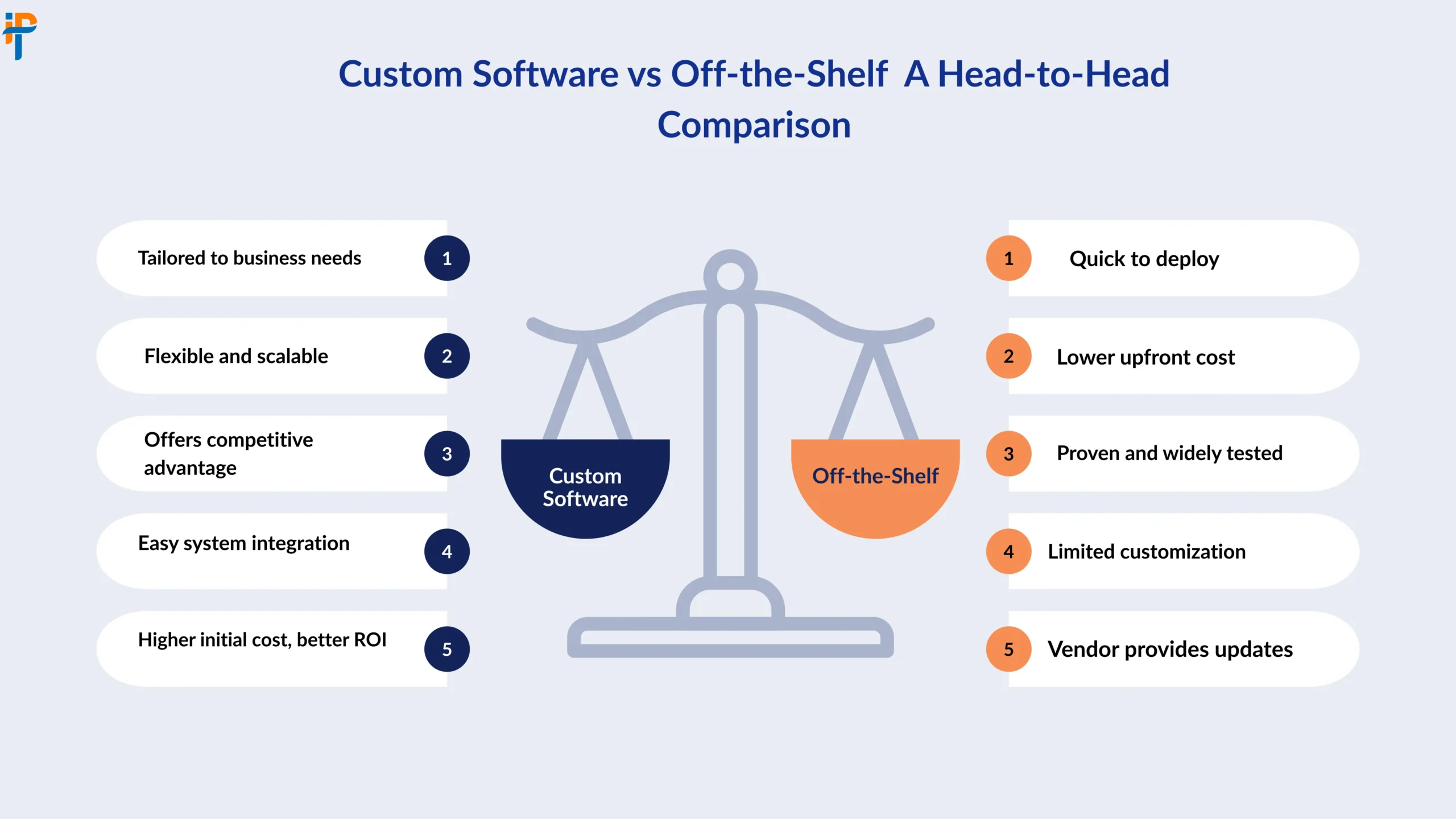
Let’s cut to the chase and compare these two approaches across the dimensions that matter most to business leaders in 2026.
| Factor | Custom Software | Off-the-Shelf Software |
|---|---|---|
| Initial Cost | Higher upfront investment | Low initial cost |
| Long-term Cost | Lower (no recurring per-seat fees) | Can escalate significantly |
| Fit to Business Needs | Perfect — built for you | Moderate — built for everyone |
| Scalability | Fully scalable to your roadmap | Limited by vendor’s roadmap |
| Integration | Seamless with existing systems | Dependent on available APIs |
| Security | High — proprietary architecture | Moderate — shared codebase risks |
| Time to Deploy | Months (3–12 typically) | Days to weeks |
| Competitive Advantage | High — unique to you | Low — available to all competitors |
| Customization | Unlimited | Limited to vendor-allowed options |
| Vendor Dependency | None | High |
Looking at this table, the story becomes clearer. Off-the-shelf wins on speed and immediate cost. Custom software wins on virtually everything else that matters over time.
Also Read – LLM vs RAG vs Agentic AI vs AI Agents: Which AI Architecture Is Right for Your Next Project?
The True Cost of Software: Breaking Down Your Investment
Here’s the truth most software vendors don’t want you to realize: cheap software is rarely inexpensive in the long run.
Hidden Costs of Off-the-Shelf Software
That $50/month per seat SaaS subscription looks harmless at first. But multiply it across a growing team, add premium tiers for the features you actually need, stack on integration plugins, training costs, data migration expenses, and the productivity lost when the software almost does what you need — and suddenly that “affordable” solution is costing you a small fortune annually.
A Flexera State of the Cloud report consistently finds that organizations waste 30% or more of their cloud and SaaS spend on unused or underutilized tools. That’s money walking out the door every single month.
The Real ROI of Custom Software Development
Custom software requires a meaningful upfront investment — there’s no sugarcoating that. But here’s the math that matters: a custom solution eliminates per-seat licensing fees, reduces the need for multiple overlapping tools, dramatically increases operational efficiency, and can become a revenue-generating product in its own right. When IPH Technologies has delivered custom platforms for clients, the average ROI timeline is 18–36 months — after which the software essentially pays for itself indefinitely.
Scalability: Which Solution Grows With Your Business?
Scaling a business is exhilarating. Watching your software buckle under the weight of that growth? Not so much.
Off-the-Shelf Scalability Limitations
When you scale with an OTS product, you’re entirely at the mercy of the vendor’s pricing tiers and feature roadmap. Hit 500 users and you move to enterprise pricing — often 5–10x what you were paying. Need a feature that doesn’t exist? Submit a request and hope the vendor agrees it’s worth building — sometime in the next 18 months. The roadmap belongs to them, not you.
How Custom Software Scales Seamlessly
Custom software is architecturally designed with your growth trajectory in mind. Need to add 10,000 new users? The infrastructure scales. Need a new module for a product line you’re launching? The codebase is yours — your development partner builds it. At IPH Technologies, we architect all our custom solutions with modular, microservice-based designs that make future expansion not just possible, but clean and efficient.
Security and Compliance in 2026
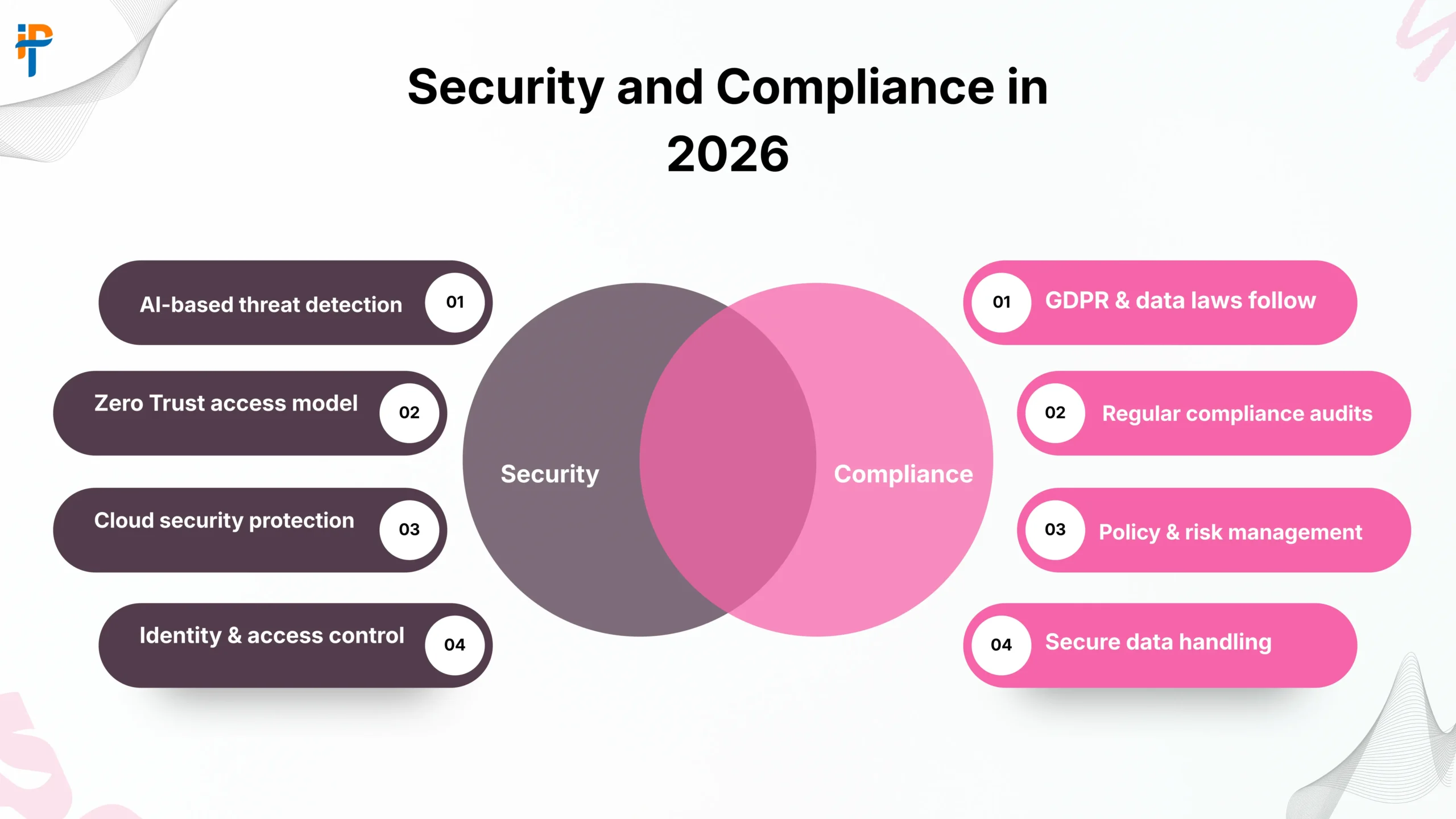
Cybersecurity isn’t optional in 2026 — it’s existential. A single breach can cost millions in recovery, legal fees, and reputational damage. According to IBM’s Cost of a Data Breach Report 2024, the global average cost of a data breach reached $4.88 million — an all-time high.
Vulnerabilities in Off-the-Shelf Platforms
Off-the-shelf software is a hacker’s dream target. Why? Because its codebase is publicly known, its vulnerabilities are widely documented, and a single exploit can be deployed against millions of installations simultaneously. Ransomware attacks, SQL injection exploits, and zero-day vulnerabilities in popular OTS platforms make headlines with disturbing regularity. If you’re operating in healthcare (HIPAA), finance (PCI-DSS, RBI regulations), or any regulated industry, off-the-shelf platforms often create compliance headaches that require costly workarounds.
Custom Software and Data Security
Custom software has an inherent security advantage: security through obscurity, combined with purpose-built hardening. Attackers can’t exploit a platform they’ve never seen. Your development team can bake compliance requirements directly into the architecture — GDPR, HIPAA, SOC 2, ISO 27001 — rather than retrofitting them. At IPH Technologies, security architecture is never an afterthought; it’s baked into our development process from day one.
Integration Capabilities: Fitting Into Your Tech Stack
Modern businesses don’t run on a single tool. Your CRM needs to talk to your ERP, your marketing automation needs to sync with your analytics, and your customer portal needs to pull data from your inventory system. Integration is everything.
Off-the-shelf tools integrate well — but only with each other, and only when the vendor has built those connectors. Want to integrate Salesforce with a legacy system your company has used for 15 years? Get ready for expensive middleware, brittle API connections, and a whole lot of troubleshooting.
Custom software is designed to integrate with anything. Since your team controls the codebase, connecting to any API, legacy database, or third-party service is simply a matter of engineering — not a matter of waiting for a vendor to prioritize it on their roadmap. This is especially important for businesses in manufacturing, logistics, healthcare, and financial services, where legacy systems are often central to operations.
Time to Market: Speed vs. Long-Term Value
When Speed Matters Most
If you’re validating a business idea, testing a market, or need something operational within weeks, off-the-shelf is your friend. Shopify gets your eCommerce store live in a day. HubSpot gets your marketing funnel running in a week. For early-stage ventures where the goal is learning quickly and iterating, OTS tools deliver incredible value.
When Long-Term Value Wins
Once your business model is validated and you’re scaling, the calculus flips. The constraints of off-the-shelf software start to chafe. Your team builds workarounds for missing features. Data lives in silos across five platforms. Customer experience suffers because the tool wasn’t built for your customer journey. At this stage, investing in custom software isn’t just smart — it’s strategically necessary.
The honest timeline for custom development ranges from 3 to 12 months depending on complexity. But think of it this way: you’re not just building software — you’re building a strategic business asset with a multi-year lifespan and compounding returns.
Industry-Specific Use CasesHealthcare and Fintech
These are industries where off-the-shelf solutions often simply cannot meet regulatory requirements. A healthcare provider needs a patient management system that integrates with specific diagnostic equipment, complies with local health data regulations, and supports a clinical workflow that no generic product has modeled. A fintech company building a lending platform needs custom credit scoring logic, real-time fraud detection, and regulatory reporting — none of which a standard SaaS can provide out of the box.
Retail, eCommerce, and SaaS
A retail brand that’s outgrown Shopify but isn’t ready for the complexity of a custom build might use a hybrid approach — starting on OTS, then migrating core functionality to a custom platform as they scale. An internal SaaS product sold to other businesses must be custom — it’s your product, your competitive moat, your IP. Outsourcing that to an off-the-shelf framework fundamentally undermines your business model.
Also Read – iOS App Development on Windows: Save Time, Money & Effort in 2026
How to Decide: A Decision Framework for 2026
Still unsure which route is right for you? Run your situation through this decision lens:
Choose Off-the-Shelf if:
- You’re in an early validation stage and speed is critical
- Your requirements closely match what existing tools already do
- Budget is severely constrained and you need to start immediately
- The business function is not a differentiator (e.g., basic payroll)
Choose Custom Software if:
- Your workflows are unique or highly specialized
- You’re scaling and long-term costs of OTS are becoming significant
- Security, compliance, or data sovereignty is a priority
- Integration with proprietary or legacy systems is essential
- You want a competitive moat competitors can’t easily replicate
- You’re building a product to sell or license to other businesses
Consider a Hybrid Approach if:
- You want to move fast now and build custom modules over time
- You’re migrating from OTS to custom incrementally
- Certain business functions are standard (use OTS) while others are specialized (use custom)
Also Read – Bullion ERP vs Traditional Accounting Software: What’s Better for Jewelers & Traders?
Why IPH Technologies Is Your Ideal Custom Software Partner
Choosing the right development partner is just as important as choosing the right type of software. At IPH Technologies, we’ve spent years perfecting the art of turning complex business requirements into elegant, high-performing digital solutions.
With over 500 successful projects delivered and 430+ satisfied clients across industries, we bring deep expertise in mobile app development, web application engineering, and custom enterprise software. Our agile teams don’t just write code — we partner with you strategically to understand your business, anticipate your growth, and architect solutions that deliver measurable ROI.
Whether you’re a startup ready to build your flagship product or an enterprise looking to replace a legacy system that’s holding you back, IPH Technologies has the talent, the process, and the track record to deliver exceptional results. We believe the best software isn’t just functional — it’s a competitive weapon.
Conclusion
The choice between custom software and off-the-shelf solutions in 2026 isn’t black and white — it depends on your stage of growth, your budget, your industry, and your ambitions. For businesses in early validation, off-the-shelf tools are a pragmatic starting point. But for businesses that are scaling, competing on differentiation, operating in regulated industries, or building products — custom software isn’t a luxury. It’s a strategic imperative.
Think of it this way: off-the-shelf software helps you play the game. Custom software helps you change the game. If you’re ready to stop working around your tools and start having your tools work for you, it’s time to have a conversation with a custom software development partner who can make that vision a reality.
At IPH Technologies, we’re ready when you are.









.png)