















































































































Healthcare App Development Compliance Checklist for 2026: A Practical Guide for Founders
Building a healthcare app is nothing like building a food delivery app or a to-do list tool. One mishandled data field, one missing consent screen, one skipped encryption layer — and you’re not just looking at a bad review. You’re looking at a federal investigation.
That sounds dramatic. It isn’t. It’s just 2026.
If you’re planning to build (or already building) a healthcare app this year, this checklist is your reality check.
We’ll walk through every layer of compliance you need — privacy law, medical device regulation, security certifications, AI governance — and turn it into something you can actually act on, not just admire in a PDF.
Why Compliance Can’t Be an Afterthought in 2026
Here’s the thing about healthcare apps: they sit at the intersection of two worlds that don’t forgive mistakes. Medicine doesn’t forgive mistakes. And neither does regulation.
The mHealth market itself tells you why the stakes keep climbing. Industry estimates put the global mHealth apps market at roughly $45 billion in 2026, growing at a compound annual rate north of 11–12% through the early 2030s.
More apps, more patient data, more attack surface. It’s basic math — the bigger the pie, the bigger the target on your back.
And regulators know this. That’s why 2026 has already brought updated HIPAA penalty structures, a new FDA cybersecurity guidance, and fresh Quality Management System rules for medical device software.
None of this happened by accident. It happened because healthcare data breaches remain, for the fourteenth year running, the most expensive kind of breach any industry can suffer.
So no, compliance isn’t paperwork you bolt on before launch. It’s architecture. It has to be baked in from your very first Figma frame.
Also Read – Healthcare App Development Trends 2026: Complete Guide
The Regulatory Landscape Healthcare Apps Must Navigate
Let’s break down the frameworks that actually matter, because “healthcare compliance” isn’t one law — it’s a stack of them, and which ones apply depends entirely on what your app does and where your users live.
HIPAA and the 2026 Security Rule Overhaul
If your app touches Protected Health Information (PHI) in the US — even indirectly, even through a vendor — HIPAA applies. Full stop.
HHS finalized updated inflation-adjusted penalty tiers effective January 28, 2026, and 2026 also brings mandatory Security Rule updates including multi-factor authentication, network segmentation, encryption of ePHI at rest and in transit, and a 72-hour breach notification requirement to OCR (Medcurity). Miss these, and you’re not looking at a warning letter — you’re looking at Tier 2 or Tier 3 penalties right out of the gate.
Here’s a detail most founders miss: HIPAA doesn’t just apply to hospitals. OCR has fined solo practitioners and small clinics between $30,000 and $250,000 for the same violations that sink hospital systems — missing risk assessments, absent Business Associate Agreements, delayed patient record access (BayArea Compliance). If you’re a startup thinking “we’re too small to matter,” think again. Small is exactly who OCR is watching now.
GDPR and International Data Protection Rules
Planning to launch in the UK, EU, Canada, or Australia? HIPAA won’t save you there. GDPR treats health data as a “special category” requiring explicit consent, strict purpose limitation, and the right to erasure. Penalties can reach up to 4% of global annual revenue — a number that makes HIPAA’s fines look almost quaint by comparison.
The practical takeaway: design your consent flows, data retention policies, and deletion mechanisms for the strictest applicable jurisdiction, then apply that baseline everywhere.
It’s far cheaper to build once correctly than to maintain five regional variants.
FDA’s Software as a Medical Device (SaMD) Framework
This is where many health app founders get tripped up. Not every health app is a “medical device” in the FDA’s eyes — but plenty are, and the line has actually gotten clearer (and in some cases, more lenient) in 2026.
In January 2026, the FDA published guidance narrowing oversight for low-risk digital health products — fitness wearables, general wellness trackers, and clinical decision support tools that don’t make autonomous clinical decisions may not require FDA clearance at all.
But if your app diagnoses, triages, or recommends specific treatment based on patient data, you’re likely in SaMD territory — and that means 510(k) clearance, De Novo classification, or full premarket approval, depending on risk class.
The FDA’s AI-enabled device list has also exploded — from roughly 950 authorized devices in August 2024 to over 1,250 by mid-2025.
If your app uses AI/ML for anything diagnostic, budget time and money for this pathway early — it’s not something you retrofit after launch.
Also Read – Step-by-Step Guide to Building a Successful Mobile App in 2026
HITRUST, SOC 2, and ISO 27001 — Do You Need All Three?
Short answer: probably not all three at once, but you’ll likely need at least one, especially if you’re courting enterprise health system clients or payers.
- HITRUST CSF is the gold standard health systems and insurers ask for by name.
- SOC 2 Type II proves your operational security controls over time — a common ask from B2B healthcare SaaS buyers.
- ISO 27001 is the international baseline, especially relevant if you’re expanding beyond the US.
Think of these certifications less as badges and more as a shared vocabulary. They let a hospital’s procurement team trust you without auditing your codebase line by line.
The Real Cost of Getting Compliance Wrong
Let’s talk numbers, because nothing focuses a founder’s mind like a dollar figure.
HIPAA Penalty Tiers, Explained in Plain English
| Tier | Culpability Level | Penalty Range (Per Violation, 2026) | Annual Cap (Per Category) |
|---|---|---|---|
| Tier 1 | No knowledge — couldn’t reasonably have known | $145 – $73,011 | $2,190,294 |
| Tier 2 | Reasonable cause — not willful neglect | $1,461 – $73,011 | $2,190,294 |
| Tier 3 | Willful neglect, corrected within 30 days | $14,602 – $73,011 | $2,190,294 |
| Tier 4 | Willful neglect, not corrected | $73,011 – $2,190,294 | $2,190,294 |
Figures reflect the January 28, 2026 inflation-adjusted HHS penalty schedule (Accountable HQ; Medcurity).
Notice something? Even the “lowest” tier — where you genuinely had no idea a violation occurred — can still cost you over $2 million annually per category if the violations pile up.
That’s the equivalent of your seed round evaporating because someone forgot to encrypt a backup.
And here’s the part that should really worry you: criminal penalties exist too, separate from OCR’s civil fines.
Knowingly obtaining or disclosing PHI can result in up to 1 year in prison; doing so for personal gain or with malicious intent escalates to 10 years and a $250,000 fine — and these penalties apply to individuals, not just companies.
What a Healthcare Data Breach Actually Costs You
Beyond regulatory fines, there’s the breach itself. IBM’s 2025 Cost of a Data Breach Report found healthcare breaches averaged $7.42 million in the US — the most expensive of any industry studied, for the fourteenth consecutive year.
Healthcare breaches also took the longest to detect and contain of any sector — about 279 days, roughly five weeks longer than the cross-industry average.
Think about that for a second. Nine months of an attacker quietly sitting inside your systems before anyone notices.
That’s not a technical failure — that’s a monitoring and governance failure, and it’s entirely preventable with the checklist below.
The Complete 2026 Healthcare App Compliance Checklist
Here’s where we get tactical. Break this down into five workstreams and treat each one as a sprint deliverable, not a launch-week scramble.
Data Privacy & Security Checklist
- Encrypt PHI/ePHI at rest and in transit (AES-256 minimum)
- Implement mandatory multi-factor authentication for all admin and clinician accounts
- Apply network segmentation between patient data systems and general app infrastructure
- Build role-based access controls with the principle of least privilege
- Set up automated audit logging for every PHI access event
- Establish a 72-hour breach notification workflow to regulators and affected users
- Define and enforce data retention and secure deletion policies
Regulatory Classification Checklist
- Determine whether your app qualifies as SaMD under FDA’s current framework
- Map every data type you collect against HIPAA, GDPR, and relevant state laws (e.g., CCPA)
- Identify your regulatory pathway early — 510(k), De Novo, or enforcement discretion
- Document your intended use statement precisely — vague claims invite regulatory scrutiny
Technical Architecture Checklist
- Choose HIPAA-eligible cloud infrastructure (AWS, Azure, GCP all offer compliant configurations)
- Sign Business Associate Agreements (BAAs) with every cloud and infrastructure vendor
- Build a Software Bill of Materials (SBOM) to track every third-party component and its vulnerabilities
- Design for “secure by design” — threat modeling and penetration testing before launch, not after
- Implement automatic session timeouts and device-level security checks
Third-Party & Vendor Management Checklist
- Vet every SDK, analytics tool, and API integration for PHI exposure risk
- Confirm BAAs are in place with all subcontractors who touch patient data
- Avoid third-party trackers and ad SDKs on any screen that touches health data
- Review vendor SOC 2 or HITRUST reports annually, not just at onboarding
Documentation & Governance Checklist
- Conduct and document an enterprise-wide HIPAA risk assessment — update it annually
- Maintain workforce HIPAA training records for every employee with data access
- Create a formal incident response plan and test it at least twice a year
- Assign a named Privacy Officer and Security Officer, even in a small startup
- Keep a change-control log for every material update to app functionality or data flows
Where AI Features Add a New Compliance Layer
AI is everywhere in healthcare apps now — symptom checkers, triage assistants, personalized treatment nudges. But every AI feature you add is also a new regulatory surface.
If your model makes or influences a clinical decision, you likely need a Predetermined Change Control Plan (PCCP) under FDA’s finalized December 2024 guidance, covering exactly how your model can evolve post-launch without triggering a fresh submission every time you retrain it.
You’ll also need documented Good Machine Learning Practices — think of it as version control, but for clinical trust.
There’s also a quieter risk: AI governance gaps are now directly tied to higher breach costs.
IBM found that organizations without formal AI governance policies paid noticeably more when breached, and breaches involving “shadow AI” tools added roughly $670,000 to the average incident cost.
If your team is quietly feeding patient data into ChatGPT to draft a feature spec, that’s not innovation — that’s an incident waiting to happen.
Building Compliance Into Your Development Timeline
Compliance works best when it’s a parallel track, not a final gate. Here’s roughly how we’d sequence it across a typical build:
| Development Phase | Compliance Activity | Owner |
|---|---|---|
| Discovery & Planning | Regulatory classification, data mapping, risk assessment | Product + Legal |
| Architecture Design | HIPAA-eligible infra selection, BAA sign-off, threat modeling | Engineering |
| Development | Encryption, access controls, audit logging, SBOM tracking | Engineering + Security |
| QA & Testing | Penetration testing, vulnerability scanning, access control audits | Security |
| Pre-Launch | Incident response plan, staff training, privacy policy finalization | Compliance Officer |
| Post-Launch | Continuous monitoring, annual risk assessment, vendor review | Operations |
Notice how little of this sits at the very end. That’s intentional. A compliance review two weeks before launch is a fire drill, not a strategy.
Common Compliance Mistakes Healthcare Startups Make
We’ve seen the same handful of mistakes sink otherwise promising healthcare apps, again and again:
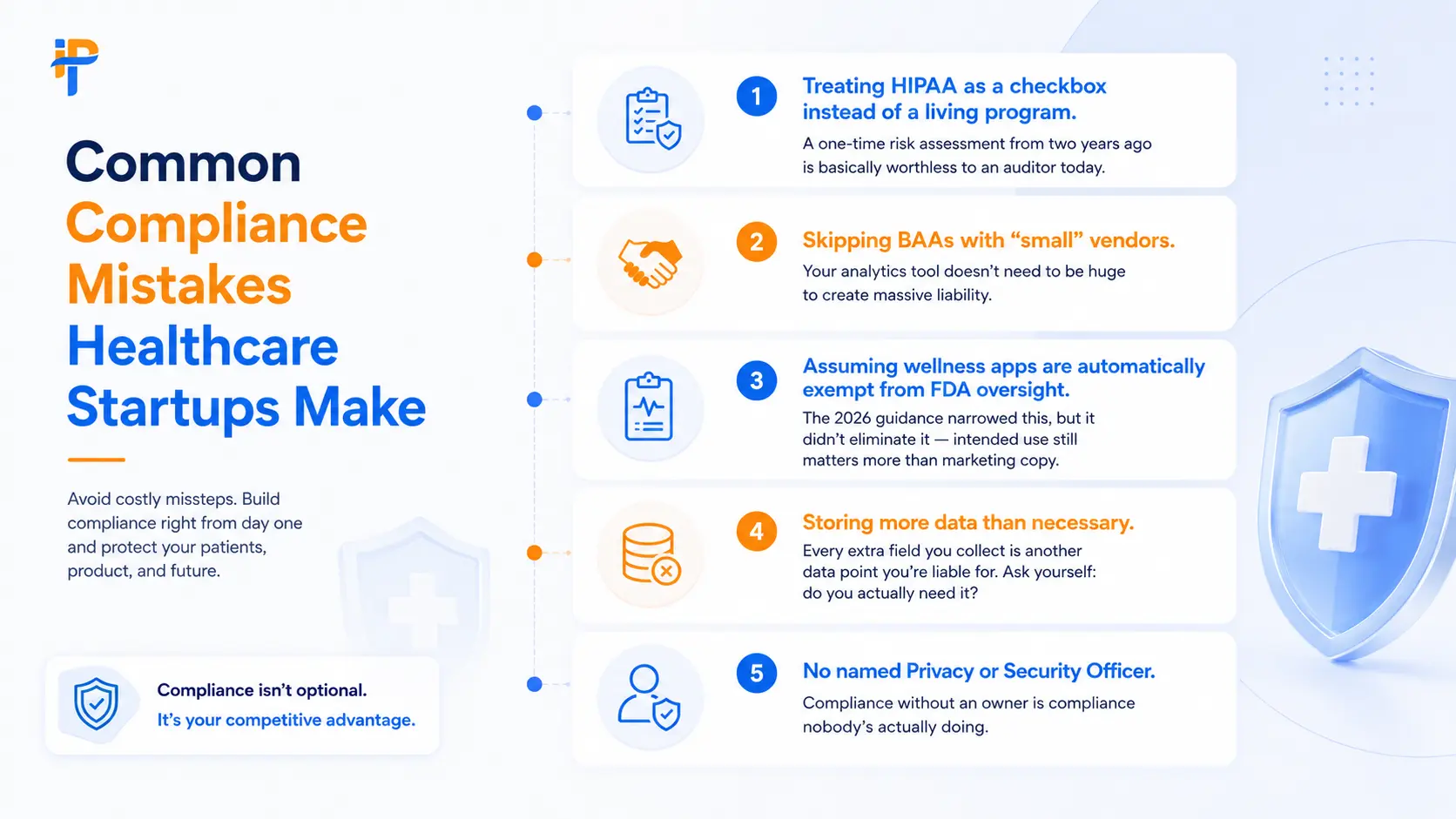
- Treating HIPAA as a checkbox instead of a living program. A one-time risk assessment from two years ago is basically worthless to an auditor today.
- Skipping BAAs with “small” vendors. Your analytics tool doesn’t need to be huge to create massive liability.
- Assuming wellness apps are automatically exempt from FDA oversight. The 2026 guidance narrowed this, but it didn’t eliminate it — intended use still matters more than marketing copy.
- Storing more data than necessary. Every extra field you collect is another data point you’re liable for. Ask yourself: do you actually need it?
- No named Privacy or Security Officer. Compliance without an owner is compliance nobody’s actually doing.
Sound familiar? If even two of these hit close to home, it’s worth pausing your roadmap for a week to fix them before you build further on shaky ground.
Also Read – 2026 Mobile App Compliance Guide: GDPR, HIPAA & App Store Rules
How IPH Technologies Builds Compliance-Ready Healthcare Apps
At IPH Technologies, we’ve spent over a decade shipping app development, web development, and custom software solutions across 500+ projects and 430+ clients — and healthcare has consistently been one of the domains where “move fast” has to be balanced with “don’t get sued.”
Our approach treats compliance as a design constraint from day one, not a post-launch audit.
We build on HIPAA-eligible infrastructure, implement encryption and access controls at the architecture level, and structure our development sprints so security and regulatory reviews run alongside feature work — not after it.
Whether you’re building an mHealth wellness app, a remote patient monitoring platform, or an AI-powered diagnostic tool that needs FDA clearance, our team helps you map the right regulatory pathway before a single line of code gets written.
We’re not just developers who happen to touch healthcare. We’re a partner who understands that in this space, the code and the compliance are the same conversation.
Conclusion
Building a healthcare app in 2026 means accepting a simple truth: your product’s success depends as much on your compliance posture as it does on your UX.
HIPAA penalties are climbing, the FDA’s AI oversight is maturing fast, and data breaches in this sector remain the costliest of any industry, year after year. None of that is going away.
But here’s the encouraging part — none of it is unmanageable either.
Every item on this checklist is achievable with the right planning, the right partners, and the discipline to treat compliance as architecture rather than an afterthought.
Get it right from the start, and you’re not just avoiding fines.
You’re building the kind of trust that gets hospitals, patients, and investors to actually say yes.










.png)