


























































Highlights
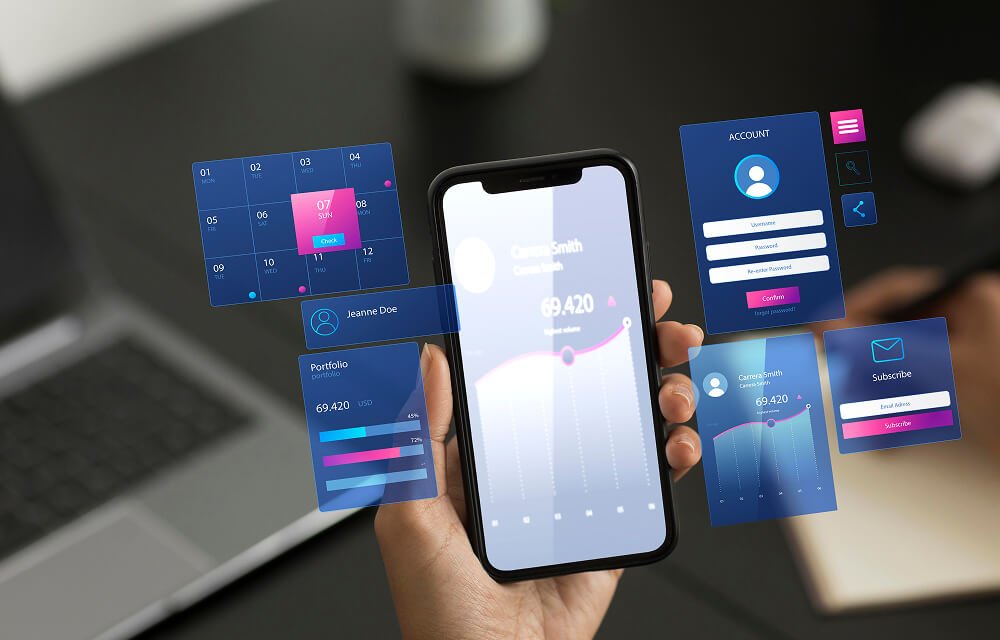
UI/UX Design
User-first, visually engaging interfaces crafted to enhance usability, boost engagement, and deliver seamless digital experiences.
Branding
Strategic brand identities that communicate your vision, build trust, and create a memorable presence across all touchpoints.
Wireframing
Structured layouts and user flows that map the product journey clearly before development begins, saving time and cost.
Prototype Design
Interactive prototypes that simulate real user interactions, helping validate ideas and refine experiences early.
Design Systems
Scalable design frameworks and reusable components that ensure consistency, speed, and efficiency across your product.
UI/UX Design

We design intuitive, user-centric interfaces that enhance engagement, improve usability, and deliver seamless digital experiences across all devices.

UI UX Design
  • User research and wireframing for clear flows
  • Modern UI design using Figma and Adobe XD
  • Interactive prototypes for better user experience testing
  • Usability testing and performance optimization improvements
  • Responsive design across all devices and screens
  • Scalable design systems with reusable UI components
Branding & Identity

We craft strong brand identities that communicate your vision, build trust, and create a lasting impression across all digital and offline touchpoints.

Branding and Identity
  • Logo design and brand identity creation
  • Brand guidelines and visual consistency systems
  • Color palette and typography selection strategy
  • Marketing materials and brand asset design
  • Social media branding and creative direction
  • Rebranding and brand positioning strategies
Wireframing

We create structured wireframes that define layout, user flow, and functionality, helping visualize ideas and build a strong foundation before design and development.

Wireframing
  • Low fidelity wireframes for initial structure
  • High fidelity wireframes with detailed layouts
  • User flow mapping for better navigation
  • Content hierarchy and layout planning
  • Clickable wireframes for early feedback
  • Clear structure before UI design phase
Prototype Design

We design interactive prototypes that simulate real user experiences, helping validate ideas, test functionality, and refine products before development.

Prototype Design
  • Interactive prototypes for real user experience
  • Clickable designs to test product functionality
  • User journey simulation for better understanding
  • Rapid prototyping for faster design validation
  • Feedback driven improvements before development
  • High fidelity prototypes with smooth interactions
Design Systems

We build scalable design systems that ensure consistency, improve collaboration, and accelerate product development across all platforms and teams.

Design Systems
  • Reusable UI components for consistent design
  • Design tokens for colors typography spacing
  • Component libraries for faster development workflow
  • Consistent branding across all digital products
  • Documentation for design and development teams
  • Scalable systems for growing product ecosystems
Highlights
Mobile Apps Development
High-performance Android and iOS mobile applications built with modern technologies, delivering seamless user experiences and robust functionality.
Desktop Application Dev
Powerful and secure desktop applications tailored for Windows, macOS, and Linux, designed for performance, scalability, and reliability.
Web App Development
Scalable and responsive web applications using modern frameworks like React, Angular, and Vue for fast, dynamic, and engaging experiences.
Cross-Platform
Cost-effective cross-platform solutions using Flutter and React Native, enabling a single codebase for both iOS and Android platforms.
PWA Development
Progressive Web Apps that combine the best of web and mobile, offering offline access, fast loading, and app-like experiences directly in the browser.
Highlights
Mobile App

Android

iOS

Flutter

Hybrid

Optimize

Native

Swift

Firebase

Android App Development

We craft powerful, scalable Android applications with intuitive UX, high performance, and deep integration with Google services.

Android App
  • Custom Android app development
  • Native Kotlin & Java apps
  • Google Play Store deployment
  • Material Design UI implementation
Kotlin

Kotlin

Java

Java

Flutter

Flutter

Android Studio

Android

Jetpack

Jetpack

iOS App Development

We build high-quality, user-centric iOS apps combining performance, security, and seamless design for Apple devices.

iOS App
  • Custom iOS app development
  • Native Swift & SwiftUI apps
  • Seamless Apple service integration
  • App Store review & deployment
Swift

Swift

SwiftUI

SwiftUI

Obj-C

Obj-C

Xcode

Xcode

Flutter

Flutter

Cross-Platform Apps

We develop cross-platform mobile apps that run flawlessly on both iOS and Android from a single codebase, saving time and cost.

Cross-Platform App
  • Single codebase for iOS & Android
  • Flutter & React Native development
  • Native-like performance & UI
  • Faster time-to-market
React Native

React Native

TypeScript

TypeScript

Redux

Redux

Firebase

Firebase

Dart

Dart

Hybrid Apps

We build hybrid mobile apps that blend web technologies with native capabilities, delivering broad reach and cost-effective development.

Hybrid App
  • Web + native feature integration
  • Ionic & Cordova frameworks
  • Reduced development costs
  • Multi-platform publishing
Flutter

Flutter

Dart

Dart

Firebase

Firebase

SQLite

SQLite

App Optimization

We enhance existing mobile apps with performance tuning, crash fixes, battery efficiency, and faster load times for a superior user experience.

App Optimization
  • Performance profiling & tuning
  • Memory & battery optimization
  • Crash analysis & bug fixing
  • App size reduction & load speed
Xcode

Xcode

Android Studio

Android

Firebase

Firebase

Java

Java

Highlights
Desktop App

Windows

macOS

Linux

Desktop

Electron

Qt

WinForms

GTK

Windows Apps

We develop robust Windows desktop applications using modern Microsoft technologies, delivering powerful tools for enterprise and consumer use.

Windows App
  • Custom Windows desktop applications
  • WPF & WinForms development
  • Microsoft Store deployment
  • Windows API & system integration
C#

C#

.NET

.NET

Electron

Electron

Visual Studio

Visual Studio

SQL Server

SQL Server

macOS Apps

We create elegant, high-performance macOS applications that leverage Apple's native frameworks for a smooth and delightful desktop experience.

macOS App
  • Native macOS app development
  • SwiftUI & AppKit integration
  • Mac App Store submission
  • Apple Silicon optimization
Swift

Swift

SwiftUI

SwiftUI

Obj-C

Obj-C

Xcode

Xcode

Cross-Platform Desktop

We develop cross-platform desktop applications that run seamlessly on Windows, macOS, and Linux from a single shared codebase.

Cross-Platform Desktop
  • Single codebase for all platforms
  • Electron & Tauri frameworks
  • Flutter for desktop support
  • Consistent UI across OS environments
Flutter

Flutter

Electron

Electron

Node.js

Node.js

TypeScript

TypeScript

Docker

Docker

Electron Apps

We build feature-rich Electron desktop apps using web technologies, enabling cross-platform deployment with native OS capabilities.

Electron App
  • Electron framework development
  • Node.js & Chromium integration
  • Auto-updater & native notifications
  • Cross-OS packaging & distribution
Electron

Electron

Node.js

Node.js

React

React

Vue

Vue

TypeScript

TypeScript

Highlights
Web App

React

Node.js

PHP

Laravel

Python

MySQL

JavaScript

HTML

CSS

React Development

We build fast, component-driven React web applications with modern state management, reusable UI, and seamless API integration.

React Development
  • Custom React SPA development
  • Redux & Context API state management
  • Next.js SSR & SSG support
  • REST & GraphQL API integration
React

React

Next.js

Next.js

Redux

Redux

TypeScript

TypeScript

Tailwind

Tailwind

Angular Development

We develop enterprise-grade Angular applications with structured architecture, two-way data binding, and robust TypeScript foundations.

Angular Development
  • Custom Angular SPA development
  • RxJS & NgRx state management
  • Angular Material UI components
  • Lazy loading & performance tuning
Angular

Angular

TypeScript

TypeScript

HTML

HTML

CSS

CSS

NPM

NPM

Node.js Backend

We build scalable, event-driven Node.js backends with RESTful APIs, real-time capabilities, and seamless database integrations.

Node.js Backend
  • RESTful & GraphQL API development
  • Express.js & Fastify frameworks
  • WebSocket & real-time features
  • MongoDB, PostgreSQL integration
Node.js

Node.js

Express

Express

MongoDB

MongoDB

GraphQL

GraphQL

Docker

Docker

Cloud Web Apps

We design and deploy cloud-native web applications on AWS, Azure, and GCP — scalable, secure, and built for high availability.

Cloud Web Apps
  • AWS, Azure & GCP deployment
  • Serverless architecture development
  • Auto-scaling & load balancing
  • CI/CD pipeline configuration
AWS

AWS

Azure

Azure

GCP

GCP

Docker

Docker

Kubernetes

Kubernetes

Full-Stack Dev

We deliver complete full-stack web solutions — from pixel-perfect frontends to robust backends — as a unified, end-to-end product.

Full-Stack Dev
  • Frontend & backend development
  • MERN & MEAN stack expertise
  • Database design & API architecture
  • DevOps, hosting & deployment
React

React

Node.js

Node.js

MongoDB

MongoDB

PostgreSQL

PostgreSQL

Docker

Docker

Highlights
Cross Platform

Flutter

R. Native

Xamarin

Ionic

Reuse

Electron

NW.js

Framework7

SwiftUI

Flutter Development

We build beautiful, natively compiled Flutter applications for mobile, web, and desktop from a single Dart codebase with pixel-perfect UI.

Flutter Development
  • Flutter mobile & web apps
  • Dart language development
  • Custom widget & animation creation
  • Firebase & REST API integration
Flutter

Flutter

Dart

Dart

Firebase

Firebase

GetX

GetX

Riverpod

Riverpod

React Native

We develop high-performance React Native apps that deliver a truly native experience on both iOS and Android using JavaScript and React.

React Native
  • Cross-platform iOS & Android apps
  • React Native CLI & Expo development
  • Native module & bridge integration
  • Redux & MobX state management
React Native

React Native

Redux

Redux

TypeScript

TypeScript

Firebase

Firebase

Xamarin

We develop Xamarin-based cross-platform apps using C# and .NET, enabling shared business logic across iOS, Android, and Windows.

Xamarin
  • Xamarin.Forms & MAUI apps
  • Shared C# codebase development
  • Native API access via bindings
  • Enterprise app integration
Xamarin

Xamarin

C#

C#

.NET MAUI

.NET

Azure

Azure

Visual Studio

Visual Studio

Ionic Framework

We create stunning Ionic applications that combine the power of web technologies with native device features for a seamless mobile experience.

Ionic Framework
  • Ionic Angular & React apps
  • Capacitor native plugin integration
  • Responsive mobile-first UI
  • PWA & hybrid app deployment
Ionic

Ionic

Angular

Angular

React

React

Vue

Vue

Code Reusability

We build reusable app architectures, reducing duplication, accelerating development, and ensuring seamless cross-platform consistency.

Code Reusability
  • Shared component library creation
  • Monorepo architecture setup
  • Design system implementation
  • Platform-agnostic business logic
Turborepo

Turborepo

Storybook

Storybook

Flutter

Flutter

React Native

React Native

Highlights
PWA

PWA

Offline

Push

Fast

App-Like

IndexedDB

Installable

Sync

Progressive Web Apps

We build Progressive Web Apps that combine the best of web and mobile — installable, reliable, and fast across all devices and browsers.

Progressive Web Apps
  • PWA architecture & manifest setup
  • Service worker implementation
  • Installable & home screen support
  • Cross-browser compatibility
HTML5

HTML5

CSS3

CSS3

JavaScript

JavaScript

Workbox

Workbox

Lighthouse

Lighthouse

Offline Support

We implement robust offline capabilities in your web apps using service workers and smart caching so users stay productive without connectivity.

Offline Support
  • Service worker caching strategies
  • IndexedDB offline data storage
  • Background sync implementation
  • Graceful offline fallback pages
Service Worker

ServiceWorker

Workbox

Workbox

IndexedDB

IndexedDB

Cache API

Cache API

Background Sync

BackgroundSync

Push Notifications

We integrate web push notification systems into your PWA to re-engage users with timely, personalized alerts even when the app is not open.

Push Notifications
  • Web Push API implementation
  • VAPID key & subscription management
  • Notification scheduling & targeting
  • Cross-browser push support
Web Push

Web Push

Firebase FCM

Firebase

OneSignal

OneSignal

Node.js

Node.js

Workbox

Workbox

Fast Loading

We optimize PWAs for lightning-fast load times using code splitting, lazy loading, and caching to deliver exceptional Core Web Vitals scores.

Fast Loading
  • Code splitting & lazy loading
  • Image & asset optimization
  • Core Web Vitals improvement
  • CDN & caching configuration
Webpack

Webpack

Lighthouse

Lighthouse

Vite

Vite

Cloudflare

Cloudflare

Workbox

Workbox

App-Like Experience

We craft PWAs that feel and behave like native mobile apps — with smooth animations, full-screen mode, gestures, and seamless transitions.

App-Like Experience
  • Full-screen & standalone display mode
  • Touch gestures & swipe navigation
  • Smooth page transitions & animations
  • App shell architecture
Web Manifest

Web Manifest

CSS Animations

CSS

Framer Motion

FramerMotion

React

React

Vue

Vue

Highlights
Custom Software
Fully tailored software solutions designed to match your unique business processes, improving efficiency and driving long-term growth.
Backend Systems
Robust and secure backend architectures built for high performance, scalability, and seamless integration with your applications.
Database Design
Efficient and scalable database structures optimized for fast queries, data integrity, and reliable performance at scale.
Cloud-Native
Modern cloud-native solutions using microservices and serverless architecture on AWS, Azure, and GCP for maximum flexibility and scalability.
API Development
Secure and well-documented RESTful and GraphQL APIs that enable seamless communication between systems and third-party integrations.
Custom Software

We develop tailored software solutions that align with your business goals, streamline operations, and deliver scalable, high-performance digital systems.

Custom Software Development
  • Custom software tailored to business needs
  • Scalable architecture for long term growth
  • Secure and high performance application development
  • API integration with third party services
  • Cloud based and enterprise software solutions
  • Ongoing maintenance and system optimization support
Backend Systems

We build robust backend systems that power applications with secure, scalable architecture, efficient data handling, and seamless integrations.

Backend Systems
  • Secure backend architecture and system design
  • Database design and performance optimization
  • API development for seamless integrations
  • Authentication and authorization system implementation
  • Server side logic and business workflows
  • Scalable infrastructure for high traffic applications
Database Design

We design efficient database structures that ensure data integrity, optimize performance, and support scalable, reliable application systems.

Database Design
  • Structured database schema design and planning
  • Efficient data modeling for scalable systems
  • Database optimization for faster query performance
  • Relational and non relational database solutions
  • Secure data storage and access management
  • Backup strategies and data recovery solutions
Cloud-Native Apps

We build cloud-native applications designed for scalability, resilience, and flexibility using modern cloud infrastructure and microservices architecture.

Cloud Native Apps
  • Cloud first architecture for scalable applications
  • Microservices based system design and deployment
  • Containerization using Docker and Kubernetes tools
  • Auto scaling infrastructure for high availability
  • Continuous integration and continuous deployment pipelines
  • Secure cloud environments with monitoring and logging
API Development

We develop secure and scalable APIs that enable seamless communication between systems, applications, and third party services.

API Development
  • RESTful API development for web applications
  • Secure API authentication and authorization systems
  • Third party API integration and data exchange
  • Scalable APIs for high traffic applications
  • API documentation for easy developer integration
  • Performance optimization and API response tuning
Highlights
Manual Testing
Detailed human-driven testing to uncover edge cases, validate user flows, and ensure a seamless, intuitive user experience.
Test Automation
Automated testing frameworks using Selenium, Cypress, and Appium to accelerate regression cycles and improve release confidence.
Performance
Load, stress, and scalability testing to ensure your application performs reliably under high traffic and demanding conditions.
Security Testing
Comprehensive security assessments including penetration testing and vulnerability analysis to safeguard your application.
Mobile QA
End-to-end mobile application testing across devices and platforms to ensure consistent performance, usability, and stability.
Manual Testing

We perform detailed manual testing to ensure software quality, identify issues early, and deliver reliable, user-friendly applications.

Manual Testing
  • Functional testing for application core features
  • UI testing for consistent user experience
  • Cross browser and device compatibility testing
  • Test case creation and execution processes
  • Bug tracking and detailed issue reporting
  • Regression testing after feature updates
Test Automation

We implement automated testing solutions to improve efficiency, reduce manual effort, and ensure faster, reliable software delivery.

Test Automation
  • Automated test scripts for faster execution
  • Regression testing using automation frameworks
  • Continuous testing within CI CD pipelines
  • Test coverage improvement across application modules
  • Reusable automation scripts for long term scalability
  • Performance and load testing automation solutions
Performance Testing

We evaluate application performance to ensure speed, stability, and scalability under different workloads and real-world conditions.

Performance Testing
  • Load testing for high traffic scenarios
  • Stress testing to identify system limits
  • Performance benchmarking and response time analysis
  • Scalability testing for growing user demands
  • Memory and resource usage optimization checks
  • Bottleneck identification and performance improvements
Security Testing

We identify vulnerabilities and secure applications against threats, ensuring data protection, compliance, and safe user interactions.

Security Testing
  • Vulnerability assessment and risk analysis testing
  • Penetration testing to identify security gaps
  • Authentication and authorization security validation
  • Data protection and encryption testing processes
  • Secure code review and security best practices
  • Compliance testing with industry security standards
Mobile QA

We ensure mobile applications deliver flawless performance, usability, and compatibility across devices, platforms, and environments.

Mobile QA
  • Mobile app testing across multiple devices
  • iOS and Android platform compatibility testing
  • UI testing for consistent mobile experience
  • Network and performance testing on mobile
  • App usability and user experience validation
  • App store readiness and release testing
Highlights
CI/CD Pipelines
Automated pipelines for building, testing, and deploying code, enabling faster releases, fewer errors, and continuous delivery.
Infrastructure
Scalable infrastructure provisioning using Infrastructure as Code (IaC) with Terraform and CloudFormation for consistency and reliability.
Deployment
Zero-downtime deployment strategies including blue-green and rolling deployments to ensure smooth and reliable releases.
Containerisation
Container-based architectures using Docker and Kubernetes for portability, scalability, and efficient resource utilization.
Monitoring
Real-time monitoring and observability using tools like Grafana, Prometheus, and Datadog to ensure system health and performance.
CI/CD Pipelines

We implement CI/CD pipelines to automate build, testing, and deployment, enabling faster releases, improved quality, and continuous delivery.

CI CD Pipelines
  • Automated build and deployment pipeline setup
  • Continuous integration for faster code validation
  • Continuous delivery for seamless release cycles
  • Integration with Git version control systems
  • Automated testing within CI CD workflows
  • Monitoring and rollback strategies for deployments
Infrastructure

We design and manage reliable infrastructure to ensure scalability, security, and high availability for modern applications and systems.

Infrastructure
  • Cloud infrastructure setup and configuration services
  • Server management and deployment automation solutions
  • High availability and load balancing implementation
  • Monitoring and logging for system performance tracking
  • Security hardening and infrastructure access controls
  • Scalable environments for growing application demands
Deployment

We manage seamless deployment processes to ensure applications are delivered efficiently, securely, and ready for production environments.

Deployment
  • Application deployment to cloud and servers
  • Automated deployment workflows for faster releases
  • Environment configuration and setup management
  • Version control and release management processes
  • Rollback strategies for safe deployment updates
  • Post deployment monitoring and performance checks
Containerization

We use containerization to package applications for consistency, scalability, and efficient deployment across different environments.

Containerization
  • Application containerization using Docker technologies
  • Environment consistency across development and production
  • Container orchestration with Kubernetes platforms
  • Scalable container deployment for microservices architecture
  • Efficient resource utilization and system isolation
  • Integration with CI CD pipelines for automation
Monitoring

We monitor systems and applications in real time to ensure performance, reliability, and quick issue detection and resolution.

Monitoring
  • Real time system performance monitoring tools
  • Application health checks and uptime tracking
  • Error tracking and issue alerting systems
  • Log management and analysis for debugging
  • Resource usage monitoring across infrastructure layers
  • Proactive issue detection and incident response
Highlights
Roadmap Planning
Strategic product roadmaps aligned with business goals, helping prioritize features, manage timelines, and deliver maximum value.
Team Coordination
Efficient coordination across design, development, and QA teams to ensure smooth collaboration and on-time project delivery.
Growth Strategy
Data-driven product strategies focused on user acquisition, retention, and continuous improvement to drive sustainable growth.
Agile Sprints
Agile methodologies like Scrum and Kanban to deliver iterative releases, improve flexibility, and maintain predictable progress.
Stakeholder Mgmt
Clear communication and alignment with stakeholders through regular updates, reporting, and feedback loops to ensure project success.
Roadmap Planning

We create strategic roadmaps that align with your business goals, helping prioritize features, plan execution, and ensure long-term success.

Roadmap Planning
  • Product roadmap planning aligned with business objectives
  • Feature prioritization based on user and market needs
  • Timeline planning for efficient project execution phases
  • Technology stack selection for scalable solutions
  • Risk assessment and mitigation strategy planning
  • Continuous roadmap updates based on performance insights
Team Coordination

We ensure smooth collaboration across teams to improve productivity, streamline workflows, and deliver projects efficiently on time.

Team Coordination
  • Cross functional team collaboration and communication
  • Agile workflow management and sprint planning processes
  • Task tracking and project progress visibility tools
  • Clear role assignment and responsibility management
  • Regular updates and performance review meetings
  • Efficient coordination between design development teams
Growth Strategy

We develop data-driven growth strategies to scale your business, increase user acquisition, and maximize long-term revenue potential.

Growth Strategy
  • Market analysis and competitive growth planning strategies
  • User acquisition and retention optimization techniques
  • Data driven decision making and performance insights
  • Scalable business models for long term expansion
  • Conversion rate optimization across digital platforms
  • Continuous growth tracking and strategy refinement
Agile Sprints

We follow agile sprint methodologies to deliver faster iterations, improve collaboration, and ensure continuous product improvement.

Agile Sprints
  • Sprint planning and backlog prioritization processes
  • Daily standups for team alignment and progress tracking
  • Iterative development with continuous feedback cycles
  • Task management using agile tools and workflows
  • Regular sprint reviews and performance retrospectives
  • Faster delivery with incremental feature releases
Stakeholder Management

We ensure clear communication and alignment with stakeholders to drive project success, transparency, and informed decision making.

Stakeholder Management
  • Regular stakeholder communication and reporting processes
  • Requirement alignment with business goals and expectations
  • Feedback collection and continuous improvement strategies
  • Transparent project updates and progress visibility
  • Risk identification and stakeholder expectation management
  • Collaborative decision making for project success

Introduction

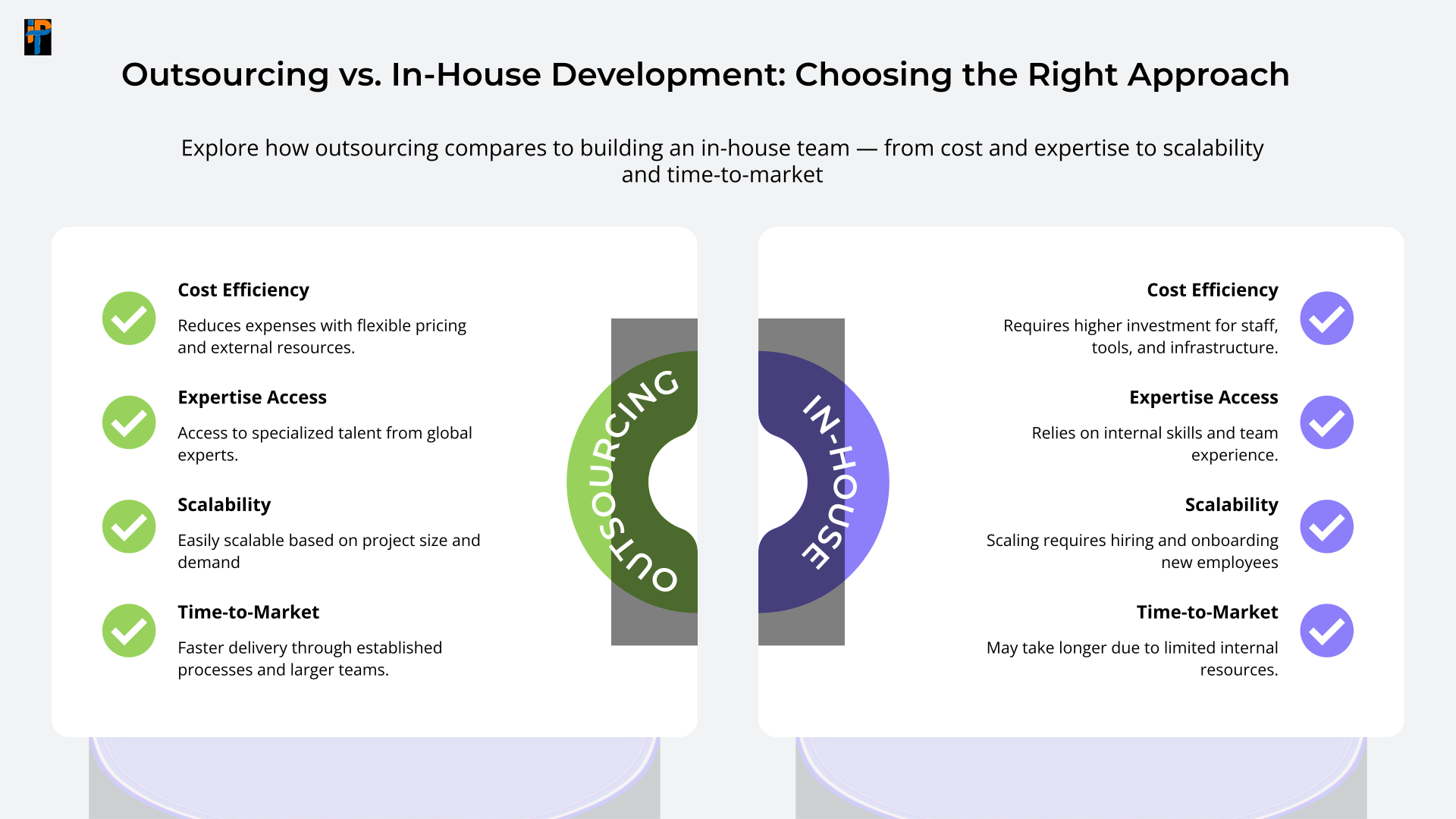
Ever found yourself standing at a crossroads, wondering whether to build your dream team in-house or tap into the global talent pool? You’re not alone. In 2025, this decision will become more critical than ever as businesses navigate unprecedented technological demands and a fiercely competitive market landscape.

The software development landscape has undergone a dramatic transformation. With the global IT outsourcing market projected to reach $591.24 billion by the end of 2025, and 64% of IT recruiters worldwide reporting that finding qualified candidates is their leading challenge, the stakes have never been higher. Companies are grappling with a fundamental question: should they invest in building an internal development powerhouse, or should they leverage the flexibility and expertise of outsourcing partners?

At IPH Technologies, we’ve witnessed this evolution firsthand through our work with over 430+ satisfied clients across 500 successful projects. We’ve seen businesses thrive with both approaches, and we’ve learned that the answer isn’t one-size-fits-all. This comprehensive analysis will help you navigate this critical decision with clarity and confidence, armed with the latest data, real-world insights, and practical frameworks that actually work.

Think of this as your strategic playbook for 2025—where we’ll dissect costs, evaluate quality, examine speed-to-market considerations, and ultimately help you make a decision that aligns perfectly with your business objectives.

Understanding In-House Development in 2026

What Does In-House Development Mean?

In-house development is like cultivating your own garden—you plant the seeds, nurture the growth, and harvest the fruits of your labor. It means assembling a dedicated team of developers, designers, quality assurance specialists, and project managers who work exclusively for your organization, embodying your company culture and living your vision every single day.

These aren’t just contractors or temporary collaborators; they’re full-time employees who become intimately familiar with your business processes, understand your unique challenges, and grow alongside your organization. When you walk into the office (or log into your virtual workspace), these are the faces you see consistently, the minds you can brainstorm with spontaneously, and the hands that build your digital future brick by brick.

The Evolution of In-House Teams

The in-house model has evolved significantly. It’s no longer just about having developers sitting in cubicles at your headquarters. Modern in-house teams can be distributed, hybrid, or fully remote while still maintaining that core employee relationship. What defines them isn’t their physical location—it’s their commitment, their integration into your organizational ecosystem, and their exclusive focus on your company’s goals.

However, building such teams in 2025 comes with substantial challenges. The IDC expects the worldwide shortage of full-time software developers to increase from 1.4 million in 2021 to 4.0 million in 2025, making talent acquisition more competitive than ever. Companies are fighting tooth and nail for qualified professionals, and it takes around 40 days on average to recruit an in-house developer, not to mention the recruitment-related expenses that pile up quickly.

Also Read – Top 15 Benefits of IT Staff Augmentation for Startups & Enterprises in 2025

Unpacking the Outsourcing Model

Types of Outsourcing Arrangements

Outsourcing isn’t a monolithic concept—it’s more like a spectrum of possibilities. You can outsource an entire project from conception to deployment, augment your existing team with specialized skills, or create a hybrid model that combines the best of both worlds. Some companies outsource specific functions like quality assurance or UI/UX design, while keeping core development in-house.

The beauty of outsourcing lies in its flexibility. Need a team of five React developers for a three-month sprint? Done. Require a specialized blockchain expert for a specific module? No problem. Want to scale up to twenty developers for a product launch, then scale back down for maintenance? Absolutely feasible.

Nearshore vs. Offshore vs. Onshore

The geography of outsourcing matters significantly:

Offshore outsourcing typically refers to partnering with teams in distant countries, often with significant time zone differences. Development rates for offshore programmers are generally around $41-$81 per hour, while equivalent programmers based in the United States charge $100-$150 per hour. Popular offshore destinations include India, the Philippines, and certain Eastern European countries.

Nearshore outsourcing means working with teams in neighboring countries or regions with minimal time zone differences. For US companies, this might mean partnering with developers in Latin America; for European businesses, it could mean teams in Eastern Europe. The advantage? Easier collaboration, cultural similarities, and overlapping working hours.

Onshore outsourcing involves contracting with teams within your own country. While typically more expensive, it eliminates time zone challenges and cultural barriers.

The Modern Outsourcing Landscape

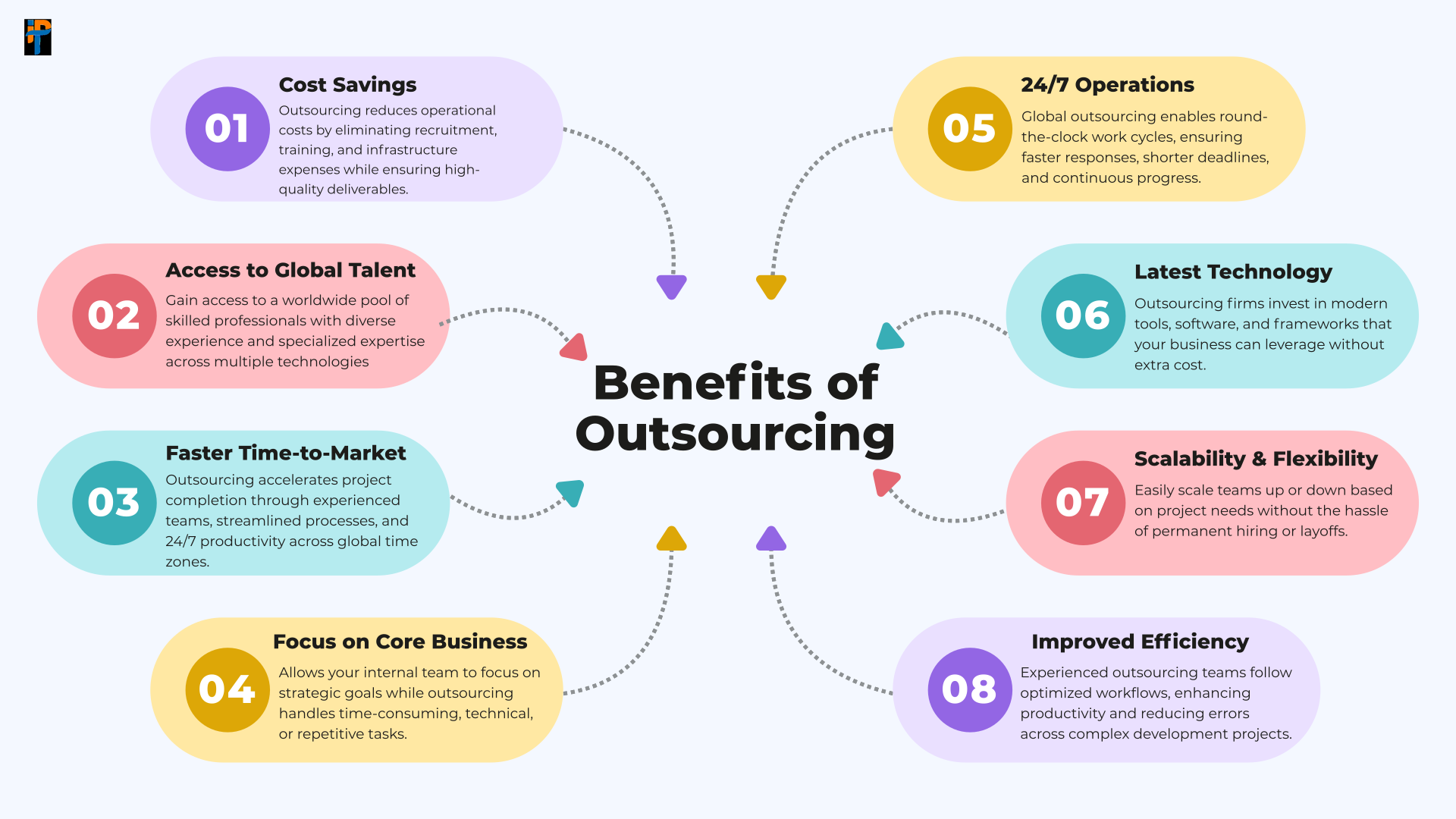
Today’s outsourcing landscape is sophisticated and mature. Gone are the days of questionable quality and communication nightmares (though those risks still exist if you don’t choose carefully). Modern outsourcing partners leverage agile methodologies, utilize cutting-edge collaboration tools, and often provide specialized expertise that would be difficult or expensive to develop in-house.

Grand View Research statistics indicate that between 2022 and 2030, outsourcing will account for 9.1% of the global market, with spending exceeding $1.3 trillion by the end of 2023. This isn’t just a trend—it’s a fundamental shift in how businesses approach software development.

Also Read – Build a Custom AI Agent: A Small Business Guide 2025

Cost Analysis: Breaking Down the Numbers

Let’s talk money—because at the end of the day, that’s what keeps CFOs up at night. But here’s the thing: comparing costs between in-house and outsourcing isn’t as straightforward as comparing sticker prices. It’s like comparing the cost of buying a house versus renting—there are visible expenses and hidden ones, short-term impacts and long-term implications.

True Cost of In-House Development

When you hire an in-house developer, the salary is just the tip of the iceberg. The average European developer’s salary oscillates around €50K annually, while in the United States, according to Glassdoor, it’s around $90K. But wait—there’s more.

Additional costs increase this number by 2.7x according to Joe Hadzima from MIT. That means your $90K developer actually costs you approximately $243K per year when you factor in everything else. The cost of setting up an in-house app development team can vary significantly, typically ranging from $50,000 to $200,000+ per month.

Cost Component Annual Cost (USD) Details
Base Salary $90,000 – $130,000 Varies by experience and location
Benefits & Insurance $18,000 – $26,000 Health, dental, vision, and life insurance
Payroll Taxes $10,000 – $15,000 Social Security, Medicare, and unemployment
Equipment & Software $5,000 – $10,000 Laptop, monitors, licenses, tools
Office Space $12,000 – $20,000 Desk, utilities, facilities
Training & Development $3,000 – $8,000 Courses, conferences, certifications
Recruitment Costs $15,000 – $30,000 Hiring, onboarding, HR time
Total Annual Cost $153,000 – $239,000 Per developer

Hidden Expenses You Can’t Ignore

Beyond the obvious costs, there are hidden expenses that slowly drain your budget:

  • Downtime costs: When your developer is between projects or waiting for requirements, you’re still paying full salary
  • Turnover costs: Due to high demand and attractive packages offered by other companies, developers are increasingly changing jobs, creating a risk that your lead developer might change careers at a critical stage in the project
  • Management overhead: Your existing managers spend significant time on hiring, mentoring, and managing the team
  • Infrastructure scaling: As your team grows, so do your infrastructure costs—more office space, more equipment, more everything
  • Benefits inflation: Healthcare costs rise annually, salary expectations increase, and you’re locked into providing competitive packages

Outsourcing Cost Structure

Outsourcing flips the cost model entirely. The average rate in outsourcing is $50-100 per hour, per person in Europe and the USA, with minimal additional costs. The total hourly cost per team is $1,050.26 for in-house development versus $300 for outsourcing to Europe.

But let’s break this down further:

Outsourcing Destination Hourly Rate Range Annual Cost (Full-time Equivalent) Quality Level
Eastern Europe $50 – $85 $100,000 – $170,000 High
Latin America $40 – $75 $80,000 – $150,000 Medium to High
Asia (India, Philippines) $25 – $60 $50,000 – $120,000 Variable
Western Europe $75 – $120 $150,000 – $240,000 Very High
United States (Onshore) $100 – $180 $200,000 – $360,000 Very High

This represents a potential savings up to 85% when comparing offshore rates to US-based developers.

Beyond the Hourly Rate

However, outsourcing has its own hidden costs that often catch businesses off guard:

  • Knowledge transfer time: The cost of transition is around 2-3% of the overall cost of the project
  • Communication overhead: More meetings, more documentation, more clarification needed
  • Quality control measures: You might need additional QA resources to ensure standards
  • Contract management: Legal fees, negotiation time, and ongoing vendor management
  • Project brief development: Creating a detailed project brief and conducting workshops with a vendor typically costs around $2,000

The smart play? If you choose offshore teams from regions like Eastern Europe or Asia, you can expect 60-70% less hiring costs compared to hiring locally, but you need to account for these additional factors in your total cost of ownership calculation.

Also Read – AI Agents Explained: Why They Matter and Real-World Use Cases

Quality Considerations: Who Delivers Better Results?

Here’s where things get interesting—and contentious. Ask ten CTOs about quality differences between in-house and outsourced development, and you’ll get twelve different opinions (some will change their minds mid-conversation).
Quality Control in In-House Teams

In-house teams have a natural advantage when it comes to quality alignment. They’re immersed in your company culture, they understand your quality standards intrinsically, and they have skin in the game for long-term product success. When something breaks in production at 2 AM, your in-house team feels the pain directly.

Moreover, in-house developers build institutional knowledge over time. They know why certain architectural decisions were made, they remember the gotchas in that legacy module, and they can maintain consistency across your entire codebase. This continuity is invaluable for complex, long-term projects where deep system understanding matters.

However, in-house teams can also develop blind spots. Without external perspectives, they might miss industry best practices, become complacent with technical debt, or resist adopting new technologies. It’s the organizational equivalent of living in an echo chamber.

Ensuring Quality with Outsourced Partners

Quality in outsourcing is entirely dependent on partner selection and management. Work with a top-tier outsourcing company like IPH Technologies, and you’ll get world-class results. Choose poorly based solely on price, and you’ll learn expensive lessons about the wisdom of penny-wise, pound-foolish decisions.

The key differentiators for quality outsourcing:

  • Proven track record: Look for partners with substantial portfolios and verifiable client references
  • Robust processes: Agile methodologies, code reviews, automated testing, CI/CD pipelines
  • Communication excellence: Regular updates, transparent progress tracking, proactive problem-solving
  • Technical expertise: Specialized skills and cutting-edge technology knowledge
  • Cultural alignment: Understanding of your business context and quality expectations

Mature development methods are refined via numerous client projects, meaning experienced outsourcing partners often bring battle-tested approaches that exceed what individual in-house teams can develop.

The reality? Quality isn’t inherently better or worse with either model—it’s about execution. A well-managed outsourced team can outperform a poorly led in-house team, and vice versa.

Time-to-Market: Speed Matters in 2026

In the digital age, speed is currency. Launch six months late, and you might find your competitor has already captured the market. Ship early, and you can establish market leadership and begin generating revenue while others are still planning.

Development Velocity Comparison

Let’s start with the recruitment timeline. Outsourcing allows for quicker project initiation, often within 1-4 weeks, compared to 40-60 days required to assemble an in-house team. That’s a massive head start—while you’re still interviewing candidates for your in-house team, your outsourced partner could already be shipping features.

But what about development speed once teams are in place? This is where things get nuanced:

In-house advantages:
  • No time spent on knowledge transfer or onboarding external teams
  • Immediate access to stakeholders for clarifications
  • Faster decision-making cycles without external coordination
  • Cultural alignment that reduces friction
Outsourcing advantages:
  • Ability to staff projects immediately with experienced developers
  • Round-the-clock development potential with distributed teams
  • Specialized expertise that reduces learning curves
  • Scaled teams that can tackle multiple workstreams simultaneously

When external developers join your team, you need to spend some time on knowledge transfer before they start to work effectively, though this factor also applies to hiring. The difference? You spend this onboarding time anyway with in-house hires—but with outsourcing, you can start with already-trained developers who just need project-specific context.

Access to Global Specialized Talent

In 2026, one of the biggest advantages of outsourcing is access to a global talent pool with specialized skills. Technologies like AI, cloud computing, cybersecurity, and DevOps evolve rapidly, and hiring in-house experts for each domain can be time-consuming and expensive. Outsourcing allows businesses to instantly work with experienced specialists who are already trained in the latest tools and frameworks, helping teams innovate faster without long-term hiring commitments.

Scalability and Flexibility

Here’s where outsourcing really shines. Imagine you’re building an MVP and need a team of eight developers for three months. With in-house hiring, you’d recruit eight developers, knowing you’ll need to keep them employed afterward or face difficult layoff decisions. With outsourcing, you scale up, launch, then scale down to a maintenance team of two—no HR nightmares, no ethical dilemmas, just business agility.

Scalability is especially vital for companies with lumpy demand or those rapidly entering new markets. You can build development teams to meet accelerating delivery demands or reduce headcount during maintenance phases without the organizational trauma of layoffs and rehiring.

This flexibility is particularly crucial for startups and growth-stage companies. When you land that big Series A funding and need to accelerate development dramatically, outsourcing lets you go from a team of five to fifty in weeks, not months. Try doing that with in-house hiring, and you’ll still be interviewing when your runway runs out.

Risk Management and Security

Let’s address the elephant in the room—the concerns that keep security officers awake at night and make legal teams nervous: data security and intellectual property protection.

Data Security Concerns

Security risks exist in both models, but they manifest differently:

In-house security considerations:

  • Physical access controls to your facilities and equipment
  • Employee vetting and background checks
  • Direct oversight of security practices and policies
  • Insider threat risks from disgruntled employees
  • Security culture development within your organization

Outsourcing security considerations:

  • Remote access to your systems and data
  • Third-party vendor security certifications (SOC 2, ISO 27001)
  • Data residency and compliance with regulations (GDPR, HIPAA)
  • Contractual obligations and liability clauses
  • Supply chain security risks

The truth? Most data breaches happen due to human error or poor security practices—not because of in-house versus outsourced arrangements. What matters is implementing robust security frameworks regardless of your development model.

When outsourcing, look for partners who:

  • Maintain relevant security certifications
  • Provide detailed security documentation
  • Offer secure development environments
  • Sign comprehensive NDAs and data protection agreements
  • Demonstrate compliance with industry-specific regulations

If your project involves sensitive data, vendors can handle compliance audits for $4,000–$5,000—often much cheaper than in-house solutions.

Intellectual Property Protection

IP protection is often cited as the primary reason to keep development in-house, but this concern can be managed effectively with outsourcing through:

  • Comprehensive contracts: Work-for-hire agreements that clearly establish IP ownership
  • NDAs and confidentiality agreements: Legally binding protections for your proprietary information
  • Code escrow arrangements: Protection against vendor bankruptcy or abandonment
  • Jurisdictional considerations: Partnering with companies in countries with strong IP law enforcement

Functions that are closely linked to your proprietary technology or intellectual property need to be managed internally, because those functions need to be protected to keep sensitive information from falling into competitors’ hands. This is sound advice for truly core, differentiating technology. But most development work—even complex, valuable work—can be safely outsourced with proper contractual protections.

At IPH Technologies, we’ve successfully managed IP protection for hundreds of clients across industries with sensitive requirements—from fintech platforms handling financial data to healthcare applications managing patient information. It’s absolutely doable with the right partner and proper agreements.

Also Read – AI App Development Cost in 2025: From MVPs to Full-Scale Solutions

When to Choose In-House Development

So when does building an in-house team make strategic sense? Here are the scenarios where in-house development typically delivers superior results:

Ideal Scenarios for Building Internal Teams

1. Core Product Development with Long-term Vision If software is your product—not just a supporting tool—and you’re building for the long haul, in-house makes sense. Companies like Amazon and PayPal maintain large in-house teams because software is their core business, and that deep, ongoing investment pays dividends over time.

2. Proprietary Technology and Competitive Advantage When your technology itself is your moat—your unique differentiator in the market—keeping that knowledge internal protects your competitive position. If competitors reverse-engineering your algorithms would threaten your business, in-house development provides an extra layer of protection.

3. Continuous Innovation and Research Organizations focused on R&D and continuous innovation benefit from in-house teams. The deep collaboration, spontaneous ideation, and iterative experimentation that drive breakthrough innovations happen more naturally with co-located or closely integrated teams.

4. Complex Integration with Existing Systems When you’re building solutions that deeply integrate with complex legacy systems, and that knowledge is scattered across multiple long-term employees, keeping development in-house reduces knowledge transfer overhead.

5. Regulatory and Compliance Requirements Certain industries (defense, intelligence, highly regulated financial services) have compliance requirements that make outsourcing impractical or impossible. If you’re building systems where every developer needs top-secret clearance, outsourcing isn’t an option.

6. Strong Financial Position with Patient Capital If you have deep pockets and a long-term vision, and you’re not pressured by aggressive growth timelines or tight budgets, the higher upfront investment in in-house teams can yield better long-term returns through accumulated knowledge and cultural alignment.

When Outsourcing Makes More Sense

Now let’s flip the script and examine when outsourcing becomes the strategically superior choice:

Strategic Situations for External Partners

1. Startup and Early-Stage Companies 90% of companies choose the outsourcing model due to endless benefits, particularly startups. When you’re pre-product-market fit, burning through a limited runway, and need to validate ideas quickly, outsourcing lets you build and iterate rapidly without the massive overhead of building a team.

2. Project-Based or Fixed-Scope Initiatives: Got a clear project with defined boundaries—like building a mobile app, redesigning your website, or developing a specific feature module? Outsourcing is perfect. Why hire full-time employees for work that has a clear endpoint?

3. Specialized Skills for Short-term Needs Need blockchain expertise for one project? Require machine learning specialists for a specific feature? Outsourcing gives you access to specialized talent without the commitment of permanent hires. 70% of surveyed companies choose outsourcing because of the opportunity to reduce development costs and get a ready-to-go solution in a short time.

4. Rapid Scaling Requirements When you need to scale development capacity quickly—either up or down—outsourcing provides unmatched flexibility. This is particularly valuable for seasonal businesses, companies experiencing rapid growth, or organizations with fluctuating development needs.

5. Cost-Constrained Environments If budget is your primary constraint and you need to maximize development output per dollar spent, outsourcing to regions with favorable cost structures makes economic sense. The same budget that hires two senior developers in San Francisco could fund a team of eight experienced developers in Eastern Europe.

6. Speed-to-Market Pressure 64% of companies now outsource their entire software development lifecycle. When time-to-market is critical and you can’t afford the months required to build an in-house team, outsourcing provides immediate access to ready-to-deploy development capacity.

7. Non-Core Technology Functions If it comes to non-core functions, like payroll processing, customer support, or routine maintenance tasks, it is better to rely on outsourcing to specialists. Save your in-house resources for strategic, differentiating work.

The Hybrid Approach: Best of Both Worlds

Here’s where strategy gets sophisticated: why choose when you can have both?

Creating a Balanced Development Strategy

The hybrid model—combining in-house and outsourced resources—is increasingly popular because it captures the advantages of both approaches while mitigating their respective weaknesses. Forward-thinking organizations are adopting flexible models that adapt to their evolving needs.

How it works in practice:
Core team in-house (30-40% of total capacity):
  • Product owners and architects who define vision and strategy
  • Senior developers who maintain critical systems and proprietary technology
  • DevOps engineers managing infrastructure and security
  • Key technical leads who guide architecture and standards
Augmented outsourced capacity (60-70% of total capacity):
  • Feature development teams working on defined requirements
  • Specialized experts for specific technology stacks
  • QA and testing resources
  • Additional capacity for peak development periods

This approach gives you strategic control, cultural continuity, and knowledge retention through your in-house core, while accessing cost savings, specialized expertise, and scalability through your outsourced partners.

Real-world implementation tips:
  • Establish clear communication protocols between in-house and outsourced teams
  • Use shared tools and platforms for seamless collaboration
  • Define clear ownership and accountability boundaries
  • Invest in relationship building—treat outsourced team members as extended family, not external contractors
  • Maintain architectural oversight through your in-house technical leadership

Use the “hybrid model” approach—keep your core team for strategic decisions and sensitive components while outsourcing routine coding tasks. This gives you control where it matters most while still accessing cost savings and specialized expertise.

Real-World Case Studies and Statistics

Let’s ground all this theory in reality with some hard data and real examples:
Market Growth Indicators:

  • The global outsourcing market is growing at 9.4% annually and is projected to exceed $1 trillion by the end of the decade
  • The global market for outsourcing app development is expected to reach $46.4 billion by 2027
  • 86% of companies now use Agile practices across both in-house and outsourced models
Success Stories:

Companies like Spotify, Uber, and Instagram have all leveraged outsourcing at different stages of their growth. Spotify used outsourced developers to rapidly scale their platform, Uber outsourced significant portions of their mobile app development, and Instagram’s original team was lean partly because they smartly outsourced non-core functions.

At IPH Technologies, we’ve seen similar patterns: a fintech startup that scaled from concept to Series B funding in 18 months using our outsourced team, a healthcare company that augmented its in-house team with our specialists to meet a critical regulatory deadline, and an e-commerce platform that reduced development costs by 55% while accelerating its roadmap by partnering with us.

Cost Comparison Reality Check:

According to our analysis of real project data:

  • A medium-complexity mobile app (3-6 months development time)
    • In-house team cost: $300,000 – $500,000
    • Outsourced to Eastern Europe: $120,000 – $200,000
    • Savings: 60-65%
  • A complex enterprise web application (12-18 months development)
    • In-house team cost: $1.2M – $2.5M
    • Outsourced hybrid model: $600K – $1.2M
    • Savings: 45-55%

These aren’t hypothetical numbers—they’re based on actual projects delivered by IPH Technologies and verified through industry research.

Making Your Decision: A Practical Framework

Alright, you’ve absorbed all this information—now what? How do you actually make this decision for your specific situation? Here’s a practical framework:

Step 1: Evaluate Your Current State

  • Financial runway: How many months of cash do you have?
  • Existing team: Do you have technical leadership in place?
  • Timeline pressure: How quickly do you need to launch?
  • Budget flexibility: Can you absorb higher upfront costs for potential long-term gains?

Step 2: Define Your Project Characteristics

  • Duration: Short-term project or ongoing development?
  • Complexity: Routine development or highly specialized?
  • Core vs. non-core: Strategic differentiator or supporting function?
  • Scale: Small team or large development capacity needed?

Step 3: Assess Your Organizational Capacity

  • Management bandwidth: Can your existing team manage an in-house hiring process?
  • Technical expertise: Do you have leaders who can guide and mentor developers?
  • Cultural maturity: Do you have an established company culture to onboard new employees?
  • HR infrastructure: Do you have robust HR systems for managing employees?

Step 4: Calculate Total Cost of Ownership

  • In-house: Salary + benefits + recruitment + infrastructure + management overhead + training
  • Outsourcing: Hourly rate × hours + knowledge transfer + management time + quality assurance
  • Compare 3-year projections, not just immediate costs

Step 5: Evaluate Risk Tolerance

  • IP protection needs: How sensitive is your technology?
  • Security requirements: What are your compliance obligations?
  • Control preferences: How much direct oversight do you need?
  • Vendor dependency: Are you comfortable with external dependencies?

Step 6: Consider Hybrid Options

  • Can you start with outsourcing and transition to in-house later?
  • Would a mixed model give you the best of both worlds?
  • Can you outsource non-core functions while building in-house core competencies?

Decision Matrix:

If you score:

  • 3+ points in “In-house” categories: Prioritize building an internal team
  • 3+ points in “Outsourcing” categories: Partner with external developers
  • Mixed scores: Seriously consider a hybrid approach
Factor In-house Outsourcing Hybrid
Long-term strategic product
Limited budget
Quick time-to-market
Proprietary core technology
Specialized short-term needs
Continuous innovation focus
Fluctuating development needs
Strong financial position

Conclusion

So, where does this leave us? Standing back at that crossroads with better maps, clearer signposts, and confidence in whichever direction we choose.

The in-house versus outsourcing debate isn’t about finding a universal “right answer”—it’s about discovering the right answer for your specific situation, at your specific stage, with your specific constraints and goals. Both models work brilliantly when applied appropriately; both fail spectacularly when mismatched to business needs.

In-house development may offer deeper alignment and continuity, but it comes with higher costs and slower scaling. Outsourcing, on the other hand, provides agility, cost efficiency, and access to specialized skills—particularly when timelines are tight or resources are limited.

The companies winning in 2025 aren’t necessarily those who made the “right” choice between in-house and outsourcing—they’re the ones who made strategic, informed decisions aligned with their business objectives, and then executed those decisions excellently.

At IPH Technologies, we’ve seen hundreds of companies navigate this decision. Some chose to build entirely in-house teams and thrived. Others went fully outsourced and achieved remarkable success. And increasingly, smart companies are adopting hybrid models that leverage the strengths of both approaches.

What matters most isn’t which path you choose—it’s that you choose deliberately, with full awareness of the tradeoffs, and then commit to making that choice work through excellent execution and continuous optimization.

As you face this decision, remember: you’re not locked into your choice forever. Start with outsourcing to validate your product, then transition to in-house as you scale. Begin with a small in-house core and augment with outsourced capacity. Test different models and adapt based on what works.

The digital transformation journey is a marathon, not a sprint. Choose the approach that gets you moving forward today, and stay flexible enough to adapt tomorrow. Whether you build, buy, or blend, success comes from strategic clarity, excellent execution, and partnering with people who share your vision.

Ready to explore how outsourcing could accelerate your development goals? At IPH Technologies, we’ve helped 430+ clients across 500 successful projects turn their visionary ideas into impactful solutions. Whether you need innovative mobile apps, robust web applications, or custom software engineering, our team leverages cutting-edge technology and agile methodologies to deliver exceptional results. Visit us at IPH Technologies to discover how we can help you stay ahead of the curve and achieve your business objectives.

FAQ

How much can I actually save by outsourcing software development in 2025?
The savings vary depending on your outsourcing destination, but you can realistically expect to save between 40-85% compared to building an equivalent in-house team in the United States. For example, offshore development rates range from $25-60 per hour compared to $100-180 for US-based developers.
How long does it take to get started with an outsourced team versus hiring in-house?
Outsourcing offers a significant speed advantage. You can typically have an outsourced team operational within 1-4 weeks, including vendor selection, contract negotiation, and initial knowledge transfer. In contrast, building an in-house team takes an average of 40-60 days just for recruitment, plus additional onboarding time. When you factor in creating job descriptions, screening candidates, conducting interviews, making offers, waiting for notice periods, and then onboarding new hires, you’re looking at 2-3 months minimum before your in-house team is productive. If you’re facing tight deadlines or market pressure, this timeline difference can be decisive for your business success.
Will I lose control over my project if I outsource development?
Not if you choose the right partner and establish proper management structures. Control loss is a common fear, but it’s largely a myth when working with professional outsourcing companies. The key is implementing robust communication protocols, using shared project management tools (like Jira, Asana, or Monday), scheduling regular video calls, and establishing clear milestones and deliverables.
How do I protect my intellectual property when outsourcing?
IP protection starts with choosing an outsourcing partner in a country with strong intellectual property laws and enforcement mechanisms. Then, implement these safeguards: comprehensive work-for-hire agreements that clearly establish IP ownership, robust NDAs and confidentiality agreements, code escrow arrangements, and regular security audits. Countries like India, Poland, Ukraine, and most Western nations have reliable IP protection frameworks. Additionally, limit access to truly proprietary algorithms or trade secrets—you can outsource feature development without exposing your core differentiating technology.
What are the biggest hidden costs of in-house development that people overlook?
The hidden costs of in-house development can increase your expenses by 2.7x beyond base salaries. Beyond the obvious salary, benefits, and office space, consider these overlooked expenses: recruitment costs ($15,000-30,000 per developer), ongoing training and professional development ($3,000-8,000 annually per person), management overhead (existing managers spending 20-30% of their time on team management), downtime costs (paying full salary during periods between projects), turnover and replacement costs (which can be 50-200% of annual salary), scaling infrastructure as your team grows, and the opportunity cost of slow hiring processes.
Can I switch from outsourcing to in-house later, or vice versa?
Absolutely, and many successful companies follow this evolution path. A common trajectory is starting with outsourcing to quickly build and validate your product, then gradually transitioning to in-house as you secure funding and establish product-market fit. The reverse also happens—established companies outsource specific projects or augment in-house teams during peak periods. The key to smooth transitions is documentation, knowledge transfer planning, and maintaining code quality standards from the beginning. When transitioning from outsourcing to in-house, budget 2-3 months for knowledge transfer and expect some productivity dips during the handover. Consider a phased approach where your outsourced team gradually trains new in-house hires before fully transitioning. Many companies find that a hybrid model—keeping some outsourced capacity alongside in-house teams—offers the best long-term flexibility.
How do I evaluate and choose the right outsourcing partner?
Choosing an outsourcing partner is one of the most critical decisions you’ll make, and it requires thorough due diligence. Start by examining their portfolio and case studies—look for projects similar to yours in complexity and industry. Request and actually check client references (don’t skip this step!). Evaluate their technical expertise through technical interviews or coding assessments. Assess their communication skills during initial conversations—if communication is poor before signing contracts, it won’t magically improve afterward. Review their development processes and methodologies to ensure they align with your expectations. Verify security certifications and compliance capabilities relevant to your industry. Consider their cultural fit and time zone overlap with your team. Finally, start with a small pilot project before committing to a large, long-term engagement. Red flags include reluctance to provide references, lack of transparent pricing, poor communication during the sales process, or promises that sound too good to be true.
Is the hybrid model (combining in-house and outsourced teams) more complex to manage?
Yes, hybrid models do add management complexity, but the benefits often outweigh the challenges when implemented thoughtfully. The key is establishing clear boundaries, communication protocols, and collaborative workflows from the start. Use shared tools and platforms for seamless coordination (Slack, Microsoft Teams, Jira, GitHub). Define clear ownership areas—typically, in-house teams handle strategic architecture and core technology while outsourced teams handle feature development and specialized functions. Schedule overlapping working hours for real-time collaboration and hold regular all-hands meetings that include both teams.
Avatar
Lekha Mishra

Verified CEO

About the Author

I'm Lekha Mishra, Co-Founder of IPH Technologies, a 6x award-winning software and mobile solutions provider. My mission is to empower global entrepreneurs by transforming visionary ideas into powerful, market-ready products. We move beyond code to provide strategic insights and a competitive edge, specializing in intelligent solutions powered by AI and ML. I believe in leveraging these technologies to unlock new possibilities, drive growth, and deliver unparalleled value. Let's connect and turn your vision into a lasting legacy.


WhatsApp
Call us
Get a Call Back