






















































2026 Mobile App Compliance Guide for Founders — GDPR, HIPAA, COPPA, PCI , App Store Rules & More
Picture this: you’ve spent a year building a groundbreaking mobile app. Your UX is polished, your investors are excited, and your launch date is circled on every office calendar. Then — bam — you get a cease-and-desist from a data protection authority because your app wasn’t GDPR-compliant. All that blood, sweat, and late-night debugging sessions, potentially undone by something you didn’t even know you were supposed to check.
Sound terrifying? It is — and it happens more often than you’d think. The good news? Compliance doesn’t have to be your nemesis. In fact, building a compliant app in 2026 is one of the smartest competitive advantages a founder can have. Users trust compliant apps. App stores favor them. And investors love them.
This guide is your comprehensive, no-jargon, founder-friendly roadmap to navigating GDPR, HIPAA, App Store rules, and every major compliance framework you’ll encounter in 2026. Let’s get into it.
Why Mobile App Compliance Is Non-Negotiable in 2026
Let’s not sugarcoat it — the regulatory environment for mobile apps has never been more intense. Global regulatory fines for data breaches and non-compliance exceeded $4.5 billion in 2023 alone, and that number has only climbed heading into 2026. According to Statista, there are now over 6.8 billion smartphone users globally, meaning your app operates in a world where regulators from Brussels to California are watching very closely.
But compliance isn’t just about avoiding penalties. It’s about:
- User Trust: 87% of consumers say they won’t use an app they don’t trust with their data (PwC Consumer Intelligence Series).
- Market Access: Non-compliant apps get delisted from Google Play and the Apple App Store — killing your distribution overnight.
- Investor Confidence: Venture capitalists and private equity firms now routinely perform compliance due diligence before writing checks.
- Long-Term Scalability: A compliance-first foundation makes it exponentially easier to expand into new markets.
Think of compliance like the foundation of a house. Nobody praises the foundation — but without it, everything collapses.
Also Read – Build a Fundable MVP in 2026: The Ultimate Founder’s Guide
Understanding the Global Compliance Landscape
Key Regulations That Define App Compliance in 2026
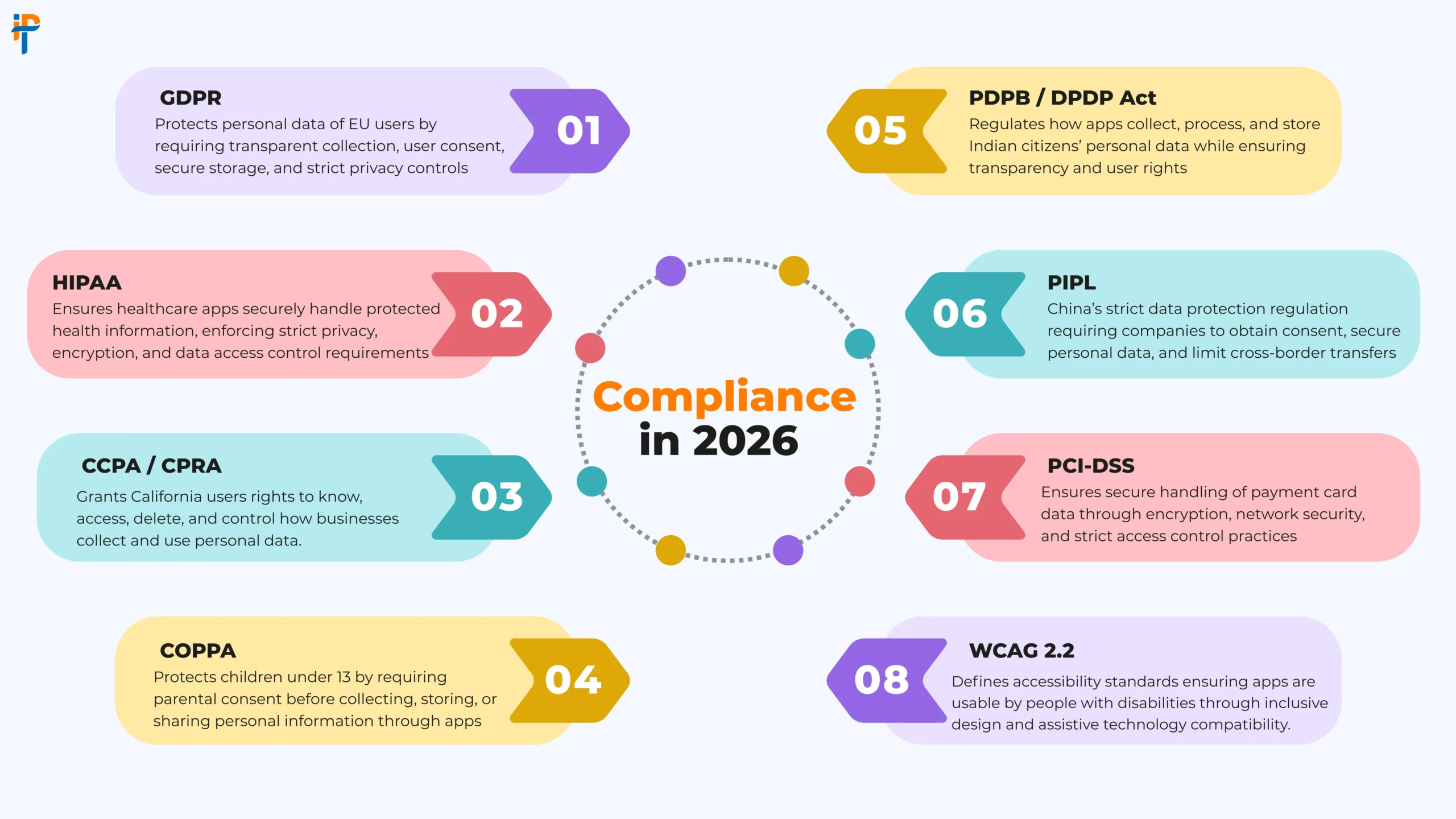
The regulatory landscape is a patchwork quilt, and founders need to understand which patches apply to them. Here’s a high-level breakdown of the major frameworks you’ll encounter:
| Regulation | Jurisdiction | Applies To | Key Authority |
|---|---|---|---|
| GDPR | European Union / UK | Any app processing EU/UK user data | European Data Protection Board (EDPB) |
| HIPAA | United States | Health/medical apps handling PHI | HHS Office for Civil Rights |
| CCPA/CPRA | California, USA | Apps with 100K+ CA users or $25M+ revenue | California Privacy Protection Agency |
| COPPA | United States | Apps targeting children under 13 | Federal Trade Commission (FTC) |
| PDPB | India | Apps processing Indian user data | Data Protection Board of India |
| PIPL | China | Apps processing Chinese citizens’ data | Cyberspace Administration of China |
| PCI-DSS | Global | Apps handling payment card data | PCI Security Standards Council |
| WCAG 2.2 | Global (ADA/EAA aligned) | All consumer-facing apps | Various accessibility authorities |
How Regulations Vary by Region and Industry
Here’s something that trips up a lot of founders: compliance isn’t one-size-fits-all. A fitness app targeting EU users faces entirely different obligations than a telemedicine app serving U.S. patients. The intersection of geography (where your users are), industry (healthcare, finance, education), and user demographics (adults vs. children) determines your compliance matrix.
The safest approach? Design for the strictest applicable standard, and you’ll typically be covered across the board.
GDPR Compliance for Mobile Apps — Everything You Need to Know
The General Data Protection Regulation is the gold standard of privacy law — and the one most global founders will encounter first. If your app collects data from anyone in the EU or UK, GDPR applies to you, regardless of where your company is headquartered.
Core GDPR Principles Every Founder Must Understand
GDPR is built on seven foundational principles, as outlined by the European Data Protection Board:
- Lawfulness, Fairness & Transparency — Users must know what you’re collecting and why.
- Purpose Limitation — Data collected for one purpose can’t be repurposed without fresh consent.
- Data Minimisation — Only collect what you actually need.
- Accuracy— Keep user data accurate and up to date.
- Storage Limitation — Don’t hold data longer than necessary.
- Integrity & Confidentiality — Implement appropriate security.
- Accountability — Be able to demonstrate compliance.
Think of these as the “7 Commandments” of GDPR. Violate them, and you’re looking at fines of up to €20 million or 4% of global annual turnover — whichever is higher.
Also Read – AI App Development Cost in 2025: From MVPs to Full-Scale Solutions
Consent Management and Data Subject Rights
GDPR consent must be freely given, specific, informed, and unambiguous. That cookie banner you see on every website? That’s GDPR consent management in action. For mobile apps, this means:
- No pre-ticked consent boxes
- Granular consent options (separate opt-ins for analytics, marketing, etc.)
- The ability to withdraw consent as easily as giving it
- Clear language (no legal jargon — write at an 8th-grade reading level)
Your users also have rights — sometimes called Data Subject Rights — that your app must honor. These include the right to access their data, correct it, delete it (“right to be forgotten”), and port it to another service. Building mechanisms to honor these rights into your app architecture from day one will save you massive headaches later.
Building a GDPR-Compliant Privacy Policy
Your privacy policy isn’t just a legal checkbox — it’s a trust document. A GDPR-compliant privacy policy must include:
- Identity and contact details of the data controller
- What data you collect and how
- Your lawful basis for processing
- Data retention periods
- Third-party sharing disclosures
- User rights and how to exercise them
- Contact details for your Data Protection Officer (if applicable)
Tools like Termly and iubenda can help you generate compliant policies, but always have a qualified attorney review the final version.
HIPAA Compliance for Health and Wellness Apps
If your app touches healthcare in any way — from tracking medications to enabling telemedicine consultations — you need to know HIPAA inside and out. The Health Insurance Portability and Accountability Act is one of the most stringent data protection frameworks in the world, and violations can result in penalties up to $1.9 million per violation category per year.
Who Needs HIPAA Compliance?
Not every health app is automatically a HIPAA-covered entity. HIPAA applies to:
- Covered Entities: Healthcare providers, health plans, and healthcare clearinghouses
- Business Associates: Third-party vendors handling Protected Health Information (PHI) on behalf of covered entities
If your app is a general wellness app (think: step counters, meditation timers), you may fall outside HIPAA’s scope. But if your app accesses, transmits, or stores PHI — medical records, diagnosis data, prescription information — you’re in HIPAA territory.
Technical Safeguards Under HIPAA
The HIPAA Security Rule mandates specific technical safeguards for electronic PHI (ePHI). According to the U.S. Department of Health & Human Services, these include:
- Access Controls: Unique user IDs, automatic logoff, encryption/decryption
- Audit Controls: Hardware and software activity logs
- Integrity Controls: Mechanisms to ensure ePHI isn’t improperly altered
- Transmission Security: End-to-end encryption for data in transit
PHI — What Counts and What Doesn’t
PHI (Protected Health Information) is broader than most founders realize. It includes any individually identifiable health information, such as:
- Names, addresses, birthdates
- Medical record numbers
- Health plan beneficiary numbers
- Biometric identifiers (fingerprints, voiceprints)
- Full-face photos
- Any other unique identifying numbers
De-identified data (where all 18 HIPAA identifiers have been removed) is generally not PHI and falls outside HIPAA’s scope. This is a common strategy for health apps that want to use aggregate data for analytics without triggering HIPAA requirements.
Also Read – How to Patent a Mobile App: Step-by-Step Legal Guide
CCPA and U.S. State Privacy Laws in 2026
The California Consumer Privacy Act (now strengthened by the California Privacy Rights Act, or CPRA) was the first major U.S. state privacy law — and it triggered a domino effect. As of 2026, over 18 U.S. states have enacted comprehensive privacy legislation, including Virginia, Colorado, Connecticut, Texas, and Florida.
The CCPA/CPRA gives California consumers the right to:
- Know what personal data is being collected
- Delete their personal data
- Opt out of the sale or sharing of personal data
- Non-discrimination for exercising their rights
The practical implication for founders? If you’re building an app with any meaningful U.S. audience, you need a “Do Not Sell or Share My Personal Information” mechanism, a clearly accessible privacy policy, and internal processes to handle consumer rights requests within 45 days.
App Store Compliance Rules — Apple App Store & Google Play
Beyond legal regulations, founders must navigate the gatekeepers of mobile distribution: Apple and Google. Both have become significantly stricter in recent years, and getting rejected from — or delisted by — an app store is catastrophic for your business.
Apple App Store Guidelines 2026
Apple’s App Store Review Guidelines are notoriously thorough. Key compliance requirements include:
- App Privacy Nutrition Labels: Required disclosure of all data types collected, how they’re used, and whether they’re linked to user identity
- App Tracking Transparency (ATT): Apps must request explicit user permission before tracking across apps and websites
- HealthKit & ResearchKit: Strict rules for apps accessing health data — must provide genuine health functionality
- In-App Purchase Rules: Digital goods and services must use Apple’s IAP system; no directing users to external payment methods
- Security Requirements: Apps must use HTTPS for all network communications and implement Certificate Pinning for sensitive transactions
Violations can result in rejection, removal, or in severe cases, developer account termination.
Google Play Compliance Policies 2026
Google Play’s policies have been significantly updated heading into 2026. Notable requirements include:
- Data Safety Section: Mandatory declaration of all data collected, shared, and whether it’s encrypted
- Sensitive Permissions: Apps requesting sensitive permissions (camera, microphone, location) must clearly explain why
- Target API Level Requirements: Apps must target recent Android API levels to ensure modern security standards
- Financial Services Policy: Fintech apps must provide proof of licensing and regulatory compliance
- Personal Loans Policy: Loan apps face strict requirements around APR disclosure and user protections
| Requirement | Apple App Store | Google Play |
|---|---|---|
| Privacy Disclosure | Privacy Nutrition Label | Data Safety Section |
| Tracking Permission | ATT Framework (mandatory) | User Consent required |
| Health Data Rules | HealthKit guidelines | Health & Fitness policy |
| Payment Processing | Apple IAP (mandatory) | Google Billing (mandatory) |
| Minimum API Level | iOS 16+ recommended | Android API 33+ required |
| Encryption Required | Yes (HTTPS/TLS) | Yes (HTTPS/TLS) |
Also Read – Build a Custom AI Agent: A Small Business Guide 2025
Data Security Standards — Encryption, Authentication, and Storage
Compliance and security are two sides of the same coin. Foundational security practices that every compliant app must implement include:
- End-to-End Encryption (E2EE) for sensitive data in transit using TLS 1.3
- AES-256 Encryption for sensitive data at rest
- Multi-Factor Authentication (MFA) for user accounts, particularly in healthcare, finance, or enterprise apps
- Secure Storage: Never store sensitive data (passwords, tokens, PHI) in plain text or in easily accessible device storage
- Certificate Pinning: Prevents man-in-the-middle attacks by validating the server’s SSL certificate
- Penetration Testing: Regular third-party security audits to identify vulnerabilities before attackers do
The OWASP Mobile Security Project publishes free guidelines and testing frameworks that are considered the industry standard for mobile app security.
Children’s App Compliance — COPPA and Beyond
Building an app for kids? The compliance bar is significantly higher. The Children’s Online Privacy Protection Act (COPPA) in the U.S. prohibits collecting personal information from children under 13 without verifiable parental consent. In the EU, GDPR sets the age of digital consent at 16 (though member states can lower it to 13).
Both Apple and Google have added HIPAA App Guidelines specifically for children’s content. Apps in the “Kids” category on both stores face the strictest data collection restrictions — essentially, you can only collect data that’s essential for the app to function.
Accessibility Compliance — ADA, WCAG 2.2, and More
Accessibility is increasingly a legal requirement, not just a design best practice. The Americans with Disabilities Act (ADA) has been interpreted by U.S. courts to apply to mobile apps, and the EU’s European Accessibility Act (EAA) took full effect in 2025. WCAG 2.2 (Web Content Accessibility Guidelines) is now the benchmark standard, requiring:
- Sufficient color contrast ratios (4.5:1 for normal text)
- Screen reader compatibility (VoiceOver/TalkBack support)
- Scalable text without loss of functionality
- Accessible navigation and touch targets (minimum 44×44 points)
Accessibility lawsuits in the U.S. are up over 300% since 2018 — building to WCAG 2.2 AA standards from the start is not just ethical, it’s financially prudent.
Financial App Compliance — PCI-DSS and Open Banking Regulations
If your app processes, stores, or transmits payment card data, PCI-DSS (Payment Card Industry Data Security Standard) compliance is mandatory. PCI-DSS v4.0, released in 2022 and fully enforced from March 2025, introduced significant new requirements around authentication, encryption, and penetration testing.
Key requirements include tokenizing card data, using payment gateways that handle cardholder data on your behalf (reducing your compliance scope), and conducting annual penetration tests.
Open Banking regulations (PSD2 in Europe, CFPB’s Open Banking Rule in the U.S.) also impose strict requirements on fintech apps accessing financial data through APIs, including strong customer authentication (SCA) and secure API standards.
Building a Compliance-First Development Process
Privacy by Design — A Framework for Founders
Privacy by Design, originally conceptualized by former Ontario Privacy Commissioner Dr. Ann Cavoukian, has been codified into GDPR and is now considered the global standard for responsible data handling. Its seven foundational principles guide you to embed privacy protections into your architecture proactively — not reactively.
Practically, this means:
- Conducting Privacy Impact Assessments (PIAs) before building new features
- Implementing data minimization at the schema level
- Defaulting to the strictest privacy settings out of the box
- Building user-facing data controls into the core UI, not buried in settings
Compliance Audits and Ongoing Monitoring
Compliance is not a one-time event — it’s an ongoing program. Build these practices into your development cycle:
- Quarterly internal compliance reviews against your applicable regulations
- Annual third-party security audits and penetration tests
- Automated dependency scanning for open-source vulnerabilities
- Real-time privacy monitoring tools (OneTrust, TrustArc, or similar) to detect and respond to incidents
- Employee training on data handling best practices
Also Read – Google Play Store Statistics 2026: 10 Insights to Transform Your App Strategy
Common Mobile App Compliance Mistakes Founders Make
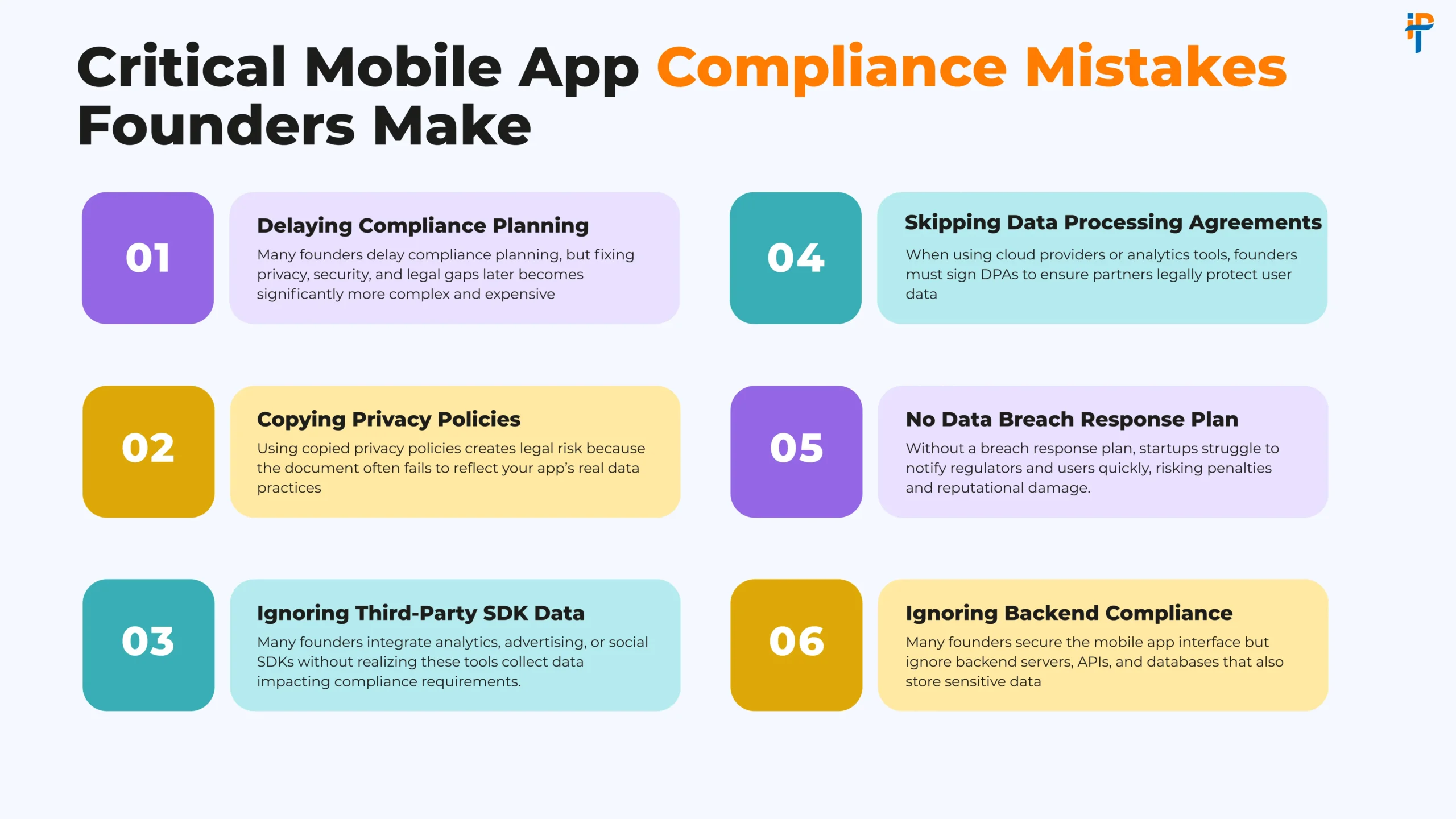
Let’s talk about the pitfalls that most often trip up first-time founders:
- Assuming compliance is a “later” problem — By the time you’re at scale, retrofitting compliance is exponentially more expensive.
- Copying privacy policies from other apps — Your policy must reflect your actual data practices. A copied policy that doesn’t match reality is worse than no policy.
- Ignoring third-party SDKs — Every SDK you integrate potentially changes your compliance posture. Analytics SDKs, advertising SDKs, and social login libraries all collect data.
- Skipping the Data Processing Agreement (DPA) — If you use third-party processors (cloud hosting, analytics platforms), GDPR requires signed DPAs.
- Not having a breach response plan — GDPR requires notifying authorities within 72 hours of a data breach. If you don’t have a plan, you’ll miss that window.
- Neglecting backend compliance — Many founders focus on the app itself but forget that their backend infrastructure, APIs, and databases are equally in scope.
How IPH Technologies Helps Founders Build Compliant Apps
Navigating the compliance maze while also building a great product is genuinely hard. That’s precisely why founders partner with experienced app development companies like IPH Technologies.
With over 500 successful projects and 430+ satisfied clients, IPH Technologies brings deep expertise in building mobile apps that are not only innovative but also architected for compliance from the ground up. Our teams are well-versed in:
- GDPR-Compliant Architecture: Designing data flows, consent management systems, and privacy policies that hold up to regulatory scrutiny.
- HIPAA-Ready Development: Implementing the technical and administrative safeguards required for healthcare applications.
- App Store Submission: Preparing privacy labels, data safety declarations, and navigating review processes for both Apple and Google.
- Security-First Engineering: Leveraging encryption, secure storage, and MFA as standard components of every build.
- Accessibility Implementation: Building to WCAG 2.2 standards so your app reaches every user — and stays out of legal trouble.
Our agile methodology means compliance requirements are built into every sprint, not bolted on at the end. We understand that founders need a technology partner who’s as invested in their long-term success as they are — and compliance is a cornerstone of sustainable success.
Conclusion
Building a mobile app in 2026 without a compliance strategy is like driving blindfolded on a highway — you might get lucky for a while, but the odds are not in your favor. GDPR, HIPAA, CCPA, App Store rules, COPPA, ADA — each of these frameworks exists to protect real people, and ignoring them puts both your users and your business at risk.
The silver lining? Compliance and great product development are not mutually exclusive. When you build with privacy by design, robust security, and accessibility as core tenets, you end up with a better product that users trust and regulators respect.
Whether you’re launching your first app or scaling an existing one, the time to get serious about compliance is right now. And if you’d rather focus on building your vision while leaving the compliance architecture to the experts, the team at IPH Technologies is ready to help you build something truly exceptional — and compliant.








.png)