



































































































AI Software Development in Australia: Cost, Timeline & Strategy Explained
Why Australia Is Becoming a Global AI Powerhouse
Let’s be real — Australia isn’t just riding the global AI wave. It’s actively shaping it. Over the last five years, the Australian AI landscape has exploded with investment, talent, and adoption across virtually every sector. From fintech startups in Sydney to agricultural AI solutions in regional Queensland, artificial intelligence is no longer a “future” technology — it’s the engine running businesses right now.
According to Australia’s National AI Centre (NAIC), Australian businesses are increasingly embedding AI into their operations to improve decision-making, automate repetitive tasks, and drive innovation at scale. The numbers back this up in a big way.
So if you’re a business owner or a product manager wondering whether AI software development in Australia makes sense for your company — spoiler alert: it absolutely does. But you need to understand the costs, timelines, and strategies involved before you dive in. That’s exactly what this guide is for.
Also Read – LLM vs RAG vs Agentic AI vs AI Agents: Which AI Architecture Is Right for Your Next Project?
The Australian Government’s Role in Fuelling AI Growth
The Australian government hasn’t been sitting on the sidelines. It has committed over $124 million to its AI Action Plan, designed to position Australia as a global leader in responsible and innovative AI deployment. This includes funding for AI research, ethical frameworks, and workforce upskilling programs.
This government backing does something powerful for businesses — it creates a stable, regulated environment where AI investment feels less like a gamble and more like a strategic advantage. When you know the regulatory landscape is maturing alongside the technology, you can build with more confidence.
Key Industries Driving AI Adoption Down Under
AI isn’t just for tech companies. Here’s where Australian businesses are deploying AI solutions the most:
- Healthcare: Predictive diagnostics, patient management, and drug discovery
- Finance & Fintech: Fraud detection, credit scoring, and robo-advisory platforms
- Retail & eCommerce: Personalisation engines, demand forecasting, and chatbots
- Agriculture (AgriTech): Crop monitoring, yield prediction, and autonomous machinery
- Construction & Mining: Safety monitoring, equipment maintenance prediction, and site analysis
- Education: Adaptive learning platforms and student performance prediction
This diversity of use cases means that no matter what industry you’re in, there’s a powerful AI application waiting to be built for your business.
What Exactly Is AI Software Development?
Before we talk costs and timelines, let’s quickly level-set on what AI software development actually means — because it’s broader than most people think.
AI software development is the process of designing, building, testing, and deploying software applications that use artificial intelligence technologies — think machine learning, natural language processing, computer vision, and deep learning — to perform tasks that traditionally required human intelligence.
Think of it like this: regular software follows rules you give it. AI software learns from data, adapts, and makes decisions on its own. It’s the difference between a calculator and a financial advisor.
Core Components of an AI-Powered Application
Most AI applications are built from a combination of these foundational technologies:
- Machine Learning & Predictive Analytics: Machine learning (ML) is the backbone of most AI applications. It enables systems to learn from historical data and make predictions without being explicitly programmed for every scenario. Predictive analytics powered by ML helps businesses forecast customer behaviour, sales trends, equipment failures, and more. It’s arguably the most commercially valuable form of AI right now.
- Natural Language Processing (NLP): NLP is what powers chatbots, voice assistants, sentiment analysis tools, and smart search features. It allows machines to understand, interpret, and generate human language. In Australia, NLP is being used heavily in customer service automation, legal document review, and healthcare documentation.
- Computer Vision: Computer vision enables machines to interpret and act on visual data — images and video. From quality control in manufacturing to facial recognition in security systems and defect detection in mining, computer vision is reshaping how Australian industries operate.
Also Read – How AI & Machine Learning Are Transforming Business Automation 2026
How Much Does AI Software Development Cost in Australia?
Alright, let’s get to the question everyone’s Googling: how much does it actually cost?
The honest answer is: it depends. But that’s not a cop-out — it’s a reflection of the genuine complexity involved. AI software development costs in Australia vary based on project scope, team composition, technology stack, and the specific AI capabilities you need.
That said, here are some realistic ballpark figures:
Cost Comparison Table: AI Development by Project Type
| Project Type | Estimated Cost (AUD) | Timeline | Complexity |
|---|---|---|---|
| AI Chatbot / Virtual Assistant | $15,000 – $60,000 | 2–4 months | Low–Medium |
| Recommendation Engine | $40,000 – $120,000 | 3–6 months | Medium |
| Predictive Analytics Platform | $80,000 – $250,000 | 4–8 months | Medium–High |
| Computer Vision System | $100,000 – $400,000 | 6–12 months | High |
| Custom ML Model (Enterprise) | $150,000 – $600,000+ | 6–18 months | Very High |
| Full AI-Powered SaaS Platform | $250,000 – $1,000,000+ | 9–24 months | Enterprise |
Note: Costs can vary significantly based on data requirements, third-party integrations, and infrastructure choices.
These ranges align with broader global AI development cost benchmarks that show enterprise AI investment growing at an unprecedented pace.
Factors That Influence AI Development Costs
So what actually moves the needle on price? Here are the key cost drivers you need to understand:
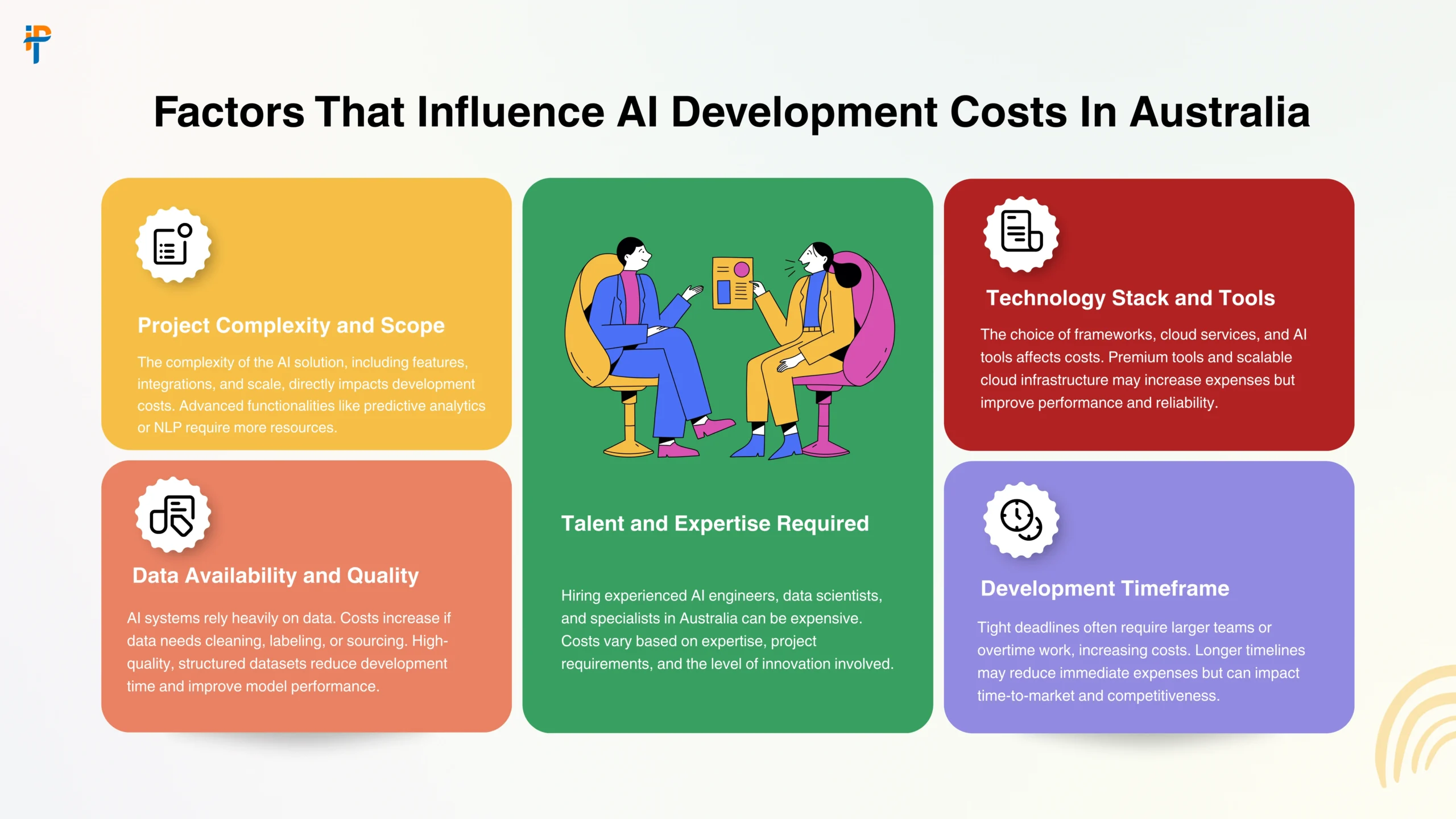
- Data Availability and Quality AI lives and dies by its data. If you have clean, well-structured training data ready to go, you’ll save significantly on data preparation costs. If you’re starting from scratch — or worse, dealing with messy, incomplete datasets — expect to spend 20–40% of your budget just on data collection, cleaning, and labelling.
- Model Complexity A simple rule-based chatbot is very different from a deep learning model that interprets medical images. The more sophisticated the AI capability, the more compute power, specialised talent, and testing cycles you’ll need.
- Team Composition Australian AI developers typically command higher hourly rates than offshore teams — and for good reason. Local rates for experienced AI/ML engineers in Australia range from $120 to $250+ per hour, depending on specialisation. Working with a full-service development partner like IPH Technologies gives you access to cross-functional expertise — including data scientists, ML engineers, backend developers, and UX designers — without the overhead of building an internal team.
- Third-Party APIs and Tools Many AI applications leverage pre-trained models and APIs from providers like OpenAI, Google Cloud AI, AWS SageMaker, or Microsoft Azure AI. Licensing and API costs can add $5,000 to $50,000+ per year to your budget, depending on usage volume.
- Infrastructure and Hosting Training large ML models is computationally expensive. Cloud GPU instances on AWS or Google Cloud for intensive training runs can cost hundreds to thousands of dollars per month. Factor this into your total cost of ownership.
- Regulatory Compliance Australia has specific privacy laws under the Privacy Act 1988 that govern how personal data can be collected, stored, and used. Ensuring your AI application is compliant with these regulations (especially if it processes sensitive data) requires additional legal and engineering work.
Also Read – 2026 Mobile App Compliance Guide: GDPR, HIPAA & App Store Rules | IPH Technologies
Breaking Down the AI Development Timeline
If cost is question #1, timeline is usually question #1B. Nobody wants to wait 18 months to see results. The good news is that with the right strategy and partner, you can often deliver a working MVP (minimum viable product) in as little as 8–12 weeks.
Phase-by-Phase Timeline Overview
Here’s how a typical AI software development project unfolds:
| Phase | Activities | Duration |
|---|---|---|
| Discovery & Strategy | Business analysis, data audit, use case definition, feasibility study | 2–4 weeks |
| Data Preparation | Collection, cleaning, labelling, and structuring training data | 3–8 weeks |
| Model Development | Algorithm selection, model training, and initial testing | 4–12 weeks |
| Integration & Development | Backend/frontend development, API integration, UI/UX design | 4–10 weeks |
| Testing & Validation | Accuracy testing, bias detection, performance benchmarking, UAT | 3–6 weeks |
| Deployment | Cloud deployment, CI/CD pipeline setup, and monitoring integration | 2–4 weeks |
| Post-Launch Optimisation | Model retraining, performance monitoring, feature expansion | Ongoing |
The total timeline for a mid-complexity AI project in Australia typically runs 4 to 10 months from discovery to live deployment. Enterprise-grade projects can stretch to 12–24 months.
What Can Slow Your AI Project Down?
Here are the timeline killers that catch businesses off guard:
- Poor data quality: This is the number one cause of AI project delays. If your data is messy or insufficient, you’ll spend weeks — sometimes months — cleaning it before a single model can be trained.
- Unclear requirements: Vague success criteria lead to endless scope creep. Know what “good” looks like before you start.
- Infrastructure underestimation: Running training jobs on inadequate compute slows everything down. Right-size your cloud infrastructure early.
- Regulatory hurdles: Especially for healthcare and fintech AI applications, compliance reviews can add 4–8 weeks to your timeline.
- Model performance gaps: Sometimes your first model just doesn’t hit accuracy targets. Plan for iteration cycles — they’re not a failure, they’re part of the process.
Also Read – Bullion ERP vs Traditional Accounting Software: What’s Better for Jewelers & Traders?
Choosing the Right AI Development Strategy for Your Business
Strategy is where most businesses either win big or waste big. Before you write a single line of code, you need a clear plan.
Build In-House vs. Partner With a Development Company
This is the classic build-vs-buy debate — but with AI, the stakes are higher. Here’s a quick breakdown:
Building In-House:
- Full control over IP and roadmap
- Requires hiring specialised AI talent (difficult and expensive in Australia’s competitive market)
- Longer ramp-up time before you have a functional team
- High ongoing costs: salaries, tools, training, infrastructure
- Best for: Large enterprises with long-term, core AI products
Partnering With an AI Development Company:
- Faster time to market (you’re leveraging an existing team and process)
- Access to diverse expertise without the hiring headache
- Predictable costs with clear project scoping
- Flexibility to scale up or down based on project needs
- Best for: SMEs, startups, and enterprises launching new AI initiatives
At IPH Technologies, we’ve helped 500+ businesses navigate this exact decision. In most cases — especially for businesses new to AI — partnering is the smarter, faster, and more cost-effective path.
Agile vs. Waterfall for AI Projects
Here’s the thing about AI: it’s inherently experimental. You don’t always know if your model will hit accuracy targets until you’ve trained it. That’s why the Agile methodology is almost universally preferred for AI development.
Agile allows you to:
- Release working increments of your application in short sprints (typically 2 weeks)
- Validate assumptions early and pivot when needed
- Get continuous stakeholder feedback throughout the process
- Reduce the risk of spending 12 months building something that misses the mark
Waterfall — where every phase is locked in before the next begins — is a poor fit for AI because the discovery is often part of the development process. You learn what your data can (and can’t) do by experimenting, not by planning.
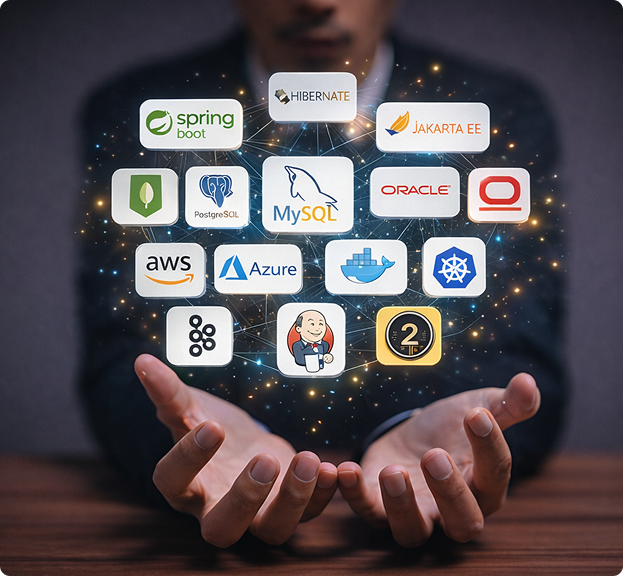
The Tech Stack Behind Modern AI Applications in Australia
Wondering what technologies actually power AI applications? Here’s a snapshot of the most commonly used tools in the Australian AI development ecosystem:
- Programming Languages: Python (dominant for ML/AI), R (statistical modelling), JavaScript (frontend AI features)
- ML Frameworks: TensorFlow, PyTorch, scikit-learn, Keras, XGBoost
- Cloud Platforms: AWS (SageMaker, Rekognition), Google Cloud AI, Microsoft Azure AI, IBM Watson
- NLP Tools: OpenAI GPT APIs, Hugging Face Transformers, spaCy, NLTK
- Data Pipeline Tools: Apache Kafka, Apache Spark, Airflow, dbt
- MLOps & Deployment: MLflow, Kubeflow, Docker, Kubernetes, GitHub Actions
- Databases: PostgreSQL, MongoDB, Pinecone (vector DB for AI search), Redis
The right stack depends entirely on your use case. A conversational AI chatbot has a completely different tech footprint than a computer vision system for manufacturing quality control.
How IPH Technologies Approaches AI Software Development
At IPH Technologies, we don’t just build software — we build solutions that actually solve business problems. Our AI development process is collaborative, transparent, and outcome-focused.
Our Proven Process — From Vision to Launch
Step 1 — Discovery & Strategy Workshop Every engagement starts with a deep dive into your business goals, existing data assets, and success criteria. We help you identify the highest-impact AI use cases and build a roadmap that aligns with your budget and timeline.
Step 2 — Data Audit & Preparation We assess the quality, volume, and structure of your data. Our data engineers handle cleaning, labelling, and pipeline construction so your models have the best possible foundation to learn from.
Step 3 — Model Development & Iteration Our ML engineers select the right algorithms, train initial models, and iterate rapidly based on performance metrics. We use explainable AI (XAI) techniques where possible to ensure your stakeholders understand how decisions are being made.
Step 4 — Application Development & Integration: AI models don’t exist in isolation. Our full-stack developers build the surrounding application — beautiful UIs, robust backends, secure APIs, and seamless third-party integrations — all within an Agile sprint framework.
Step 5 — Testing, Validation & Compliance We rigorously test for accuracy, bias, performance under load, and regulatory compliance. Every AI application we deploy meets Australian privacy and data governance standards.
Step 6 — Deployment & Ongoing Support We deploy your solution to your preferred cloud infrastructure and set up monitoring dashboards to track model performance in production. And we don’t disappear after launch — our team remains your partner for ongoing optimisation and iteration.
Common Mistakes Businesses Make in AI Development
Let’s save you from some expensive lessons. Here are the most common AI development pitfalls we see Australian businesses fall into:
Mistaking AI for Magic: AI isn’t a silver bullet. It works best when applied to specific, well-defined problems with sufficient data. If you can’t articulate what problem you’re solving, no AI system will fix it for you.
Skipping the Data Strategy: Building an AI model without a solid data strategy is like training for a marathon on junk food. The model is only as good as the data it learns from.
Underinvesting in Testing: AI models can behave unexpectedly in production — especially when they encounter data that looks different from their training set. Inadequate testing leads to poor performance, biased outputs, and erosion of user trust.
Ignoring Explainability: Especially in regulated industries like finance and healthcare, you need to be able to explain why your AI made a particular decision. Black-box models that can’t be interpreted are a compliance and reputational risk.
Building for Today, Not Tomorrow: AI applications need to evolve as your data grows and business needs change. Build with scalability and model retraining in mind from day one.
AI Software Development Cost vs. ROI — Is It Worth It?
Here’s the real question: Does the investment pay off?
The short answer is yes — when done right. McKinsey’s Global AI Survey consistently shows that companies that embed AI into their core operations report measurable improvements in revenue growth, cost reduction, and customer satisfaction.
In practical Australian business terms:
- A retail company deploying an AI recommendation engine can see a 15–30% increase in average order value
- A financial services firm using AI fraud detection can reduce fraud losses by up to 40%
- A healthcare provider implementing predictive analytics for patient readmission can cut readmission rates by 20–25%
- A manufacturer using computer vision for quality control can reduce defect-related waste by 30–50%
The ROI picture is compelling — but it requires realistic expectations, a solid strategy, and the right development partner.
The Future of AI Software in Australia
Australia’s AI industry is only going to accelerate from here. Several mega-trends are shaping what AI software development will look like in the next 3–5 years:
- Generative AI Integration: Large language models (LLMs) like GPT-4 and Claude are rapidly moving from novelty to necessity. Australian businesses are finding creative ways to embed generative AI into content creation, customer service, code generation, and data analysis workflows.
- Edge AI: Moving AI inference from the cloud to edge devices (smartphones, IoT sensors, industrial equipment) is enabling real-time AI decisions without internet dependency — massive for mining, agriculture, and logistics.
- AI Regulation: The Australian government’s Responsible AI Framework is maturing, which will create clearer rules around AI transparency, accountability, and bias — good news for businesses that want to build AI they can stand behind.
- Democratisation of AI Tools: Low-code and no-code AI tools are lowering the barrier to entry for smaller businesses, while specialist development firms like IPH Technologies are focusing on the high-value, custom AI solutions that these tools can’t deliver.
The window to get ahead of your competition with AI is open right now — but it won’t stay open forever.
Conclusion
AI software development in Australia is no longer a question of if but when and how. The costs are more accessible than ever, the technology is more powerful than ever, and the competitive advantage for early movers is very real.
But here’s the truth: building a successful AI application isn’t just about picking the right algorithm or cloud provider. It’s about having a clear strategy, quality data, an experienced development team, and a commitment to continuous improvement. That’s where having the right partner makes all the difference.
At IPH Technologies, we’ve helped businesses across Australia — from agile startups to established enterprises — turn AI ambitions into measurable business outcomes. Whether you’re exploring your first AI use case or scaling an existing AI product, our team is ready to help you move from idea to impact.
The future is AI-powered. The question is: will your business help build it, or watch from the sideline?










.png)