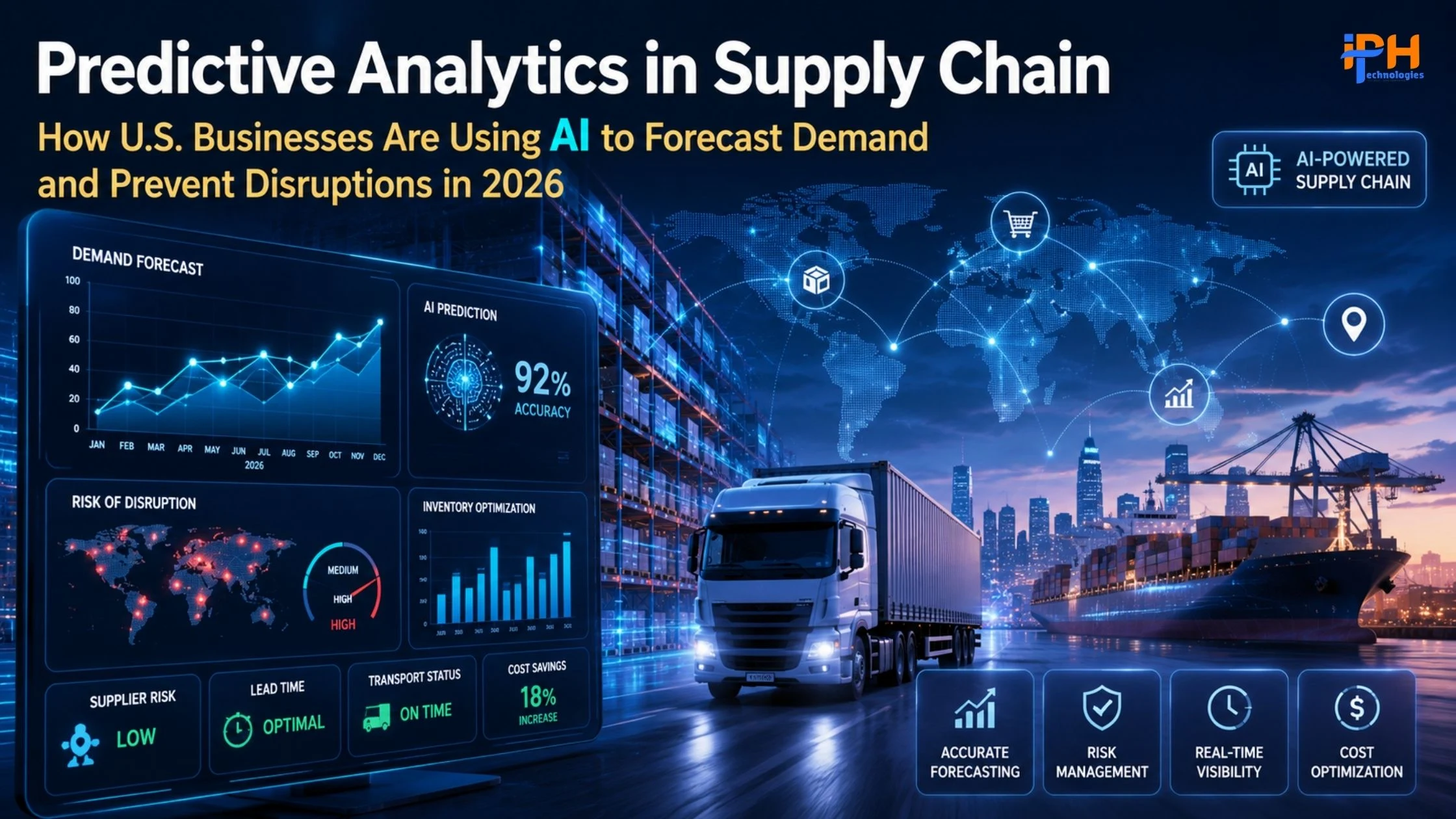





































































































Supply chains in the United States are becoming more complex, interconnected, and difficult to predict. Manufacturers, retailers, distributors, logistics providers, and e-commerce businesses are dealing with changing customer demand, transportation constraints, supplier risks, labor shortages, tariffs, geopolitical uncertainty, and increasingly tight delivery expectations.
In this environment, traditional forecasting methods based primarily on historical sales data are often not enough. This is where predictive analytics in the supply chain is becoming increasingly important.
By combining artificial intelligence (AI), machine learning (ML), historical business data, real-time operational information, and external signals, predictive analytics allows companies to anticipate demand, identify potential disruptions, optimize inventory, and make faster supply chain decisions.
In 2026, U.S. supply chain leaders are moving beyond simply analyzing what happened in the past. They are increasingly using AI to determine what is likely to happen next and what actions should be taken before a problem occurs.
What Is Predictive Analytics in Supply Chain?
Predictive analytics in supply chain refers to the use of data, statistical models, machine learning, and AI to predict future supply chain events and business conditions.
Instead of simply analyzing historical performance, predictive analytics looks for patterns and relationships that can help businesses anticipate future outcomes.
AI models can process these signals and generate forecasts that help supply chain teams make more informed decisions.
Why Predictive Analytics Matters for U.S. Supply Chains in 2026?
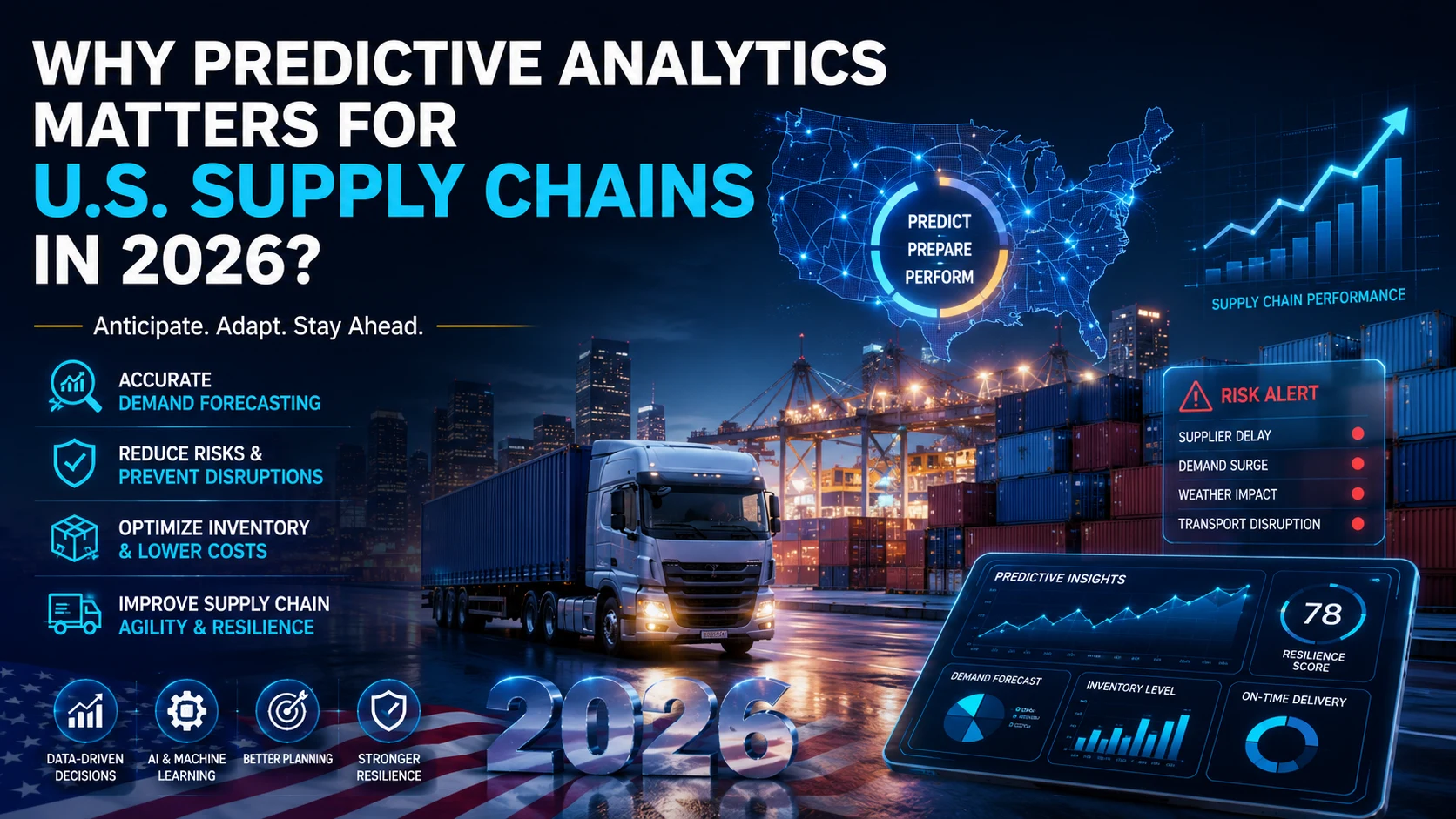
U.S. businesses operate in an environment where supply chain disruptions can quickly affect revenue, customer satisfaction, and operating costs.
The 2026 KPMG U.S. Supply Chain Survey of 462 supply chain leaders found that risk and resilience are major priorities. Cybersecurity, multi-tier supplier exposure, shortages, regulatory pressure, geopolitical uncertainty, and tariffs are among the concerns influencing supply chain strategies.
Predictive analytics can help businesses identify warning signals before they become major operational problems.
How U.S. Businesses Are Using Predictive Analytics in Supply Chain?
1. AI-Powered Demand Forecasting
One of the most important applications of predictive analytics is demand forecasting.
Businesses need to determine how much inventory they will need in the future. Forecasting too high can result in excess inventory and increased carrying costs, while forecasting too low can cause stockouts and lost sales.
AI-powered demand forecasting analyzes multiple data sources to generate more dynamic forecasts. The system can then estimate future demand at the product, store, region, or channel level.
2. Predictive Inventory Optimization
Inventory management is another area where predictive analytics can create significant value.
Instead of maintaining inventory based on fixed safety-stock rules, businesses can use AI models to continuously evaluate demand, lead times, supplier reliability, and inventory levels.
For e-commerce businesses and retailers, this becomes particularly important because customers increasingly expect fast and reliable fulfillment.
3. Early Detection of Supply Chain Disruptions
A major advantage of predictive analytics in the supply chain is its ability to identify potential disruptions before they happen. AI systems can monitor signals such as:
- Supplier delays
- Port congestion
- Transportation disruptions
- Weather events
- Geopolitical developments
- Material shortages
- Production delays
- Labor constraints
- Demand spikes
- Cybersecurity incidents
Instead of waiting for an event to affect operations, businesses can receive an early warning.
4. Supplier Risk Prediction
Supplier dependency is a major concern for manufacturers and distributors. A company may have hundreds or thousands of suppliers, making it difficult to manually monitor every supplier’s performance.
Predictive analytics can create supplier risk scores using information such as:
- Delivery history
- Quality performance
- Lead-time variability
- Order fulfillment rates
- Financial indicators
- Geographic exposure
- Capacity constraints
- Past disruptions
AI can then identify suppliers that may be more likely to experience delays or quality issues.
This enables procurement teams to take preventive action rather than reacting after a supplier fails to deliver.
Also Read: How To Make Money From Astrology App
Predictive vs. Prescriptive Analytics in Supply Chain
Predictive and prescriptive analytics both help businesses make smarter supply chain decisions, but they serve different purposes.
Predictive analytics focuses on answering:
“What is likely to happen?”
It uses historical data, real-time information, machine learning, and AI to forecast future outcomes.
Prescriptive analytics takes the next step by answering:
“What should we do about it?”
It evaluates different possible actions and recommends the most effective response based on business objectives and available resources.
In a modern supply chain, these technologies can work together. Predictive analytics helps businesses anticipate demand, risks, and disruptions, while prescriptive analytics helps them determine the best action to address those predictions.
Key Benefits of Predictive Analytics in Supply Chain
For U.S. businesses, the major benefits include:
1. Improved Demand Forecasting: AI can identify complex demand patterns and continuously update forecasts as new data becomes available.
2. Lower Inventory Costs: Better forecasting can reduce unnecessary inventory while maintaining appropriate service levels.
3. Fewer Stockouts: Companies can identify potential demand increases earlier and adjust inventory accordingly.
4. Better Supply Chain Resilience: Businesses can identify potential disruptions and develop mitigation strategies before operations are affected.
5. Faster Decision-Making: Automated analytics can process large amounts of data much faster than manual analysis.
6. Improved Supplier Management: Predictive supplier analytics can identify performance risks and support better sourcing decisions.
7. Improved Customer Experience: More accurate forecasts and reliable fulfillment can improve product availability and delivery performance.
Challenges of Implementing Predictive Analytics in Supply Chain
Predictive analytics offers significant opportunities, but implementation isn’t simply a matter of adding an AI tool.
Poor Data Quality: Incomplete, duplicated, outdated, or inconsistent data can reduce forecasting accuracy.
Legacy Systems: Older ERP, warehouse, and logistics systems may not easily integrate with modern AI platforms.
Lack of Skilled Talent: Organizations need professionals who understand both supply chain operations and AI/data analytics.
Integration Complexity: AI predictions become less valuable when they remain isolated from procurement, inventory, logistics, and operational workflows.
Data Security: Supply chains contain sensitive operational, financial, supplier, and customer information. Businesses must consider cybersecurity, access controls, governance, and compliance when implementing AI.
Also Read: AI Healthcare Software Development Services USA
The Future of Predictive Analytics in Supply Chain
The next phase of supply chain analytics is moving beyond prediction toward AI-assisted and autonomous decision-making.
This suggests that future supply chains could increasingly use AI systems that:
- Monitor supply chain conditions.
- Detecting anomalies.
- Predict potential disruptions.
- Evaluate possible responses.
- Recommend or execute corrective actions.
- Continuously learn from results.
The role of supply chain professionals will not necessarily disappear. Instead, their work is likely to shift toward strategic decision-making, AI supervision, exception management, governance, and business optimization.
Why U.S. Businesses Should Invest in Predictive Supply Chain Analytics?
For U.S. manufacturers, retailers, logistics companies, distributors, and e-commerce businesses, supply chain performance directly affects profitability and customer satisfaction.
Predictive analytics provides an opportunity to make supply chains more:
- Data-driven
- Agile
- Resilient
- Responsive
- Cost-efficient
- Customer-focused
The biggest opportunity isn’t simply predicting demand. It is connecting predictions to business decisions.
A demand forecast becomes more valuable when it automatically influences inventory planning. A supplier risk alert becomes more valuable when procurement teams can immediately evaluate alternative suppliers. A transportation prediction becomes more valuable when logistics teams can adjust routes before delays occur.
This is why modern predictive analytics in the supply chain is increasingly moving toward connected, real-time, AI-powered decision systems.
Also Read: Vedic Vs Western Astrology App Development
Final Thoughts on Predictive Analytics in Supply Chain
In 2026, predictive analytics is becoming an important component of modern supply chain management in the United States.
From AI demand forecasting and inventory optimization to supplier risk prediction, predictive maintenance, logistics optimization, and disruption management, businesses can use AI to anticipate problems instead of simply reacting to them.
However, successful implementation requires more than an AI model. Businesses need reliable data, integrated systems, clear business objectives, skilled teams, strong cybersecurity, and measurable KPIs.
For U.S. companies facing increasingly unpredictable demand and supply chain risks, the competitive advantage will come from building a supply chain that can see problems earlier, predict what happens next, and respond faster.
Frequently Asked Questions (FAQs)
What is predictive analytics in the supply chain?
Predictive analytics in supply chain uses historical and real-time data, machine learning, AI, and statistical models to predict future demand, inventory requirements, supplier risks, transportation issues, and potential disruptions.
How does AI improve supply chain forecasting?
AI can analyze large volumes of historical and external data to identify patterns and continuously update forecasts as new information becomes available. This can help businesses improve demand planning and inventory decisions.
What industries benefit from predictive supply chain analytics?
Manufacturing, retail, e-commerce, logistics, wholesale distribution, automotive, healthcare, pharmaceuticals, food and beverage, and consumer goods companies can all benefit from predictive supply chain analytics.
Can predictive analytics prevent supply chain disruptions?
Predictive analytics cannot eliminate every disruption, but it can identify warning signals and estimate risks early enough for businesses to take preventive action.
What is the difference between predictive and prescriptive analytics?
Predictive analytics estimates what is likely to happen, while prescriptive analytics recommends what action should be taken based on the predicted outcome.










.png)