





























































































How Much Does Bullion App Development Cost in 2026?
Let’s get one thing straight — if you’re asking “how much does a bullion app cost?” and someone gives you a single flat number without asking a single question about your business, run. Fast.
The real answer is nuanced. It depends on what you’re building, who’s building it, where they’re based, and how many bells and whistles you want attached. Think of it like ordering a custom car. A base model and a fully loaded luxury edition are both “cars,” but the price tag tells a very different story.
In 2026, the bullion market is on fire — and we mean that almost literally. Gold surged past $4,500 per ounce, and silver broke above $75 per ounce in 2025, setting over 50 new all-time highs within a single calendar year.
Investors, dealers, and fintech companies are scrambling to get their digital platforms live before the market leaves them behind. And that’s creating a massive surge in demand for purpose-built bullion apps.
So, whether you’re a precious metals dealer trying to digitize your operations, an entrepreneur building the next great investment platform, or an enterprise looking to give your clients a mobile-first experience — this guide is for you. Let’s break it all down.
Why the Bullion App Market Is Exploding Right Now
The Precious Metals Boom Driving Digital Demand
The numbers tell the story better than any analyst’s pitch deck. The global precious metals market was valued at approximately $565 billion in 2025 and is projected to reach nearly $984.77 billion by 2033, growing at a compound annual growth rate (CAGR) of 6.6%. Gold alone, which hit record highs above $4,500 per ounce, commands over 71% of this market by revenue.
And it’s not just speculation driving prices. Structural forces are at play — central bank accumulation, geopolitical tensions, currency debasement concerns, and skyrocketing industrial demand for silver in solar panels, electric vehicles, and AI data centers. The World Bank projected precious metals would surge 42% in 2026 relative to 2025 averages, making precious metals the top-performing commodity class of the year.
What does this mean for app development? Simple: when assets are moving this fast, investors and dealers need digital tools that move even faster. A spreadsheet just doesn’t cut it when gold is updating every two seconds.
How Investors Are Going Mobile
Today’s bullion investor isn’t sitting at a desktop waiting for a fax from their broker. They’re on their phone, tracking live spot prices, setting price alerts, managing portfolios across multiple metals, and executing trades — all before their morning coffee goes cold.
Platforms like BullionVault have processed over $278 million worth of gold, silver, platinum, and palladium traded via mobile apps in a single year. Apps are no longer a “nice to have” for the bullion industry. They’re table stakes.
What Exactly Is a Bullion App?
Before we talk dollars, we need to talk definitions. “Bullion app” is actually an umbrella term that covers several very different product types — and each one has a dramatically different development scope and price tag.
Types of Bullion Apps You Can Build
Bullion Trading Platforms
These are the heavyweights — think of them as the Robinhood or Coinbase of precious metals. They allow users to buy and sell gold, silver, platinum, and palladium directly within the app, often connected to live order books, payment gateways, and vault storage partners.Real-time pricing engines, KYC/AML verification, two-factor authentication, and multi-currency support are all expected at this tier. This is where cost really starts to climb.
Portfolio Tracking Apps
These are lighter-weight apps designed to help investors monitor the value of their physical holdings. Users log their purchases (even from third-party dealers), and the app pulls live spot prices to calculate current portfolio value, profit/loss, and performance metrics.Features like price alerts, charts, and market news feeds are common additions. This is a popular entry point for startups looking to build an audience before adding transactional features.
Dealer & Inventory Management Apps
Built for bullion dealers, wholesalers, and traders rather than end consumers, these apps focus on back-office functionality — inventory tracking, billing, multi-branch management, compliance reporting, and CRM.
They’re less glamorous than a consumer trading app but often more critical to business continuity. Many IPH Technologies clients in the bullion space start here before expanding to customer-facing products.
How Much Does Bullion App Development Cost in 2026?
Alright, the moment you’ve been waiting for. Here are realistic cost ranges based on current market data and development benchmarks.
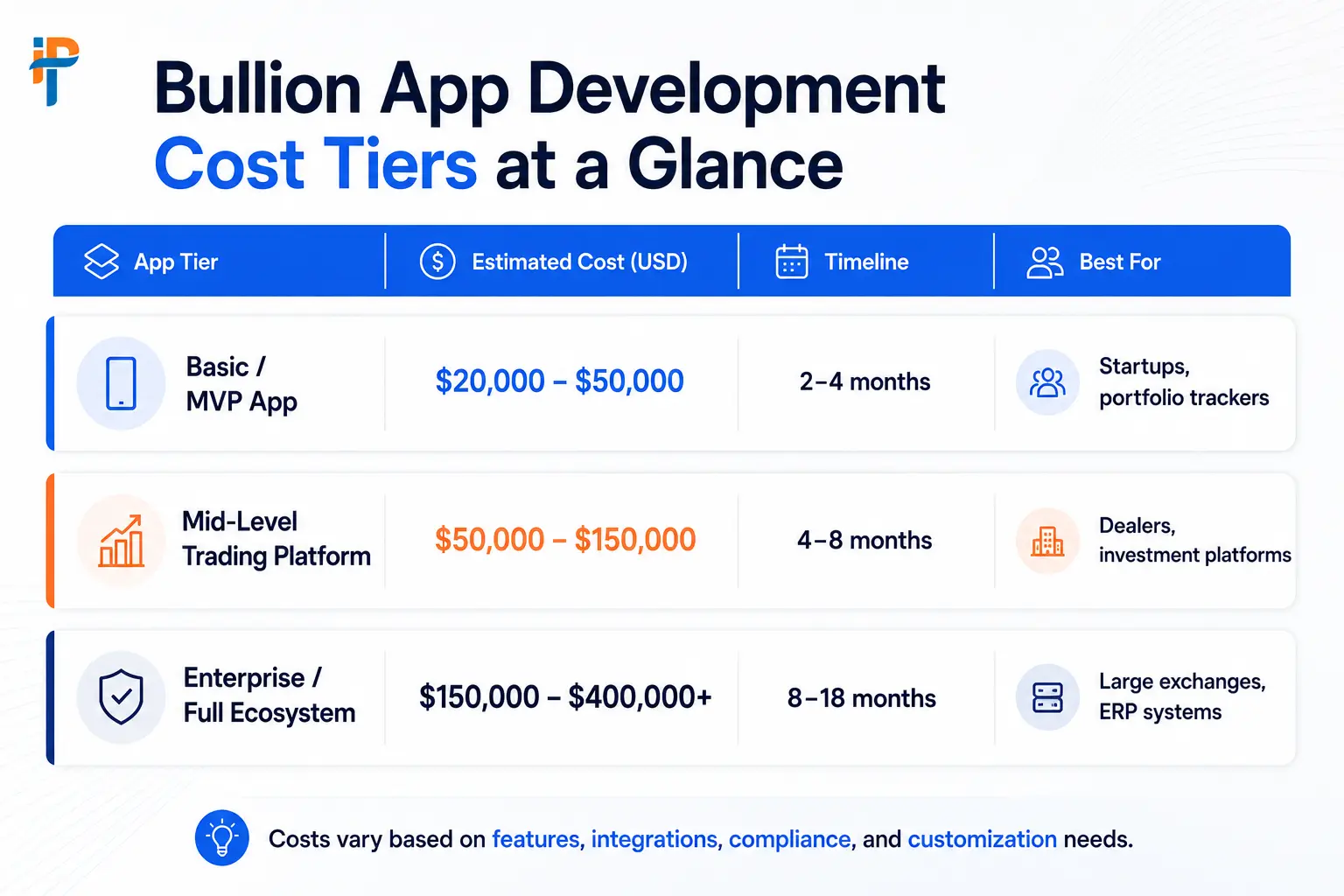
Bullion App Development Cost Tiers at a Glance
| App Tier | Estimated Cost (USD) | Timeline | Best For |
|---|---|---|---|
| Basic / MVP App | $20,000 – $50,000 | 2–4 months | Startups, portfolio trackers |
| Mid-Level Trading Platform | $50,000 – $150,000 | 4–8 months | Dealers, investment platforms |
| Enterprise / Full Ecosystem | $150,000 – $400,000+ | 8–18 months | Large exchanges, ERP systems |
Basic Bullion App Cost
At the entry level, you’re looking at somewhere between $20,000 and $50,000 for a basic bullion portfolio tracker or inventory app.
This covers essential features: user login, live spot price integration (via APIs like Metals-API or Kitco), a basic portfolio dashboard, price alerts, and simple charting. You’re likely building on a cross-platform framework like Flutter or React Native to cover both iOS and Android simultaneously, which cuts costs by 30–50% versus building two native apps.
This tier suits startups, freelancers entering the space, or established dealers looking to offer a simple client-facing tool.
Don’t expect a fully automated trading engine at this price point — but for an MVP to validate your concept and attract early users, it’s a smart starting point.
Mid-Level Bullion Trading Platform Cost
This is where most serious businesses live — a production-ready platform with real transactional capability. Expect costs between $50,000 and $150,000 and a timeline of 4 to 8 months.
At this level, you get: real-time pricing with sub-second updates, buy/sell order execution, payment gateway integration (including wire, crypto, and card options), KYC/AML compliance workflows, multi-metal support (gold, silver, platinum, palladium), historical charts and analytics, multi-currency display, and a secure admin panel. Security architecture gets serious here too — think AES-256 encryption, biometric authentication, and secure session management.
Enterprise-Grade Bullion App Cost
For large exchanges, banks, and companies building a complete digital ecosystem, the investment ranges from $150,000 to $400,000 or more, with enterprise platforms sometimes exceeding $500,000.
These projects involve advanced features: AI-powered market prediction, real-time order books, multi-branch inventory management, full ERP integration, automated compliance reporting, vault storage coordination, white-label capabilities, and custom analytics dashboards.
At IPH Technologies, we’ve guided businesses through all three tiers. The right tier isn’t about budget alone — it’s about the operational control, transparency, and long-term growth you need your platform to deliver.
Key Factors That Drive Bullion App Development Costs
Think of app development costs like a recipe. The final dish depends on the ingredients you choose, and no two recipes are exactly alike. Here’s what goes into the pot.
Feature Complexity and Scope
This is the single biggest cost driver — bar none. An app that displays spot prices and lets users log their holdings is a fundamentally different engineering challenge from an app that executes live trades, manages a multi-tier vault storage system, and sends automated compliance reports to regulators. Every additional feature adds development hours, and development hours translate directly to cost.
A real-time pricing engine connected to live market feeds — essential for any serious bullion app — alone can add $10,000 to $30,000 to your build, depending on the data provider and the level of redundancy you need.
Platform Choice: iOS, Android, or Cross-Platform?
Building separate native apps for iOS and Android can easily double your development cost. Cross-platform frameworks like Flutter and React Native have matured significantly — they now cover over 90% of business app use cases and deliver performance differences of only 5–15% compared to fully native applications. For most bullion apps, that trade-off is absolutely worth it.
If you insist on native builds for both platforms, budget accordingly — a mid-complexity app that costs $80,000 cross-platform might run $160,000+ as two separate native builds.
Tech Stack and Third-Party Integrations
Your bullion app doesn’t live in a vacuum. It needs to talk to live precious metals price APIs, payment processors, KYC providers, banking partners, cloud infrastructure, SMS/email notification services, and potentially even blockchain networks for transaction verification. Every integration adds complexity and cost.
Popular stacks for bullion apps in 2026 include Node.js and React for the backend and web layers, Flutter or React Native for mobile, and Firebase or AWS for cloud infrastructure. Blockchain integration (for transparency and immutable transaction records) adds another layer of both capability and cost.
Developer Location and Team Size
Where your development team is based has an enormous impact on cost, and this is where the widest range in quotes comes from. Here’s a quick breakdown of typical hourly rates in 2026:
Developer Hourly Rates by Region (2026)
| Region | Hourly Rate (USD) | Typical Mid-App Build |
|---|---|---|
| USA / Canada | $125–$200/hr | $150,000–$300,000 |
| Western Europe | $80–$140/hr | $100,000–$200,000 |
| Eastern Europe | $45–$80/hr | $50,000–$120,000 |
| India / South Asia | $25–$60/hr | $30,000–$100,000 |
| Southeast Asia | $30–$65/hr | $35,000–$110,000 |
Security and Compliance Requirements
A bullion app is, at its core, a financial application. It handles high-value transactions, sensitive personal and financial data, and in many jurisdictions, falls under regulatory frameworks like KYC (Know Your Customer), AML (Anti-Money Laundering), GDPR, and PCI-DSS.
Fintech and compliance-heavy apps typically cost 30 to 80% more than equivalent unregulated consumer apps.
You can’t skip on security in the precious metals space. Features like military-grade AES-256 encryption, multi-factor authentication, biometric login, and secure session management aren’t optional extras — they’re baseline expectations for users trusting your platform with significant wealth.
Must-Have Features in a Bullion App (And What They Cost)
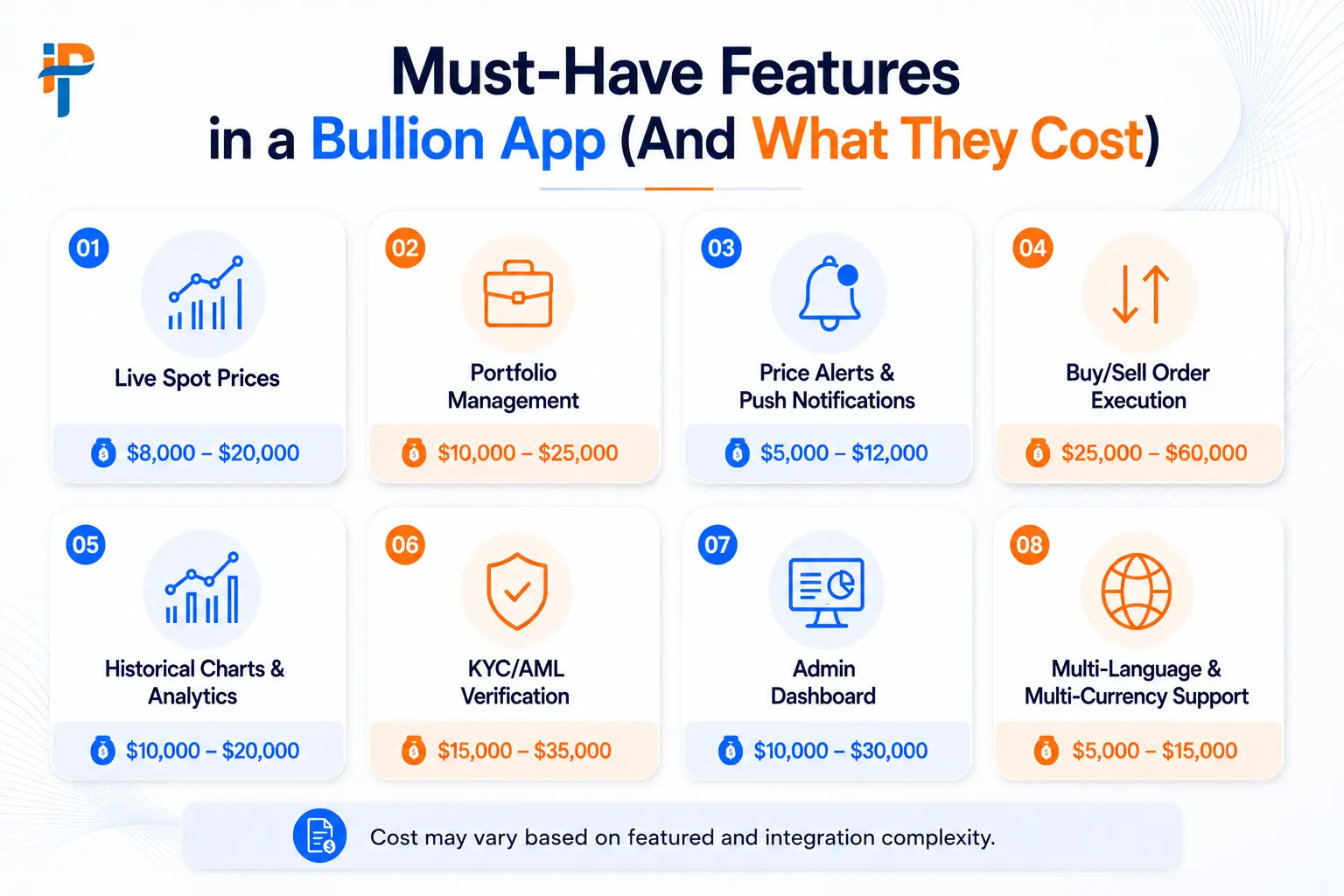
Every great bullion app shares a core set of features. Here’s what to budget for and why each one matters.
Live Spot Prices: Real-time updates for gold, silver, platinum, and palladium across multiple currencies. Prices that update every 2 seconds — like the Gold Bullion Stacker app — require robust API connections and efficient client-side rendering. Budget: $8,000–$20,000.
Portfolio Management: The ability for users to add holdings (from any dealer, not just your platform), track average purchase price, view profit/loss in real-time, and organize by metal type, denomination, or storage location. Budget: $10,000–$25,000.
Price Alerts & Push Notifications: Customizable thresholds that notify users when gold or silver hits their target — even with the app closed. Budget: $5,000–$12,000.
Buy/Sell Order Execution: For trading platforms, the ability to execute buy and sell orders with instant settlement. This requires backend trading engine integration, payment gateway connections, and robust error handling. Budget: $25,000–$60,000.
Historical Charts & Analytics: Price performance over multiple timeframes (24 hours, 7 days, 30 days, 1 year, 5 years), with technical indicators like RSI, SMA50, SMA200, and DXY correlation. Budget: $10,000–$20,000.
KYC/AML Verification: Automated identity verification workflows for compliance. Budget: $15,000–$35,000.
Admin Dashboard: Backend panel for managing users, monitoring transactions, configuring pricing feeds, and generating reports. Budget: $10,000–$30,000.
Multi-Language & Multi-Currency Support: Essential for global platforms. Nine language settings, as BullionVault offers, serve international markets significantly better. Budget: $5,000–$15,000.
Hidden Costs Most Clients Overlook
Here’s the thing about app development budgets: the headline number is rarely the final number. Industry data consistently shows that hidden costs add 15–30% to the base build quote. Here’s what catches most clients off guard:
Third-Party API Fees: Live precious metals pricing APIs aren’t free. Services like Metals-API, Kitco, or proprietary exchange feeds often charge monthly subscription fees that range from a few hundred to several thousand dollars per month, depending on update frequency and data depth.
Post-Launch Maintenance: Your app doesn’t stop needing attention after launch day. Bug fixes, OS updates, API changes, security patches, and performance optimizations run an average of 15–25% of your initial build cost annually.
App Store Fees & Review Cycles: Apple charges a $99/year developer fee and has notoriously unpredictable review timelines. Android’s Google Play store charges a one-time $25 fee. Build these into your launch timeline — rejections happen.
Infrastructure & Hosting: Backend servers, databases, CDNs, and cloud infrastructure scale with your user base. A simple backend runs $5,000–$20,000 to set up, while enterprise-grade infrastructure supporting millions of users can exceed $150,000.
QA & Testing: Thorough quality assurance isn’t an afterthought — it runs alongside development and typically accounts for 15% of total build cost. For a financial app where a single bug could mean a trader misses a critical price move, skimping on QA is a false economy.
How Long Does It Take to Build a Bullion App?
Timeline and cost are inseparable. Here’s a realistic breakdown by project tier:
• Basic Portfolio Tracker / MVP: 2–4 months
• Mid-Level Trading Platform: 4–8 months
• Enterprise Bullion Ecosystem: 8–18 months
These timelines assume a well-defined scope, clear requirements, and an experienced team working efficiently. Scope creep — adding features mid-build — is the number one cause of timeline overruns. Define your MVP ruthlessly before you write a single line of code.
The best-practice contract structure in 2026 is hybrid: fixed-scope for the launchable MVP, followed by a time-and-materials retainer for ongoing iteration and maintenance.
How to Choose the Right Bullion App Development Partner
Your development partner isn’t just a vendor — they’re a co-architect of your business’s digital future. Here’s what to look for before signing anything.
Domain Expertise in Fintech & Precious Metals: Not every app development company understands the nuances of bullion trading — spot price feeds, vault integration, regulatory compliance, high-value transaction security. Ask for case studies specifically in fintech or precious metals.
Transparent Pricing & Scope Definition: Any reputable partner will walk you through a detailed scope document before quoting. Two quotes for the same app that differ by $80,000 are almost certainly not quoting the same scope.
Agile Development Methodology: The precious metals market moves fast. Your development process needs to be nimble enough to adapt when requirements evolve. Agile sprints, regular demos, and iterative builds give you far more control than a waterfall approach.
Post-Launch Support: Building the app is the beginning, not the end. Make sure your partner offers ongoing maintenance, bug fixes, and feature development after launch.
Track Record & Client Satisfaction: Numbers matter. A company with 500+ successful projects and 430+ satisfied clients has been stress-tested by real-world challenges. That experience translates directly into fewer surprises for your project.
Why IPH Technologies Is Your Ideal Bullion App Development Partner
At IPH Technologies, we don’t just build apps — we build the digital backbone of growing businesses. Based in Lucknow, India, with a decade-plus of experience and a portfolio spanning 500+ successful projects across 430+ satisfied clients, we’ve worked with bullion dealers, precious metals investors, and trading platforms at every stage of their digital journey.
Our approach to bullion app development is grounded in three pillars: technical excellence, domain intelligence, and client partnership. We leverage the latest technologies — React Native, Flutter, Node.js, and AI-driven analytics — to build apps that don’t just work on day one, but scale confidently as your business grows.
We understand that in the bullion industry, even small inefficiencies in pricing, reporting, or inventory visibility can translate into significant financial impact. That’s why we focus on precision — getting the data flows right, the security architecture rock-solid, and the user experience intuitive enough that your clients spend more time investing and less time figuring out your app.
Whether you need a nimble portfolio tracker to launch in three months or a full-featured trading ecosystem with vault integration and AI-powered market insights, we have the expertise and the methodology to deliver it — on scope, on timeline, and within budget.
We’re not just a development shop. We’re the partner who stays invested in your success long after your app goes live.
Conclusion
Building a bullion app in 2026 isn’t a small decision — but it’s an increasingly essential one. With the precious metals market surging to record heights, gold trading above $4,500 per ounce, and investors demanding real-time, mobile-first experiences, the window for digital differentiation has never been more open.
The cost of your bullion app will depend on your ambition: a lean MVP portfolio tracker can be live for as little as $20,000–$50,000, a mid-level trading platform runs $50,000–$150,000, and a full enterprise ecosystem can easily reach $400,000 or beyond. What matters most is making sure that every rupee or dollar invested maps directly to operational value, user trust, and long-term growth.
At IPH Technologies, we’ve helped businesses at every one of those tiers turn their vision into reality. If you’re ready to digitize your bullion operations, build your trading platform, or launch the next great precious metals app, let’s talk. The market is moving fast — your technology should too.










.png)