













































































































Introduction
Let’s be honest — the precious metals industry has never been afraid of disruption. It survived the collapse of the gold standard, the shift to digital commodity trading, and the explosive rise of ETF markets. Each wave brought new technology, new players, and new rules. But nothing — absolutely nothing — has shifted the landscape quite as dramatically as artificial intelligence.
Today, AI is quietly rewriting the rulebook for how bullion software is built, deployed, and scaled. It’s showing up in every layer of the stack — from back-office inventory reconciliation to real-time price prediction, from KYC onboarding to autonomous trade execution. And the companies that are building with AI at the core of their platforms aren’t just keeping up with the market. They’re pulling ahead of it.
If you’re a bullion dealer, a precious metals exchange, or a financial institution with exposure to commodity trading — and you’re still running on legacy software with rule-based logic and manual workflows — this blog is for you. We’re going to break down exactly where AI is making an impact, what it means for your operations, and what a modern bullion software development engagement looks like in 2026.
The Old Way of Building Bullion Software — And Why It’s Failing
Traditional bullion trading platforms were engineered to be dependable, not dynamic. They tracked spot prices, managed vault inventory, processed orders, and generated compliance reports. Functional, yes. But the architecture underneath was largely static — rigid rule-sets, fixed workflows, and a fundamental assumption that the market would behave in predictable ways.
That assumption no longer holds.
Today’s precious metals markets are driven by a tangle of variables that no static system can adequately model. Geopolitical shocks, central bank policy shifts, currency fluctuations, ESG sentiment, retail investor behavior on social platforms — all of it moves gold, silver, platinum, and palladium in ways that couldn’t have been anticipated even five years ago. Traders operate across multiple commodities, multiple jurisdictions, and multiple risk profiles simultaneously. The volume and velocity of data has exploded.
Manual oversight can’t keep up. Static rules can’t adapt fast enough. And legacy codebases — often held together with years of patches and workarounds — can’t scale to meet modern demands.
That’s the gap AI was built to fill. And the bullion software firms that recognize this early are the ones building durable competitive advantages right now.
Also Read- Best AI App Development Companies in India 2026 | Top Ranked List
AI vs Traditional Bullion Software — A Direct Comparison
Here’s a clear side-by-side look at how AI-powered bullion platforms stack up against traditional systems across the functions that matter most:
| Feature / Function | Traditional Bullion Software | AI-Powered Bullion Software |
|---|---|---|
| Price forecasting | Static spot price feeds, manual analysis | ML models with macro, sentiment & historical data |
| Trade execution | Human-triggered, rule-based automation | Autonomous agentic AI with real-time strategy adjustment |
| Fraud detection | Fixed rule sets, known pattern matching | Anomaly detection that adapts to new fraud patterns |
| Inventory management | Manual reconciliation, spreadsheet-based | Predictive allocation, automated vault reconciliation |
| KYC / AML compliance | Manual document review, slow onboarding | AI-verified identity checks, real-time watchlist screening |
| Client experience | Uniform dashboards for all users | Dynamic, personalized interfaces based on behavior |
| Risk management | Periodic manual review | Continuous portfolio simulation and real-time alerts |
| Reporting | Static templates, manual data entry | Automated, regulation-ready reports with audit trails |
| Scalability | Requires significant re-engineering | Built to scale with data volume and market complexity |
| Downtime sensitivity | High — manual processes create single points of failure | Low — AI systems operate continuously with redundancy |
The gap between these two columns isn’t a minor technical upgrade. It’s the difference between a platform that processes your business and one that actively drives it.
Also Read- 2026 Mobile App Compliance Guide: GDPR, HIPAA & App Store Rules | IPH Technologies
7 Ways AI Is Transforming Bullion Software Development
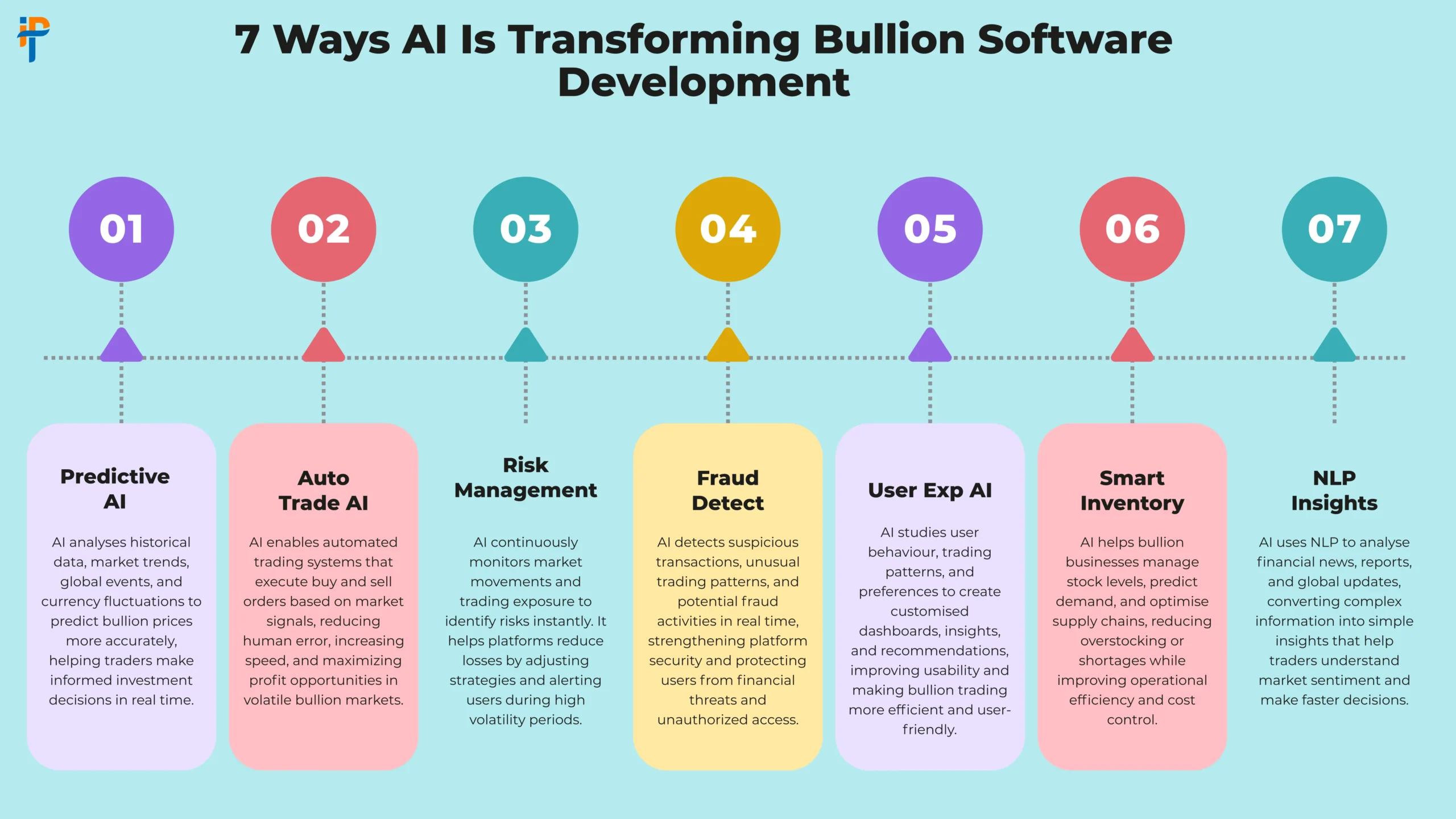
1. Real-Time Price Prediction That Actually Predicts
Spot price feeds have always been the backbone of any bullion platform. What AI brings is the ability to do something far smarter with those feeds — not just display the price, but anticipate where it’s heading and why.
Modern machine learning models trained on precious metals data can ingest decades of commodity price history, correlate it with macroeconomic signals like inflation data, central bank policy decisions, and dollar index movements, and overlay real-time geopolitical sentiment pulled from news sources and financial feeds. The output isn’t a guess — it’s a probabilistic forecast with a confidence interval attached, updated continuously as new data arrives.
For traders, this means context they couldn’t realistically generate on their own, delivered in seconds. For platform operators, it means a genuinely differentiated product feature that turns a price dashboard into an intelligence tool.
2. Automated Trade Execution at Machine Speed
One of the most significant shifts in modern bullion software development is the move toward autonomous trading agents — AI systems that don’t just assist traders, but act on their behalf.
An agentic AI trading system monitors live market conditions continuously, evaluates them against a predefined or dynamically adjusted strategy, and executes buy, sell, or hedge actions without waiting for a human to make a decision. In volatile markets, this speed advantage is not marginal — it’s decisive. A millisecond can mean the difference between a profitable position and a loss.
What distinguishes modern agentic systems from the old algorithmic trading bots of the 2000s is genuine reasoning capability. These systems don’t just follow if-then logic trees — they weigh contextual signals, adapt their approach as inputs change, and can escalate decisions to human review when conditions fall outside their confidence parameters. It’s automation with judgment baked in.
3. Fraud Detection That Learns as Fast as Fraud Evolves
The precious metals industry has always been a target for financial crime. Money laundering, price manipulation, wash trading, and identity fraud are persistent and costly problems. Traditional fraud detection systems respond to known patterns — essentially a list of things that have been seen before, codified into rules.
The fundamental problem is that fraudsters study those rules. They learn what triggers alerts and engineer around them. Rule-based systems are always one step behind.
AI-powered anomaly detection takes a completely different approach. Rather than matching against a known list, it builds a detailed model of what normal behavior looks like for each user, account, and trading pattern — and then surfaces anything that deviates from that model, even if it’s never been seen before. The system improves continuously as it processes more data. It’s fraud detection that evolves alongside the threat.
4. Smart Vault and Inventory Intelligence
Physical bullion introduces a logistics dimension that software has historically underserved. Where exactly is the stock sitting? How is it allocated across vaults in different geographies? How do physical holdings correlate with paper positions? These aren’t trivial questions — they matter enormously in settlement, and getting them wrong is expensive.
AI brings genuine predictive intelligence to inventory management. Systems can flag allocation imbalances before they create problems, optimize cross-vault transfers based on anticipated settlement demand, and automate reconciliation between physical stock records and digital trading positions. For large bullion dealers operating across multiple locations, this kind of intelligence isn’t a nice-to-have — it’s operationally essential.
5. KYC and AML Compliance — Done Fast and Done Right
Compliance in precious metals is non-negotiable, and the regulatory burden is growing. KYC and AML requirements differ by jurisdiction and are tightening globally, particularly as authorities increase scrutiny of commodity markets as a vector for financial crime. Processing this manually for every client onboarding is slow, expensive, and prone to inconsistency.
AI-powered compliance engines change the equation entirely. They can verify identity documents in seconds, cross-reference multiple international watchlists simultaneously, generate risk scores based on behavioral and transactional data, and flag suspicious activity for human review — all in near real time. What used to take a compliance team days now takes minutes, with a cleaner audit trail and fewer errors. Onboarding velocity improves dramatically. So does the quality of the output.
6. Client Experiences That Feel Genuinely Personal
Here’s the feature that gets underestimated most often. The majority of bullion platforms treat all clients identically — same interface, same data views, same alert thresholds. But a high-frequency institutional desk running multi-million dollar positions has fundamentally different needs from a retail investor buying their first gold ETF or physical bar.
AI enables software to adapt to the individual. Dynamic dashboards that surface what’s actually relevant to each user. Alert systems calibrated to individual risk tolerance and trading behavior. Recommendation engines that draw on a client’s real portfolio data to surface timely, relevant insights. This level of personalization at scale was technically and economically out of reach just a few years ago. Today, it’s one of the most meaningful competitive advantages a bullion platform can offer.
7. Predictive Risk Management Across the Entire Portfolio
Risk in precious metals isn’t confined to any single trade. It lives in the relationships between positions — how gold exposure interacts with silver holdings, how commodity risk correlates with currency risk, how a geopolitical event in one region cascades through a multi-geography portfolio. Seeing this clearly, in real time, requires more computational power and more data than human analysts alone can manage.
AI-powered risk engines can run continuous portfolio simulations, model thousands of market scenarios simultaneously, and surface concentration risks and emerging vulnerabilities before they become losses. Modern bullion platforms built with AI don’t just report risk — they actively help you manage it, generating rebalancing recommendations and alerting the right people before problems compound
Also Read- AI Software Development in Australia: Cost, Timeline & Strategy [2026]
What the Best Bullion Software Development Partners Deliver
Building AI-powered bullion platforms is genuinely hard. It requires simultaneous expertise across financial domain knowledge, regulatory frameworks, real-time distributed systems, machine learning engineering, and product design. Most development shops can cover one or two of these areas confidently. Very few operate across all of them.
Here’s what separates a capable partner from an ordinary one:
| Capability | What It Means in Practice |
|---|---|
| Fintech domain expertise | Understands bullion market mechanics, not just software patterns |
| AI/ML engineering | Builds and trains models in-house — not just wraps third-party APIs |
| Regulatory knowledge | Familiar with FATF, MiFID II, FinCEN, and local commodity regulations |
| Agentic AI development | Can architect autonomous systems with appropriate human-in-the-loop controls |
| Mobile-first development | Delivers native-grade mobile experiences alongside web platforms |
| Agile delivery | Ships in iterative cycles with transparent communication throughout |
| Security architecture | Builds for financial-grade data security from day one |
| Scalability planning | Designs systems that grow with your data volume and user base |
| Integration capability | Connects with existing ERPs, market data feeds, and banking infrastructure |
| Long-term partnership | Invested in your success beyond the initial build — not just delivery |
This is not a checklist to run through casually. Each of these capabilities represents years of real-world experience building software where the cost of getting it wrong is high. The right partner doesn’t just write good code — they understand the business problem behind the code and build accordingly.
Also Read- LLM vs RAG vs Agentic AI vs AI Agents: Which AI Architecture Is Right for Your Next Project?
How IPH Technologies Approaches Bullion Software Development
At IPH Technologies, we build intelligent, high-impact digital products for businesses that operate at the edge of what technology can do. We specialize in mobile app development, web application development, custom software engineering, and Agentic AI — autonomous systems that think, decide, and act to drive measurable business outcomes.
With 500+ successful projects delivered and 430+ satisfied clients across industries, we’ve built a reputation for doing what we say, delivering what we promise, and pushing further than expected. Our approach is agile execution, transparent communication, and an obsessive focus on your success — not just your software.
For precious metals businesses, this means a development partner who understands that you’re not just building an app. You’re building the operational backbone of a business where accuracy, speed, security, and compliance are non-negotiable. We take that seriously from the first conversation to the final deployment — and long after.
We’re not just your development vendor. We’re your long-term technology partner.
Visit us at: iphtechnologies.com
The Bottom Line
Gold doesn’t change. The weight of a troy ounce is what it always was. But the way the world trades it, tracks it, secures it, and builds software around it? That is changing faster than at any point in modern history — and AI is the engine driving that change.
The firms investing in AI-powered bullion platforms today aren’t just solving today’s operational problems. They’re building the infrastructure that will define competitive advantage in this industry for the next decade. Faster execution, smarter risk management, cleaner compliance, deeper client relationships — this is what becomes possible when AI is built into the foundation of your bullion software, not added as an afterthought.
The window to lead is open. But it won’t stay open forever.
If you’re ready to build the bullion platform your business deserves, IPH Technologies is ready to build it with you.










.png)