
















































































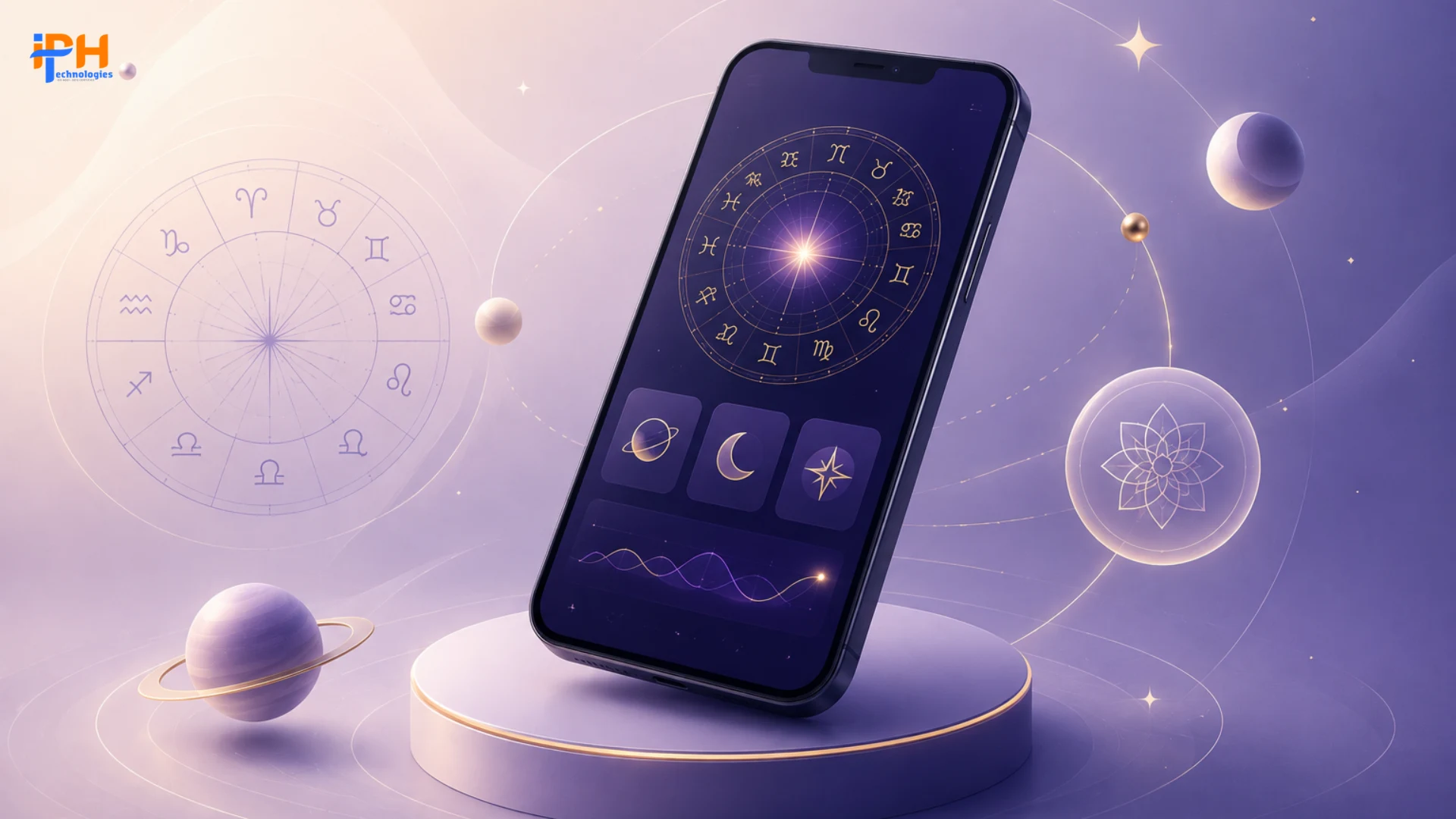
AI Astrology App Development: What It Actually Takes to Build a Horoscope App That Scales in 2026
Every founder that comes to us for a discovery call at IPH Technologies seems to say the same thing: “I need an astrology app, but not like the ones already on the market.” And they are not wrong; most of the existing products take the form of a horoscope newspaper with twelve cards of the zodiac signs, each with a short paragraph of text, and a notification at 7 am. The user experience is not exactly groundbreaking and leads to plenty of complaints in the app store.
As a Senior Software Developer, with experience in shipping multiple astrology and horoscope products with this team, I want to walk you through what exactly gets updated in this space, what a proper AI solution actually entails at the technical level, and how exactly you can monetize those solutions most profitably in 2026. This is the technical due diligence analysis I would present to a client before building any products for them.
The Category Has Outgrown “Just an Astrology App”
Astrology software is a “consumer” technology that is set to thrive and grow. According to various competing research firms, the global astrology app market is projected to be worth anywhere between $5–6 billion in 2026, and most projections put it on a path toward $ billion USD by the early 2030s, growing at a CAGR of close to 20% for the decade. In other words, astrology apps are set to grow far faster than the rest of the consumer app space.
I saw two figures that stood out to me while doing my research for this article. First, I found that while the daily horoscope content drives the volume of engagement on the platforms, it is the compatibility tools, AI-read personalized horoscopes, and consultations that drive revenues. Second, I saw that the apps that were able to introduce AI-powered personalization saw engagement jumps of over 10x (in some cases, even 30x) on key retention metrics vs. the apps that continued to use non-personalized content. And this trend will only accelerate.
Money is flowing too. Astrology consultation marketplaces have been raising funds consistently through 2025-2026, while the Indian Vedic astrology sector is set to grow at a near 50% CAGR through 2030 as domestic platforms begin targeting the US, UK and Gulf diaspora. So, do you want to build one or wait?
“AI-Powered” Astrology: What Should It Actually Mean?
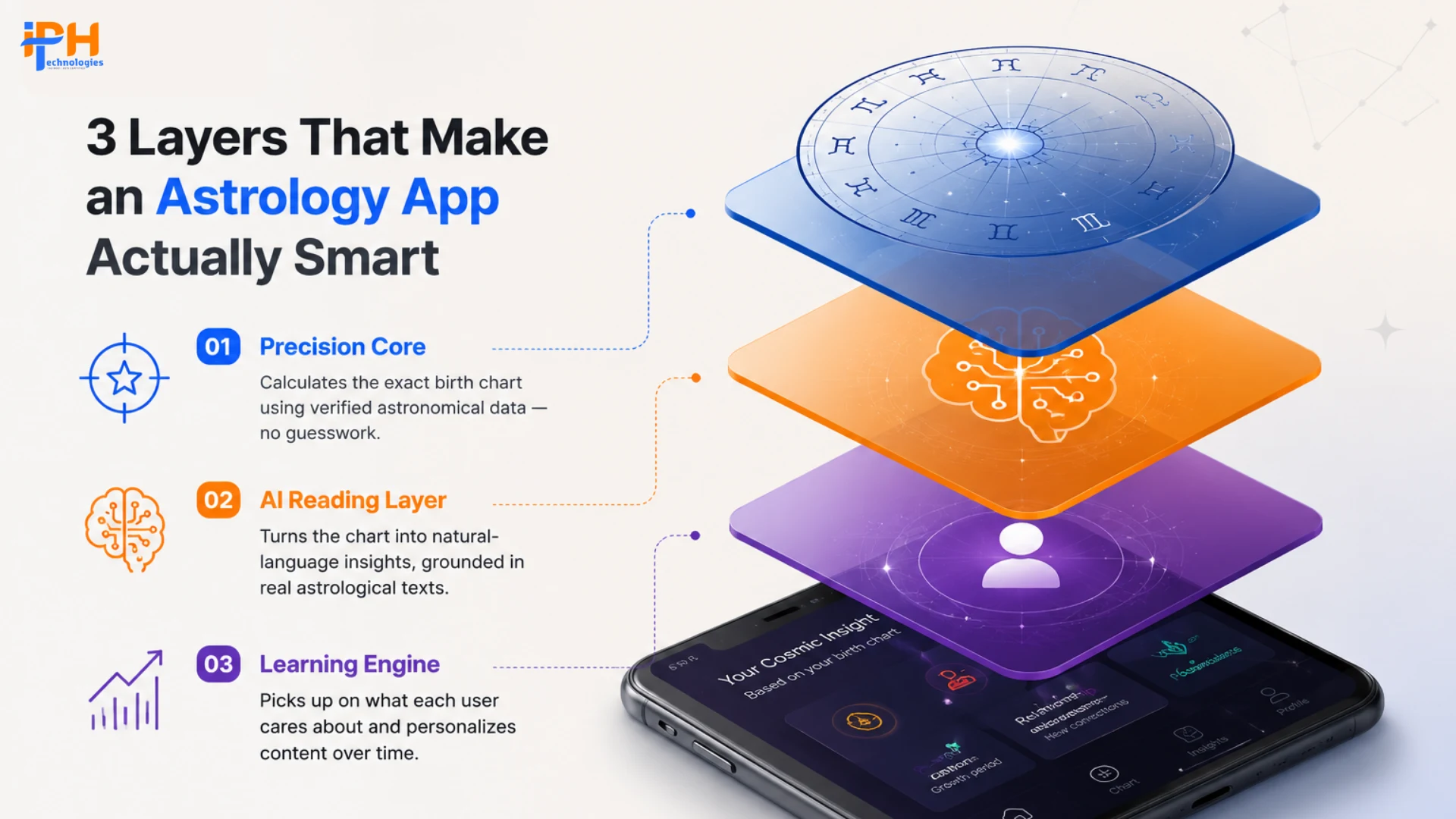
Recently on product discovery, all Astrology App Development Company sites seem to promise AI. As an engineer, that makes me want to see the architecture diagrams before believing them. Here’s what I look for in our own projects, and what I recommend looking for elsewhere.
A properly engineered AI astrology platform is really three systems working together, not one:
- The calculation engine. Thousands of hours of research and development are dedicated to delivering precise astrological calculations. Reliable ephemeris data, accurate house systems, dasha period calculations, and planetary transits are handled according to established astronomical standards. This is where precision matters most — intuition and guesswork have no place in the core calculations.
- The interpretation layer. An LLM interprets the generated birth chart in natural, human language, but only after being grounded in the computed chart data and classical astrological texts. Using a retrieval-augmented generation approach, the system helps prevent unsupported or inaccurate interpretations that have no basis in the chart or established astrological principles.
- The personalisation engine. Machine learning identifies the areas users care about most — such as career, relationships, and health — and uses those preferences to personalise future content, insights, and notification timing for a more relevant astrology experience.
Skip the step of grounding the model and let it “wing it,” and you could well end up producing a reading that places a planet in a house that isn’t there for that particular chart. After all, you’re relying on the user’s trust in the product. This is not a tolerable error to make.
The Services That Actually Belong on Your Roadmap
Here’s how we typically scope an astrology mobile app development company engagement, broken into the modules clients ask for most:
- Daily Horoscope App Development. Personalized daily, weekly, and monthly horoscopes based on a user’s birth details rather than generic Sun Sign predictions.
- Vedic Astrology App Development. Features focused on dasha, nakshatra, Panchang, and other Vedic astrology principles for users seeking traditional Indian astrology experiences.
- Kundli App Development. Instant birth chart generation, detailed horoscope reports, and Kundli matching features designed for astrology consultations and marriage compatibility.
- Zodiac Horoscope App Development. Western and tropical astrology solutions designed for international audiences and markets beyond the traditional Vedic astrology ecosystem.
- Tarot & Palm Reading App Development. Camera-based palm scanning and interactive digital tarot spreads that bring engaging, personalized experiences beyond conventional horoscope readings.
- Numerology App Development. Number-based life-path insights and personalized numerology reports that complement birth chart and horoscope-based experiences.
- Live Astrologer Consultation Apps. Chat, voice, and video consultations with astrologers, supported by appointment scheduling, ratings, reviews, and secure payment integration.
- Compatibility & Matchmaking Tools. Synastry-based compatibility scoring and relationship analysis for dating, marriage, and personalized matchmaking use cases.
Most clients do not aim to develop all the features described above right away. Usually, we suggest starting with 2-3 modules to see what users are willing to buy. After that, the custom astrology app development will continue to grow, which will reduce initial costs.
Under the Hood: How We Actually Build This
This is the point where most competitor descriptions seem to meander too much – let me get to specifics. Ephemeris data is used as a foundation and must be correct within a fraction of a second – we rely on trusted sources such as Swiss Ephemeris or other similar databases, not approximate calculations based on estimated positions.
AI Needs Guardrails, Not Freedom: Our RAG Pipelines Are Giving the LLM the User’s Computed Chart Plus Curated Interpretive Sources So That It Is Actually Explaining the Chart, Not Making Up Astrology on the Fly. Therefore, It’s Not a Fraudulent Online Astrology Platform Development Venture
Birth data is one of those things that I feel is a sensitive piece of information. The date, time, and location of birth as well as any consultations need to be handled with the same level of security as any financial or medical data. Encrypted at rest and in transit, GDPR compliant consent, and minimized retention are some of the measures that I would take, and they are the same security measures that I utilize in my experience working in the regulated industry. The Secure Real Estate Loan Management Platform case study is a great example of how I have handled such sensitive data, performed audits, and built the backend infrastructure to meet the required regulations. Although the industry is different, I hold myself to the same standard when it comes to personal and payment data in astrology platforms.
Traffic is spiked on a regular basis. It is highly seasonal and concentrated around big events and holidays like eclipses and retrogrades. On the backend, we make our product highly scalable so a spike does not take us down at the moment when the app is needed most.
Monetization must be integrated into the very core of the design. Subscription plans, billing for time spent on a call, or selling reports should all be built on an underlying financial infrastructure, which is capable of handling different currencies and billing cycles from day one. This is much more cost-effective than retrofitting an existing system.
Where the Revenue Actually Comes From
Industry data shows that for most apps in the astrology genre, recurring subscriptions and small microtransactions comprise the lion’s share of revenue, not one-time purchases, and that users who receive AI-personalized content have a significantly higher conversion rate to paying customers than those who see generic content. By revenue contribution, the most lucrative options are, in order:
- 1. Freemium Subscriptions. Offer free daily astrology content while placing detailed birth charts, dasha analysis, compatibility reports, and advanced insights behind premium subscription plans.
- 2. Live Astrologer Consultations. Enable pay-per-minute or per-session chat, voice, and video consultations with astrologers, creating a high-value and potentially high-margin revenue stream.
- 3. One-Time Premium Reports. Sell individual astrology reports, including detailed horoscopes, marriage compatibility reports, career predictions, and other personalized insights without requiring a recurring subscription.
- 4.In-App Purchases. Monetize individual features such as tarot card pulls, numerology reports, personalized remedy suggestions, and other on-demand astrology services.
- 5.White-Label & B2B Licensing. License ready-to-integrate astrology modules to social, wellness, dating, and media platforms, allowing businesses to add astrology experiences without the cost and complexity of developing the technology in-house.
Realistic Cost and Timeline Ranges
Every scope is different, but here’s the benchmark range we typically walk clients through in early conversations:
| App Scope | Typical Timeline | What’s Included |
| MVP (Horoscope + Kundli Core) | 4–8 weeks | Daily horoscope, basic birth chart, zodiac content |
| Mid-Tier Astrology Platform | 3–4 months | Compatibility tools, notifications, premium reports, and payments |
| Full AI-Powered Astrology Platform | 5–7+ months | AI-personalized readings, live consultations, video, multilingual support, admin panel, and astrologer panel |
Our standard advice: launch the MVP, prove engagement with real users, then fund the full AI personalization layer with usage data in hand rather than guesswork. It’s a faster route to product-market fit and a much stronger story if you’re raising capital.
What’s Actually New in This Space Right Now
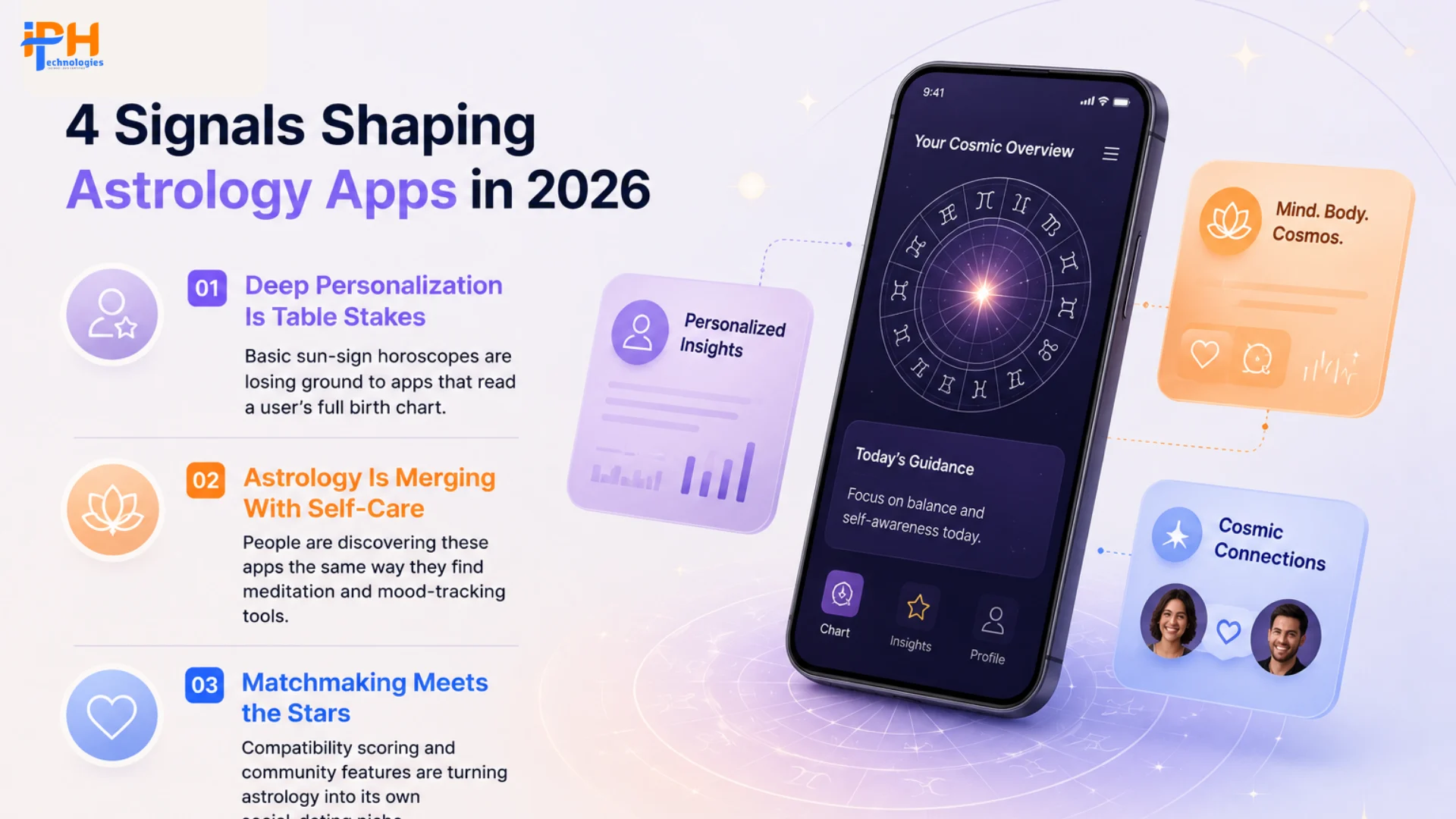
A few shifts worth building your roadmap around:
- Natal-chart-level AI personalization is becoming the baseline, not the differentiator. Apps still running generic sun-sign content are losing users to competitors offering real, personalized chart analysis.
- Astrology is blending into the wellness category. Users are increasingly discovering astrology apps through the same channels as meditation and mood-tracking apps, which changes how you should think about acquisition and cross-promotion.
- Regional Vedic platforms are pushing hard into Western markets, driven by both diaspora demand and mainstream curiosity – multi-language and multi-system (Vedic, Western, Chinese) support is quickly becoming a baseline requirement, not a premium add-on.
- Astrology-based social and dating features are emerging as their own growth niche, combining compatibility scoring with community and matchmaking mechanics.
Why Founders Build This With IPH Technologies
“We are not a spiritual-tech only company,” says one of the founders of the astrology software development company. “Our approach to developing products in astrology is the same as we do in fintech, healthcare, and real estate apps – we implement secure architecture, cloud technologies, and AI that has real-world applications, not just superficial coolness.”
A combination of 500 + successfully implemented projects and practical experience in the field of Vedic, Western and Chinese astrologies, as well as profound knowledge of the corresponding technical possibilities for the rapid and profitable implementation of astrological services.
If you’re putting together a horoscope application development services roadmap for 2026, and you want the team to treat the user’s birth data with the same level of seriousness as their financial data, Contact our Team to discuss your plans and requirements in a free introductory meeting.










.png)