

































































Our Achievements
appfutura
BusinessFirms
DesignRush
GoodFirms
ITFirms
iTRate.co
Mobile App Daily
Tech Behemoths
Highlights
UI/UX Design
User-first, visually engaging interfaces crafted to enhance usability, boost engagement, and deliver seamless digital experiences.
Branding
Strategic brand identities that communicate your vision, build trust, and create a memorable presence across all touchpoints.
Wireframing
Structured layouts and user flows that map the product journey clearly before development begins, saving time and cost.
Prototype Design
Interactive prototypes that simulate real user interactions, helping validate ideas and refine experiences early.
Design Systems
Scalable design frameworks and reusable components that ensure consistency, speed, and efficiency across your product.
UI/UX Design

We design intuitive, user-centric interfaces that enhance engagement, improve usability, and deliver seamless digital experiences across all devices.

UI UX Design
  • User research and wireframing for clear flows
  • Modern UI design using Figma and Adobe XD
  • Interactive prototypes for better user experience testing
  • Usability testing and performance optimization improvements
  • Responsive design across all devices and screens
  • Scalable design systems with reusable UI components
Branding & Identity

We craft strong brand identities that communicate your vision, build trust, and create a lasting impression across all digital and offline touchpoints.

Branding and Identity
  • Logo design and brand identity creation
  • Brand guidelines and visual consistency systems
  • Color palette and typography selection strategy
  • Marketing materials and brand asset design
  • Social media branding and creative direction
  • Rebranding and brand positioning strategies
Wireframing

We create structured wireframes that define layout, user flow, and functionality, helping visualize ideas and build a strong foundation before design and development.

Wireframing
  • Low fidelity wireframes for initial structure
  • High fidelity wireframes with detailed layouts
  • User flow mapping for better navigation
  • Content hierarchy and layout planning
  • Clickable wireframes for early feedback
  • Clear structure before UI design phase
Prototype Design

We design interactive prototypes that simulate real user experiences, helping validate ideas, test functionality, and refine products before development.

Prototype Design
  • Interactive prototypes for real user experience
  • Clickable designs to test product functionality
  • User journey simulation for better understanding
  • Rapid prototyping for faster design validation
  • Feedback driven improvements before development
  • High fidelity prototypes with smooth interactions
Design Systems

We build scalable design systems that ensure consistency, improve collaboration, and accelerate product development across all platforms and teams.

Design Systems
  • Reusable UI components for consistent design
  • Design tokens for colors typography spacing
  • Component libraries for faster development workflow
  • Consistent branding across all digital products
  • Documentation for design and development teams
  • Scalable systems for growing product ecosystems
Highlights
Mobile Apps Development
High-performance Android and iOS mobile applications built with modern technologies, delivering seamless user experiences and robust functionality.
Desktop Application Dev
Powerful and secure desktop applications tailored for Windows, macOS, and Linux, designed for performance, scalability, and reliability.
Web App Development
Scalable and responsive web applications using modern frameworks like React, Angular, and Vue for fast, dynamic, and engaging experiences.
Cross-Platform
Cost-effective cross-platform solutions using Flutter and React Native, enabling a single codebase for both iOS and Android platforms.
PWA Development
Progressive Web Apps that combine the best of web and mobile, offering offline access, fast loading, and app-like experiences directly in the browser.
Highlights
Mobile App

Android

iOS

Flutter

Hybrid

Optimize

Native

Swift

Firebase

Android App Development

We craft powerful, scalable Android applications with intuitive UX, high performance, and deep integration with Google services.

Android App
  • Custom Android app development
  • Native Kotlin & Java apps
  • Google Play Store deployment
  • Material Design UI implementation
Kotlin

Kotlin

Java

Java

Flutter

Flutter

Android Studio

Android

Jetpack

Jetpack

iOS App Development

We build high-quality, user-centric iOS apps combining performance, security, and seamless design for Apple devices.

iOS App
  • Custom iOS app development
  • Native Swift & SwiftUI apps
  • Seamless Apple service integration
  • App Store review & deployment
Swift

Swift

SwiftUI

SwiftUI

Obj-C

Obj-C

Xcode

Xcode

Flutter

Flutter

Cross-Platform Apps

We develop cross-platform mobile apps that run flawlessly on both iOS and Android from a single codebase, saving time and cost.

Cross-Platform App
  • Single codebase for iOS & Android
  • Flutter & React Native development
  • Native-like performance & UI
  • Faster time-to-market
React Native

React Native

TypeScript

TypeScript

Redux

Redux

Firebase

Firebase

Dart

Dart

Hybrid Apps

We build hybrid mobile apps that blend web technologies with native capabilities, delivering broad reach and cost-effective development.

Hybrid App
  • Web + native feature integration
  • Ionic & Cordova frameworks
  • Reduced development costs
  • Multi-platform publishing
Flutter

Flutter

Dart

Dart

Firebase

Firebase

SQLite

SQLite

App Optimization

We enhance existing mobile apps with performance tuning, crash fixes, battery efficiency, and faster load times for a superior user experience.

App Optimization
  • Performance profiling & tuning
  • Memory & battery optimization
  • Crash analysis & bug fixing
  • App size reduction & load speed
Xcode

Xcode

Android Studio

Android

Firebase

Firebase

Java

Java

Highlights
Desktop App

Windows

macOS

Linux

Desktop

Electron

Qt

WinForms

GTK

Windows Apps

We develop robust Windows desktop applications using modern Microsoft technologies, delivering powerful tools for enterprise and consumer use.

Windows App
  • Custom Windows desktop applications
  • WPF & WinForms development
  • Microsoft Store deployment
  • Windows API & system integration
C#

C#

.NET

.NET

Electron

Electron

Visual Studio

Visual Studio

SQL Server

SQL Server

macOS Apps

We create elegant, high-performance macOS applications that leverage Apple's native frameworks for a smooth and delightful desktop experience.

macOS App
  • Native macOS app development
  • SwiftUI & AppKit integration
  • Mac App Store submission
  • Apple Silicon optimization
Swift

Swift

SwiftUI

SwiftUI

Obj-C

Obj-C

Xcode

Xcode

Cross-Platform Desktop

We develop cross-platform desktop applications that run seamlessly on Windows, macOS, and Linux from a single shared codebase.

Cross-Platform Desktop
  • Single codebase for all platforms
  • Electron & Tauri frameworks
  • Flutter for desktop support
  • Consistent UI across OS environments
Flutter

Flutter

Electron

Electron

Node.js

Node.js

TypeScript

TypeScript

Docker

Docker

Electron Apps

We build feature-rich Electron desktop apps using web technologies, enabling cross-platform deployment with native OS capabilities.

Electron App
  • Electron framework development
  • Node.js & Chromium integration
  • Auto-updater & native notifications
  • Cross-OS packaging & distribution
Electron

Electron

Node.js

Node.js

React

React

Vue

Vue

TypeScript

TypeScript

Highlights
Web App

React

Node.js

PHP

Laravel

Python

MySQL

JavaScript

HTML

CSS

React Development

We build fast, component-driven React web applications with modern state management, reusable UI, and seamless API integration.

React Development
  • Custom React SPA development
  • Redux & Context API state management
  • Next.js SSR & SSG support
  • REST & GraphQL API integration
React

React

Next.js

Next.js

Redux

Redux

TypeScript

TypeScript

Tailwind

Tailwind

Angular Development

We develop enterprise-grade Angular applications with structured architecture, two-way data binding, and robust TypeScript foundations.

Angular Development
  • Custom Angular SPA development
  • RxJS & NgRx state management
  • Angular Material UI components
  • Lazy loading & performance tuning
Angular

Angular

TypeScript

TypeScript

HTML

HTML

CSS

CSS

NPM

NPM

Node.js Backend

We build scalable, event-driven Node.js backends with RESTful APIs, real-time capabilities, and seamless database integrations.

Node.js Backend
  • RESTful & GraphQL API development
  • Express.js & Fastify frameworks
  • WebSocket & real-time features
  • MongoDB, PostgreSQL integration
Node.js

Node.js

Express

Express

MongoDB

MongoDB

GraphQL

GraphQL

Docker

Docker

Cloud Web Apps

We design and deploy cloud-native web applications on AWS, Azure, and GCP — scalable, secure, and built for high availability.

Cloud Web Apps
  • AWS, Azure & GCP deployment
  • Serverless architecture development
  • Auto-scaling & load balancing
  • CI/CD pipeline configuration
AWS

AWS

Azure

Azure

GCP

GCP

Docker

Docker

Kubernetes

Kubernetes

Full-Stack Dev

We deliver complete full-stack web solutions — from pixel-perfect frontends to robust backends — as a unified, end-to-end product.

Full-Stack Dev
  • Frontend & backend development
  • MERN & MEAN stack expertise
  • Database design & API architecture
  • DevOps, hosting & deployment
React

React

Node.js

Node.js

MongoDB

MongoDB

PostgreSQL

PostgreSQL

Docker

Docker

Highlights
Cross Platform

Flutter

R. Native

Xamarin

Ionic

Reuse

Electron

NW.js

Framework7

SwiftUI

Flutter Development

We build beautiful, natively compiled Flutter applications for mobile, web, and desktop from a single Dart codebase with pixel-perfect UI.

Flutter Development
  • Flutter mobile & web apps
  • Dart language development
  • Custom widget & animation creation
  • Firebase & REST API integration
Flutter

Flutter

Dart

Dart

Firebase

Firebase

GetX

GetX

Riverpod

Riverpod

React Native

We develop high-performance React Native apps that deliver a truly native experience on both iOS and Android using JavaScript and React.

React Native
  • Cross-platform iOS & Android apps
  • React Native CLI & Expo development
  • Native module & bridge integration
  • Redux & MobX state management
React Native

React Native

Redux

Redux

TypeScript

TypeScript

Firebase

Firebase

Xamarin

We develop Xamarin-based cross-platform apps using C# and .NET, enabling shared business logic across iOS, Android, and Windows.

Xamarin
  • Xamarin.Forms & MAUI apps
  • Shared C# codebase development
  • Native API access via bindings
  • Enterprise app integration
Xamarin

Xamarin

C#

C#

.NET MAUI

.NET

Azure

Azure

Visual Studio

Visual Studio

Ionic Framework

We create stunning Ionic applications that combine the power of web technologies with native device features for a seamless mobile experience.

Ionic Framework
  • Ionic Angular & React apps
  • Capacitor native plugin integration
  • Responsive mobile-first UI
  • PWA & hybrid app deployment
Ionic

Ionic

Angular

Angular

React

React

Vue

Vue

Code Reusability

We build reusable app architectures, reducing duplication, accelerating development, and ensuring seamless cross-platform consistency.

Code Reusability
  • Shared component library creation
  • Monorepo architecture setup
  • Design system implementation
  • Platform-agnostic business logic
Turborepo

Turborepo

Storybook

Storybook

Flutter

Flutter

React Native

React Native

Highlights
PWA

PWA

Offline

Push

Fast

App-Like

IndexedDB

Installable

Sync

Progressive Web Apps

We build Progressive Web Apps that combine the best of web and mobile — installable, reliable, and fast across all devices and browsers.

Progressive Web Apps
  • PWA architecture & manifest setup
  • Service worker implementation
  • Installable & home screen support
  • Cross-browser compatibility
HTML5

HTML5

CSS3

CSS3

JavaScript

JavaScript

Workbox

Workbox

Lighthouse

Lighthouse

Offline Support

We implement robust offline capabilities in your web apps using service workers and smart caching so users stay productive without connectivity.

Offline Support
  • Service worker caching strategies
  • IndexedDB offline data storage
  • Background sync implementation
  • Graceful offline fallback pages
Service Worker

ServiceWorker

Workbox

Workbox

IndexedDB

IndexedDB

Cache API

Cache API

Background Sync

BackgroundSync

Push Notifications

We integrate web push notification systems into your PWA to re-engage users with timely, personalized alerts even when the app is not open.

Push Notifications
  • Web Push API implementation
  • VAPID key & subscription management
  • Notification scheduling & targeting
  • Cross-browser push support
Web Push

Web Push

Firebase FCM

Firebase

OneSignal

OneSignal

Node.js

Node.js

Workbox

Workbox

Fast Loading

We optimize PWAs for lightning-fast load times using code splitting, lazy loading, and caching to deliver exceptional Core Web Vitals scores.

Fast Loading
  • Code splitting & lazy loading
  • Image & asset optimization
  • Core Web Vitals improvement
  • CDN & caching configuration
Webpack

Webpack

Lighthouse

Lighthouse

Vite

Vite

Cloudflare

Cloudflare

Workbox

Workbox

App-Like Experience

We craft PWAs that feel and behave like native mobile apps — with smooth animations, full-screen mode, gestures, and seamless transitions.

App-Like Experience
  • Full-screen & standalone display mode
  • Touch gestures & swipe navigation
  • Smooth page transitions & animations
  • App shell architecture
Web Manifest

Web Manifest

CSS Animations

CSS

Framer Motion

FramerMotion

React

React

Vue

Vue

Highlights
Custom Software
Fully tailored software solutions designed to match your unique business processes, improving efficiency and driving long-term growth.
Backend Systems
Robust and secure backend architectures built for high performance, scalability, and seamless integration with your applications.
Database Design
Efficient and scalable database structures optimized for fast queries, data integrity, and reliable performance at scale.
Cloud-Native
Modern cloud-native solutions using microservices and serverless architecture on AWS, Azure, and GCP for maximum flexibility and scalability.
API Development
Secure and well-documented RESTful and GraphQL APIs that enable seamless communication between systems and third-party integrations.
Custom Software

We develop tailored software solutions that align with your business goals, streamline operations, and deliver scalable, high-performance digital systems.

Custom Software Development
  • Custom software tailored to business needs
  • Scalable architecture for long term growth
  • Secure and high performance application development
  • API integration with third party services
  • Cloud based and enterprise software solutions
  • Ongoing maintenance and system optimization support
Backend Systems

We build robust backend systems that power applications with secure, scalable architecture, efficient data handling, and seamless integrations.

Backend Systems
  • Secure backend architecture and system design
  • Database design and performance optimization
  • API development for seamless integrations
  • Authentication and authorization system implementation
  • Server side logic and business workflows
  • Scalable infrastructure for high traffic applications
Database Design

We design efficient database structures that ensure data integrity, optimize performance, and support scalable, reliable application systems.

Database Design
  • Structured database schema design and planning
  • Efficient data modeling for scalable systems
  • Database optimization for faster query performance
  • Relational and non relational database solutions
  • Secure data storage and access management
  • Backup strategies and data recovery solutions
Cloud-Native Apps

We build cloud-native applications designed for scalability, resilience, and flexibility using modern cloud infrastructure and microservices architecture.

Cloud Native Apps
  • Cloud first architecture for scalable applications
  • Microservices based system design and deployment
  • Containerization using Docker and Kubernetes tools
  • Auto scaling infrastructure for high availability
  • Continuous integration and continuous deployment pipelines
  • Secure cloud environments with monitoring and logging
API Development

We develop secure and scalable APIs that enable seamless communication between systems, applications, and third party services.

API Development
  • RESTful API development for web applications
  • Secure API authentication and authorization systems
  • Third party API integration and data exchange
  • Scalable APIs for high traffic applications
  • API documentation for easy developer integration
  • Performance optimization and API response tuning
Highlights
Manual Testing
Detailed human-driven testing to uncover edge cases, validate user flows, and ensure a seamless, intuitive user experience.
Test Automation
Automated testing frameworks using Selenium, Cypress, and Appium to accelerate regression cycles and improve release confidence.
Performance
Load, stress, and scalability testing to ensure your application performs reliably under high traffic and demanding conditions.
Security Testing
Comprehensive security assessments including penetration testing and vulnerability analysis to safeguard your application.
Mobile QA
End-to-end mobile application testing across devices and platforms to ensure consistent performance, usability, and stability.
Manual Testing

We perform detailed manual testing to ensure software quality, identify issues early, and deliver reliable, user-friendly applications.

Manual Testing
  • Functional testing for application core features
  • UI testing for consistent user experience
  • Cross browser and device compatibility testing
  • Test case creation and execution processes
  • Bug tracking and detailed issue reporting
  • Regression testing after feature updates
Test Automation

We implement automated testing solutions to improve efficiency, reduce manual effort, and ensure faster, reliable software delivery.

Test Automation
  • Automated test scripts for faster execution
  • Regression testing using automation frameworks
  • Continuous testing within CI CD pipelines
  • Test coverage improvement across application modules
  • Reusable automation scripts for long term scalability
  • Performance and load testing automation solutions
Performance Testing

We evaluate application performance to ensure speed, stability, and scalability under different workloads and real-world conditions.

Performance Testing
  • Load testing for high traffic scenarios
  • Stress testing to identify system limits
  • Performance benchmarking and response time analysis
  • Scalability testing for growing user demands
  • Memory and resource usage optimization checks
  • Bottleneck identification and performance improvements
Security Testing

We identify vulnerabilities and secure applications against threats, ensuring data protection, compliance, and safe user interactions.

Security Testing
  • Vulnerability assessment and risk analysis testing
  • Penetration testing to identify security gaps
  • Authentication and authorization security validation
  • Data protection and encryption testing processes
  • Secure code review and security best practices
  • Compliance testing with industry security standards
Mobile QA

We ensure mobile applications deliver flawless performance, usability, and compatibility across devices, platforms, and environments.

Mobile QA
  • Mobile app testing across multiple devices
  • iOS and Android platform compatibility testing
  • UI testing for consistent mobile experience
  • Network and performance testing on mobile
  • App usability and user experience validation
  • App store readiness and release testing
Highlights
CI/CD Pipelines
Automated pipelines for building, testing, and deploying code, enabling faster releases, fewer errors, and continuous delivery.
Infrastructure
Scalable infrastructure provisioning using Infrastructure as Code (IaC) with Terraform and CloudFormation for consistency and reliability.
Deployment
Zero-downtime deployment strategies including blue-green and rolling deployments to ensure smooth and reliable releases.
Containerisation
Container-based architectures using Docker and Kubernetes for portability, scalability, and efficient resource utilization.
Monitoring
Real-time monitoring and observability using tools like Grafana, Prometheus, and Datadog to ensure system health and performance.
CI/CD Pipelines

We implement CI/CD pipelines to automate build, testing, and deployment, enabling faster releases, improved quality, and continuous delivery.

CI CD Pipelines
  • Automated build and deployment pipeline setup
  • Continuous integration for faster code validation
  • Continuous delivery for seamless release cycles
  • Integration with Git version control systems
  • Automated testing within CI CD workflows
  • Monitoring and rollback strategies for deployments
Infrastructure

We design and manage reliable infrastructure to ensure scalability, security, and high availability for modern applications and systems.

Infrastructure
  • Cloud infrastructure setup and configuration services
  • Server management and deployment automation solutions
  • High availability and load balancing implementation
  • Monitoring and logging for system performance tracking
  • Security hardening and infrastructure access controls
  • Scalable environments for growing application demands
Deployment

We manage seamless deployment processes to ensure applications are delivered efficiently, securely, and ready for production environments.

Deployment
  • Application deployment to cloud and servers
  • Automated deployment workflows for faster releases
  • Environment configuration and setup management
  • Version control and release management processes
  • Rollback strategies for safe deployment updates
  • Post deployment monitoring and performance checks
Containerization

We use containerization to package applications for consistency, scalability, and efficient deployment across different environments.

Containerization
  • Application containerization using Docker technologies
  • Environment consistency across development and production
  • Container orchestration with Kubernetes platforms
  • Scalable container deployment for microservices architecture
  • Efficient resource utilization and system isolation
  • Integration with CI CD pipelines for automation
Monitoring

We monitor systems and applications in real time to ensure performance, reliability, and quick issue detection and resolution.

Monitoring
  • Real time system performance monitoring tools
  • Application health checks and uptime tracking
  • Error tracking and issue alerting systems
  • Log management and analysis for debugging
  • Resource usage monitoring across infrastructure layers
  • Proactive issue detection and incident response
Highlights
Roadmap Planning
Strategic product roadmaps aligned with business goals, helping prioritize features, manage timelines, and deliver maximum value.
Team Coordination
Efficient coordination across design, development, and QA teams to ensure smooth collaboration and on-time project delivery.
Growth Strategy
Data-driven product strategies focused on user acquisition, retention, and continuous improvement to drive sustainable growth.
Agile Sprints
Agile methodologies like Scrum and Kanban to deliver iterative releases, improve flexibility, and maintain predictable progress.
Stakeholder Mgmt
Clear communication and alignment with stakeholders through regular updates, reporting, and feedback loops to ensure project success.
Roadmap Planning

We create strategic roadmaps that align with your business goals, helping prioritize features, plan execution, and ensure long-term success.

Roadmap Planning
  • Product roadmap planning aligned with business objectives
  • Feature prioritization based on user and market needs
  • Timeline planning for efficient project execution phases
  • Technology stack selection for scalable solutions
  • Risk assessment and mitigation strategy planning
  • Continuous roadmap updates based on performance insights
Team Coordination

We ensure smooth collaboration across teams to improve productivity, streamline workflows, and deliver projects efficiently on time.

Team Coordination
  • Cross functional team collaboration and communication
  • Agile workflow management and sprint planning processes
  • Task tracking and project progress visibility tools
  • Clear role assignment and responsibility management
  • Regular updates and performance review meetings
  • Efficient coordination between design development teams
Growth Strategy

We develop data-driven growth strategies to scale your business, increase user acquisition, and maximize long-term revenue potential.

Growth Strategy
  • Market analysis and competitive growth planning strategies
  • User acquisition and retention optimization techniques
  • Data driven decision making and performance insights
  • Scalable business models for long term expansion
  • Conversion rate optimization across digital platforms
  • Continuous growth tracking and strategy refinement
Agile Sprints

We follow agile sprint methodologies to deliver faster iterations, improve collaboration, and ensure continuous product improvement.

Agile Sprints
  • Sprint planning and backlog prioritization processes
  • Daily standups for team alignment and progress tracking
  • Iterative development with continuous feedback cycles
  • Task management using agile tools and workflows
  • Regular sprint reviews and performance retrospectives
  • Faster delivery with incremental feature releases
Stakeholder Management

We ensure clear communication and alignment with stakeholders to drive project success, transparency, and informed decision making.

Stakeholder Management
  • Regular stakeholder communication and reporting processes
  • Requirement alignment with business goals and expectations
  • Feedback collection and continuous improvement strategies
  • Transparent project updates and progress visibility
  • Risk identification and stakeholder expectation management
  • Collaborative decision making for project success

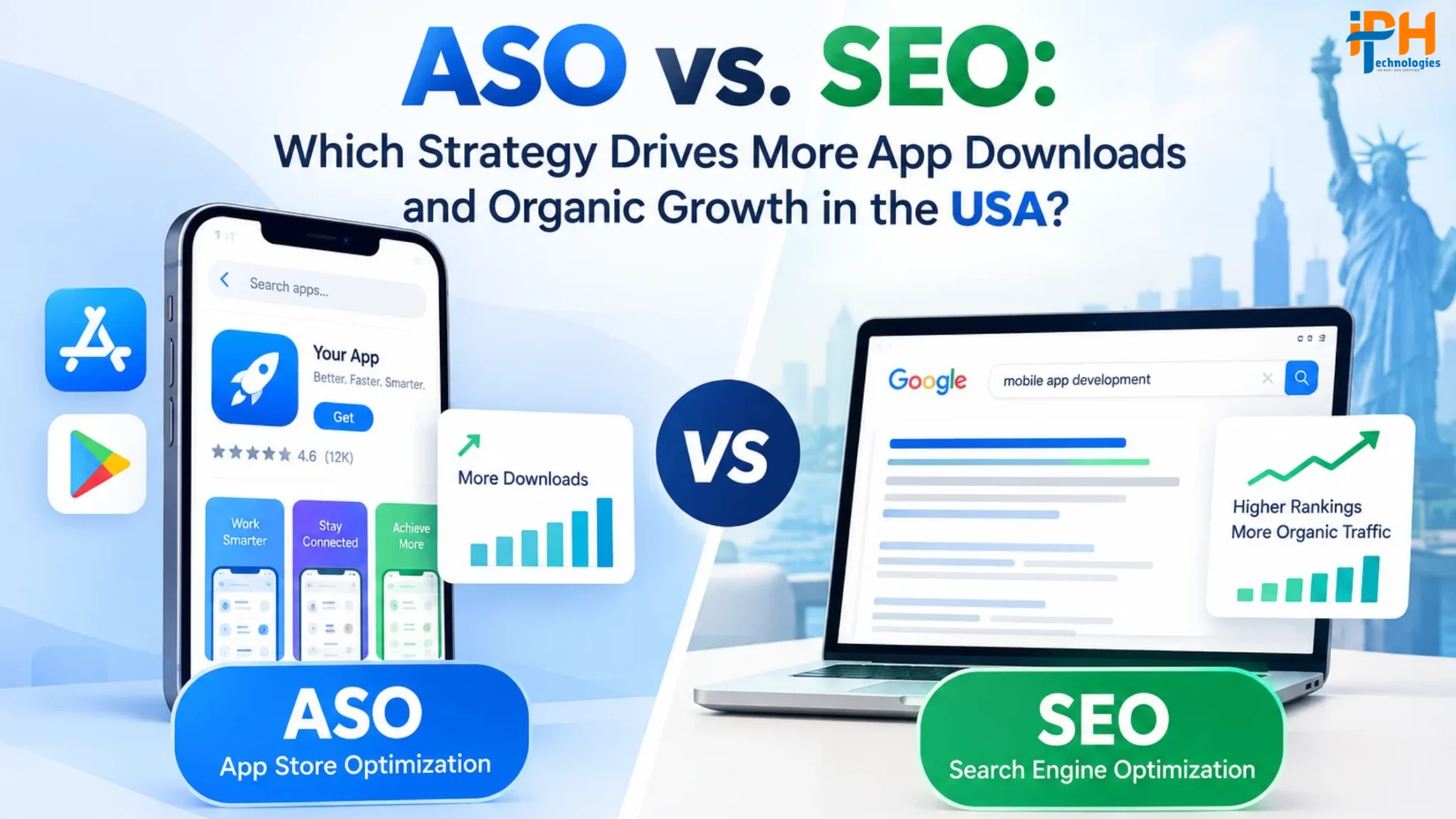
ASO vs SEO In today’s competitive digital landscape, getting discovered online is just as important as building a great product. For businesses in the United States, attracting potential customers requires more than launching a website or publishing a mobile app. Companies need strategies that help their digital products reach the right audience at the right time.

Two important strategies for achieving this are App Store Optimization (ASO) and Search Engine Optimization (SEO). While ASO helps mobile applications gain visibility in app marketplaces, SEO helps websites attract users through organic search results.

But which strategy delivers better results in 2026? The answer depends on your business goals, target audience, and the way customers discover your products.

What Is App Store Optimization (ASO)?

App Store Optimization, commonly known as ASO, is the process of improving a mobile application’s visibility and conversion rate within app marketplaces such as the Apple App Store and Google Play Store.

The objective is to help an app appear in relevant store searches and encourage users to download it after discovering its listing.

Key Elements of ASO

App title and keywords: Using relevant search terms in the app title, subtitle, and other supported metadata helps communicate the app’s purpose and improve its discoverability.

App description: A clear, benefit-focused description explains the application’s features, functionality, and value to potential users.

App icon and screenshots: Professional visuals help users understand the app experience and evaluate whether it meets their needs.

Ratings and reviews: Genuine user feedback can influence download decisions and provide insights into areas that need improvement.

Conversion rate optimization: Testing listing elements, such as screenshots and promotional messages where supported, can help increase the percentage of store visitors who install the app.

Localization: Adapting app listings for relevant U.S. audiences, languages, and user expectations can improve the relevance of an app’s presentation.

Also Read: Windows vs Android kiosk software

What Is Search Engine Optimization (SEO)?

Search Engine Optimization is the process of improving a website’s visibility in unpaid search engine results. SEO helps businesses connect with users who are searching for information, comparing solutions, or looking for specific products and services.

A well-planned SEO strategy helps businesses attract relevant visitors, establish credibility, and guide potential customers toward meaningful actions.

Key Elements of SEO

Keyword research: Identifying the search terms that potential customers use helps businesses create content aligned with their needs and search intent.

On-page SEO: Optimizing page titles, headings, URLs, internal links, and content helps search engines and users understand what a page offers.

Technical SEO: Improving crawlability, indexability, website performance, mobile usability, and site architecture supports effective search engine discovery.

Content marketing: Publishing useful blogs, service pages, comparison guides, and industry resources helps answer customer questions and attract relevant organic traffic.

Off-page SEO: Earning relevant, credible backlinks and building brand authority can strengthen a website’s ability to compete in search results.

Conversion optimization: Clear calls to action, relevant landing pages, and a smooth user experience help turn organic visitors into leads, customers, or app users.

ASO vs. SEO in 2026: Which Drives More App Downloads?

If your primary goal is to increase app downloads, ASO is generally the more direct starting point because it focuses on the platforms where users discover and install applications.

However, SEO can also contribute to app growth by attracting users who are researching a problem, comparing products, or searching for a solution before choosing an app.

When ASO Is the Better Choice

ASO is especially useful when your business already has a mobile application and wants to improve its performance in app marketplaces.

An effective ASO strategy can help the company improve listing relevance, communicate its value more clearly, and convert more qualified store visitors into installs.

ASO is particularly important when app store searches and product page visits represent a significant share of your potential acquisition opportunities.

When SEO Is the Better Choice

SEO is often the stronger starting point when users need information before they are ready to download an app.

Consider a healthcare technology company offering a patient engagement application. Potential customers might initially search for appointment scheduling tools, patient communication solutions, or healthcare workflow software.

The company can create useful content that answers these questions, explain how its application addresses the relevant challenges, and direct interested visitors to its app listing or product page.

SEO can also help businesses attract users through comparison pages, tutorials, feature explanations, and problem-focused articles that may not be discovered through app store searches alone.

Also Read: Duolingo Clone App Development

Why Combining ASO and SEO Can Deliver Better Results

For many app-based businesses, the strongest approach is to use ASO and SEO together.

SEO attracts users through relevant website content, while ASO helps convert app store discovery into installations. Both strategies can support different stages of the customer journey.

For example, an e-commerce company could publish SEO-focused buying guides and product comparisons, then optimize its mobile app listing to make installation easier for interested customers.

The website can also provide clear links to the app’s official store listings, allowing visitors to move from research to installation.

The result is a more connected acquisition strategy that does not rely entirely on a single discovery channel.

How U.S. Businesses Can Build an Effective ASO Strategy in 2026

The U.S. app market is competitive, so businesses need to understand their audience and communicate their app’s value clearly.

Start by researching the search terms that prospective users might enter in the Apple App Store or Google Play Store. Prioritize terms that accurately describe the app’s functionality and match the needs of your intended audience.

Next, improve the app listing. Use a clear title, a recognizable icon, compelling screenshots, and concise messaging that explains the benefits of the application. Ensure that every claim is accurate and supported by the actual product experience.Localization should also reflect the audience you want to reach. For a U.S.-focused app, this may include appropriate American English terminology, familiar date and currency formats where relevant, and examples that align with local user expectations.

ASO is an ongoing process. Changes in user behavior, competitor positioning, app features, and marketplace presentation can all affect performance over time.

How to Build an SEO Strategy That Supports Organic Growth

SEO requires a broader approach because websites can attract users through many types of searches and content.

1. Target Keywords Based on Search Intent

Keyword selection should reflect what users are trying to accomplish. Informational searches require useful explanations, while commercial searches often indicate that a user is comparing providers or evaluating solutions.

Creating content for both audiences helps businesses connect with users at different stages of the decision-making process.

2. Create Useful, Original Content

Publish content that answers real questions, explains relevant problems, and provides practical guidance. Blogs, comparison articles, feature pages, and case studies can each serve a different purpose within an organic growth strategy.Avoid publishing repetitive pages simply to target variations of the same keyword. Instead, focus on content that provides genuine value and gives users a clear reason to engage with your business.

3. Strengthen Technical SEO

A technically sound website helps search engines discover and understand its pages. Review indexability, XML sitemaps, canonical tags, internal linking, mobile usability, and page performance.Technical SEO does not guarantee rankings, but unresolved technical issues can prevent valuable content from being discovered or displayed effectively in search results.

4. Connect Organic Traffic With Business Outcomes

Website traffic alone does not determine whether an SEO strategy is successful. Monitor relevant conversions, including consultation requests, qualified leads, product inquiries, and app store visits.

This helps businesses identify which content attracts the most valuable audiences and where improvements may be needed.

Also Read: Ipad Apps Development For Healthcare

How AI Is Influencing ASO and SEO in 2026

AI is changing how businesses research keywords, analyze performance, create content, and understand user behavior. However, its role differs across ASO and SEO.

For ASO, AI-assisted tools can help identify keyword opportunities, analyze competitor listings, summarize user feedback, and develop alternative messaging for testing. Businesses can use these insights to improve listing relevance and communicate product benefits more effectively.

For SEO, AI can support topic research, content planning, search intent analysis, technical issue identification, and performance reporting. It can also help teams understand how users search for information across different stages of the buying journey.

However, using AI does not automatically improve rankings or app downloads. Automatically generated content that is inaccurate, repetitive, or unhelpful can weaken user trust. Human review remains essential for accuracy, originality, brand consistency, and compliance.In 2026, businesses should treat AI as a tool for improving research and execution rather than a replacement for a well-defined strategy.

Common ASO and SEO Mistakes Businesses Should Avoid

Even a well-funded digital growth strategy can underperform when its priorities are unclear.

One common ASO mistake is focusing exclusively on keyword placement while neglecting the quality of the app listing. Users also need clear screenshots, understandable messaging, and a compelling reason to install the app.

In SEO, a frequent mistake is publishing content around high-volume keywords without considering relevance or search intent. This can attract visitors who are unlikely to become customers.

Other mistakes include ignoring technical issues, neglecting mobile usability, failing to measure conversions, and making significant optimization changes without evaluating their results.

Businesses should also avoid treating downloads or organic traffic as the only indicators of success. User retention, engagement, lead quality, and revenue contribution may provide a more complete picture of long-term performance.

How Does IPH Technologies Help Businesses with the Best App Store Optimization Services?

IPH Technologies helps businesses improve their mobile app visibility, attract relevant users, and increase organic downloads through App Store Optimization (ASO) services. ASO is similar to SEO, but instead of optimizing a website for Google, it focuses on improving an app’s visibility and conversion rate in the Apple App Store and Google Play Store.

1. App Store Keyword Research

IPH identifies relevant search terms that potential users use to find apps like yours. These keywords help optimize your app listing and improve its chances of appearing in relevant searches.

2. App Listing Optimization

The team optimizes your app title, description, subtitle, and other available metadata to communicate your app’s value clearly and improve its discoverability.

3. App Visual Optimization

Better app icons, screenshots, preview videos, and promotional graphics help users understand your app’s benefits and can encourage more store visitors to install it.

4. Ratings and Review Management

IPH helps businesses monitor user feedback, respond to reviews, and develop ethical strategies to encourage genuine customer ratings, building trust with potential users.

5. Performance Tracking and Continuous Improvement

By monitoring keyword rankings, store listing performance, downloads, and conversion rates, the team can identify improvement opportunities and refine the ASO strategy over time.

Final Thought: ASO vs. SEO

The choice between ASO and SEO depends on how your target audience discovers your product and what you want them to do next.

ASO is generally the more direct strategy for improving app store visibility and increasing the likelihood of app installations. SEO is better suited to attracting relevant website visitors, answering customer questions, building online visibility, and generating organic leads.

For businesses in the United States, using both strategies can create a more comprehensive growth approach. SEO can help potential customers discover your brand through search engines, while ASO can help interested users find and install your application through app marketplaces.

Avatar
Deep Chaturvedi

Verified Process Manager

About the Author

Deep Chaturvedi is an experienced technology professional with over 12 years in software development and process management. Based in Lucknow, he currently serves as Process Manager, overseeing end-to-end project lifecycles in web, mobile, and AR app domains. Deep combines his technical background in full-stack development—including Laravel, Node.js, React, and Android—with strong skills in process optimization, quality assurance, and team leadership.


WhatsApp
Call us
Get a Call Back