





























































































How Much Does AI Agent Development Cost in India in 2026?
If you’ve been hearing a lot about AI agents lately, you’re not imagining it. Businesses across India — from scrappy startups to large enterprises — are actively exploring autonomous AI systems that can handle customer support, process data, automate workflows, and a whole lot more. But as exciting as the technology is, one question comes up almost every time a conversation gets serious: How much does AI agent development actually cost in India in 2026?
We get it. Budget decisions are real, and vague answers don’t help. At IPH Technologies, we work with learners, developers, and businesses navigating exactly this space every day. So let’s break it down clearly — no fluff, no jargon walls — just honest numbers and the context you need to make smart decisions.
What Is an AI Agent, Really?
Before we get to the rupees, it’s worth drawing a line between what an AI agent is and what it isn’t.
A traditional chatbot follows a script. It responds to predefined inputs and can’t go beyond what it’s been told to say. An AI agent, on the other hand, understands context, makes decisions based on data, and can even learn and improve over time. Think of it as the difference between a vending machine and a personal assistant. One does exactly what it’s programmed to do; the other figures things out.
In 2026, businesses aren’t just looking for FAQ bots. They want agents that use tools, plan multi-step workflows, integrate with CRMs, ERPs, and APIs — and do all of this with minimal human supervision. That shift in expectations is one of the main reasons AI agent development costs have gone up compared to just a couple of years ago.
AI Agent Development Cost in India: The Broad Range
Here’s the honest answer: costs vary quite a bit depending on what you’re building. But the market has settled into a fairly clear three-tier structure.
Tier 1 — Basic AI Agent (₹8 Lakhs to ₹15 Lakhs)
This covers focused, single-purpose agents — things like a customer FAQ assistant, a lead qualification bot, or an appointment scheduling agent. The scope is limited, the integrations are simple, and development timelines typically run 6 to 18 weeks. If you’re just getting started with AI automation or want to validate a use case before committing larger budgets, this is the right entry point.
Tier 2 — Mid-Complexity AI Agent (₹20 Lakhs to ₹40 Lakhs)
These are agents that handle multi-step tasks, require natural language understanding, and connect with multiple enterprise systems. A virtual assistant managing complex customer service scenarios, or a real-time fraud detection agent pulling data from various sources, would fall into this category. Timelines here range from 8 to 16 weeks, and the cost reflects the added engineering effort around NLP model tuning, ML pipeline setup, and system integration.
Tier 3 — Enterprise-Grade Multi-Agent Systems (₹40 Lakhs and above)
At this level, you’re looking at multiple AI agents working in parallel — one researching, one processing, one executing — all coordinated by an orchestration layer. These are the most complex builds and can run anywhere from ₹40 lakhs to well over ₹1 crore for large-scale deployments with deep integrations, compliance requirements, and custom model development.
For pilot implementations and proof-of-concept projects, most businesses start in the ₹8–20 lakh range, while full production systems with deeper integrations and governance requirements typically sit in the ₹25 lakh and above bracket.
What Drives the Cost? Key Factors to Know
Understanding the numbers is only half the story. Knowing why costs move up or down helps you make smarter decisions about where to invest and where to simplify.
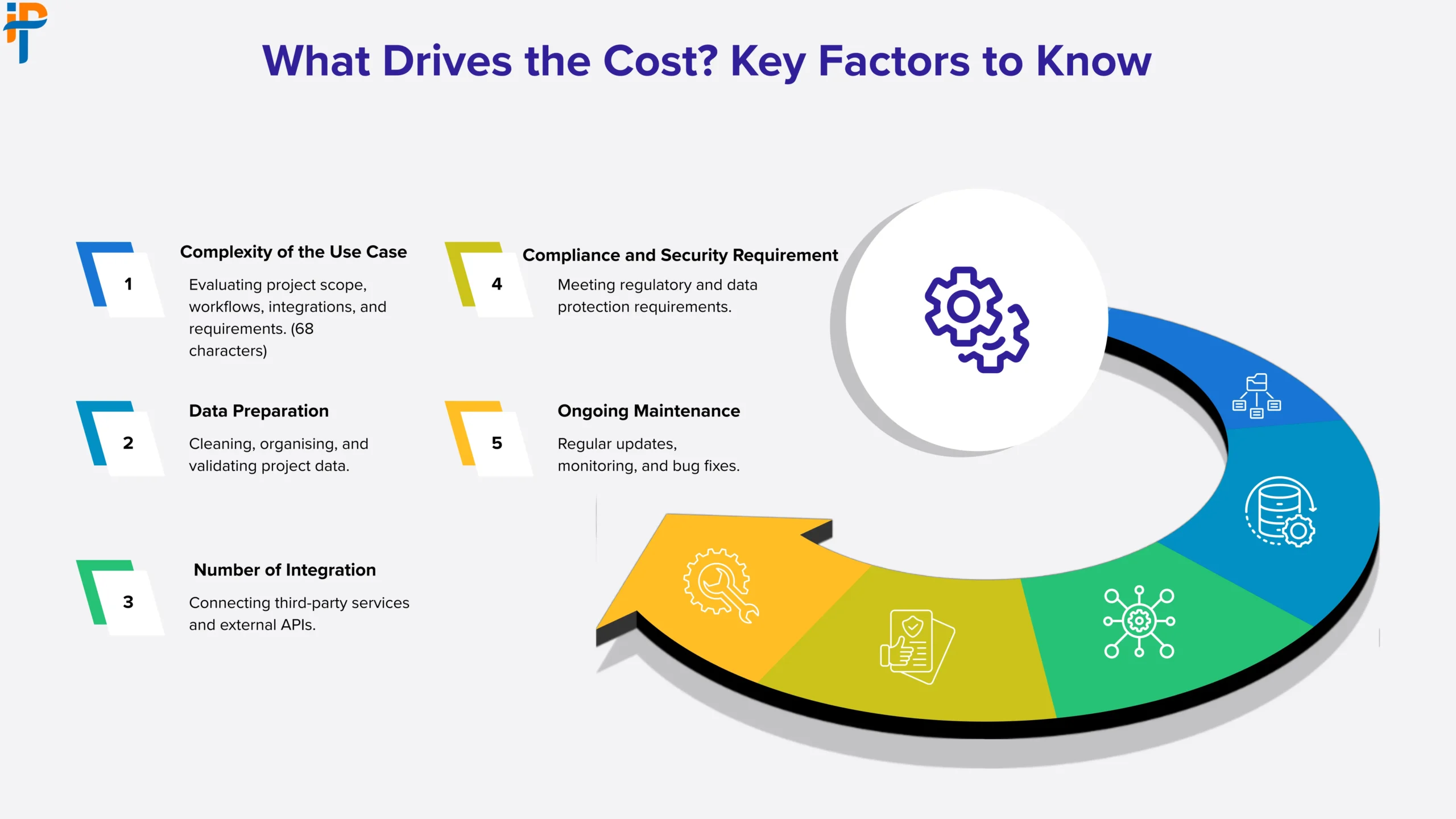
1. Complexity of the Use Case
A rule-based chatbot costs a fraction of what a multi-modal AI system with real-time learning requires. The more complex the decision-making logic and the wider the action space, the higher the cost. Computer vision, reinforcement learning, and multi-agent orchestration all push numbers up.
2. Data Preparation
Data is the foundation of every AI system. If your organisation already has clean, structured, labelled data — great, your costs come down. But if data needs to be collected, cleaned, and annotated, this phase alone can account for 25 to 40 percent of your total project cost. Never underestimate this.
3. Number of Integrations
Every connection to an external system — a CRM, an ERP, a legacy database, a third-party API — adds engineering hours and testing time. A single integration can add anywhere from ₹4 lakh to ₹16 lakh to your overall project cost, especially if those systems don’t have clean, well-documented APIs to begin with.
4. Compliance and Security Requirements
Healthcare, finance, and legal sectors need more than just a working AI agent. HIPAA, DPDP Act compliance, audit logging, and model explainability features are non-negotiable in regulated industries. Plan to add 20 to 40 percent to your base estimate if your project falls in these domains.
5. Ongoing Maintenance
The build is just the beginning. Maintenance typically runs 15 to 30 percent of the initial development cost annually. This covers updates, performance monitoring, API cost management, and continuous improvement — all of which are essential for agents running in production environments.
Also Read – Apple WWDC 2026: Every Announcement Explained
Developer Rates in India vs. the World
One of the biggest reasons India has become a preferred destination for AI agent development is cost competitiveness — and it’s not about cutting corners. Indian development firms deliver the same architecture, the same models, and the same security standards as their Western counterparts, at 40 to 60 percent lower cost.
In India, senior AI engineers typically bill at ₹3,000 to ₹8,000 per hour. Specialist ML researchers or solution architects sit at the higher end of that range. Compare this to US or UK teams that bill anywhere from $100 to $200 per hour for equivalent seniority, and the math quickly makes sense for businesses watching their budgets.
Cities like Bengaluru, Hyderabad, Pune, and Noida host some of the deepest AI engineering talent pools in the world. The quality of work — tested through code review, production deployments, and client outcomes — consistently matches global standards.
Realistic Timelines
Costs and timelines are closely linked, so here’s what to expect at each level:
• Simple agent: 2 to 6 weeks
• MVP or proof of concept: 6 to 10 weeks
• Mid-complexity agent: 8 to 16 weeks
• Full-scale enterprise system: 3 to 9 months
A word of caution here: rushed timelines almost always result in brittle agents that behave unpredictably in production. It’s far better to take the extra weeks upfront than to deal with failures after launch.
How to Optimise Your AI Agent Budget
You don’t have to choose between quality and affordability. Here are a few approaches that work:
Start with one high-impact workflow. Don’t try to automate everything at once. Identify the single workflow where automation would have the clearest, most measurable impact. Build there first, prove ROI, then expand.
Define KPIs before you pick technology. Many businesses choose a model or framework before defining what success looks like. That’s backwards. Set your measurable targets first — cost saved, tickets resolved, time reduced — and then let those guide the technical choices.
Budget in phases. Separate your budget for build, hardening, and optimisation. These are three distinct phases with different resource needs, and treating them as one lump sum leads to either overspending on the build or underspending on the parts that actually make the agent reliable.
Avoid overbuilding orchestration early. Don’t invest in complex multi-agent orchestration before you’ve proven the value of a single workflow. It’s a common trap, and it’s expensive.
Why AI Agent Development Matters Now
2026 isn’t a “wait and see” moment for AI agents — it’s a build-or-fall-behind one. Businesses that move now are setting the workflows, integrations, and data pipelines that will define how they operate for the next decade. Those that wait will spend the next few years playing catch-up with competitors who already have working systems in production.
The shift is already visible. Companies that once treated AI agents as an experiment are now treating them as core infrastructure — handling support tickets, qualifying leads, processing claims, and coordinating multi-step operations that used to require entire teams. The gap between businesses using agents well and those still relying on manual processes is widening every quarter.
The same urgency applies to individual professionals. Developers, solution architects, and ML engineers who build real, hands-on experience with agent orchestration, tool use, and enterprise integrations today will be the ones leading these projects tomorrow. This isn’t a space where theoretical knowledge alone gets you far — it rewards people who’ve actually shipped agents into production and dealt with the messy realities of data quality, API limits, and compliance requirements.
The market size backs this up. The global AI agent market is projected to grow from roughly $7.6 billion in 2025 to over $182 billion by 2033 — a trajectory few technology categories have matched. Businesses that invest in the right use case now, and professionals who build practical skills now, are positioning themselves for a market that’s still in its early innings.
The opportunity is real, but so is the cost of sitting it out
Final Thoughts
AI agent development cost in India in 2026 ranges from around ₹8 lakhs for a focused basic agent to ₹1 crore and above for enterprise-grade multi-agent systems. The right number for your project depends on your use case, your data readiness, your integration complexity, and your compliance requirements.
The good news? India is one of the most commercially viable destinations in the world for this kind of work — a rare combination of engineering talent, cost efficiency, and maturing cloud infrastructure. Whether you’re a business planning to deploy AI agents or a professional looking to build the skills to develop them, the opportunity is right here.
At IPH Technologies, we’re committed to helping you navigate it — through world-class training, hands-on projects, and guidance from professionals who’ve done this work in the real world.
Ready to take the next step? Explore our AI and software development training programs at IPHS Learning Hub and build the skills that matter.
Frequently Asked Questions
How much does AI agent development cost in India in 2026?
What is the difference between a chatbot and an AI agent??
What factors affect the cost of AI agent development in India?
The main cost drivers include:
• Complexity of the use case — simple FAQ routing vs. autonomous multi-step workflows
• Data preparation — clean, labelled data reduces costs; raw, unstructured data increases them (can account for 25–40% of project cost)
• Number of system integrations — each CRM, ERP, or API connection adds engineering hours
• Compliance requirements — healthcare, finance, and legal sectors add 20–40% to base estimates
• Ongoing maintenance — typically 15–30% of the initial build cost annually
How long does it take to develop an AI agent in India?
Development timelines vary by scope:
• Simple agent: 2 to 6 weeks
• MVP or proof of concept: 6 to 10 weeks
• Mid-complexity agent: 8 to 16 weeks
• Full-scale enterprise system: 3 to 9 months
Rushed timelines often lead to unreliable agents in production. Building in adequate testing time upfront saves cost in the long run.
Why is AI agent development cheaper in India than in the US or UK?
What are the ongoing costs of running an AI agent after launch?
• Maintenance and updates: 15–30% of initial build cost annually
• LLM API usage fees (GPT-4o, Claude, Gemini): scale with conversation volume and task complexity
• Vector database costs for RAG-based agents (Pinecone, Weaviate)
• Cloud infrastructure and hosting fees
• Monitoring and performance optimisation
How soon can a business expect ROI from an AI agent?
Should I build a custom AI agent or use an off-the-shelf platform?
What industries in India are using AI agents in 2026?
• Customer support — automated ticket resolution, 24/7 query handling
• E-commerce — product recommendations, order tracking
• Healthcare — patient data monitoring, appointment scheduling
• Finance — fraud detection, loan processing automation
• EdTech — personalised learning paths, student support bots
• SaaS businesses — onboarding automation, usage analytics










.png)