Introduction: Why IPH Technologies Leads Blockchain App Development
The Blockchain Revolution in Mobile Apps
Picture this: you’re scrolling through your phone, making a payment, verifying your identity, or even buying digital art. Behind these seamless interactions lies a technology that’s quietly revolutionizing how mobile apps handle data, transactions, and trust. That technology? Blockchain.
The mobile app landscape is undergoing a massive transformation. Businesses across industries are discovering that blockchain isn’t just about cryptocurrency anymore—it’s a powerful tool for creating secure, transparent, and efficient mobile applications. From healthcare to supply chain management, from finance to entertainment, blockchain is reshaping how we think about mobile app development.
But here’s what many business leaders struggle with: understanding how to actually implement blockchain technology in their mobile apps. Should you use it? When does it make sense? What are the real costs? These are the questions keeping entrepreneurs and CTOs up at night.
Why Choose IPH Technologies for Your Blockchain Journey
At IPH Technologies, we don’t just build blockchain apps—we craft solutions that solve real business problems. With over 500 successful projects and 430+ satisfied clients under our belt, we’ve mastered the art of turning blockchain complexity into business simplicity.
What sets us apart? We combine cutting-edge blockchain expertise with agile methodologies and a client-first approach. Whether you’re a startup exploring blockchain possibilities or an enterprise ready to scale, we’re your strategic partner in this transformative journey.
Our team doesn’t believe in one-size-fits-all solutions. Instead, we take the time to understand your unique challenges and design blockchain integrations that deliver measurable results.
Also read- AI Statistics 2026: 77% Are Ahead—Are You Behind?
Blockchain Fundamentals for Business Decision-Makers
What is Blockchain Technology?
Let me break this down in plain English. Imagine a digital ledger that’s shared across thousands of computers. Every time someone makes a transaction, it’s recorded in a “block.” This block is then linked to the previous block, creating a “chain”—hence, blockchain.
But here’s what makes it revolutionary: once information is recorded on this chain, it’s virtually impossible to change it without everyone noticing. It’s like writing in permanent ink across thousands of notebooks simultaneously. Each notebook holder can see the entries, verify them, and ensure no one’s tampering with the records.
Key Components of Blockchain Architecture
Think of blockchain as a sophisticated system with several moving parts working in harmony:
Distributed Ledger: Instead of one company controlling the data, it’s spread across multiple nodes. This means no single point of failure exists. If one node goes down, hundreds of others keep the network running smoothly.
Cryptographic Security: Advanced encryption protects every transaction. Each block is secured with complex mathematical algorithms that would take centuries to crack with current technology.
Consensus Mechanisms: These are rules that ensure all participants agree on the validity of transactions. Think of it as a democratic voting system where the majority must approve before anything gets added to the blockchain.
Smart Contracts: Self-executing agreements that run automatically when conditions are met. Imagine a vending machine—you insert money, select a product, and it automatically dispenses. Smart contracts work the same way, but for complex business logic.
Why Blockchain Matters for Mobile Apps
You might be wondering, “Why should my mobile app use blockchain?” Fair question. Here’s the deal:
Traditional mobile apps store data on centralized servers. If that server gets hacked, compromised, or simply fails, your users’ data is at risk. It’s like keeping all your money in one bank vault—if someone breaks in, everything’s gone.
Blockchain flips this model on its head. Data is distributed, encrypted, and nearly impossible to tamper with. For mobile apps dealing with sensitive information, financial transactions, or requiring absolute trust between parties, blockchain provides an unprecedented level of security and transparency.
Also read- Zero Trust Architecture for Mobile Apps Complete 2025 Security Guide
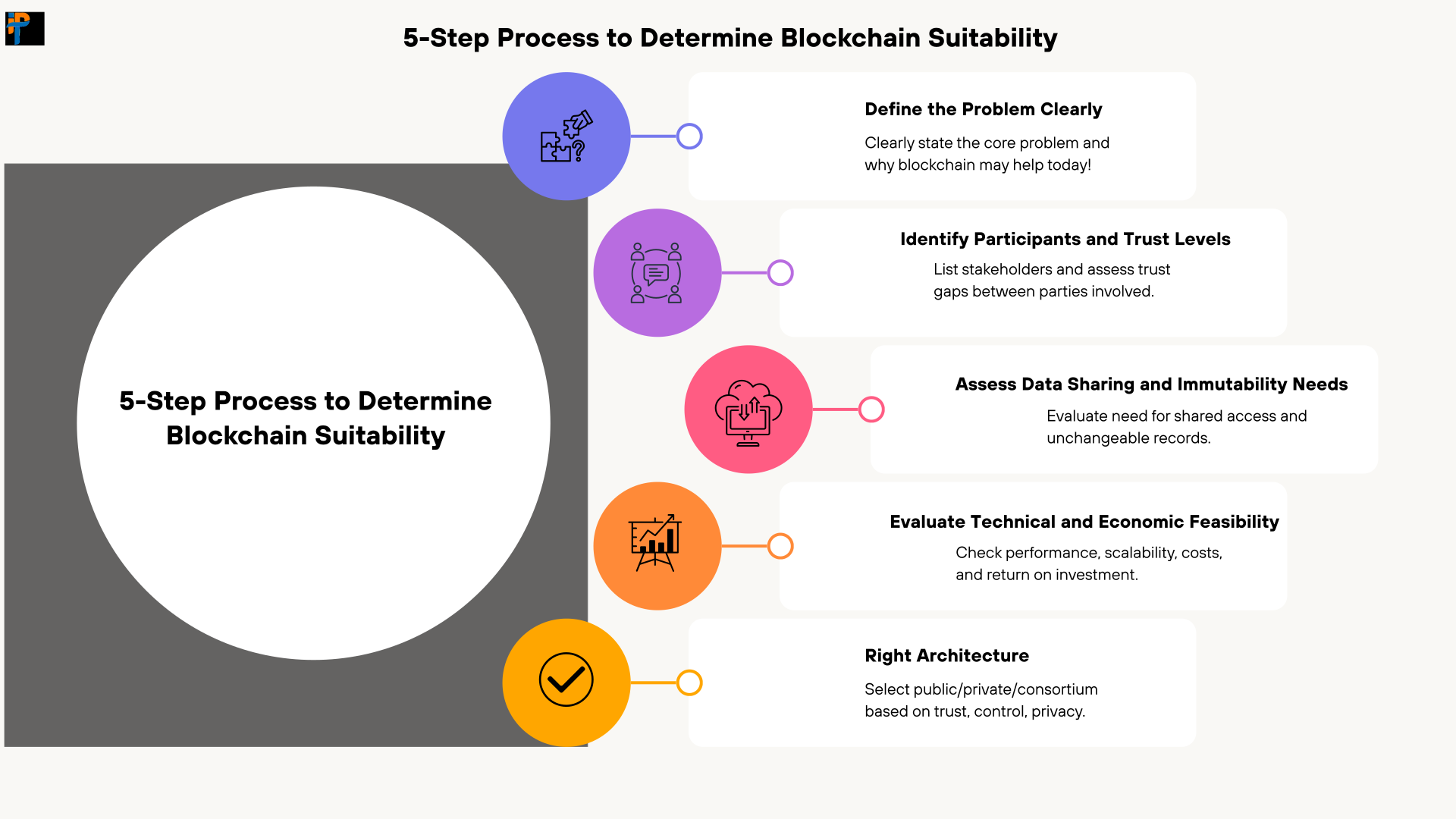
5-Step Process to Determine Blockchain Suitability
1. Identify Your Business Problem
Before you jump on the blockchain bandwagon, ask yourself: what problem am I actually trying to solve?
Not every app needs blockchain.
If you’re building a simple to-do list app or a basic calculator, blockchain might be overkill.
Blockchain could be your answer if you’re facing:
- Lack of transparency in transactions or data sharing
- Trust issues between multiple parties
- High costs due to intermediaries
- Data security vulnerabilities
- Need for immutable record-keeping
2. Evaluate Blockchain Necessity
Here’s our litmus test at IPH Technologies.
Your app needs blockchain if you answer “yes” to most of these questions:
- Do you require transparent, tamper-proof records?
- Are multiple parties accessing and trusting the same data?
- Do you want to eliminate costly intermediaries?
- Is security and data immutability non-negotiable?
- Are you building decentralized applications?
If you’re nodding your head, congratulations—blockchain makes sense for your project.
3. Choose the Right Blockchain Type
Not all blockchains are created equal. You have three main options:
Public Blockchains
Completely open networks like Bitcoin or Ethereum. Ideal for maximum transparency and decentralization,
but slower and more expensive.
Private Blockchains
Restricted to specific participants. Best for enterprises needing speed, scalability, and privacy.
Hybrid Blockchains
Combines public and private benefits. Keep sensitive data private while sharing selected information publicly.
4. Assess Technical Requirements
This is where the rubber meets the road. Consider the following factors:
-
Transaction Speed:
Instant confirmation for payment apps vs flexible timing for supply chains. -
Scalability:
Will your app process 100 or 100,000 transactions per day? -
Consensus Mechanism:
Proof of Work, Proof of Stake, or other models. -
Programming Language:
Solidity, Go, JavaScript—your team’s expertise matters.
5. Calculate ROI Potential
At the end of the day, your blockchain investment must deliver measurable returns.
-
Cost Savings:
Reduce intermediaries, fraud, and operational inefficiencies. -
Revenue Generation:
Enable new business models and monetization strategies. -
Risk Mitigation:
Minimize data breaches and fraud-related losses. -
Competitive Advantage:
Gain early-market leadership through blockchain adoption.
Also read: Top 10 Real Estate App Development Companies in 2025 | Expert Guide
Blockchain Use Cases in Mobile Apps Beyond Cryptocurrency
Digital Identity Verification
Have you ever wondered how many times you’ve entered your personal information into different apps and websites?
Each time, you’re creating another potential vulnerability. Blockchain-powered digital identity solutions are
changing this game entirely.
With blockchain identity management in mobile apps, users create one verified digital identity that they control
completely. Instead of sharing your actual passport or driver’s license with every service provider, you share
cryptographic proof that you’ve been verified.
It’s like having a bouncer vouch for you at every club instead of showing your ID repeatedly.
Real-world applications include banking apps that verify customers instantly, travel apps that store boarding
passes and visas securely, and age verification for restricted content—all without storing sensitive personal data
on centralized servers.
Smart Contracts and Automated Workflows
Smart contracts are perhaps the most transformative aspect of blockchain for business applications.
Think of them as digital agreements that execute themselves automatically when predetermined conditions are met.
In mobile apps, this translates to powerful automation. An insurance app could automatically process claims when
certain conditions are verified. A real estate app could facilitate property transactions without lawyers or escrow
agents. A freelance marketplace app could release payments automatically when deliverables are approved.
The beauty of smart contracts? They’re trustless. Nobody needs to trust anyone else because the code guarantees
execution. This eliminates disputes, reduces processing time, and cuts costs dramatically.
NFT Marketplaces and Digital Asset Management
Non-Fungible Tokens (NFTs) have exploded beyond digital art. Mobile apps are now using NFTs for concert tickets,
membership passes, gaming items, loyalty rewards, and even real estate ownership records.
The key advantage is true ownership and provable scarcity. When you buy a digital item as an NFT through a mobile
app, you genuinely own it. You can sell it, trade it, or keep it—and the blockchain verifies your ownership
permanently.
We’ve developed NFT marketplace apps for clients in entertainment, gaming, and collectibles. These apps allow
users to mint, buy, sell, and showcase their digital assets—all from their smartphones.
Decentralized Finance (DeFi) Applications
DeFi is revolutionizing financial services by removing traditional intermediaries. Mobile DeFi apps allow users
to lend, borrow, trade, earn interest, and access financial services without banks.
For mobile app developers, DeFi presents exciting opportunities. Users want convenient access to these services,
and mobile apps provide the perfect interface. Whether it’s yield farming, liquidity provision, or decentralized
exchanges, mobile DeFi apps are bringing sophisticated financial tools to everyday users.
Also read – In-House vs. Outsourcing Development 2025: Full Cost-Benefit Guide
Security Considerations: How Blockchain Protects Your App
Cryptographic Security Features
Let’s talk about what makes blockchain security so robust. At its core, blockchain uses advanced cryptographic
techniques that would make even the most determined hacker break a sweat.
Every transaction is encrypted using public-key cryptography. Users have two keys: a public key (like an email
address) that others can see, and a private key (like a password) that only they control.
To access funds or data, you need the private key. Without it, the data is essentially locked in an unbreakable
digital vault.
Hash functions add another layer of security. Each block contains a unique hash—a mathematical fingerprint.
Change even one character in the block, and the entire hash changes, immediately alerting the network to
tampering attempts.
Data Immutability and Transparency
Here’s a powerful concept: once data is written to a blockchain, it cannot be altered or deleted. Ever.
This immutability is crucial for applications where data integrity is paramount.
For mobile apps, this means:
- Financial transaction records that can’t be doctored
- Medical records that maintain a complete, unalterable history
- Supply chain data that provides definitive proof of origin
- Audit trails that satisfy the most stringent compliance requirements
But immutability doesn’t mean inflexibility. You can always add new blocks with updated information.
The old records remain, creating a complete, transparent history of all changes.
Vulnerability Prevention Strategies
While blockchain is inherently secure, the applications built on top of it can still have vulnerabilities.
At IPH Technologies, we implement comprehensive security measures:
-
Smart Contract Auditing:
We rigorously test smart contracts for bugs and vulnerabilities before deployment.
A single error in smart contract code can have catastrophic consequences. -
Private Key Management:
We build secure key management systems into mobile apps, often using biometric authentication
and secure enclaves on mobile devices. -
API Security:
The connection points between your mobile app and the blockchain need robust security.
We implement rate limiting, authentication, and encryption for all API calls. -
Regular Security Assessments:
Blockchain technology evolves rapidly. We conduct regular security audits to identify and patch potential vulnerabilities before they become problems.
Also read – App Maintenance Costs: What Developers Don’t Tell You
Development Challenges & How to Overcome Them
Scalability Issues
Let’s address the elephant in the room: blockchain can be slow. Public blockchains like Bitcoin process only a
handful of transactions per second, while traditional payment systems handle thousands.
For mobile apps, this presents a real challenge. Users expect instant responses, not waiting minutes for
transaction confirmation. So how do we overcome this?
Layer 2 Solutions:These are built on top of the main blockchain, handling many transactions off-chain before settling on the main chain. Think of it like running a tab at a bar rather than paying for each drink individually.
Sidechains:Separate blockchains that run parallel to the main chain, processing transactions independently and only periodically syncing with the main chain.
Blockchain Platform Selection:Some newer blockchain platforms are designed for high throughput. Choosing the right platform for your specific use case can solve scalability issues before they start.
At IPH Technologies, we carefully analyze your scalability requirements during the planning phase
and architect solutions that can grow with your business.
Integration Complexity
Integrating blockchain with existing mobile app infrastructure isn’t always straightforward. You’re essentially
connecting cutting-edge technology with legacy systems, and that can get messy.
Common integration challenges include:
- Different data formats between blockchain and traditional databases
- Synchronization issues when data exists in multiple places
- Latency problems when waiting for blockchain confirmation
- Complexity in user experience design
Our approach is to build robust middleware layers that act as translators between your blockchain and traditional systems. This abstraction layer makes integration seamless while keeping your architecture flexible for future changes.
User Experience Optimization
Here’s a harsh truth: most users don’t care about blockchain. They care about whether your app solves their
problem and is easy to use.
If your blockchain app requires users to understand cryptographic keys, gas fees, and consensus mechanisms,
you’ve already lost them.
The challenge is hiding the complexity while maintaining security. We achieve this through:
Simplified Onboarding:Users don’t see “blockchain” or “wallet creation.” They see “Create Account” and simple, familiar interfaces.
Automated Key Management: Secure, user-friendly key handling without users needing to understand the underlying technology.
Clear Transaction Feedback: Instead of “Transaction pending in mempool,” users see “Processing your request” with estimated completion times.
Progressive Disclosure:
Advanced features are available for power users, while beginners get a streamlined experience.
Also read – Build a Fundable MVP in 2025: The Ultimate Founder’s Guide
Cost Breakdown: What Blockchain App Development Actually Costs
Factors Influencing Development Costs
Let’s talk numbers—because budget is always a concern. Blockchain app development costs vary widely based on
several factors:
Complexity Level: A simple blockchain integration might cost $40,000–$80,000, while a complex DeFi application could run
$200,000–$500,000 or more.
Platform Choice:Developing on established platforms like Ethereum is generally more expensive than using newer,
less popular platforms.
Smart Contract Complexity:The more complex your business logic, the higher the development and auditing costs.
Design Requirements:Custom UI/UX design adds to costs, but it’s crucial for user adoption.
Team Location:Development teams in North America typically charge $100–$250 per hour, while teams in Eastern Europe or Asia might charge $40–$100 per hour.
Pricing by Complexity Level
Here’s a realistic breakdown of what you can expect to invest:
| App Complexity | Features | Development Time | Cost Range |
|---|---|---|---|
| Basic | Simple blockchain integration, basic wallet functionality, standard transactions | 3-4 months | $40,000-$80,000 |
| Medium | Smart contracts, multiple blockchain interactions, custom dashboard, API integrations | 5-7 months | $80,000-$150,000 |
| Advanced | Complex smart contracts, DeFi features, NFT marketplace, multi-chain support, and advanced security | 8-12 months | $150,000-$300,000 |
| Enterprise | Full blockchain ecosystem, custom blockchain, extensive integrations, advanced analytics, compliance features | 12+ months | $300,000-$500,000+ |
Hidden Costs to Consider
Many businesses underestimate the total cost of blockchain app ownership. Beyond initial development, you should factor in the following ongoing expenses:
Ongoing Maintenance:Blockchain technology evolves rapidly. Budget 15–20% of initial development costs annually for updates and continuous improvements.
Gas Fees: If you’re using public blockchains, every transaction incurs gas fees.These costs can grow quickly as your user base scales.
Security Audits:Professional smart contract audits typically cost $10,000–$50,000 and are essential for protecting both your users and your brand reputation.
Scaling Infrastructure: As your app grows, you’ll need additional nodes, server infrastructure,and potentially Layer 2 solutions to maintain performance.
Legal and Compliance: Blockchain applications often operate in regulatory gray areas. Budget for legal consultation to ensure ongoing compliance.
Choosing the Right Blockchain Platform for Your App
Ethereum vs. Hyperledger Fabric
The two most popular blockchain platforms for mobile app development couldn’t be more different.
Understanding their strengths helps you make the right choice.
Ethereum is the go-to platform for public, decentralized applications.
It’s battle-tested, has massive developer support, and offers incredible flexibility through smart contracts.
It’s ideal for DeFi apps, NFT marketplaces, and applications that require true decentralization.
However, Ethereum does have drawbacks. It can be slow and expensive during periods of high network usage.
Transaction fees, known as gas fees, are unpredictable and can sometimes become prohibitively high.
Hyperledger Fabric takes a very different approach.
It’s designed for private, permissioned blockchains and is ideal for enterprise applications.
Hyperledger Fabric is faster, more scalable, and offers fine-grained privacy controls.
It’s well suited for supply chain management, healthcare records, and enterprise solutions
where not every participant should have access to all data.
The tradeoff is reduced decentralization and increased responsibility for infrastructure management.
Other Popular Platforms
The blockchain ecosystem is rich with alternative platforms, each offering unique strengths
depending on your app’s goals, performance needs, and security requirements.
| Platform | Best For | Key Advantage | Transaction Speed | Cost |
|---|---|---|---|---|
| Ethereum | DeFi, NFTs, public dApps | Largest ecosystem, most developers | 15–30 TPS | Variable gas fees |
| Binance Smart Chain | Cost-effective dApps | Low fees, EVM compatible | 100+ TPS | Very low |
| Solana | High-performance apps | Extremely fast transactions | 50,000+ TPS | Very low |
| Polygon | Ethereum scaling | Ethereum benefits with lower costs | 7,000+ TPS | Low |
| Hyperledger Fabric | Enterprise solutions | Privacy, permissioned access | 3,500+ TPS | Infrastructure costs |
| Cardano | Sustainable, academic approach | Peer-reviewed development | 250+ TPS | Low |
Also read- Web vs Native vs Hybrid Apps in 2025: The Ultimate Guide
Platform Selection Criteria
Choosing the right platform isn’t just about features—it’s about alignment with your business goals.
Before making a decision, ask yourself the following questions:
Primary Use Case:Are you building a public, consumer-facing application or an enterprise B2B solution?
Public apps typically align better with Ethereum or similar platforms, while enterprise solutions work best with Hyperledger or private blockchains.
Budget Considerations: Evaluate both development costs and ongoing transaction expenses. Some platforms are inexpensive to build on but costly to operate, while others have higher upfront costs but lower long-term fees.
Decentralization Requirements:True decentralization requires public blockchains. If control, governance, and data privacy are priorities, private blockchains may be the better option.
Scalability Needs:Applications with high transaction volumes require platforms capable of processing
thousands of transactions per second without performance degradation.
Timeline Constraints:Platforms with mature ecosystems, proven tooling, and abundant developer talent
enable faster development and quicker time-to-market.
Integration with Existing Business Systems
API Development and Integration
Your shiny new blockchain app doesn’t exist in a vacuum. It must communicate seamlessly with your existing systems such as CRM platforms ERP tools, databases, payment processors, and other business software.
This is where robust API development becomes critical. We build RESTful APIs that act as secure bridges between blockchain networks and traditional systems.
These APIs handle data translation, manage authentication, and ensure smooth, reliable data flow in both directions.
For example, when a customer makes a purchase in a blockchain-enabled e-commerce app, the API automatically performs multiple actions behind the scenes.
Blockchain Recording:
The transaction is securely recorded on the blockchain to ensure immutability and transparency.
Inventory Update:
The inventory management system is updated in real time.
Logistics Trigger:
Shipping and fulfillment workflows are initiated automatically.
Customer Communication:
Confirmation emails or notifications are sent to the customer.
CRM Synchronization:
Customer records are updated in your CRM system for future engagement.
All of this happens seamlessly in the background, with blockchain providing security
and immutability while existing systems continue handling their specialized roles.
Legacy System Compatibility
Many businesses worry that adopting blockchain requires replacing their existing infrastructure.
That’s not the case.
At IPH Technologies, we design blockchain solutions that complement
your current systems instead of disrupting them.
Phase 1 – Process Identification:
We identify which workflows benefit most from blockchain.
Not every process needs to be on-chain.
Phase 2 – Parallel Systems:
We build blockchain-enabled systems that mirror existing functionality
while adding transparency, security, and automation.
Phase 3 – Gradual Migration:
Data and processes are migrated incrementally as confidence in the new system grows.
Phase 4 – System Synchronization:
Old and new systems are synchronized to coexist during the transition period.
This phased approach minimizes risk, avoids downtime,
and allows your team to adopt blockchain at a comfortable pace.
Data Migration Strategies
Migrating data to blockchain requires careful planning.
You can’t simply move all existing data on-chain—it would be costly and inefficient.
Our approach focuses on selective and strategic migration.
Historical Data:
Typically remains in traditional databases,
with only critical summaries or verification records stored on-chain.
Active Data:
Current transactions and ongoing interactions are recorded on-chain
to maximize security and transparency.
Reference Data:
Stored off-chain, with cryptographic hashes saved on the blockchain
to enable tamper-proof verification.
We also implement hybrid storage models where sensitive data stays encrypted off-chain,
while the blockchain manages access permissions, audit trails,
and data integrity checks.
Also read – Lending Software Development 2025: Quick Guide to Costs, Features & Process
Regulatory Compliance & Legal Considerations
GDPR and Data Privacy
Here’s a tricky question: How do you comply with GDPR’s “right to be forgotten” when blockchain data is immutable? This apparent contradiction keeps many businesses from adopting blockchain.
The solution lies in understanding what you store on-chain. Instead of storing personal data directly on the blockchain, we store encrypted references or hashes. The actual personal data remains in traditional databases where it can be deleted if needed.
We implement privacy-by-design principles:
Minimize on-chain personal data.
Use encryption for sensitive information.
Implement access controls and permissions.
Maintain detailed audit logs.
Provide clear user consent mechanisms.
Financial Regulations
If your blockchain app handles financial transactions, you’re entering heavily regulated territory. Different jurisdictions have different rules, and non-compliance can result in hefty fines or even criminal charges.
Key regulations to consider include:
KYC/AML Requirements: Know Your Customer and Anti-Money Laundering regulations require identity verification for financial transactions.
We build compliant verification systems directly into your app.
Securities Laws: If your app involves tokens that could be classified as securities, you must comply with securities regulations
in every jurisdiction where you operate.
Payment Processing Regulations: Apps that facilitate payments must comply with PCI DSS standards and regional payment regulations.
Cross-Border Transfer Rules: Blockchain transactions can cross borders instantly, but that doesn’t exempt you
from international transfer regulations.
Industry-Specific Compliance
Different industries face unique regulatory challenges.
Healthcare: HIPAA compliance is non-negotiable for health-related apps.
We design blockchain solutions that maintain patient privacy while providing transparency and security.
Finance: Financial apps must comply with banking regulations, which vary significantly by country
and even by state in the US.
Supply Chain: Import/export regulations, customs requirements, and industry-specific standards all need consideration.
Gaming: Regulations around digital assets, gambling laws, and age restrictions affect blockchain gaming apps.
We work closely with legal experts in your industry to ensure your blockchain app meets all regulatory requirements from day one.
Future-Proofing Your Blockchain Investment
Emerging Trends in Blockchain Technology
Blockchain technology is evolving at breakneck speed. What’s cutting-edge today may be outdated in just a few years.
Staying ahead requires understanding where the technology is headed.
Cross-Chain Interoperability:Future blockchain apps will interact seamlessly across multiple networks. Imagine transferring assets from Ethereum to Binance Smart Chain to Polkadot without friction or manual intervention.
Quantum-Resistant Cryptography:As quantum computing advances, existing encryption methods may become vulnerable. New cryptographic standards are being developed to safeguard blockchain systems against future quantum threats.
AI-Blockchain Convergence:Artificial intelligence and blockchain are increasingly working together. AI can optimize blockchain operations, while blockchain can verify AI training data and ensure transparency in AI-driven decisions.
Green Blockchain Solutions: Environmental concerns are driving the adoption of energy-efficient consensus mechanisms. Expect continued growth in eco-friendly blockchain platforms in the coming years.
Regulatory Clarity:As governments worldwide establish clearer blockchain regulations, enterprise adoption and innovation will accelerate significantly.
Scalability Solutions
The blockchain scalability trilemma—balancing security, decentralization, and performance—continues to challenge developers. However, powerful solutions are emerging.
Sharding:Breaking blockchains into smaller shards that process transactions in parallel, dramatically increasing throughput and network efficiency.
Zero-Knowledge Proofs:Advanced cryptographic techniques that validate transactions without revealing sensitive details, enabling faster processing and enhanced privacy.
Optimistic and ZK Rollups: Layer 2 solutions that bundle hundreds of transactions into a single proof,
posting only summarized data to the main blockchain.
State Channels:Enable unlimited off-chain transactions between parties,with only opening and closing states recorded on-chain.
When we develop your blockchain app, we architect it with these scalability solutions in mind to ensure long-term performance and growth.
Interoperability Standards
The future of blockchain is not isolated networks, but an interconnected ecosystem of blockchains communicating seamlessly.
We are seeing rapid adoption of interoperability standards that enable this vision.
Cross-Chain Messaging Protocols:Enable secure communication and data transfer between different blockchains.
Universal Wallet Standards: Allow users to interact with multiple blockchains through a single wallet interface.
Standardized Smart Contract Interfaces: Promote compatibility and reuse across platforms and ecosystems.
Decentralized Identity Frameworks:Enable portable, blockchain-based digital identities across applications.
When we build your app, we implement these standards from day one, ensuring seamless integration with the broader blockchain ecosystem as it evolves.
How to Partner with a Blockchain Development Agency
What to Look For in a Development Partner
Choosing the right blockchain development partner can make or break your project.The difference between an exceptional partner and a mediocre one often comes down to a few critical factors.
Proven Track Record:Look for agencies with documented blockchain projects. Ask for case studies, client testimonials, and ideally live applications that you can review or test yourself.
Technical Expertise:Your partner should demonstrate deep expertise across multiple blockchain platforms, smart contract development, and mobile app development. Blockchain is highly complex—you need specialists, not generalists experimenting with the technology.
Business Understanding: Technical skills alone are not enough. The best partners understand business strategy and help determine whether blockchain genuinely aligns with your goals.
Security Focus:Given blockchain’s financial and data implications, security must be non-negotiable. Look for partners who follow best practices rigorously and conduct comprehensive security audits.
Communication:Blockchain projects involve complex concepts. Your partner should communicate clearly, explain technical decisions in plain language, and keep you informed throughout the development lifecycle.
Post-Launch Support: Blockchain applications require ongoing maintenance, updates, and optimization.
Ensure your partner offers long-term support beyond the initial launch.
At IPH Technologies, we’ve refined blockchain app development into a repeatable, proven process.
Here’s what sets us apart.
Comprehensive Expertise:
With over 500 successful projects across multiple industries, we’ve encountered and solved nearly every blockchain challenge. Our team includes blockchain engineers, smart contract specialists, mobile app developers, and business strategists.
Client-First Methodology:
We don’t promote blockchain for its own sake. Our engagement starts with understanding your business objectives. If blockchain isn’t the right solution, we’ll tell you transparently.
Agile Development:
We follow agile methodologies to deliver functional prototypes quickly and incorporate your feedback throughout the process. This iterative approach ensures the final product aligns perfectly with your vision.
End-to-End Service:
From strategy and UX design to development, testing, deployment, and post-launch support—we partner with you at every stage.
Transparent Pricing:
No hidden fees and no surprise costs. We provide clear, detailed cost breakdowns upfront and communicate openly
about any changes along the way.
Security Obsession:
Every smart contract undergoes rigorous internal testing followed by third-party security audits. We prioritize protecting user assets and sensitive data above all else.
Future-Ready Architecture:
We design blockchain applications that can evolve alongside emerging technologies, ensuring your investment remains valuable long-term.
Proven ROI:
Our 430+ satisfied clients have achieved measurable outcomes, including reduced operational costs, new revenue streams, improved efficiency, and lasting competitive advantages.
When you partner with IPH Technologies, you’re not just hiring developers. You’re gaining long-term strategic advisors committed to your success.
Conclusion: Your Blockchain Journey Starts Here
We’ve covered a lot of ground in this guide—from blockchain fundamentals to development costs, from platform selection to regulatory compliance. If your head is spinning a bit, that’s normal. Blockchain integration is complex, multifaceted, and requires careful strategic thinking.
But here’s what you should take away: blockchain isn’t some far-off future technology anymore.
It’s here, it’s proven, and it’s delivering real business value across industries. Companies that hesitated five years ago are now playing catch-up to competitors who moved early.
The question isn’t whether blockchain will transform your industry—it’s whether you’ll be leading that transformation or scrambling to keep up.
At IPH Technologies, we’ve guided hundreds of businesses through their blockchain journey. We’ve seen startups become industry leaders and established enterprises reinvent themselves through strategic blockchain adoption. We’ve celebrated successes and learned from challenges, refining our approach with every project.
Your blockchain app doesn’t have to be perfect from day one. It needs to be strategic, well-executed, and built on a foundation that can evolve as the technology matures and your business grows. That’s exactly what we deliver.
Whether you’re exploring blockchain possibilities, ready to build, or somewhere in between, we’re here to help. Our team combines technical excellence with business acumen, ensuring your blockchain investment delivers measurable results.
The future of mobile apps is decentralized, transparent, and secure. The companies that thrive in this new landscape will be those that embrace blockchain strategically—not as a buzzword, but as a powerful tool for solving real business challenges.
Your blockchain journey starts with a conversation. Let’s talk about your vision, your challenges, and how blockchain can transform your mobile app from ordinary to extraordinary.








.png)