





































































































When was the last time you watched a developer write every single line of code by hand, with zero AI assistance? Rare, right? AI coding agents have quietly become the extra pair of hands on almost every serious engineering team in the U.S. and now businesses want their own version, built around their stack, their standards, and their data.
But here’s where it gets tricky. “Build me a coding agent” sounds simple, until you realize you’re not just wiring up a chatbot you’re building something that reads a codebase, plans changes, edits multiple files, runs tests, and fixes its own mistakes. That’s a serious piece of engineering.
So let’s walk through exactly what it costs, what it needs to actually work, and how the whole build comes together from day one to launch.
What Is an AI Coding Agent, Really?
An AI coding agent isn’t just autocomplete on steroids. It’s a system that can take a high-level instruction “add pagination to this API” , analyze your existing repository, figure out which files need changes, edit them, run your tests, catch failures, and fix them, often without a human babysitting every step.
AI Coding Assistant vs. AI Coding Agent
Here’s a distinction people mix up constantly:
- AI Coding Assistant: Suggests code as you type. You approve, reject, or edit. Think of it as a very sharp intern looking over your shoulder.
- AI Coding Agent: Given a goal, it plans and executes multi-step tasks autonomously — reading files, running commands, testing, and iterating — more like a junior developer working independently while you review the final pull request.
That difference in autonomy is exactly why the price tags aren’t even close.
Also Read– Hire Ai Agent Developers For AI Automation Multi-Agent and Intelligent workflow
How Much Does It Cost to Build an AI Coding Agent in the USA?
Let’s cut to the number everyone actually wants. Building a custom AI coding agent in the USA typically runs between $25,000 and $150,000+, and enterprise-grade platforms with deep governance and multi-repo support can push well past that.
Why such a wide range? Because “AI coding agent” covers everything from a lightweight code-review bot to a full autonomous engineering system that plans, codes, tests, and deploys on its own.
Cost by Complexity Tier
| Agent Tier | What It Does | Estimated Cost Range (USD) | Typical Timeline |
| Basic Code-Suggestion Assistant | Inline suggestions, single-file context | $15,000 – $35,000 | 4–8 weeks |
| Repo-Aware Review Agent | Reads full repo, flags issues, suggests fixes | $35,000 – $70,000 | 8–14 weeks |
| Task-Executing Coding Agent | Plans, edits multiple files, runs tests | $70,000 – $150,000 | 3–5 months |
| Enterprise Autonomous Platform | Multi-repo, CI/CD integration, governance layer | $150,000 – $400,000+ | 6+ months |
Notice the pattern? Every extra ounce of autonomy, the ability to act, not just suggest adds real engineering weight. It’s the difference between hiring a proofreader and hiring a co-author.
Also read- How to Validate AI Product Idea Before Building IT
What Factors Push the Price Up or Down?
Not all coding agents are created equal, and neither are their price tags. Here’s what actually moves the number.
Level of Autonomy
A tool that only suggests code is far cheaper than one that plans, executes, tests, and self-corrects. Autonomy requires orchestration logic, safety guardrails, and rollback mechanisms none of which are optional once the agent can actually touch production code.
Foundation Model Choice
Do you build on top of an existing frontier model via API, or fine-tune your own? API-based approaches lower your upfront engineering cost but mean ongoing token billing that scales with usage. Fine-tuning gives you more control but costs significantly more to set up and maintain.
Repository and Tool Integrations
Connecting your agent to GitHub or GitLab, your CI/CD pipeline, your ticketing system, and your internal documentation each adds development and testing time. It’s a bit like assembling furniture: every extra bracket looks small until you’re three hours in and still not done.
Security and Governance
An agent with write-access to your codebase needs audit logs, permission scoping, and human-approval checkpoints before it touches anything sensitive. For regulated industries, this layer alone can add 20–30% to your total build cost.
Team Location
U.S.-based senior AI engineers typically bill $100–$200+ per hour. You’re paying for depth of experience with agentic architectures, a genuinely new discipline that not every developer has mastered yet.
Also Read– Vedic Vs Western Astrology App Development What to Know
Must-Have Features of a Modern AI Coding Agent
Before you greenlight a build, make sure your scope actually covers what a coding agent needs to be useful, not just impressive in a demo.
Core Features
| Feature | Why It Matters |
| Repository-Wide Context Retrieval | Lets the agent understand your entire codebase, not just the open file |
| Multi-Step Task Planning | Breaks a high-level request into an executable sequence of actions |
| Automated Test Execution | Runs your existing test suite to validate changes before completion |
| Self-Correction Loop | Catches its own failed tests or errors and attempts a fix |
| Tool and API Access | Enables actions like running shell commands, searching docs, or calling internal APIs |
| Audit Logging | Tracks every decision and file change for compliance and debugging |
| Human-in-the-Loop Approval | Lets developers review and approve changes before they merge |
| Cost and Usage Monitoring | Tracks token spend so bills don’t quietly spiral |
Skip any of these, and you’ll likely end up bolting them on later, usually at a higher cost than if you’d planned for them from the start.
The AI Coding Agent Developing Process, Step by Step
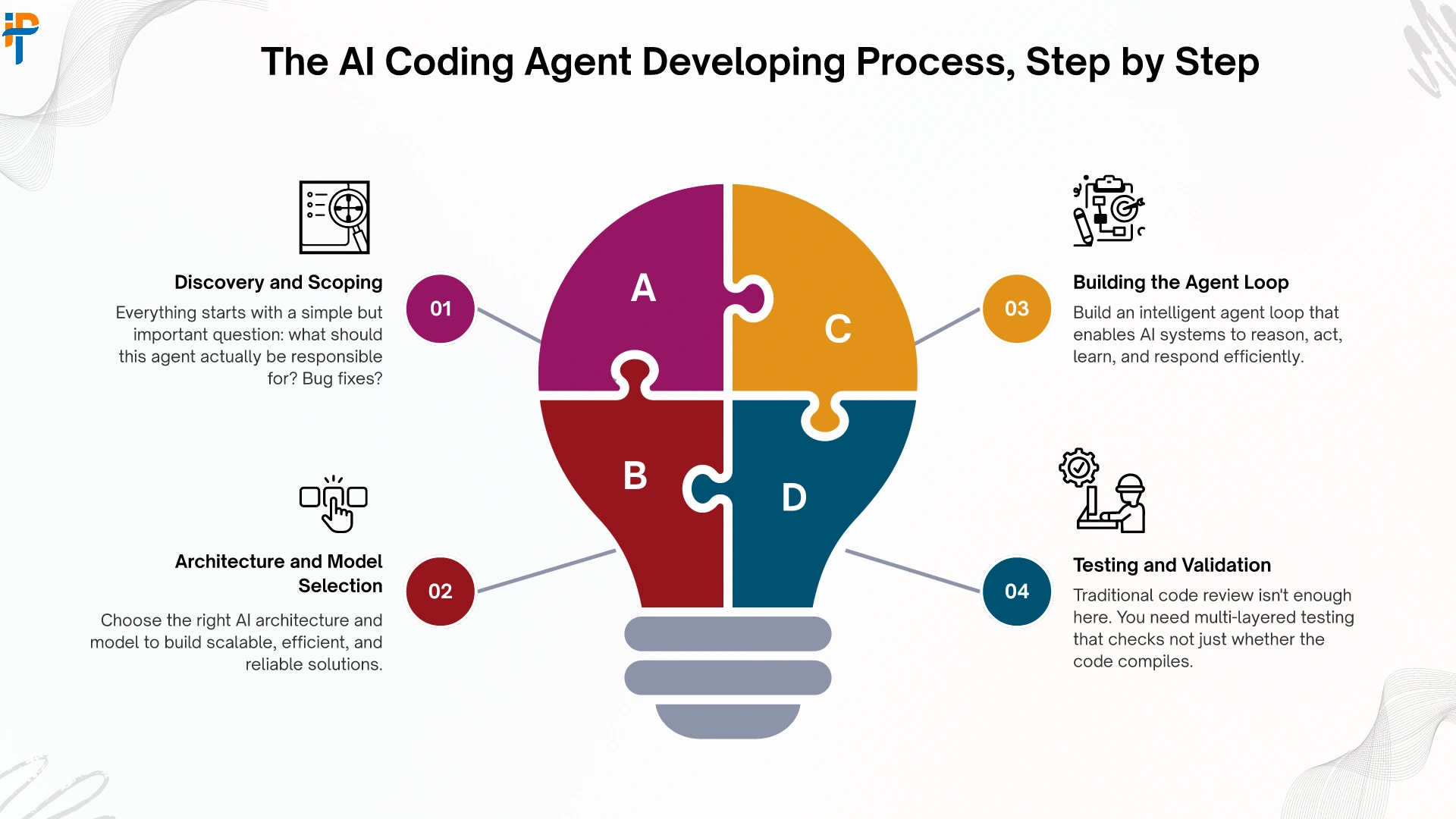
Here’s how a well-run build actually unfolds, from first conversation to production launch.
Discovery and Scoping
Everything starts with a simple but important question: what should this agent actually be responsible for? Bug fixes? Feature scaffolding? Full-repo refactors? Nailing this down early prevents scope creep and scope creep is where budgets quietly explode.
Architecture and Model Selection
Next comes picking the right foundation model and designing how the agent will retrieve context from your codebase usually through a combination of embeddings, vector search, and structured code parsing.
Building the Agent Loop
This is the engine room: the planning logic, the tool-calling framework, and the feedback loop that lets the agent evaluate its own output and try again if something breaks.
Testing and Validation
Traditional code review isn’t enough here. You need multi-layered testing that checks not just whether the code compiles, but whether the agent’s decisions were sound, safe, and aligned with your standards. Skipping this step is one of the riskiest shortcuts a team can take.
Deployment and Monitoring
Once live, the agent needs continuous monitoring, tracking token usage, error rates, and developer satisfaction so small issues get caught before they become expensive ones.
Also Read- Ai Healthcare Software Development Services Usa
Ongoing Costs Nobody Mentions Upfront
Building the agent is only step one. Running it costs money every single month, mostly driven by:
- Model inference/token usage: Can range from a few hundred to several thousand dollars monthly depending on team size and usage intensity.
- Infrastructure and hosting: Servers, vector databases, and compute for retrieval.
- Maintenance and updates: Typically 15–25% of your original build cost annually.
- Monitoring and observability tooling: Necessary to catch runaway costs or agent errors before they snowball.
Heavy daily usage across a development team can realistically land anywhere from a few hundred to a few thousand dollars per developer per month, depending on how autonomous — and how busy — your agent is.
In-House Build vs. Hiring a Development Partner
Building in-house makes sense if agentic AI is becoming core to your product and you already have engineers experienced in LLM orchestration. But if you need a working, production-ready agent without spending six months building internal expertise from scratch, partnering with an experienced development team is usually the faster and more cost-predictable path.
How to Keep Your AI Coding Agent Budget Realistic
- Start narrow. Launch with one clear use case like automated code review before expanding to full autonomy.
- Set token spending caps. Don’t let usage-based billing surprise you at month-end.
- Prioritize testing infrastructure early. It’s far cheaper than fixing agent mistakes in production.
- Choose the right model tier for each task, rather than defaulting to the most expensive option everywhere.
Why Build Your AI Coding Agent With IPH Technologies
At IPH Technologies, we’ve spent years turning ambitious technical ideas into working software with over 500 successful projects delivered for 430+ satisfied clients across mobile, web, and custom software development. Building an AI coding agent isn’t just about wiring up a model to a repository; it takes real engineering discipline around architecture, security, and testing.
Our team combines agile development practices with a genuine understanding of agentic AI systems, so what you get isn’t a flashy demo it’s a coding agent your developers will actually trust and use every day. We scope every project honestly, flag risks before they become expensive surprises, and stay involved well past launch day.
Conclusion
Building an AI coding agent in the USA isn’t a one-size-fits-all investment; it can run anywhere from $25,000 for a focused review assistant to well over $400,000 for a fully autonomous, enterprise-grade platform. The real differentiator isn’t the price tag itself, but how clearly you scope autonomy, plan for ongoing token costs, and invest in proper testing before your agent ever touches production code. Done right, an AI coding agent doesn’t just speed up development — it becomes a genuine extension of your engineering team.
Also Read– Ai In Crm Software Development
Frequently Asked Questions (FAQs)
What's the minimum budget to build a basic AI coding agent?
A simple code-suggestion assistant with limited scope can start around $15,000–$20,000, though most functional agents land closer to $35,000 and up.
Do AI coding agents require ongoing costs after launch?
Yes. Expect recurring expenses for model inference, infrastructure, and maintenance, which can range from a few hundred to several thousand dollars monthly depending on usage.
How is an AI coding agent different from tools like GitHub Copilot?
Off-the-shelf tools like Copilot suggest code as you type. A custom AI coding agent can plan and execute multi-step tasks autonomously, tailored specifically to your codebase and workflows.
How long does it take to build a production-ready coding agent?
Basic assistants can launch in 4–8 weeks, while fully autonomous enterprise systems often take 6 months or longer.
Is it safe to let an AI agent make changes directly to production code?
Not without proper safeguards. Most well-built agents include human-approval checkpoints, audit logs, and rollback mechanisms before any change reaches production.
Does industry regulation affect coding agent development cost?
Yes. Regulated industries requiring strict audit trails and access controls can see costs increase by 20–30% due to added governance requirements.
Can a coding agent be built to work with our existing tech stack?
Absolutely. Most custom agents are designed to integrate with your existing repositories, CI/CD pipelines, and internal tools rather than replacing them.
Should we build in-house or hire a development partner?
It depends on your existing AI engineering expertise. Teams without prior experience in agentic architectures generally see faster, more cost-predictable results by partnering with an experienced development team.










.png)