10 Surprising Google Play Store Statistics That Will Change Your Strategy in 2026
Have you ever wondered why some apps skyrocket to millions of downloads while others struggle to break through the noise?
The answer isn’t just about having a great idea—it’s about understanding the data that drives the world’s largest app marketplace.
With over 2.5 billion monthly users, the Google Play Store isn’t just an app distribution platform;
it’s a dynamic ecosystem where success depends on strategic insights and data-driven decisions.
In 2026, the Google Play Store landscape has transformed dramatically. We’re seeing unprecedented growth in app downloads,
revolutionary changes in monetization strategies, and a fierce competitive environment where quality trumps quantity.
Whether you’re a startup founder planning your first app launch or an established business looking to optimize your mobile strategy,
these statistics will reshape how you think about app development and distribution.
Let’s dive into ten surprising Google Play Store statistics that will fundamentally change your approach to
mobile app strategy in 2026.
Understanding the Google Play Store Landscape in 2026
Why These Statistics Matter for Your Business
Think of the Google Play Store as a bustling digital metropolis where billions of transactions happen daily. Understanding this marketplace isn’t optional—it’s essential for survival. According to recent industry reports, the average smartphone user spends 88% of their phone time inside applications, making app presence critical for business success.
These statistics aren’t just numbers on a spreadsheet. They represent real user behaviors, revenue opportunities, and competitive dynamics that can make or break your app strategy. By understanding where the market is heading, you can position your app for maximum impact.
The Evolution from Android Market to Global Dominance
Remember when Google Play was called the Android Market? Since its launch in 2008, just months after the Apple App Store, the platform has undergone a remarkable transformation. By 2017, the store peaked at 3.6 million apps, but Google then shifted its strategy from quantity to quality, implementing stricter policies and removing low-performing apps.
This evolution reflects a mature marketplace that prioritizes user experience and app quality over sheer volume. For businesses, this means the bar for entry is higher, but the opportunities for well-crafted apps are more substantial than ever.
Also read – AI Chatbots & Virtual Assistants Boost Conversions 2026
The App Ecosystem Has Quality Over Quantity
From 3.6 Million to Strategic Curation
Here’s a statistic that might surprise you: as of February 2025, approximately 2.06 million apps are available on the Google Play Store. That’s a significant reduction from the 3.6 million peak in 2017. Why? Google removed over 2.6 million applications over the years, focusing on maintaining quality standards.
This isn’t bad news—it’s actually great news for serious developers. The platform is cleaning house, removing abandoned apps, malware, and low-quality experiences. What remains is a more curated marketplace where quality apps have better chances of discovery.
What This Means for App Developers
The message is clear: mediocre won’t cut it anymore. Google’s 2025 policies now demand 12 engaged testers for 14 days for fresh developer accounts, tightening standards significantly. This shift means you need to invest in:
- Robust testing before launch
- Genuine user feedback during development
- Continuous improvement based on user needs
- Compliance with evolving platform requirements
At IPH Technologies, we’ve seen firsthand how this quality-first approach benefits our clients. With over 500 successful projects delivered, we understand that excellence in app development isn’t just about writing code—it’s about creating experiences that users love and Google rewards.
143 Billion Downloads Expected by 2026
Breaking Down the Download Explosion
Hold onto your hats: by 2026, consumers are expected to download approximately 143 billion apps from the Google Play Store, up from 111 billion in 2021. That’s a staggering 31% growth in just five years!
To put this in perspective, that’s roughly 18 app downloads for every person on the planet annually. This explosion isn’t just about more users—it’s about changing behaviors. People are using more apps across more categories, from finance and health to education and entertainment.
Regional Growth Patterns
What’s driving this growth? Emerging markets are the powerhouse. In countries like India, Indonesia, Brazil, and Mexico, 90% of downloads come from the Google Play Store, highlighting Android’s dominance in these regions.
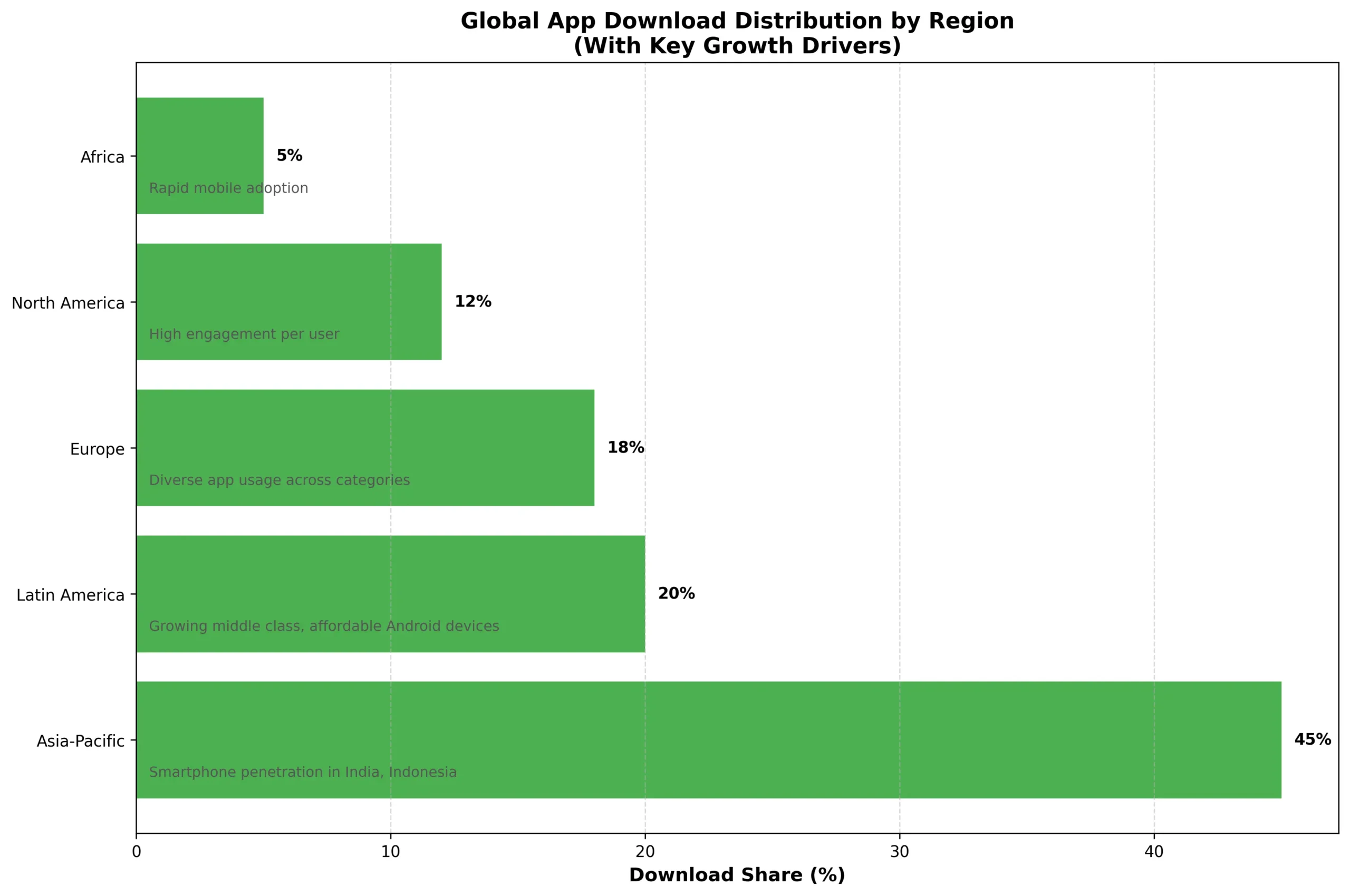
Here’s a breakdown of regional download patterns:
| Region | Download Share | Growth Driver |
|---|---|---|
| Asia-Pacific | 45% | Smartphone penetration in India, Indonesia |
| Latin America | 20% | Growing middle class, affordable Android devices |
| Europe | 18% | Diverse app usage across categories |
| North America | 12% | High engagement per user |
| Africa | 5% | Rapid mobile adoption |
This geographic distribution creates massive opportunities for developers who understand localization and cultural nuances.
97% of Apps Are Free, But That’s Not the Whole Story
The Freemium Revolution
Here’s a paradox that puzzles many newcomers: about 97% of apps on the Google Play are free to download, while only 3% require upfront payment. So how does anyone make money?
The answer lies in sophisticated monetization strategies that go far beyond simple pricing. Free apps dominate because they lower the barrier to entry, allowing users to try before they commit. This approach has become the gold standard in app economics.
Revenue Generation Beyond Upfront Costs
Don’t confuse “free” with “unprofitable.” The data tells a different story: 98% of global app revenue is generated by free applications that employ monetization techniques such as:
- In-app purchases (IAP)
- Subscription models
- In-app advertising (IAA)
- Freemium features
- Premium memberships
This freemium model works because it creates a low-friction entry point while monetizing engaged users who see value in the premium features.
Revenue Reaching $60-65 Billion Despite Free Apps
Understanding the Monetization Paradox
How can a marketplace dominated by free apps generate such massive revenue? Google Play Store revenue is projected to reach $60-65 billion by the end of 2025, with continued growth expected through 2026. This represents a compound annual growth rate (CAGR) of 10-12%.
The secret sauce? Multiple revenue streams working in harmony:
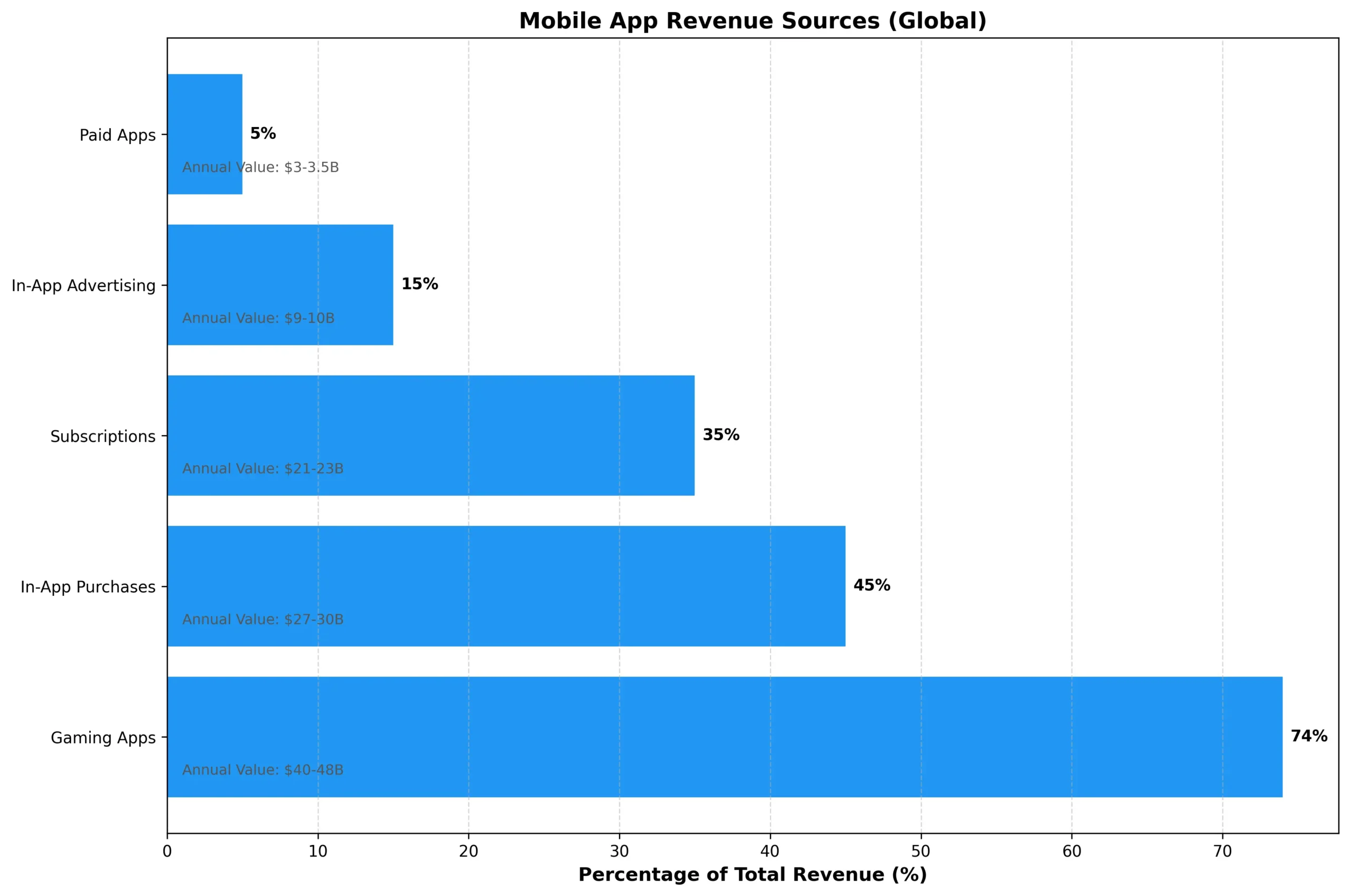
| Revenue Source | Percentage of Total | Annual Value |
|---|---|---|
| Gaming Apps | 74% | $40-48 billion |
| In-App Purchases | 45% | $27-30 billion |
| Subscriptions | 35% | $21-23 billion |
| In-App Advertising | 15% | $9-10 billion |
| Paid Apps | 5% | $3-3.5 billion |
In-App Purchases Drive the Economy
Here’s where it gets interesting: the top 1% of users, known as “whales,” account for 40-60% of all in-app spending. This power law distribution means that successful apps don’t need to monetize every user—they need to create exceptional value for their most engaged users.
At IPH Technologies, we’ve leveraged this insight across 430+ satisfied clients, helping them design monetization strategies that balance user experience with revenue generation. Our expertise in custom software solutions ensures that your app doesn’t just attract users—it converts them into paying customers.
1,200-1,750 New Apps Launch Daily
The Intense Competition for Visibility
Imagine competing in a race where 1,200 to 1,250 new apps go live every single day. That’s the reality of the Google Play Store in 2026. These numbers translate to roughly 41,000 fresh apps hitting the platform each month.
What does this mean for you? The window for discoverability is extremely small. Your app needs to stand out immediately, or it risks drowning in a sea of alternatives.
ASO Has Become Non-Negotiable
App Store Optimization (ASO) isn’t optional anymore—it’s survival. With fierce competition from over 1,249 new daily releases, your app needs:
- Strategic keyword targeting
- Compelling visual assets
- Localized descriptions
- Social proof through ratings and reviews
- Pre-registration campaigns
- Early user engagement strategies
Think of ASO as SEO’s mobile cousin. Just as websites need optimization to rank in Google Search, apps need ASO to appear in Play Store searches and recommendations.
Apps with 4.5+ Stars Dominate Visibility
The Rating Revolution
Here’s a wake-up call: of 2,074,270 Google Play apps examined, only 1,027,752 had at least one rating. More importantly, apps with 4.5 stars or above significantly outperform in visibility and retention.
If your app is rated below 3.5 stars, discoverability drops dramatically and uninstalls rise. Google’s algorithm heavily favors highly-rated apps, creating a virtuous cycle: better ratings lead to more visibility, which leads to more downloads, which (if your app is good) leads to even better ratings.
Quality Standards Are Rising
The data shows that approximately 234,466 apps have ratings of 4.0 stars or higher, with 109,473 apps rated above 4.5 stars. This sets a high bar for new entrants.
What can you do?
- Prioritize early-stage testing and feedback
- Launch with 4+ star potential
- Actively solicit reviews from satisfied users
- Respond to negative feedback constructively
- Continuously improve based on user input
Remember: better quality equals better retention, better ASO, and better revenue.
Also read- Top 7 Digital Transformation Technologies Revolutionizing Business Operations
Only 71% User Retention After 90 Days
The Retention Crisis
Here’s perhaps the most sobering statistic: 71% of users churn within 90 days of downloading an app. That means nearly three out of four users who install your app won’t be using it three months later.
This retention crisis isn’t unique to any category—it affects gaming apps, productivity tools, social platforms, and everything in between. The challenge? Creating experiences compelling enough to become daily habits.
Building Habit-Forming Experiences
The true measure of an app’s success isn’t its download count—it’s post-install engagement and retention. Consider this: the average smartphone user spends between 4.8 to 5 hours daily on their phone, with approximately 88% of that time spent inside applications.
To capture and keep that attention, successful apps focus on:
- Personalized onboarding – Getting users to value quickly
- Push notification strategies – Bringing users back at optimal times
- Regular content updates – Providing fresh reasons to return
- Gamification elements – Creating engagement loops
- Community building – Fostering user-to-user connections
At IPH Technologies, we understand that retention starts with exceptional user experience. Our team leverages agile methodologies and the latest technology to create apps that don’t just attract users—they keep them coming back.
Gaming Apps Generate 74% of Play Store Revenue
The Gaming Goldmine
Gaming isn’t just the most popular category—it’s the revenue powerhouse. Gaming apps generated $31.3 billion in 2022, rising to $34.3 billion in 2023, with projections reaching around $40.1 billion in 2025.
That means gaming apps, which represent about 13.8% of total app listings, drive nearly three-quarters of all Google Play revenue. This outsized impact comes from highly engaged user bases and sophisticated monetization models.
Monetization Strategies That Work
The gaming sector has pioneered monetization techniques now spreading to other categories:
- Battle passes: 41% of gaming revenue now comes from battle passes, highlighting a shift toward value-driven, seasonal content
- In-app purchases: Consumables, power-ups, and cosmetics
- Subscription models: Premium tiers with exclusive benefits
- Rewarded advertising: Users watch ads for in-game benefits
- Procedural content: 68% of the top 100 games utilize procedural level generation, enhancing replayability
Non-gaming apps can learn from these strategies, adapting them for their own use cases and audiences.
Also read- Top 8 Reasons Startups Choose Custom Software Development
Emerging Markets Drive 90% of Downloads
Geographic Distribution Matters
Here’s where geography becomes destiny: in countries like India, Indonesia, Brazil, and Mexico, 90% of downloads are from the Google Play Store, highlighting Android’s dominance in emerging markets.
While Android holds over 70% of the global mobile OS market share, this distribution isn’t uniform. Emerging markets represent the fastest-growing segment, driven by:
- Increasing smartphone penetration
- Affordable Android devices
- Growing middle class with disposable income
- Mobile-first internet adoption
- Local language content demand
Localization Is Key
Success in these markets requires more than translation—it demands cultural adaptation. Apps that thrive understand local payment preferences, design aesthetics, feature priorities, and usage patterns.
Consider that the most popular apps vary dramatically by region. In India, payment apps like PayTM dominate. In Japan, LINE messaging is essential. In Brazil, shopping and fintech apps lead growth.
2.5+ Billion Monthly Active Users
The Largest Digital Marketplace
Let’s put the scale in perspective: Google Play dominates with 2.5+ billion monthly active users, making it the essential platform for global business scaling in 2026.
To compare, that’s roughly one-third of the world’s population accessing the Play Store every single month. No other digital marketplace comes close to this reach and engagement level.
Scale Creates Opportunity
This massive user base creates a unique environment:
- Network effects: More users attract more developers, creating better apps, which attract more users
- Diverse niches: With billions of users, even tiny niches represent substantial markets
- Multiple revenue streams: Scale allows experimentation with different monetization models
- Data advantages: Large user bases generate insights that drive continuous improvement
While Google Play’s consumer spending of $46.7 billion trails Apple’s App Store at $103.4 billion, the gap is narrowing as monetization strategies improve and emerging market spending power grows.
How IPH Technologies Can Help You Navigate This Landscape
Strategic App Development Services
Understanding statistics is one thing—applying them strategically is another. At IPH Technologies, we specialize in turning visionary ideas into impactful solutions. As a leading app development company, we offer comprehensive services designed to meet your unique business needs.
Our approach combines:
- Data-driven planning: Using market statistics to inform strategy
- Agile development: Flexible methodologies that adapt to changing requirements
- Quality assurance: Rigorous testing to ensure 4.5+ star potential
- ASO expertise: Optimization strategies that drive discoverability
- Monetization design: Revenue models that respect user experience
From Concept to Market Success
With a track record of over 500 successful projects and 430+ satisfied clients, we’ve learned what separates successful apps from failures. Our expertise extends across:
- Mobile app development (iOS and Android)
- Web application development
- Custom software engineering
- Cloud solutions
- AI and machine learning integration
We understand that staying ahead in today’s competitive market requires more than just technology—it requires a partner dedicated to your success. That’s why we focus on delivering not only cutting-edge solutions but also an unparalleled client experience.
Also read – Online Earning App Development in UAE | Complete 2026 Guide
Actionable Strategies Based on These Statistics
Quality-First Development Approach
The statistics make it clear: quality isn’t optional. To succeed in the modern Play Store:
- Invest in pre-launch testing with real users
- Aim for a 4.5+ star launch rating through beta feedback
- Build for retention from day one, not just acquisition
- Update regularly – 28% of apps are updated weekly, 72% monthly
- Monitor and respond to user feedback promptly
Smart Monetization Planning
With 97% of apps being free, your monetization strategy needs sophistication:
- Choose the right model – freemium, subscription, or hybrid
- Focus on engaged users rather than trying to monetize everyone
- Test pricing across different markets and segments
- Learn from gaming – adapt successful strategies to your category
- Balance revenue and experience – never sacrifice UX for short-term gains
Data-Driven ASO Implementation
With 1,200+ apps launching daily, discoverability demands strategy:
- Conduct thorough keyword research before launch
- Create compelling visual assets that stand out in search
- Localize for target markets beyond simple translation
- Build pre-launch momentum through pre-registration campaigns
- Analyze and iterate based on performance data
Conclusion
The Google Play Store in 2026 presents unprecedented opportunities alongside formidable challenges. These ten statistics reveal a marketplace that rewards quality, demands strategic thinking, and offers massive scale to those who understand its dynamics.
From the shift toward quality over quantity to the massive growth in downloads reaching 143 billion, from the freemium revolution to the gaming revenue dominance, from emerging market opportunities to the critical importance of ratings and retention—each statistic tells part of a larger story about where mobile apps are heading.
What It Takes to Succeed
Success in this environment requires more than just a good idea. It demands:
- Excellence in execution
- Strategic monetization
- Relentless focus on user experience
- Data-driven optimization
- Cultural sensitivity for global markets
- Partnership with experienced developers
At IPH Technologies, we’re committed to helping you navigate this complex landscape. Whether you’re launching your first app or optimizing an existing portfolio, our innovative and tailored solutions can help you stay ahead of the curve and achieve your business objectives.
The question isn’t whether to embrace the Google Play Store—it’s how to do it strategically. These statistics provide the roadmap. Your move is next.
Also read – Low-Code No-Code Automation Transform Business Processes in 2026








.png)