






























































HIPAA SOC 2 GDPR ISO 27001 PDPL ISO 9001
Our Achievements
appfutura
BusinessFirms
DesignRush
GoodFirms
ITFirms
iTRate.co
Mobile App Daily
Tech Behemoths
Highlights
UI/UX Design
User-first, visually engaging interfaces crafted to enhance usability, boost engagement, and deliver seamless digital experiences.
Branding
Strategic brand identities that communicate your vision, build trust, and create a memorable presence across all touchpoints.
Wireframing
Structured layouts and user flows that map the product journey clearly before development begins, saving time and cost.
Prototype Design
Interactive prototypes that simulate real user interactions, helping validate ideas and refine experiences early.
Design Systems
Scalable design frameworks and reusable components that ensure consistency, speed, and efficiency across your product.
UI/UX Design

We design intuitive, user-centric interfaces that enhance engagement, improve usability, and deliver seamless digital experiences across all devices.

UI UX Design
  • User research and wireframing for clear flows
  • Modern UI design using Figma and Adobe XD
  • Interactive prototypes for better user experience testing
  • Usability testing and performance optimization improvements
  • Responsive design across all devices and screens
  • Scalable design systems with reusable UI components
Branding & Identity

We craft strong brand identities that communicate your vision, build trust, and create a lasting impression across all digital and offline touchpoints.

Branding and Identity
  • Logo design and brand identity creation
  • Brand guidelines and visual consistency systems
  • Color palette and typography selection strategy
  • Marketing materials and brand asset design
  • Social media branding and creative direction
  • Rebranding and brand positioning strategies
Wireframing

We create structured wireframes that define layout, user flow, and functionality, helping visualize ideas and build a strong foundation before design and development.

Wireframing
  • Low fidelity wireframes for initial structure
  • High fidelity wireframes with detailed layouts
  • User flow mapping for better navigation
  • Content hierarchy and layout planning
  • Clickable wireframes for early feedback
  • Clear structure before UI design phase
Prototype Design

We design interactive prototypes that simulate real user experiences, helping validate ideas, test functionality, and refine products before development.

Prototype Design
  • Interactive prototypes for real user experience
  • Clickable designs to test product functionality
  • User journey simulation for better understanding
  • Rapid prototyping for faster design validation
  • Feedback driven improvements before development
  • High fidelity prototypes with smooth interactions
Design Systems

We build scalable design systems that ensure consistency, improve collaboration, and accelerate product development across all platforms and teams.

Design Systems
  • Reusable UI components for consistent design
  • Design tokens for colors typography spacing
  • Component libraries for faster development workflow
  • Consistent branding across all digital products
  • Documentation for design and development teams
  • Scalable systems for growing product ecosystems
Highlights
Mobile Apps Development
High-performance Android and iOS mobile applications built with modern technologies, delivering seamless user experiences and robust functionality.
Desktop Application Dev
Powerful and secure desktop applications tailored for Windows, macOS, and Linux, designed for performance, scalability, and reliability.
Web App Development
Scalable and responsive web applications using modern frameworks like React, Angular, and Vue for fast, dynamic, and engaging experiences.
Cross-Platform
Cost-effective cross-platform solutions using Flutter and React Native, enabling a single codebase for both iOS and Android platforms.
PWA Development
Progressive Web Apps that combine the best of web and mobile, offering offline access, fast loading, and app-like experiences directly in the browser.
Highlights
Mobile App

Android

iOS

Flutter

Hybrid

Optimize

Native

Swift

Firebase

Android App Development

We craft powerful, scalable Android applications with intuitive UX, high performance, and deep integration with Google services.

Android App
  • Custom Android app development
  • Native Kotlin & Java apps
  • Google Play Store deployment
  • Material Design UI implementation
Kotlin

Kotlin

Java

Java

Flutter

Flutter

Android Studio

Android

Jetpack

Jetpack

iOS App Development

We build high-quality, user-centric iOS apps combining performance, security, and seamless design for Apple devices.

iOS App
  • Custom iOS app development
  • Native Swift & SwiftUI apps
  • Seamless Apple service integration
  • App Store review & deployment
Swift

Swift

SwiftUI

SwiftUI

Obj-C

Obj-C

Xcode

Xcode

Flutter

Flutter

Cross-Platform Apps

We develop cross-platform mobile apps that run flawlessly on both iOS and Android from a single codebase, saving time and cost.

Cross-Platform App
  • Single codebase for iOS & Android
  • Flutter & React Native development
  • Native-like performance & UI
  • Faster time-to-market
React Native

React Native

TypeScript

TypeScript

Redux

Redux

Firebase

Firebase

Dart

Dart

Hybrid Apps

We build hybrid mobile apps that blend web technologies with native capabilities, delivering broad reach and cost-effective development.

Hybrid App
  • Web + native feature integration
  • Ionic & Cordova frameworks
  • Reduced development costs
  • Multi-platform publishing
Flutter

Flutter

Dart

Dart

Firebase

Firebase

SQLite

SQLite

App Optimization

We enhance existing mobile apps with performance tuning, crash fixes, battery efficiency, and faster load times for a superior user experience.

App Optimization
  • Performance profiling & tuning
  • Memory & battery optimization
  • Crash analysis & bug fixing
  • App size reduction & load speed
Xcode

Xcode

Android Studio

Android

Firebase

Firebase

Java

Java

Highlights
Desktop App

Windows

macOS

Linux

Desktop

Electron

Qt

WinForms

GTK

Windows Apps

We develop robust Windows desktop applications using modern Microsoft technologies, delivering powerful tools for enterprise and consumer use.

Windows App
  • Custom Windows desktop applications
  • WPF & WinForms development
  • Microsoft Store deployment
  • Windows API & system integration
C#

C#

.NET

.NET

Electron

Electron

Visual Studio

Visual Studio

SQL Server

SQL Server

macOS Apps

We create elegant, high-performance macOS applications that leverage Apple's native frameworks for a smooth and delightful desktop experience.

macOS App
  • Native macOS app development
  • SwiftUI & AppKit integration
  • Mac App Store submission
  • Apple Silicon optimization
Swift

Swift

SwiftUI

SwiftUI

Obj-C

Obj-C

Xcode

Xcode

Cross-Platform Desktop

We develop cross-platform desktop applications that run seamlessly on Windows, macOS, and Linux from a single shared codebase.

Cross-Platform Desktop
  • Single codebase for all platforms
  • Electron & Tauri frameworks
  • Flutter for desktop support
  • Consistent UI across OS environments
Flutter

Flutter

Electron

Electron

Node.js

Node.js

TypeScript

TypeScript

Docker

Docker

Electron Apps

We build feature-rich Electron desktop apps using web technologies, enabling cross-platform deployment with native OS capabilities.

Electron App
  • Electron framework development
  • Node.js & Chromium integration
  • Auto-updater & native notifications
  • Cross-OS packaging & distribution
Electron

Electron

Node.js

Node.js

React

React

Vue

Vue

TypeScript

TypeScript

Highlights
Web App

React

Node.js

PHP

Laravel

Python

MySQL

JavaScript

HTML

CSS

React Development

We build fast, component-driven React web applications with modern state management, reusable UI, and seamless API integration.

React Development
  • Custom React SPA development
  • Redux & Context API state management
  • Next.js SSR & SSG support
  • REST & GraphQL API integration
React

React

Next.js

Next.js

Redux

Redux

TypeScript

TypeScript

Tailwind

Tailwind

Angular Development

We develop enterprise-grade Angular applications with structured architecture, two-way data binding, and robust TypeScript foundations.

Angular Development
  • Custom Angular SPA development
  • RxJS & NgRx state management
  • Angular Material UI components
  • Lazy loading & performance tuning
Angular

Angular

TypeScript

TypeScript

HTML

HTML

CSS

CSS

NPM

NPM

Node.js Backend

We build scalable, event-driven Node.js backends with RESTful APIs, real-time capabilities, and seamless database integrations.

Node.js Backend
  • RESTful & GraphQL API development
  • Express.js & Fastify frameworks
  • WebSocket & real-time features
  • MongoDB, PostgreSQL integration
Node.js

Node.js

Express

Express

MongoDB

MongoDB

GraphQL

GraphQL

Docker

Docker

Cloud Web Apps

We design and deploy cloud-native web applications on AWS, Azure, and GCP — scalable, secure, and built for high availability.

Cloud Web Apps
  • AWS, Azure & GCP deployment
  • Serverless architecture development
  • Auto-scaling & load balancing
  • CI/CD pipeline configuration
AWS

AWS

Azure

Azure

GCP

GCP

Docker

Docker

Kubernetes

Kubernetes

Full-Stack Dev

We deliver complete full-stack web solutions — from pixel-perfect frontends to robust backends — as a unified, end-to-end product.

Full-Stack Dev
  • Frontend & backend development
  • MERN & MEAN stack expertise
  • Database design & API architecture
  • DevOps, hosting & deployment
React

React

Node.js

Node.js

MongoDB

MongoDB

PostgreSQL

PostgreSQL

Docker

Docker

Highlights
Cross Platform

Flutter

R. Native

Xamarin

Ionic

Reuse

Electron

NW.js

Framework7

SwiftUI

Flutter Development

We build beautiful, natively compiled Flutter applications for mobile, web, and desktop from a single Dart codebase with pixel-perfect UI.

Flutter Development
  • Flutter mobile & web apps
  • Dart language development
  • Custom widget & animation creation
  • Firebase & REST API integration
Flutter

Flutter

Dart

Dart

Firebase

Firebase

GetX

GetX

Riverpod

Riverpod

React Native

We develop high-performance React Native apps that deliver a truly native experience on both iOS and Android using JavaScript and React.

React Native
  • Cross-platform iOS & Android apps
  • React Native CLI & Expo development
  • Native module & bridge integration
  • Redux & MobX state management
React Native

React Native

Redux

Redux

TypeScript

TypeScript

Firebase

Firebase

Xamarin

We develop Xamarin-based cross-platform apps using C# and .NET, enabling shared business logic across iOS, Android, and Windows.

Xamarin
  • Xamarin.Forms & MAUI apps
  • Shared C# codebase development
  • Native API access via bindings
  • Enterprise app integration
Xamarin

Xamarin

C#

C#

.NET MAUI

.NET

Azure

Azure

Visual Studio

Visual Studio

Ionic Framework

We create stunning Ionic applications that combine the power of web technologies with native device features for a seamless mobile experience.

Ionic Framework
  • Ionic Angular & React apps
  • Capacitor native plugin integration
  • Responsive mobile-first UI
  • PWA & hybrid app deployment
Ionic

Ionic

Angular

Angular

React

React

Vue

Vue

Code Reusability

We build reusable app architectures, reducing duplication, accelerating development, and ensuring seamless cross-platform consistency.

Code Reusability
  • Shared component library creation
  • Monorepo architecture setup
  • Design system implementation
  • Platform-agnostic business logic
Turborepo

Turborepo

Storybook

Storybook

Flutter

Flutter

React Native

React Native

Highlights
PWA

PWA

Offline

Push

Fast

App-Like

IndexedDB

Installable

Sync

Progressive Web Apps

We build Progressive Web Apps that combine the best of web and mobile — installable, reliable, and fast across all devices and browsers.

Progressive Web Apps
  • PWA architecture & manifest setup
  • Service worker implementation
  • Installable & home screen support
  • Cross-browser compatibility
HTML5

HTML5

CSS3

CSS3

JavaScript

JavaScript

Workbox

Workbox

Lighthouse

Lighthouse

Offline Support

We implement robust offline capabilities in your web apps using service workers and smart caching so users stay productive without connectivity.

Offline Support
  • Service worker caching strategies
  • IndexedDB offline data storage
  • Background sync implementation
  • Graceful offline fallback pages
Service Worker

ServiceWorker

Workbox

Workbox

IndexedDB

IndexedDB

Cache API

Cache API

Background Sync

BackgroundSync

Push Notifications

We integrate web push notification systems into your PWA to re-engage users with timely, personalized alerts even when the app is not open.

Push Notifications
  • Web Push API implementation
  • VAPID key & subscription management
  • Notification scheduling & targeting
  • Cross-browser push support
Web Push

Web Push

Firebase FCM

Firebase

OneSignal

OneSignal

Node.js

Node.js

Workbox

Workbox

Fast Loading

We optimize PWAs for lightning-fast load times using code splitting, lazy loading, and caching to deliver exceptional Core Web Vitals scores.

Fast Loading
  • Code splitting & lazy loading
  • Image & asset optimization
  • Core Web Vitals improvement
  • CDN & caching configuration
Webpack

Webpack

Lighthouse

Lighthouse

Vite

Vite

Cloudflare

Cloudflare

Workbox

Workbox

App-Like Experience

We craft PWAs that feel and behave like native mobile apps — with smooth animations, full-screen mode, gestures, and seamless transitions.

App-Like Experience
  • Full-screen & standalone display mode
  • Touch gestures & swipe navigation
  • Smooth page transitions & animations
  • App shell architecture
Web Manifest

Web Manifest

CSS Animations

CSS

Framer Motion

FramerMotion

React

React

Vue

Vue

Highlights
Custom Software
Fully tailored software solutions designed to match your unique business processes, improving efficiency and driving long-term growth.
Backend Systems
Robust and secure backend architectures built for high performance, scalability, and seamless integration with your applications.
Database Design
Efficient and scalable database structures optimized for fast queries, data integrity, and reliable performance at scale.
Cloud-Native
Modern cloud-native solutions using microservices and serverless architecture on AWS, Azure, and GCP for maximum flexibility and scalability.
API Development
Secure and well-documented RESTful and GraphQL APIs that enable seamless communication between systems and third-party integrations.
Custom Software

We develop tailored software solutions that align with your business goals, streamline operations, and deliver scalable, high-performance digital systems.

Custom Software Development
  • Custom software tailored to business needs
  • Scalable architecture for long term growth
  • Secure and high performance application development
  • API integration with third party services
  • Cloud based and enterprise software solutions
  • Ongoing maintenance and system optimization support
Backend Systems

We build robust backend systems that power applications with secure, scalable architecture, efficient data handling, and seamless integrations.

Backend Systems
  • Secure backend architecture and system design
  • Database design and performance optimization
  • API development for seamless integrations
  • Authentication and authorization system implementation
  • Server side logic and business workflows
  • Scalable infrastructure for high traffic applications
Database Design

We design efficient database structures that ensure data integrity, optimize performance, and support scalable, reliable application systems.

Database Design
  • Structured database schema design and planning
  • Efficient data modeling for scalable systems
  • Database optimization for faster query performance
  • Relational and non relational database solutions
  • Secure data storage and access management
  • Backup strategies and data recovery solutions
Cloud-Native Apps

We build cloud-native applications designed for scalability, resilience, and flexibility using modern cloud infrastructure and microservices architecture.

Cloud Native Apps
  • Cloud first architecture for scalable applications
  • Microservices based system design and deployment
  • Containerization using Docker and Kubernetes tools
  • Auto scaling infrastructure for high availability
  • Continuous integration and continuous deployment pipelines
  • Secure cloud environments with monitoring and logging
API Development

We develop secure and scalable APIs that enable seamless communication between systems, applications, and third party services.

API Development
  • RESTful API development for web applications
  • Secure API authentication and authorization systems
  • Third party API integration and data exchange
  • Scalable APIs for high traffic applications
  • API documentation for easy developer integration
  • Performance optimization and API response tuning
Highlights
Manual Testing
Detailed human-driven testing to uncover edge cases, validate user flows, and ensure a seamless, intuitive user experience.
Test Automation
Automated testing frameworks using Selenium, Cypress, and Appium to accelerate regression cycles and improve release confidence.
Performance
Load, stress, and scalability testing to ensure your application performs reliably under high traffic and demanding conditions.
Security Testing
Comprehensive security assessments including penetration testing and vulnerability analysis to safeguard your application.
Mobile QA
End-to-end mobile application testing across devices and platforms to ensure consistent performance, usability, and stability.
Manual Testing

We perform detailed manual testing to ensure software quality, identify issues early, and deliver reliable, user-friendly applications.

Manual Testing
  • Functional testing for application core features
  • UI testing for consistent user experience
  • Cross browser and device compatibility testing
  • Test case creation and execution processes
  • Bug tracking and detailed issue reporting
  • Regression testing after feature updates
Test Automation

We implement automated testing solutions to improve efficiency, reduce manual effort, and ensure faster, reliable software delivery.

Test Automation
  • Automated test scripts for faster execution
  • Regression testing using automation frameworks
  • Continuous testing within CI CD pipelines
  • Test coverage improvement across application modules
  • Reusable automation scripts for long term scalability
  • Performance and load testing automation solutions
Performance Testing

We evaluate application performance to ensure speed, stability, and scalability under different workloads and real-world conditions.

Performance Testing
  • Load testing for high traffic scenarios
  • Stress testing to identify system limits
  • Performance benchmarking and response time analysis
  • Scalability testing for growing user demands
  • Memory and resource usage optimization checks
  • Bottleneck identification and performance improvements
Security Testing

We identify vulnerabilities and secure applications against threats, ensuring data protection, compliance, and safe user interactions.

Security Testing
  • Vulnerability assessment and risk analysis testing
  • Penetration testing to identify security gaps
  • Authentication and authorization security validation
  • Data protection and encryption testing processes
  • Secure code review and security best practices
  • Compliance testing with industry security standards
Mobile QA

We ensure mobile applications deliver flawless performance, usability, and compatibility across devices, platforms, and environments.

Mobile QA
  • Mobile app testing across multiple devices
  • iOS and Android platform compatibility testing
  • UI testing for consistent mobile experience
  • Network and performance testing on mobile
  • App usability and user experience validation
  • App store readiness and release testing
Highlights
CI/CD Pipelines
Automated pipelines for building, testing, and deploying code, enabling faster releases, fewer errors, and continuous delivery.
Infrastructure
Scalable infrastructure provisioning using Infrastructure as Code (IaC) with Terraform and CloudFormation for consistency and reliability.
Deployment
Zero-downtime deployment strategies including blue-green and rolling deployments to ensure smooth and reliable releases.
Containerisation
Container-based architectures using Docker and Kubernetes for portability, scalability, and efficient resource utilization.
Monitoring
Real-time monitoring and observability using tools like Grafana, Prometheus, and Datadog to ensure system health and performance.
CI/CD Pipelines

We implement CI/CD pipelines to automate build, testing, and deployment, enabling faster releases, improved quality, and continuous delivery.

CI CD Pipelines
  • Automated build and deployment pipeline setup
  • Continuous integration for faster code validation
  • Continuous delivery for seamless release cycles
  • Integration with Git version control systems
  • Automated testing within CI CD workflows
  • Monitoring and rollback strategies for deployments
Infrastructure

We design and manage reliable infrastructure to ensure scalability, security, and high availability for modern applications and systems.

Infrastructure
  • Cloud infrastructure setup and configuration services
  • Server management and deployment automation solutions
  • High availability and load balancing implementation
  • Monitoring and logging for system performance tracking
  • Security hardening and infrastructure access controls
  • Scalable environments for growing application demands
Deployment

We manage seamless deployment processes to ensure applications are delivered efficiently, securely, and ready for production environments.

Deployment
  • Application deployment to cloud and servers
  • Automated deployment workflows for faster releases
  • Environment configuration and setup management
  • Version control and release management processes
  • Rollback strategies for safe deployment updates
  • Post deployment monitoring and performance checks
Containerization

We use containerization to package applications for consistency, scalability, and efficient deployment across different environments.

Containerization
  • Application containerization using Docker technologies
  • Environment consistency across development and production
  • Container orchestration with Kubernetes platforms
  • Scalable container deployment for microservices architecture
  • Efficient resource utilization and system isolation
  • Integration with CI CD pipelines for automation
Monitoring

We monitor systems and applications in real time to ensure performance, reliability, and quick issue detection and resolution.

Monitoring
  • Real time system performance monitoring tools
  • Application health checks and uptime tracking
  • Error tracking and issue alerting systems
  • Log management and analysis for debugging
  • Resource usage monitoring across infrastructure layers
  • Proactive issue detection and incident response
Highlights
Roadmap Planning
Strategic product roadmaps aligned with business goals, helping prioritize features, manage timelines, and deliver maximum value.
Team Coordination
Efficient coordination across design, development, and QA teams to ensure smooth collaboration and on-time project delivery.
Growth Strategy
Data-driven product strategies focused on user acquisition, retention, and continuous improvement to drive sustainable growth.
Agile Sprints
Agile methodologies like Scrum and Kanban to deliver iterative releases, improve flexibility, and maintain predictable progress.
Stakeholder Mgmt
Clear communication and alignment with stakeholders through regular updates, reporting, and feedback loops to ensure project success.
Roadmap Planning

We create strategic roadmaps that align with your business goals, helping prioritize features, plan execution, and ensure long-term success.

Roadmap Planning
  • Product roadmap planning aligned with business objectives
  • Feature prioritization based on user and market needs
  • Timeline planning for efficient project execution phases
  • Technology stack selection for scalable solutions
  • Risk assessment and mitigation strategy planning
  • Continuous roadmap updates based on performance insights
Team Coordination

We ensure smooth collaboration across teams to improve productivity, streamline workflows, and deliver projects efficiently on time.

Team Coordination
  • Cross functional team collaboration and communication
  • Agile workflow management and sprint planning processes
  • Task tracking and project progress visibility tools
  • Clear role assignment and responsibility management
  • Regular updates and performance review meetings
  • Efficient coordination between design development teams
Growth Strategy

We develop data-driven growth strategies to scale your business, increase user acquisition, and maximize long-term revenue potential.

Growth Strategy
  • Market analysis and competitive growth planning strategies
  • User acquisition and retention optimization techniques
  • Data driven decision making and performance insights
  • Scalable business models for long term expansion
  • Conversion rate optimization across digital platforms
  • Continuous growth tracking and strategy refinement
Agile Sprints

We follow agile sprint methodologies to deliver faster iterations, improve collaboration, and ensure continuous product improvement.

Agile Sprints
  • Sprint planning and backlog prioritization processes
  • Daily standups for team alignment and progress tracking
  • Iterative development with continuous feedback cycles
  • Task management using agile tools and workflows
  • Regular sprint reviews and performance retrospectives
  • Faster delivery with incremental feature releases
Stakeholder Management

We ensure clear communication and alignment with stakeholders to drive project success, transparency, and informed decision making.

Stakeholder Management
  • Regular stakeholder communication and reporting processes
  • Requirement alignment with business goals and expectations
  • Feedback collection and continuous improvement strategies
  • Transparent project updates and progress visibility
  • Risk identification and stakeholder expectation management
  • Collaborative decision making for project success

Gold trading is no longer dictated by emotional factors. Behind every profitable trade is a complex algorithm, which analyzes the constant exchange rate fluctuations and interest rates, as well as geopolitical events occurring worldwide. This technological revolution in the market is what makes Bullion Software Development the most popular choice among numerous dealers, refiners, and trading platforms, which wish to remain ahead of the game.

This article covers the basics of AI-based analytics utilized to predict gold price fluctuations, discusses particularities of the software used in contemporary bullion trading, and highlights the criteria for selecting an offshore development partner capable of building such software. We will talk about the machine learning models used to train AI, data sources used for training and validation, the must-have and nice-to-have features, as well as address common pitfalls and deal-breakers in building a reliable Bullion Software.

Key Takeaways

  • AI-based analytics harness machine learning, real-time spot price feeds, and macroeconomic data to predict short-term gold, silver price movements more accurately than traditional trend-line approaches.
  • Bullion Software Development now focuses on predictive pricing engines, automated spread management and multi-location inventory synchronization, not just point of sale systems.
  • Cloud-based, API-first architecture (AWS, Firebase, RESTful integrations) is the technical backbone that makes real-time precious metals pricing possible at scale.
  • AI forecasting is not always accurate, as data inaccuracies and thin-market securities’ manipulation can affect it, which is why humans are essential in trading.

Why Traditional Gold Price Forecasting Falls Short

Outdated gold forecasts are based on chart patterns, historical spot price averages, or a trader’s gut feeling on the desk. Although this approach is not wrong per se, it is not effective in current markets where any news – be it a tweet from the Fed chief, a traffic jam in the Red Sea, or a surprise spike in inflation – can drive prices up or down faster than a human trader can update his spreadsheet.

Traditional forecasting is also limited in terms of volume. A single coin dealer may be tracking the spot price of gold, silver, platinum, and palladium – across dozens of product SKUs – at the same time. Manually, with any degree of accuracy, that’s impossible. Bullion Software Development is designed to close that gap – systems that do not sleep or miss a beat.

The Rise of AI-Powered Bullion Trading Platforms

Over the past several years, precious metals dealers have undergone the same evolution as has been seen in retail and fintech more recently – their operations are no longer manual and heavily paper-based, but instead digitized and driven by software.

While platforms like Kitco and APMEX were some of the earliest to embrace the consumer-facing bullion e-commerce space, the innovation in the industry has since been focused on the underlying mechanisms at work.

A gold dealer using AI to price gold can reprice their entire inventory at the same time as a spot move in under a second, something that previously took someone on the staff around an hour. This has massive implications on their profit and loss.

What Is AI-Driven Analytics?

AI-driven analytics (the utilization of ML algorithms to mine large datasets for predictive signals) uses statistical modeling of historical and real-time market data to forecast probable price movements. In gold trading, this refers to algorithms trained on decades of spot price behavior, cross-referenced to macroeconomic variables to generate short-term directional signals.

How AI-Driven Analytics Actually Work in Gold Markets
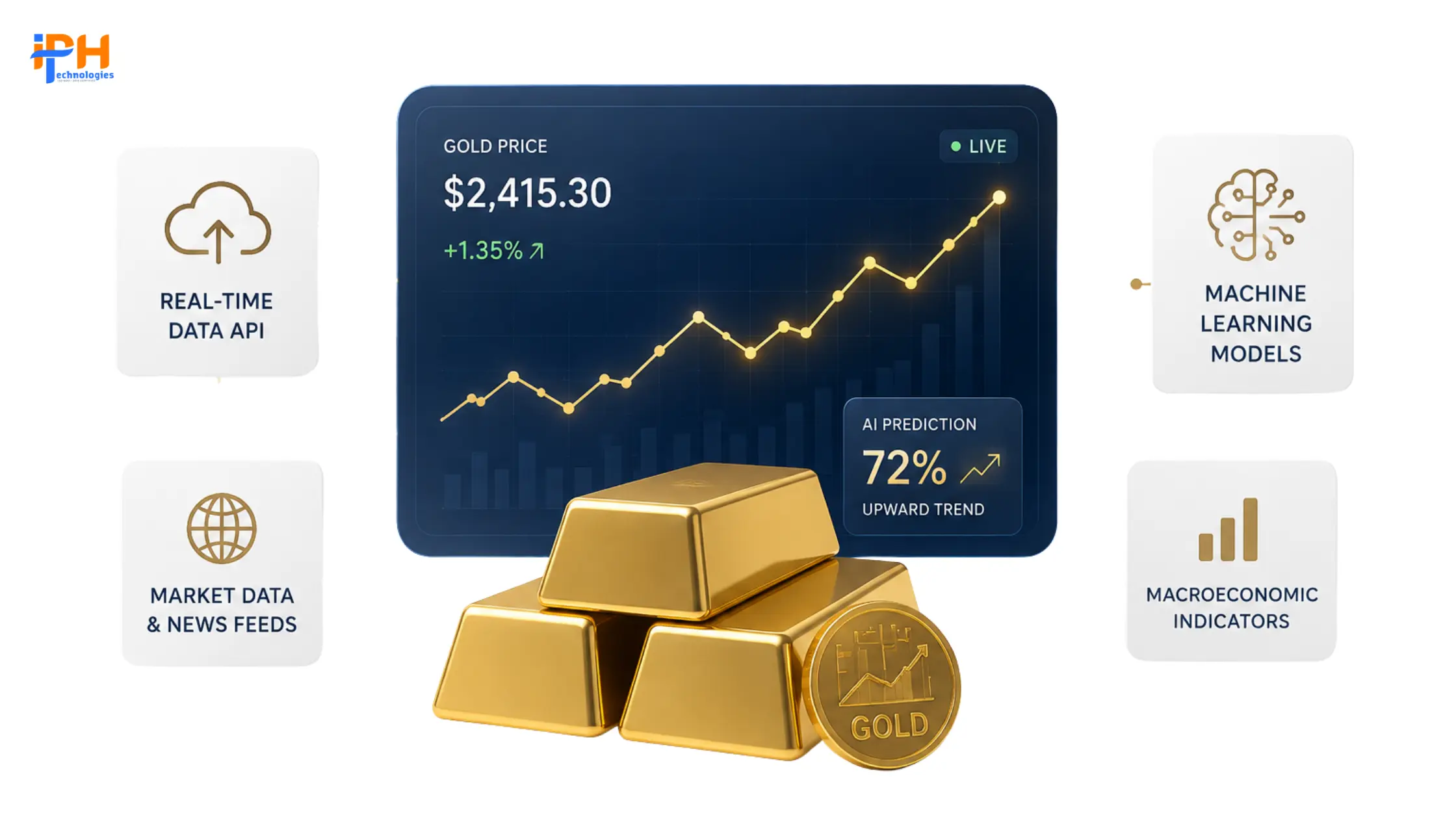
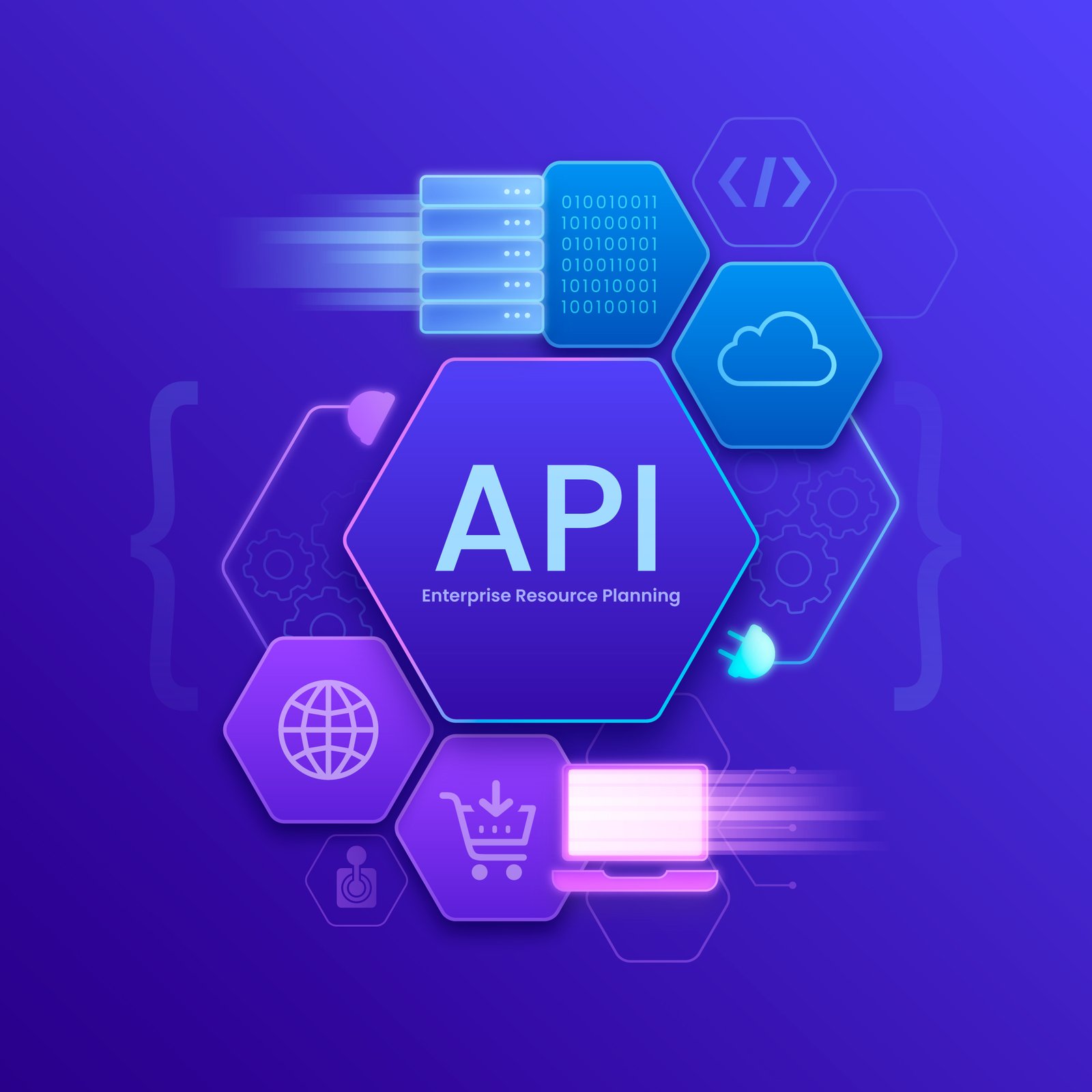
How AI-driven analytics actually work in gold markets

AI systems can predict future prices of gold by analyzing market trends. This involves constantly feeding fresh data into a learning model and comparing its solution with other data sets on the economy and market psychology, all in fractions of a second, resulting not in one prediction but a constantly updated probability distribution.

Real-Time Gold Price API and Live Spot Price Integration

Any AI’s pricing model implementation is only as good as the data that feeds it. For this reason, it’s crucial to implement a real-time gold price API, an algorithm that regularly updates itself on gold’s price per ounce from any given source, whether that be COMEX, LBMA, or an external provider.

Most modern platforms use multiple, redundant feeds, so that if one source freezes or becomes inaccurate, switching to the next one happens instantly, not letting traders (or customers) see an out-of-date price. That’s a detail that most dealers would not think about ahead of a volatile session in which a pricing error could cost them dearly.

Machine Learning Models Used in Precious Metals Pricing Engines

Several model classes are recurrent in pricing algorithms for precious metals: long short-term memory networks (LSTM) for time series forecasting, gradient boosted decision trees for short-term directional prediction, and sentiment analysis NLP models that ingest news/social data for market moving information extraction.

LSTM networks are good at predicting prices of gold since they can learn long-term patterns and dependencies, thus, being able to account for a decision made by the Fed three weeks ago which still affects the price today.

No single model gets it right consistently; the platforms that perform best blend several models and weight their outputs dynamically based on current market conditions. That ensemble approach is a hallmark of serious Bullion Software Development, not an afterthought bolted on later.

Market Data Feeds, News Sentiment, and Macroeconomic Indicators

Beyond spot prices, robust prediction models pull in third-party market data feeds covering currency exchange rates, bond yields, and central bank policy statements. News sentiment analysis scanning Reuters, Bloomberg, and financial Twitter/X for language patterns adds another layer, since gold is famously reactive to headline risk around inflation, war, and monetary policy.

Macroeconomic indicators worth tracking include the US Dollar Index (DXY), 10-year Treasury real yields, and global ETF holdings data, all of which have historically shown strong inverse or direct correlation with gold price movement. A well-built pricing engine doesn’t just track gold in isolation it tracks gold’s relationship to everything else.

Read More: How AI is Revolutionizing in Bullion Software Development in 2026

Core Features of AI-Powered Bullion Trading Software

The attributes of a dealership tracking software that matter most to car traders are predictive pricing engines, automated spread control, and inventory systems that are able to update in real time across all outlets and sales channels. All the rest are mere accessories.

Predictive Pricing Engines and Melt Value Calculators

A precious metals pricing engine (the software that automatically calculates buy and sell prices based on current spot prices, premiums and dealer-defined spreads) sits at the heart of any serious bullion platform. Combined with a melt value calculator (that determines the value of the metals contained in a coin or piece of jewelry based on purity and weight) it provides dealers with the pricing power that manual calculations simply can’t match, when it comes to mixed inventory of 22k, 18k and sterling silver.

Inventory Tracking and Multi-Location Inventory Sync

For dealers with multiple storefronts, or who split inventory between retail, vault, and online listings, multi-location inventory syncing is an essential tool to understand exactly where inventory is at any given time. Along with barcoding and lot-level tracking, it provides an accurate, real-time view of what inventory a dealer has on hand and at what cost basis.

Read More: Branded White Label Bullion Application

Benefits of AI-Driven Trend Prediction for Traders and Dealers

The main advantage of using AI systems for predicting trends is the ability to make calculations faster and at a bigger scale, thus optimizing inventory and reducing costs while being able to adapt to sudden changes in demand. These advantages add up throughout the whole trading season.

Improved Decision-Making for Coin Dealers and Bullion Brokers

When a coin dealer or bullion broker has access to a forecasting model which identifies weighted price direction over the next 24-72 hour period, it fundamentally changes the way they make buy and sell decisions; not just on the spot market, but with respect to how much inventory they want to carry in any given session.

Risk Reduction Through Predictive Inventory Management

The predictive nature of the system can be similarly applied to inventory management. It helps track imbalances in levels of a particular metal at a specific dealer, whether they are overexposed to the risk of depreciation or underexposed ahead of demand surges.

Bullion businesses using AI-assisted inventory forecasting have reported inventory carrying cost reductions in the double digits within the first year of deployment.

Faster Response to Market Volatility

Gold can move 2-3% in a single trading session during a genuine risk-off event – a currency crisis, a surprise rate decision, a geopolitical shock. Platforms with real-time gold price API integration and automated repricing respond to that volatility in seconds rather than the minutes or hours a manual process would take, protecting margin on both sides of the transaction.

Read More: Bullion ERP vs Traditional Accounting Software: What’s Better for Jewelers & Traders

Technical Architecture Behind AI Gold Price Prediction
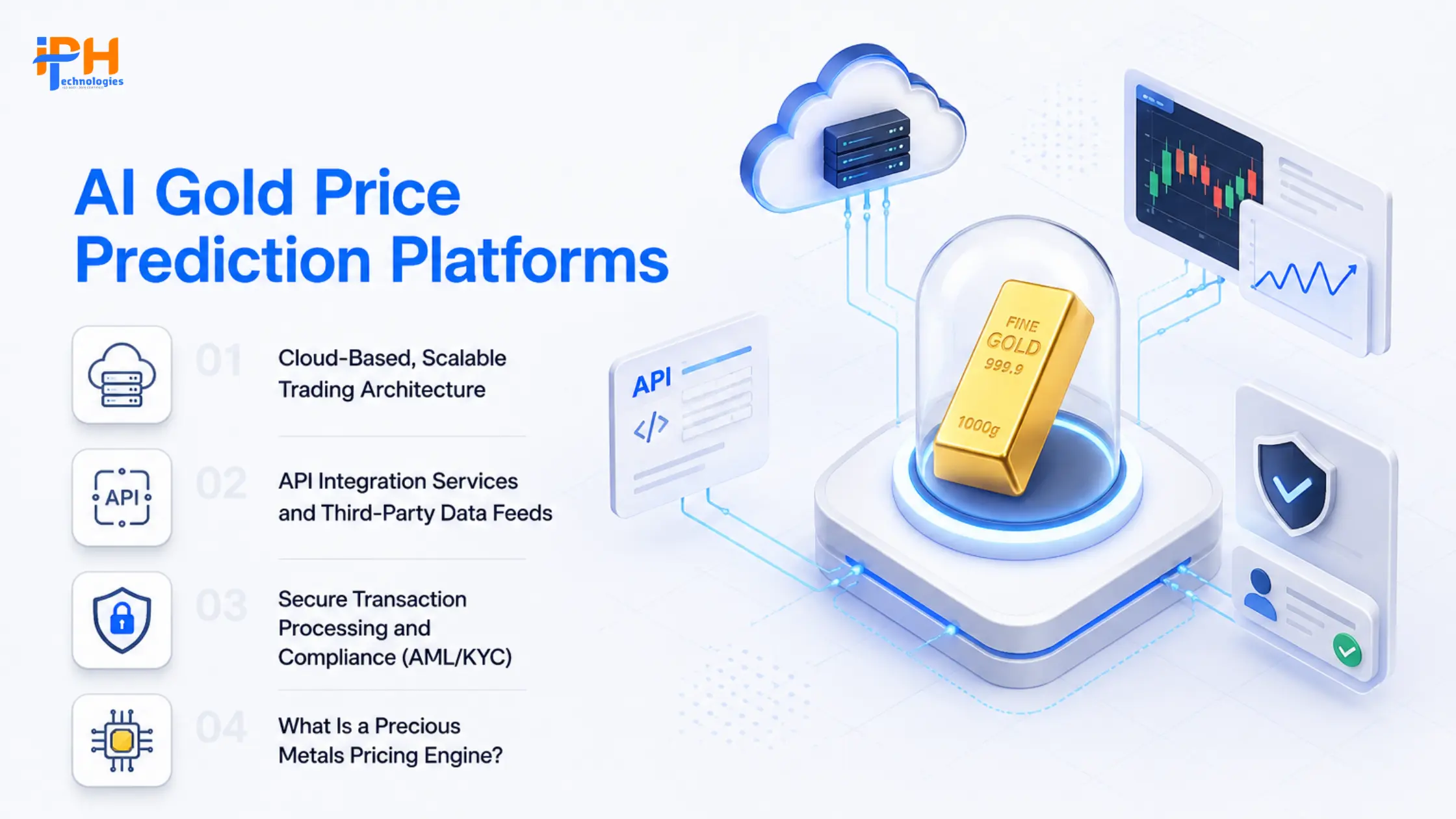
Technical architecture behind AI gold price prediction platforms

The technical foundation of any AI-driven bullion platform comes down to three things: cloud infrastructure that scales under load, reliable API connections to market data, and secure, compliant transaction processing. Get any one of these wrong and the whole system becomes a liability rather than an asset.

Cloud-Based, Scalable Trading Architecture

A cloud-based bullion platform built on infrastructure like AWS or Google Cloud can scale computing resources up during high-traffic trading windows (a gold price spike during a bank holiday weekend, for example) and back down during quiet periods, keeping costs proportional to actual usage. This scalable trading architecture matters more than most dealers realize until they hit a traffic spike their old on-premise server can’t handle.

API Integration Services and Third-Party Data Feeds

Good Bullion Software Development is fundamentally an integration exercise. The platform itself needs to talk to spot price feeds, payment gateways, shipping and insurance providers, and often a CRM or accounting system – all through API integration services that need to be reliable, well-documented, and built with failover in mind. This is one of the areas where experience really separates development firms; anyone can call an API once, but building for the times it fails is a different skill entirely.

Secure Transaction Processing and Compliance (AML/KYC)

Precious metals transactions above certain thresholds trigger regulatory obligations, which means secure transaction processing has to be built alongside AML (anti-money laundering) tracking and KYC (know your customer) verification software from day one – not added later as a compliance afterthought. Retrofitting compliance into an existing platform is dramatically more expensive and error-prone than building it in from the architecture stage.

Read More: AI Powered KYC for GOLD Dealers in USA

What Is a Precious Metals Pricing Engine?

A precious metals pricing engine is the core software module responsible for calculating live, accurate buy and sell prices for gold, silver, platinum, and palladium products based on real-time spot rates, applicable premiums, and dealer-configured margins. It’s the single most business-critical component of any bullion trading platform.

Comparison of SaaS vs. Custom-Built Precious Metals Trading Software

FactorSaaS Bullion PlatformCustom-Built Bullion Platform
Upfront CostLow — subscription-basedHigher — full development investment
Time to LaunchFast, typically weeksLonger, typically months
CustomizationLimited to vendor’s feature setFully tailored to business workflow
ScalabilityDepends on vendor’s infrastructureBuilt to scale with your business
Compliance FlexibilityStandardized, may not fit niche needsConfigurable to specific jurisdictions
Data OwnershipOften vendor-controlledFully owned by the business
Best FitSmall-to-mid dealers testing the modelEstablished dealers, refiners, high-volume brokers

Challenges and Limitations of AI in Bullion Price Forecasting

AI forecasting improves decision speed and pattern recognition, but it isn’t a crystal ball – data quality problems, thin-market manipulation, and over-reliance on automation without human oversight can all undermine model accuracy. Being upfront about these limitations is part of building trust with traders who’ve seen “guaranteed” trading systems fail before.

Data Quality and Market Manipulation Risks

Machine learning models are only as reliable as the data they’re trained on. Gold markets, particularly in thinner trading sessions, are susceptible to spoofing and short-term manipulation that can generate misleading signals if a model isn’t designed to filter for anomalous volume spikes. A poorly built pricing engine can actually amplify a bad signal rather than catch it.

Even the most sophisticated forecasting model is vulnerable to garbage-in, garbage-out — data pipeline quality matters more than model sophistication. This is a genuine tradeoff worth acknowledging: a simpler model fed clean, well-validated data will often outperform a complex model fed noisy data.

Balancing Automation with Human Trading Expertise

The dealers getting the best results aren’t the ones who’ve fully automated every decision – they’re the ones using AI-driven analytics as a decision-support tool while keeping experienced traders in the loop for judgment calls the model can’t make (a sudden geopolitical event with no historical precedent, for example). Full automation without human oversight tends to work fine right up until the one scenario nobody trained the model on.

Read More: Innovations in Bullion Software Development You Should Know About

Choosing the Right AI-Driven Bullion Software Development Partner

The right partner to develop AI-driven bullion software would be one that has experience in financial or trading platforms, has the technical know-how to build an API-first solution, and a track-record of delivering compliant and scalable applications.

Key Features to Look for in Custom Software Development

When evaluating a partner for custom software development, look past the sales pitch and ask specific questions: What real-time gold price APIs have they integrated before? Do they have direct experience with AML/KYC compliance requirements for precious metals? Can they show a portfolio of similar fintech or trading platforms, not just generic e-commerce apps?

This is where a company like IPH Technologies often excels when it comes to talking to dealers: 500+ successfully executed projects and 430+ satisfied clients in the fields of mobile app development, web application development, and custom software engineering, with an agile approach that prioritizes iterative development and transparency over a black-box six-month build.

Their work on real-time gold and silver rate applications serves as a good reference for dealers looking to understand what a modern, live-pricing bullion platform should look like in practice.

SaaS vs. Custom-Built Precious Metals Solutions

The SaaS versus custom built decision depends on volume and specificity. With a small dealer just starting out with digital pricing, it is reasonable to start with a SaaS precious metals solution to test the waters before investing into an entirely custom built system.

But at a certain point where transaction volume, compliance complexity, or multi-jurisdictional operations start to ramp up the out-of-the-box flexibility of custom Bullion Software Development typically pays for itself many times over in terms of increased efficiency and reduced costs.

The Future of AI and Gold Price Trend Prediction

The next stage in AI development in precious metals trading revolves around deeper blockchain integration for provenance/settlement and more sophisticated ERP systems that consolidate pricing, inventory, and compliance into a predictive, unified platform, versus disparate modules.

Blockchain and AI Convergence in Precious Metals Trading

Blockchain for precious metals is starting to intersect meaningfully with AI-driven trading platforms particularly around provenance verification for certified coins and allocated bullion storage, where an immutable record adds real trust value for buyers wary of counterfeit products.

What’s Next for Precious Metals ERP and Trading Platforms?

Expect precious metals ERP systems to keep absorbing functionality that used to live in separate tools – pricing, AML/KYC, multi-location inventory, and predictive analytics converging into unified platforms. Dealers still running five or six disconnected systems to manage one business are, functionally, competing with one hand tied behind their back against dealers running unified, AI-driven platforms.

Read More: How Bullion Software Development Is Transforming Precious Metals Trading in 2026

AI-Driven Bullion Platform Feature Adoption by Dealer Size

FeatureSmall Dealers (Under $2M Volume)Mid-Size Dealers ($2M–$20M)Large Dealers/Refiners ($20M+)
Real-Time Spot Price IntegrationCommonStandardStandard
AI Predictive Pricing EngineEmergingCommonStandard
Automated Spread ManagementRareEmergingCommon
Multi-Location Inventory SyncRareCommonStandard
AML/KYC AutomationBasicCommonStandard
Blockchain Provenance TrackingRareRareEmerging

Conclusion

AI-driven analytics have fundamentally changed how gold price trends get predicted — from reactive, chart-based guesswork to real-time, multi-source forecasting that adjusts pricing and inventory decisions in seconds.

Getting that architecture right isn’t a weekend project, and it’s not something to hand off to a generalist developer who’s never touched financial data or compliance requirements. Whether you’re weighing SaaS versus a fully custom-built platform, or you already know you need a development partner with real fintech experience, this decision shapes everything downstream from how accurately your platform predicts price trends to how well it holds up under regulatory scrutiny.

Working with a team that’s shipped live bullion pricing applications like IPH Technologies, with its track record across 500+ projects and a portfolio that includes real-time gold and silver rate platforms makes that decision considerably less risky. If you’re serious about building or upgrading your bullion trading software, that’s the conversation worth having next.

Frequently Asked Questions (FAQs)

What is AI-driven analytics in gold trading?

AI-driven analyses apply machine learning to current and past market data, including prices of gold, economic indicators, news sentiment, and other factors, in order to forecast potential market movements.

How accurate is AI gold price prediction?

AI predictions may help analyze the short-term trends, but it cannot be considered accurate since it is only a theory. The most effective method of the two is using the probabilities and the human factor in the mix.

What's the difference between a real-time gold price API and a pricing engine?

A real-time gold price API differs from a pricing engine which employs the former’s data to determine bid and ask prices, incorporating spreads, margins, and adjustments.

AI predicts demand and price trends to help dealers identify inventory risks, lowering excess stock, carrying costs, and exposure to the market.

Is blockchain necessary for bullion software development?

No. Blockchain technology is optional but could enhance provenance of bullion, particularly certified or allocated bullion, as well as authentication and trust.

What compliance features should bullion trading software include?

Among key features to consider when selecting a crypto trading platform are anti-money laundering monitoring, KYC verification, tax reporting, and transaction tracking. It is better if these functions are built into the platform at its foundation.

Avatar
Lekha Mishra

Verified CEO

About the Author

I'm Lekha Mishra, Co-Founder of IPH Technologies, a 6x award-winning software and mobile solutions provider. My mission is to empower global entrepreneurs by transforming visionary ideas into powerful, market-ready products. We move beyond code to provide strategic insights and a competitive edge, specializing in intelligent solutions powered by AI and ML. I believe in leveraging these technologies to unlock new possibilities, drive growth, and deliver unparalleled value. Let's connect and turn your vision into a lasting legacy.


WhatsApp
Call us
Get a Call Back