









































































































Native vs Cross Platform App Development Which Is Better choice in 2026
Introduction:
Picture this: You’re standing at a crossroads with your revolutionary app idea, and you need to make a critical decision that could determine your project’s success or failure. Should you go native or cross-platform? In 2026, this question has become more nuanced than ever before, with emerging technologies and frameworks reshaping the mobile development landscape.
The mobile app market continues to explode, with billions of users worldwide relying on mobile applications for everything from banking to entertainment. Making the right development approach crucial for capturing your share of this massive opportunity. At IPH Technologies, with our track record of 500+ successful projects and 430+ satisfied clients, we’ve witnessed firsthand how this decision impacts businesses across industries.
But here’s the million-dollar question: Is there really a clear winner, or does the answer depend on your unique circumstances? Let’s dive deep into this debate and help you make an informed decision that aligns with your business goals and budget.
What Is Cross-Platform App Development?
Cross-platform app development is like being multilingual in the app world—you write code once and deploy it across multiple platforms. Instead of creating separate applications for iOS and Android, developers use frameworks like React Native, Flutter, or Xamarin to build apps that run seamlessly on both operating systems.
Think of it as creating a universal remote control that works with every TV brand, rather than having separate remotes for Samsung, LG, and Sony. The core functionality remains the same, but it adapts to each platform’s specific requirements.
Modern cross-platform frameworks have evolved significantly over the past few years. Flutter, backed by Google, has gained tremendous popularity among developers for its expressive UI capabilities and fast performance. React Native, supported by Meta (Facebook), continues to dominate with its massive developer community and extensive library ecosystem. These frameworks bridge the gap between web and mobile development, allowing developers to leverage familiar programming languages like JavaScript and Dart.
Also read- Low-Code/No-Code Automation Transform Business Processes in 2026
Advantages of Cross-Platform Development
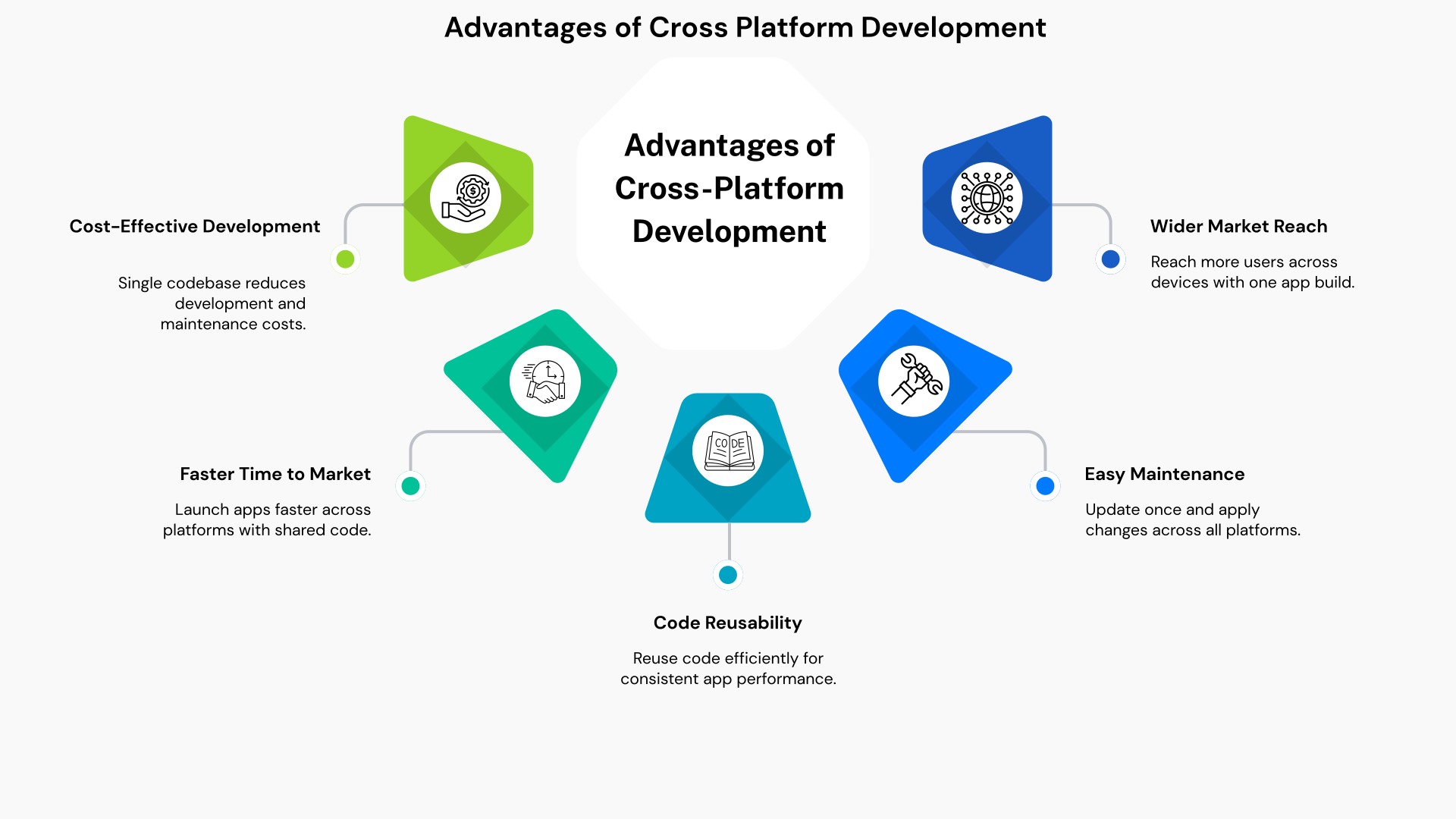
Cost-Effectiveness and Resource Optimization
Let’s talk money. Cross-platform development typically reduces costs by 30-40% compared to building separate native apps. Why? You’re essentially paying for one development team instead of two. Your iOS and Android apps share the same codebase, which means less code to write, test, and maintain.
Instead of hiring separate iOS developers proficient in Swift and Android developers skilled in Kotlin, you need a single team working with one framework. This consolidation doesn’t just save on salaries—it reduces project management overhead, streamlines communication, and simplifies quality assurance processes.
Faster Development Cycles
Time is money, especially in the fast-paced tech world. Cross-platform frameworks allow you to launch your app 50-60% faster than native development. Instead of building and debugging two separate applications, your team focuses on a single codebase that works across platforms.
Imagine you’ve identified a market opportunity and need to launch quickly before competitors. Cross-platform development lets you hit both the Apple App Store and Google Play Store simultaneously, maximizing your market penetration from day one. This speed advantage can be the difference between capturing market share and being left behind.
Code Reusability Benefits
Here’s where cross-platform really shines: you can reuse 60-90% of your code across platforms. This isn’t just about the initial build—it’s about every update, feature addition, and bug fix moving forward. Change once, deploy everywhere.
When you need to add a new feature, fix a bug, or update your app’s functionality, you do it once in your shared codebase. Compare this to native development where the same change must be implemented twice—once for iOS and once for Android—doubling the effort, time, and potential for inconsistencies.
Limitations of Cross-Platform Development
Performance Constraints
Let’s be honest—cross-platform apps run through an abstraction layer, which can impact performance. While modern frameworks have dramatically narrowed this gap, resource-intensive applications like high-end games or complex AR/VR experiences may experience 10-15% performance degradation compared to native apps.
The abstraction layer acts as a translator between your code and the native platform, which introduces overhead. For most business applications, social media apps, or e-commerce platforms, this performance difference is negligible and unnoticeable to users. However, if you’re building a graphically intensive 3D game or a real-time video processing app, that performance gap becomes significant.
Platform-Specific Feature Access
Whenever Apple or Google releases new platform features, native developers get immediate access. Cross-platform developers? They wait for framework updates to support these features, which can take weeks or even months. This delay can be frustrating if you’re trying to leverage the latest iOS or Android capabilities.
For instance, when Apple introduces a groundbreaking new ARKit feature or Android releases an innovative material design component, native apps can implement it immediately. Cross-platform apps must wait for their framework maintainers to create support, test it, and release an update. If being first-to-market with cutting-edge features is critical to your competitive advantage, this delay matters.
Also read- Blockchain Integration in Mobile Apps: Complete Guide 2025
What Is Native App Development?
Native app development is the purist’s approach—building applications specifically for iOS using Swift or Objective-C, and for Android using Kotlin or Java. These apps are crafted to leverage every capability of their respective platforms, speaking the native language of the operating system.
It’s like having a tailor-made suit versus buying off-the-rack. Sure, both get you dressed, but one fits perfectly and showcases quality craftsmanship that’s immediately noticeable. Native development means your app is built from the ground up to work seamlessly with the specific platform’s architecture, design guidelines, and performance characteristics.
Native apps have complete access to device hardware, platform-specific APIs, and all the tools that Apple and Google provide to their developers. This unrestricted access translates into apps that feel natural on their respective platforms, delivering experiences that users have come to expect from high-quality mobile applications.
Advantages of Native App Development
Superior Performance
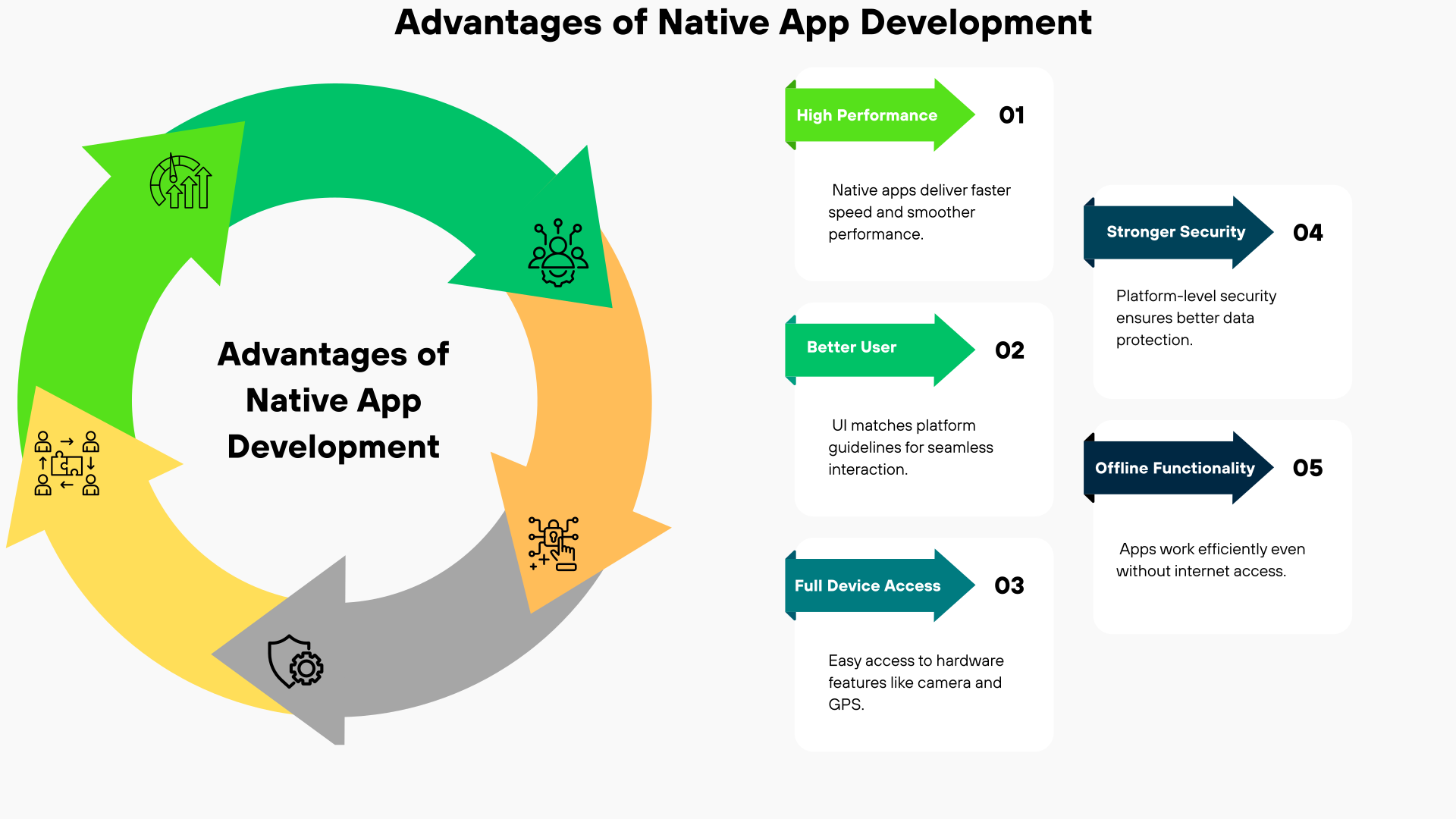
Native apps don’t mess around—they deliver 100% platform optimization and blazing-fast performance. Native applications consistently outperform cross-platform alternatives by 20-40% in computation-heavy tasks because there’s no intermediary layer between your code and the device’s hardware.
When you’re scrolling through Instagram, playing a graphics-intensive game, or using a sophisticated photo editing app, you’re experiencing the power of native development. Every animation is buttery smooth, every interaction feels instantaneous, and the app responds exactly as you’d expect without any lag or stuttering.
Enhanced Security Features
When you’re dealing with sensitive user data, security isn’t negotiable. Native apps provide direct access to platform-specific security features, encryption protocols, and biometric authentication systems without intermediary layers that could introduce vulnerabilities.
Banking apps, healthcare applications, and enterprise software handling confidential information almost always choose native development. Why? Because security breaches can cost companies millions in damages and irreparably harm customer trust. Native development provides the tightest security implementation possible, with direct integration into platform-level security features like Keychain on iOS or KeyStore on Android.
Seamless Platform Integration
Native development gives you unfettered access to device hardware, latest APIs, and platform-specific features the moment they’re released. Want to integrate with Apple’s latest ARKit update or Android’s newest Material Design components? Native development has you covered from day one.
Your app can leverage every sensor, every hardware capability, and every software feature without limitations. Need to access the gyroscope, magnetometer, barometer, or any other device component? Native apps integrate effortlessly. This seamless integration extends to system-level features like widgets, live activities, notifications, and deep linking.
Limitations of Native App Development
Higher Development Costs
Here’s the reality check: building two separate native apps can cost 2x to 2.5x more than cross-platform development. You’re essentially funding two complete projects with separate teams, codebases, and maintenance cycles.
Your iOS team writes code in Swift, your Android team writes code in Kotlin, and neither codebase helps the other. Every feature must be designed, developed, and tested twice. Every bug fix requires two implementations. Every update means double the work. For startups and small businesses with limited budgets, this reality can be prohibitive.
Extended Timeline
Patience is required with native development. Building separate iOS and Android apps typically extends your time-to-market by 40-60%. If you’re racing to launch before competitors, this timeline might not align with your business objectives.
Consider a scenario where your competitor is using cross-platform development and launches their app in 4 months, capturing early market share and building brand awareness. Meanwhile, your native apps won’t be ready for another 3-4 months. In rapidly evolving markets, this head start can be decisive. First-mover advantage is real, and sometimes speed trumps perfection.
Also read- 10 MVP Features You Must Have (And 5 to Skip) | 2025 Guide
The Hybrid-Native Approach Best of Both Worlds
Now, here’s where IPH Technologies brings innovation to the table. Why choose between chocolate and vanilla when you can have swirl? The hybrid-native approach represents the evolution of mobile development thinking—a pragmatic solution that combines the best aspects of both worlds.
Strategic Module Separation
The hybrid-native approach involves identifying which components of your app demand native performance and which can thrive on cross-platform frameworks. We typically architect apps with:
- Performance-critical modules (real-time processing, complex animations, game engines) built natively
- Standard UI and business logic developed cross-platform for efficiency
- Native bridges for platform-specific integrations and hardware access
This strategic separation means you’re not making an all-or-nothing decision. Instead, you’re thoughtfully evaluating each component of your application and choosing the optimal development approach for that specific functionality. It’s like building a car where the engine is precision-engineered for performance, but the interior uses standardized components for cost-efficiency.
Real-World Implementation
In one of our recent projects for a fintech client, we achieved 35% cost savings while maintaining 92% native-level performance by strategically implementing this hybrid approach. The transaction processing engine was built natively for security and speed, while the user interface leveraged React Native for rapid development.
The result? A banking app that processes thousands of transactions daily with bank-grade security, yet cost significantly less than a fully native solution and launched faster than traditional development timelines suggested. This hybrid approach allowed our client to allocate saved budget toward marketing and customer acquisition instead of inflated development costs.
Future-Proofing Your Investment: 5-Year Technology Roadmap
Think beyond the launch date. Your app isn’t a one-and-done project—it’s a living product that will evolve with your business. The development approach you choose today will impact your company for years to come, affecting everything from maintenance costs to feature development speed.
Scalability Considerations
Most successful apps undergo major architectural changes within their first three years. Your initial development choice should accommodate future expansion, whether that’s integrating AI/ML capabilities, supporting IoT devices, scaling to millions of users, or expanding into new markets.
Ask yourself: Where will my app be in three years? Will you need to add augmented reality features? Will you integrate with wearable devices? Will your user base grow from thousands to millions? These aren’t hypothetical questions—they’re strategic considerations that should inform your development decision today. An app that can’t scale with your business becomes a liability rather than an asset.
Technology Evolution Planning
Framework longevity matters immensely. React Native has maintained strong community support since 2015, proving its staying power. Flutter has rapidly grown since 2017, backed by Google’s substantial resources. When choosing your development approach, consider:
- Framework maturity and community size: Larger communities mean more resources, plugins, and developers
- Corporate backing: Frameworks supported by major tech companies have more sustainable futures
- Migration complexity: If pivoting becomes necessary, how difficult will it be?
- Long-term maintenance: Will you find developers for this technology in five years?
A framework that’s trendy today but lacks corporate backing or community support might become obsolete, forcing expensive rewrites. Conversely, established native development will always be around because it’s maintained directly by Apple and Google. This long-term perspective is crucial for protecting your technology investment.
Also read- Web vs Native vs Hybrid Apps in 2025: The Ultimate Guide
Native vs Cross Platform: Performance Comparison
Let’s cut through the marketing hype and look at real-world performance metrics:
| Performance Metric | Native Apps | Cross-Platform Apps | Performance Gap |
|---|---|---|---|
| App Launch Time | 1.2 seconds | 1.8 seconds | 50% slower |
| Frame Rate (Gaming) | 60 FPS | 45–55 FPS | 8–25% slower |
| Memory Usage | 100 MB baseline | 120–140 MB baseline | 20–40% higher |
| API Response Time | 150ms | 180ms | 20% slower |
| Battery Consumption | Standard | 10–15% higher | Noticeable difference |
| Animation Smoothness | Excellent | Good to Very Good | Slight difference |
Native vs Cross Platform: Time-to-Market
In today’s competitive landscape, speed matters tremendously. Cross-platform development typically delivers your app to market 3-4 months faster than native development. This timeline advantage can be the difference between capturing a market opportunity and watching competitors seize it first.
Consider the implications: If you launch three months earlier, you gain three additional months of user acquisition, revenue generation, and market feedback. You can iterate on your product based on real user data while competitors are still in development. You establish brand presence and build user loyalty before alternatives even exist.
However, if your app requires extensive platform-specific features or peak performance, that native development timeline might be worth the investment. Sometimes slower and better beats fast and mediocre. The key is understanding whether speed or quality is your competitive advantage.
Industry-Specific Recommendations
Different industries have vastly different needs, and the right choice varies accordingly:
FinTech & Banking:
Native development is strongly recommended due to stringent security requirements and performance needs for real-time transactions. Users expect banking apps to be fast, secure, and reliable. Any security breach can be catastrophic, making native development’s robust security features worth the premium cost.
E-Commerce:
Cross-platform works brilliantly for standard shopping experiences. Most e-commerce apps involve browsing products, reading reviews, and completing purchases—functionality that doesn’t require peak performance. However, high-traffic platforms processing thousands of transactions per minute benefit from native optimization.
Healthcare:
Native is preferred for apps handling sensitive medical data and requiring device integration with wearables, medical equipment, or health sensors. HIPAA compliance, data encryption, and secure communication are non-negotiable, making native development’s security advantages critical.
Social Media:
The hybrid-native approach is ideal for social platforms. Use native development for media processing, video encoding, and image filters where performance matters. Use cross-platform for UI/UX, feeds, messaging, and standard interactions where user interface consistency across platforms is valuable.
Enterprise Solutions
Cross-platform excels for internal tools where cost-efficiency and rapid deployment take priority over absolute peak performance. Employee productivity apps, internal communication tools, and business management software typically don’t require the performance ceiling of native development.
Gaming
Native development is essential for graphics-intensive games requiring smooth 60 FPS gameplay, complex physics engines, and intensive GPU usage. Casual puzzle games or turn-based games can work on cross-platform frameworks, but action games, racing games, and 3D experiences demand native performance.
Also read- Top 10 AI & Development Trends at GITEX 2025 | IPH Technologies
When to Choose Native App Development
Choose native development when:
- Your app requires intensive graphics processing for gaming, AR/VR, or complex visualizations
- Security is paramount for handling financial transactions, medical records, or government data
- You need immediate access to latest platform features for competitive differentiation
- Your target audience is platform-specific, with 80%+ users on iOS or Android
- Peak performance is non-negotiable because slow apps mean user abandonment
- You have budget flexibility allowing premium investment for superior quality
- Your app integrates deeply with device hardware like advanced camera features or sensors
- Long-term maintenance of separate codebases is manageable for your team
Native development makes sense when your app is your business, not just a tool for your business. If your revenue depends on app performance, user experience, and security, the investment in native development pays dividends through user satisfaction and retention.
When to Choose Cross-Platform App Development
Go cross-platform when
- You’re working with limited budgets common for startups, MVPs, or small businesses
- Fast time-to-market is critical for capturing market opportunities
- Your app features standard UI/UX without complex animations or intensive graphics
- You need to reach both platforms simultaneously to maximize market penetration
- Your team has limited platform-specific expertise, making hiring challenging
- The app doesn’t require intensive hardware integration beyond basic sensors
- Cost of ownership over multiple years is a primary concern
- You’re building an MVP to test market viability before committing larger resources
- Your app is a companion tool rather than your core business offering
Cross-platform development shines when pragmatism trumps perfection. If your app serves as a customer touchpoint for an existing business (like a restaurant, retail store, or service company), cross-platform’s efficiency makes perfect sense.
IPH’s Comprehensive Decision Framework
At IPH Technologies, we’ve developed a proprietary decision matrix that evaluates:
1. Business Objectives:
What are you trying to achieve? Market reach versus time constraints? First-mover advantage or market leadership through quality? Your business strategy should drive technical decisions, not the other way around.
2. Budget Constraints:
What’s your total cost of ownership over 3-5 years? Consider not just initial development but ongoing maintenance, feature additions, and potential scaling costs. A cheaper initial build that becomes expensive to maintain isn’t actually cheaper.
3. Technical Requirements:
What performance do you genuinely need? Be honest about whether you need native performance or if you’re chasing perfection unnecessarily. Most apps don’t need Ferrari performance when a Toyota will suffice.
4. User Experience Goals:
Do you need platform-specific experiences that feel native to each ecosystem, or is unified experience across platforms valuable? Some brands benefit from consistent cross-platform experiences; others want apps that feel perfectly at home on each platform.
5. Maintenance Strategy:
Who will maintain your app long-term? Do you have in-house developers or will you outsource? Native development requires platform-specific expertise, while cross-platform allows more flexible staffing.
6. Team Capabilities:
What expertise does your team have? Hiring Swift developers in some regions can be challenging, while JavaScript developers for React Native are more abundant. Your team’s existing skills matter.
This framework has guided our 430+ clients toward optimal development approaches, ensuring alignment between technical decisions and business goals. We don’t push one solution—we recommend what genuinely serves your interests.
Also read- How Much Does React Native App Development Cost in 2025 | Budget & ROI Insights
Conclusion: Which Is Better Choice in 2026?
So, which is better—native or cross-platform? The truth is, there’s no universal answer. It’s like asking whether a sports car or an SUV is better—the answer depends entirely on what you need the vehicle for, where you’ll drive it, and what you can afford.
In 2026, the lines between native and cross-platform are blurrier than ever. Modern frameworks like Flutter and React Native have dramatically improved performance, narrowing the gap to the point where most users can’t tell the difference. Simultaneously, native development tools have become more efficient, with improved IDEs, better debugging tools, and streamlined workflows.
The emergence of the hybrid-native approach offers a compelling middle ground that wasn’t viable just a few years ago. This strategy acknowledges that not all parts of your app have the same requirements—some components demand native performance while others work perfectly with cross-platform efficiency.
Here’s our recommendation based on a decade of experience and 500+ projects: Start by honestly assessing your priorities.
Choose cross-platform if you’re a startup or small business prioritizing cost-efficiency and speed-to-market. Cross-platform lets you validate your idea, gather user feedback, and generate revenue faster. You can always migrate to native later if your app’s success justifies the investment.
Choose native if you’re building a performance-critical app, handling sensitive data, or creating experiences where every millisecond matters. Native development provides the performance ceiling, security robustness, and platform integration that demanding applications require.
Choose hybrid-native if you want optimal efficiency without compromising on critical performance. This approach requires more sophisticated planning but delivers the best return on investment for complex applications that have both standard and performance-intensive components.
At IPH Technologies, we don’t believe in one-size-fits-all solutions. Our comprehensive suite of services and decade of experience ensures we match the right development approach to your unique business needs. Whether you choose native, cross-platform, or hybrid, we’re committed to delivering exceptional results that help you stay ahead in today’s competitive market.
The mobile landscape will continue evolving. New frameworks will emerge, existing ones will improve, and the debate will continue. But one thing remains constant: the best choice is the one that aligns with your business objectives, budget realities, and user expectations.
Ready to turn your visionary idea into an impactful solution? Let’s talk about which approach will drive your business forward and help you achieve your goals in 2026 and beyond.










.png)