






































































































Introduction: The Digital Transformation of Healthcare
The healthcare industry is experiencing an unprecedented digital revolution, and mobile health applications are at the forefront of this transformation. Remember when getting medical advice meant waiting weeks for an appointment? Those days are rapidly fading into the past. Today’s healthcare landscape is being reshaped by innovative mobile applications that put medical expertise right in your pocket.
The Evolution of mHealth Applications
Mobile health (mHealth) applications have evolved from simple fitness trackers to sophisticated healthcare management systems. The journey began with basic step counters and has progressed to AI-powered diagnostic tools, real-time patient monitoring systems, and comprehensive telemedicine platforms. This evolution isn’t just about technology—it’s about fundamentally changing how we approach healthcare delivery and patient engagement.
Current State of Healthcare Technology Adoption
The statistics tell a remarkable story: 43% of the U.S. population actively uses health apps, marking a significant shift in healthcare consumption patterns. The COVID-19 pandemic accelerated this adoption dramatically, with telehealth usage stabilizing at 38 times higher than pre-pandemic levels. This isn’t a temporary trend—it’s the new normal in healthcare delivery.
Healthcare App Development Market Analysis & Statistics
Global Market Size and Growth Projections
The numbers tell a compelling story of explosive growth. The global mHealth apps market is experiencing phenomenal expansion, with various market analyses showing consistent upward trajectories:
| Market Segment | 2024 Value | 2025 Projection | Future Projection | Growth Rate (CAGR) |
|---|---|---|---|---|
| Health Apps Market | $36.68B | $40.65B | $88.70B by 2032 | 11.8% |
| Alternative Analysis | $37.44B | $43.13B | $154.12B by 2034 | 15.20% |
| Conservative Estimate | $37.5B | $41.5B | $86.37B by 2030 | 14.8% |
The healthcare mobile application market presents even more dramatic growth potential, with projections showing expansion from $114.17 billion in 2024 to $1,070.58 billion by 2030, representing a remarkable compound annual growth rate of 45.2%.
Regional Market Breakdown
North America leads the global market, commanding approximately 30.56% market share in 2024, valued at $11.21 billion. The region’s dominance stems from advanced healthcare infrastructure, widespread smartphone penetration exceeding 85%, and robust reimbursement policies for digital health solutions.
Asia Pacific represents the fastest-growing region, driven by increasing smartphone adoption, rising healthcare expenditure, and government initiatives promoting digital health. Countries like India and China are experiencing explosive growth in healthcare app adoption, with year-over-year growth rates exceeding 25%.
Europe follows closely, with significant investments in digital health initiatives and a strong focus on integrating technology into existing healthcare systems. The European market is particularly focused on data privacy and interoperability standards.
Investment Trends in Healthcare Technology
The investment landscape reflects strong confidence in healthcare technology. In 2024, health tech companies attracted $25.2 billion in venture capital globally. Particularly notable is the surge in AI-powered healthcare solutions, with funding for telemedicine, AI-driven care, and remote patient monitoring increasing by nearly 300% in early 2020, a momentum that continues into 2025.
Also read- App Maintenance Costs: What Developers Don’t Tell You
Top 12 Healthcare App Development Trends Dominating
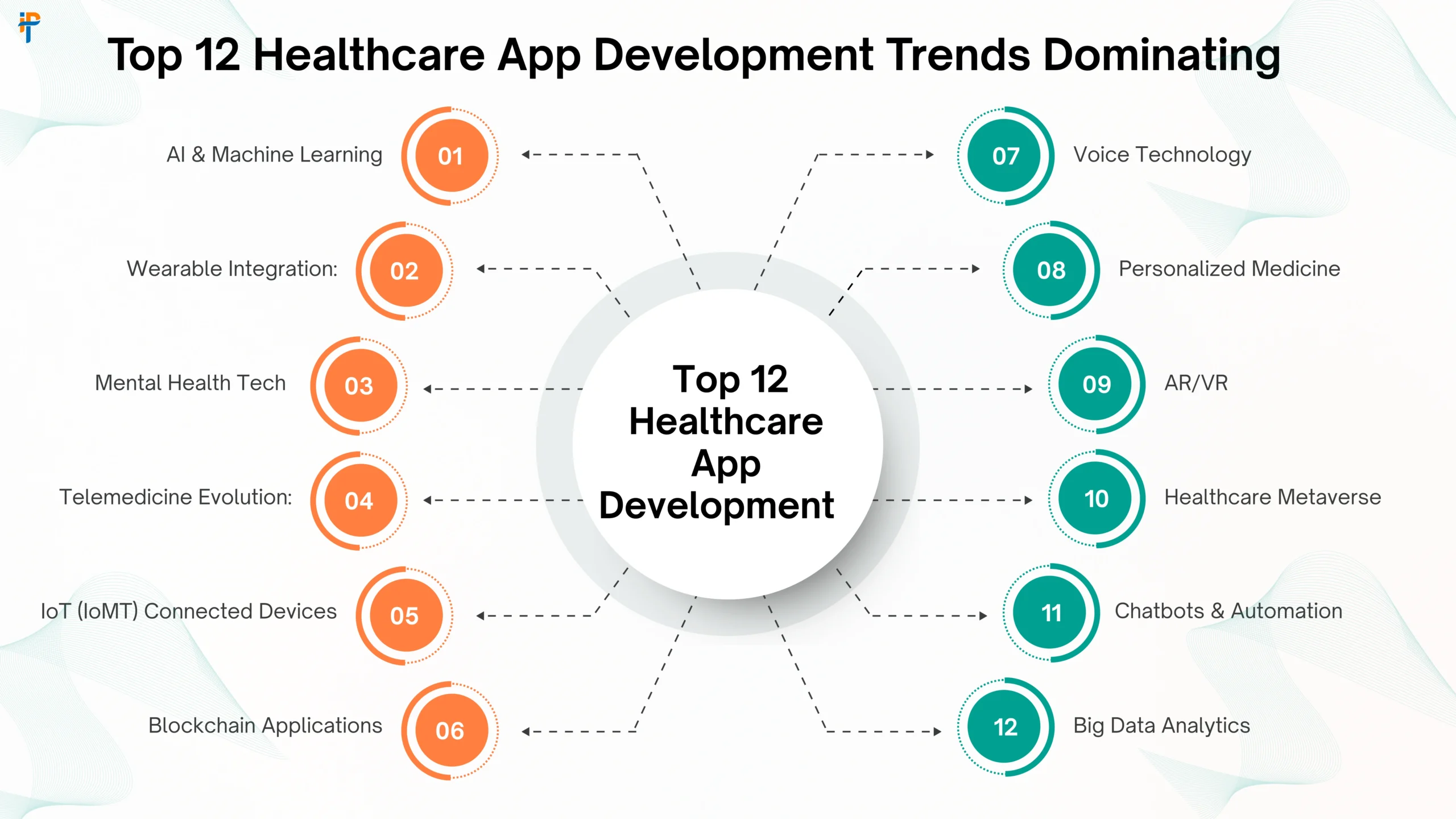
Artificial Intelligence and Machine Learning Integration
AI is no longer a futuristic concept—it’s here, transforming healthcare delivery right now. The AI in healthcare market is expected to reach $208.2 billion by 2030, growing at an impressive CAGR of 36.4%. But what does this mean in practical terms?
AI-powered healthcare apps are revolutionizing diagnostics by analyzing vast amounts of medical data to identify patterns that human practitioners might miss. For instance, AI algorithms can now reduce diagnostic times from 20 minutes to just 30 seconds for certain conditions. These applications include:
Predictive Analytics: Identifying health risks before symptoms appear, with accuracy rates exceeding 85%
AI Scribes: Automatically generating visit transcripts and clinical summaries, with investment in AI medical note-taking doubling in 2024
Personalized Treatment Plans: Tailoring healthcare recommendations based on individual patient data and genetic profiles
Chatbot Health Assistants: Providing 24/7 medical guidance and triage, now handling 26% of telemedicine interactions
Image Recognition: Detecting anomalies in X-rays, MRIs, and CT scans with accuracy comparable to experienced radiologists
Telemedicine and Virtual Care Platforms
Telemedicine has evolved from a pandemic necessity to a permanent fixture in healthcare delivery. The global telemedicine market is projected to grow from $104.6 billion in 2024 to $111.9 billion in 2025, with continued expansion expected to reach $298 billion by 2028.
Virtual care platforms now offer:
- High-definition video consultations with specialist physicians
- Remote patient monitoring with real-time data transmission
- Digital prescription management and pharmacy integration
- Integrated diagnostic tool sharing and screen annotation
- Multi-specialty consultations and second opinions
- Mental health therapy sessions with licensed professionals
Why is telemedicine so popular? It eliminates geographical barriers, reduces wait times by up to 75%, and makes healthcare accessible to underserved populations. Patients in rural areas can now consult with specialists thousands of miles away, something unimaginable just a decade ago.
Internet of Medical Things (IoMT) and Wearables
The IoMT ecosystem is exploding, with the market expected to reach $169.99 billion by 2030, witnessing a CAGR of 21.2%. The transformation in wearable technology adoption is staggering—from just 28.8 million units shipped worldwide in 2014 to an impressive 537 million units in 2024.
Modern IoMT applications include:
- Continuous glucose monitors (CGMs) for diabetes management, reducing hypoglycemic events by 40%
- Smartwatches with integrated heart rate, oxygen saturation, and ECG monitors
- Biosensors for real-time temperature and respiratory rate monitoring
- Wearable ECG monitors for cardiac patients with automatic arrhythmia detection
- Smart pills for medication adherence tracking with 98% accuracy
- Connected inhalers for asthma management
- Blood pressure cuffs with Bluetooth connectivity
Think of IoMT devices as your personal health guardians, continuously monitoring your vital signs and alerting healthcare providers to potential issues before they become emergencies. Studies show that patients using IoMT devices have 30% fewer emergency room visits.
Blockchain Technology for Data Security
Blockchain isn’t just for cryptocurrency—it’s becoming a cornerstone of healthcare data security. This technology offers immutable record-keeping, decentralized storage, and enhanced data integrity. The blockchain in the healthcare market is projected to reach $5.61 billion by 2025.
Blockchain applications in healthcare apps include:
- Secure patient data management with cryptographic protection
- Transparent prescription tracking to combat opioid abuse
- Audit trails for data access with tamper-proof logging
- Interoperable health records across multiple providers
- Smart contracts for insurance claims processing, reducing approval time by 60%
- Clinical trial data verification
- Medical credential verification for healthcare professionals
- Augmented Reality (AR) and Virtual Reality (VR)
The AR and VR healthcare market, valued at $3.7 billion in 2024, is expected to reach $19.6 billion by 2033. These immersive technologies are revolutionizing:
Surgical Training and Planning: Surgeons can practice complex procedures in virtual environments hundreds of times before operating on real patients
Pain Management Therapy: VR distraction therapy reduces pain perception by up to 50% during procedures
Physical Rehabilitation: Gamified VR exercises increase patient engagement in physical therapy by 70%
Mental Health Treatment: VR-based exposure therapy for phobias and PTSD shows 80% effectiveness rates
Medical Education: Medical students can explore 3D anatomy models and practice procedures in risk-free environments
Patient Education: Patients can visualize their conditions and treatment options in immersive 3D
Imagine a surgeon practicing a complex procedure in virtual reality hundreds of times before performing it on a real patient—that’s the power of AR/VR in healthcare.
Big Data Analytics and Predictive Healthcare
The global volume of healthcare data is expected to reach over 10,000 exabytes by 2025, with the U.S. accounting for about 30% of this total. Big data analytics transforms this massive information pool into actionable insights:
- Disease Outbreak Prediction: Identifying potential epidemics weeks before they occur
- Treatment Effectiveness Analysis: Comparing outcomes across millions of patient cases
- Hospital Resource Optimization: Predicting patient admission rates with 90% accuracy
- Population Health Management: Identifying at-risk populations for preventive interventions
- Clinical Decision Support: Providing evidence-based treatment recommendations
- Drug Development: Accelerating pharmaceutical research by analyzing molecular interactions
Big data analytics adoption in healthcare is expected to reach $67.82 billion by 2025, with clinical analytics leading the charge at 35% market share.
5G Technology Integration
5G isn’t just faster internet—it’s the backbone of future healthcare delivery. This technology reduces network latency by up to 80% compared to 4G, bringing average speeds of 1-10 Gbps. The impact on healthcare includes:
- Real-time Remote Surgery Capabilities: Surgeons can perform procedures on patients thousands of miles away with haptic feedback
- Instant Transmission: High-resolution medical imaging (4K/8K) transfers in seconds instead of minutes
- Seamless Telemedicine Experiences: Zero-lag video consultations with crystal-clear quality
- Enhanced IoT Device Connectivity: Supporting up to 1 million connected devices per square kilometer
- Improved Emergency Response: Paramedics can stream live patient data to hospitals during transport
- Mobile Health Units: Fully-equipped diagnostic capabilities in ambulances and rural clinics
Cloud-Based EHR/EMR Systems
Cloud computing enables healthcare providers to access patient information anytime, anywhere, securely. The cloud-based EHR market is projected to grow at a CAGR of 8.4% through 2028. Cloud-based electronic health records offer:
- Real-time Data Synchronization: Updates instantly across all provider locations
- AI-powered Clinical Decision Support: Flagging potential drug interactions and contraindications
- Automated Prescription Refills: Reducing pharmacy workload by 40%
- Multi-provider Coordination: Seamless information sharing for coordinated care
- Scalable Storage Solutions: Accommodating growing data volumes without infrastructure investment
- Disaster Recovery: Automatic data backup with 99.99% uptime guarantees
- Cost Reduction: 25-30% lower IT infrastructure costs compared to on-premise systems
Voice-Activated Healthcare Assistants
Voice technology is making healthcare more accessible, especially for elderly and disabled patients. Integration with platforms like Amazon Alexa, Google Home, and Apple’s Siri allows patients to:
- Set Medication Reminders: Voice-activated alerts with 95% adherence improvement
- Schedule Appointments: Book, reschedule, or cancel appointments hands-free
- Access Health Information: Ask questions and receive instant medical guidance
- Track Symptoms: Log daily health metrics using natural language
- Receive Health Tips: Personalized wellness advice based on health profiles
- Emergency Assistance: Quick access to emergency services with voice commands
- Lab Results: Receive test results verbally with explanations
Mental Health and Wellness Applications
Mental health apps are gaining significant traction, addressing the fact that nearly 1 in 4 individuals will be affected by mental disorders at some point in their lives. The mental health app market is expected to reach $17.5 billion by 2030. These applications offer:
Therapy Session Scheduling: Connect with licensed therapists via video or chat
- Mood Tracking: Daily emotional journaling with AI-powered insights
- Meditation Guidance: Guided mindfulness exercises with personalized programs
- Crisis Intervention Resources: 24/7 access to crisis helplines and resources
- Peer Support Communities: Connect with others facing similar challenges
- Cognitive Behavioral Therapy (CBT): Self-guided CBT programs with proven effectiveness
- Sleep Management: Sleep tracking and improvement techniques
- Stress Reduction: Breathing exercises and relaxation techniques
Women’s Health (FemTech) Solutions
With 50% of global healthcare app users being women, and the FemTech market expected to grow to $50 billion by 2025, this sector demands attention. FemTech apps provide:
- Menstrual Cycle Tracking: Predicting periods with 90% accuracy using AI algorithms
- Pregnancy Monitoring: Week-by-week fetal development tracking and prenatal care guidance
- Fertility Management: Ovulation prediction and conception optimization
- Menopause Support: Symptom tracking and hormone therapy management
- Personalized Wellness Plans: Nutrition and exercise recommendations based on hormonal cycles
- Breast Health Monitoring: Self-examination reminders and breast cancer awareness
- Pelvic Floor Exercise Programs: Guided Kegel exercises with biofeedback
- Reproductive Health Education: Comprehensive information on women’s health topics
Gamification in Healthcare Apps
Gamification transforms health management from a chore into an engaging activity. Studies show gamified health apps increase user engagement by 48% and improve health outcomes by 35%. By incorporating game elements, healthcare apps increase user retention through:
- Achievement Badges and Rewards: Visual recognition for reaching health milestones
- Progress Tracking Visualizations: Interactive dashboards showing health improvements
- Social Challenges and Competitions: Friendly competition with friends and family
- Educational Quests: Learn about health conditions through interactive missions
- Virtual Rewards: Earn points redeemable for health services or products
- Leaderboards: Compare progress with community members (anonymized)
- Level-Up Systems: Unlock new features as health goals are achieved
- Storytelling: Health journeys presented as narrative adventures
HIPAA Compliance & Data Security Framework for Healthcare Apps
Understanding HIPAA Requirements in 2025
HIPAA compliance isn’t optional—it’s mandatory for any healthcare app handling Protected Health Information (PHI). The stakes are high: healthcare organizations paid over $137 million in penalties for HIPAA violations as of February 2024, a dramatic increase from just $13 million in previous years. In 2024 alone, over 275 million healthcare records were breached, including the largest-ever healthcare data breach affecting approximately 190 million individuals.
The average cost of a healthcare data breach reached $10.93 million in 2024, making it the most expensive industry for data breaches. These sobering statistics underscore the critical importance of robust security measures.
Essential Security Safeguards
HIPAA mandates three types of safeguards that must work in harmony:
Technical Safeguards
| Security Measure | Implementation | Purpose |
|---|---|---|
| End-to-End Encryption | AES-256 encryption standard | Protect data in transit and at rest |
| Multi-Factor Authentication | Biometric + PIN/Password combination | Verify user identity with 99.9% accuracy |
| Access Controls | Role-based permissions (RBAC) | Limit data access to authorized users only |
| Audit Trails | Comprehensive logging system | Track all data access and modifications |
| Secure APIs | OAuth 2.0, JWT tokens | Protect data exchange between systems |
| Session Management | Auto-timeout after 15 minutes | Prevent unauthorized access |
| Data Backup | Automated daily backups | Ensure data recovery capabilities |
| Intrusion Detection | Real-time monitoring systems | Alert on suspicious activities |
Administrative Safeguards
- Security Risk Assessments: Conduct comprehensive audits annually
- Employee Training Programs: Quarterly HIPAA training for all staff members
- Incident Response Procedures: Written protocols for breach notification within 60 days
- Business Associate Agreements (BAAs): Legally binding contracts with all third-party vendors
- Documented Policies and Procedures: Updated compliance manuals
- Designated Security Officers: Appointed HIPAA compliance officer
- Workforce Clearance: Background checks and access authorization procedures
- Sanction Policies: Disciplinary measures for policy violations
Physical Safeguards
- Secure Server Facilities: Climate-controlled data centers with 24/7 security
- Device Encryption: Full-disk encryption on all mobile devices and laptops
- Remote Wipe Capabilities: Ability to erase data from lost or stolen devices
- Facility Access Controls: Biometric scanners and keycard systems
- Workstation Security: Privacy screens and locked workstations when unattended
- Device and Media Controls: Proper disposal and sanitization of hardware
- Visitor Logs: Tracking and escorting non-employees in secure areas
Business Associate Agreements (BAAs)
Any third-party vendor handling PHI must sign a Business Associate Agreement. This includes:
- Cloud service providers (AWS, Azure, Google Cloud)
- App development companies
- Analytics services (excluding fully anonymized data)
- Communication platforms (video conferencing, messaging)
- Data storage providers
- Payment processing services
- Marketing platforms accessing patient data
The typical cost of HIPAA-compliant app development ranges from $45,000 to $300,000, with annual maintenance costs of $4,000-$12,000. These costs reflect the additional security layers, compliance documentation, and ongoing auditing requirements.
Also Read- AI App Development Cost in 2025: From MVPs to Full-Scale Solutions
Building Healthcare Apps Users and Providers Trust
User-Centric Design Principles
Trust begins with design. Healthcare apps must prioritize:
- Intuitive Navigation: Users should find what they need within three clicks maximum
- Clear Privacy Policies: Transparency about data usage written in plain language, not legal jargon
- Accessibility: Compliance with WCAG 2.1 AA guidelines for users with disabilities
- Consistent User Experience: Seamless functionality across iOS, Android, and web platforms
- Cultural Sensitivity: Multilingual support (minimum 3 languages) and culturally appropriate content
- Fast Load Times: Pages loading in under 3 seconds to prevent user frustration
- Minimal Data Collection: Request only essential information, not “nice-to-have” data
- Error Prevention: Clear validation messages and confirmation dialogs for critical actions
Transparency in Data Usage
Users want to know how their data is being used. Successful healthcare apps:
- Provide Clear Consent Mechanisms: Explicit opt-in for data sharing, not buried in terms of service
- Explain Data Sharing Practices: Who has access to data and for what purposes
- Offer Granular Privacy Controls: Users can control what data is shared and with whom
- Allow Users to Download Their Data: Export functionality in standard formats (PDF, CSV)
- Implement “Privacy by Design” Principles: Security considerations from the first line of code
- Regular Privacy Updates: Notify users of any policy changes with clear explanations
- Data Retention Policies: Clearly state how long data is kept and when it’s deleted
- Third-Party Disclosure: List all external services that access user data
Ensuring Interoperability
Healthcare data should flow seamlessly between systems. Interoperability standards include:
- HL7 FHIR (Fast Healthcare Interoperability Resources): Modern API-based standard for health data exchange
- DICOM: Standard for medical imaging storage and transmission
- IHE Profiles: (Integrating the Healthcare Enterprise) implementation guidelines
- API-Driven Architectures: RESTful APIs for easy system integration
- Standard Terminologies: SNOMED CT, LOINC, ICD-10 for consistent medical coding
- CDA Documents: Clinical Document Architecture for structured medical documents
- Direct Messaging: Secure email-like system for provider-to-provider communication
Key Benefits of Modern Healthcare Mobile Applications
Benefits for Patients
- 24/7 Access to Healthcare: Consult doctors anytime, anywhere, eliminating time zone and schedule constraints
- Reduced Costs: Save an average of $100 per visit on transportation, parking, and time off work
- Better Health Outcomes: Studies show mHealth apps can reduce hospital readmission rates by 20% and improve chronic disease management by 35%
- Empowered Health Management: Take control of chronic conditions with real-time data and insights
- Medication Adherence: Automated reminders improve compliance rates from 50% to 85%
- Shorter Wait Times: Average wait time reduced from 18 days to same-day appointments
- Second Opinions: Easy access to specialist consultations without travel
- Health Literacy: Educational resources helping patients understand their conditions better
- Privacy: Discuss sensitive health issues from the comfort of home
Benefits for Healthcare Providers
- Expanded Patient Reach: Serve patients beyond geographical boundaries, potentially tripling patient base
- Improved Efficiency: Reduce administrative burden by up to 40%, freeing time for patient care
- Enhanced Patient Engagement: Continuous connection with patients leads to 60% better treatment adherence
- Data-Driven Decisions: Access to real-time patient data improves diagnostic accuracy by 30%
- Revenue Growth: Increase patient volume by 150% and diversify service offerings
- Reduced No-Shows: Automated reminders decrease missed appointments by 70%
- Better Documentation: Digital records are more complete and legible than paper charts
- Continuity of Care: Easy collaboration with other specialists and care team members
- Work-Life Balance: Flexible scheduling options and remote consultation capabilities
Benefits for Healthcare Administrators
- Cost Reduction: Decreased overhead (rent, utilities, staffing) by 25–35%
- Resource Optimization: Better allocation of healthcare resources based on demand analytics
- Compliance Management: Automated regulatory reporting saves 100+ administrative hours monthly
- Performance Analytics: Track key performance indicators with real-time dashboards
- Competitive Advantage: Stay ahead in the digital healthcare race and attract tech-savvy patients
- Scalability: Serve more patients without proportional increase in infrastructure costs
- Risk Management: Better tracking of adverse events and quality metrics
- Staff Satisfaction: Reduced burnout through streamlined workflows
- Market Expansion: Enter new geographical markets without physical presence
Also Read:10 MVP Features You Must Have (And 5 to Skip) | 2025 Guide
Implementation Roadmap: From Concept to Launch
Planning and Requirements Gathering
- Define Target Audience: Identify primary users (patients, providers, administrators)
- Conduct Market Research: Analyze competitors and identify market gaps
- Establish Compliance Requirements: Determine applicable regulations (HIPAA, GDPR, FDA, PIPEDA)
- Create Technical Specifications: Document functional and non-functional requirements
- Develop Project Timeline: Create realistic milestones with buffer time
- Budget Planning: Allocate funds for development, testing, compliance, and marketing
- Stakeholder Interviews: Gather input from potential users and healthcare professionals
- Risk Assessment: Identify potential challenges and mitigation strategies
Design and Architecture
- Create User Personas: Develop detailed profiles of typical users
- User Journey Mapping: Visualize how users will interact with the app
- Design Wireframes: Create low-fidelity sketches of all screens
- Develop Prototypes: Build interactive mockups for user testing
- Information Architecture: Structure content and navigation logically
- Plan Data Security Architecture: Design encryption, authentication, and authorization systems
- Design APIs: Plan integration points with EHR systems, payment gateways, etc.
- Database Schema Design: Structure data storage for scalability and security
- UI/UX Design: Create high-fidelity mockups with branding elements
Development and Testing
- Implement Core Features: Build MVP functionality first
- Integrate Third-Party Services: Connect payment processors, video platforms, SMS gateways
- Security Testing: Conduct penetration testing and vulnerability assessments
- Usability Testing: Test with real users (minimum 20 participants per user type)
- Performance Optimization: Ensure app loads quickly and handles peak loads
- Cross-Platform Testing: Verify functionality on iOS, Android, and web browsers
- Accessibility Testing: Ensure compliance with WCAG guidelines
- Beta Testing: Release to limited audience (100–500 users) for real-world feedback
- Bug Fixing: Address issues identified during testing phases
Compliance Validation
- Conduct HIPAA Compliance Audit: Third-party assessment of security controls
- Complete Security Risk Assessment: Document all potential vulnerabilities and mitigation
- Obtain Necessary Certifications: FDA approval (if applicable), SOC 2 compliance
- Sign Business Associate Agreements: Execute BAAs with all vendors handling PHI
- Document Compliance Procedures: Create policies, procedures, and training materials
- Privacy Impact Assessment: Evaluate data collection and processing practices
- Legal Review: Attorney review of terms of service, privacy policy, and user agreements
- Prepare Breach Notification Procedures: Document incident response plan
Launch and Post-Launch Support
- Deploy to Production Environment: Release to app stores and web hosting
- Monitor System Performance: Track uptime, response times, and error rates
- Gather User Feedback: Implement in-app feedback mechanisms and surveys
- Release Regular Updates: Monthly updates with bug fixes and feature enhancements
- Provide Continuous Security Monitoring: 24/7 threat detection and response
- Customer Support: Offer multi-channel support (phone, email, chat)
- Analytics Review: Analyze user behavior and engagement metrics weekly
- Content Updates: Refresh health information and educational materials
- Compliance Audits: Annual security assessments and HIPAA audits
- Feature Iterations: Add new capabilities based on user requests and market trends
Choosing the Right Healthcare App Development Partner
Essential Qualities to Look For
When selecting a healthcare app development partner, consider these critical factors:
Healthcare Industry Experience
- Minimum 5 years of healthcare-specific development experience
- Portfolio of at least 10 successfully launched healthcare apps
- Understanding of clinical workflows and medical terminology
- Experience with various healthcare specialties (primary care, mental health, chronic disease management)
Compliance Expertise
- Deep understanding of HIPAA, FDA regulations, GDPR, and other healthcare laws
- Documented compliance processes and procedures
- Experience with compliance audits and certifications
- Up-to-date knowledge of evolving regulations
Technical Proficiency
- Expertise in modern tech stacks (React Native, Flutter, Node.js, Python)
- Cloud infrastructure experience (AWS, Azure, Google Cloud)
- AI/ML implementation capabilities
- Integration experience with EHR systems (Epic, Cerner, Allscripts)
- IoT and wearable device integration skills
Security Focus
- Proven security implementation practices
- Penetration testing and vulnerability assessment experience
- Encryption and authentication expertise
- Incident response capabilities
Agile Methodology
- Flexible, iterative development approach
- Regular sprints with demo deliverables
- Transparent communication and project tracking
- Ability to pivot based on feedback
Post-Launch Support
- 24/7 technical support availability
- Ongoing maintenance and updates
- Performance monitoring and optimization
- Scalability planning for user growth
Communication and Transparency
- Clear, jargon-free communication
- Regular status updates and meetings
- Transparent pricing without hidden costs
- Collaborative approach treating you as a partner
Why IPH Technologies Stands Out
At IPH Technologies, we specialize in turning visionary healthcare ideas into impactful solutions.
As a leading app development company, we offer comprehensive services designed to meet your unique healthcare needs.
Our Healthcare App Expertise
- Proven Track Record: Over 500 successful projects delivered across various healthcare domains
- Satisfied Clients: 430+ healthcare organizations, hospitals, and medical practices trust us
- Compliance First: HIPAA-compliant development from day one, with zero security breaches in our history
- Cutting-Edge Technology: Expertise in AI, machine learning, IoT, blockchain, and cloud solutions
- Agile Methodology: Rapid development with 2-week sprint cycles and iterative improvements
- End-to-End Services: From initial concept and design to launch, maintenance, and scaling
What Makes Us Different
We understand that staying ahead in today’s competitive healthcare market requires more than just technology—it requires a dedicated partner committed to your success. Our team delivers not only cutting-edge solutions but also an unparalleled client experience.
Our Comprehensive Service Offering
- Telemedicine Platforms: Virtual care with HD video, scheduling, and EHR integration
- Custom EHR/EMR Solutions: Tailored electronic health record systems
- IoMT Integrations: Real-time monitoring through wearable and medical devices
- AI-Powered Diagnostics: Machine learning for image recognition and predictive analytics
- Patient Engagement Apps: Gamification and education-based health tools
- Healthcare Analytics Dashboards: Advanced data visualization and BI platforms
- Mental Health Platforms: HIPAA-compliant therapy and wellness applications
- Chronic Disease Management: Diabetes, hypertension, asthma, and more
From innovative mobile apps and telemedicine platforms to custom software solutions, our team leverages the latest technology and agile methodologies to deliver exceptional results. Our expertise spans multiple healthcare domains, ensuring the perfect solution for every challenge.
We focus on helping you stay ahead of the curve and achieve your business objectives with innovative, tailored healthcare solutions that put patients first while driving your business growth.
Our Development Process
- Discovery Workshop: Deep-dive sessions to understand your vision and requirements
- Strategic Planning: Comprehensive roadmap with milestones and deliverables
- Agile Development: Transparent, iterative development with regular demos
- Quality Assurance: Security, usability, and performance testing
- Compliance Validation: Third-party audits ensuring regulatory compliance
- Smooth Launch: Coordinated deployment with minimal disruption
- Ongoing Partnership: Continuous support, updates, and optimization
Also Read: Top 5 Mobile App Development Companies in Qatar | Your Complete 2025 Guide
Future Outlook: What’s Next for Healthcare Apps
Digital Twins and Personalized Medicine
Digital twin technology creates virtual replicas of patients for simulation and prediction. By 2027, approximately
$73.5 billion is likely to be spent on this technology. Leading research organizations like the
Mayo Clinic, Cleveland Clinic, and Johns Hopkins already have digital twins in development.
How Digital Twins Work
- Aggregate data from wearables, EHRs, genetic profiles, and lifestyle factors
- Create a comprehensive virtual model of the patient
- Simulate treatment outcomes before actual implementation
- Predict disease progression with 80% accuracy
- Optimize medication dosages based on individual metabolism
Applications
- Cardiovascular disease simulation and prevention
- Cancer treatment planning and response prediction
- Surgical procedure planning with outcome simulation
- Drug efficacy testing without patient risk
- Chronic disease management optimization
Genomics Integration
Personalized medicine based on genetic profiles is rapidly advancing. The global genomics market is predicted to
surpass $175 billion by 2034, from $37.94 billion in 2024, driven by AI/ML-based computation tools
and dramatically reduced sequencing costs.
The Genomics Revolution
- Whole genome sequencing costs dropped from $100 million in 2001 to under $1,000 today
- Pharmacogenomics ensures medications work effectively based on genetic makeup
- Cancer treatment personalization based on tumor genetic profiles
- Rare disease diagnosis accelerated through genetic analysis
- Ancestry and disease risk prediction becoming mainstream
Healthcare App Integration
- Upload genetic data from 23andMe, Ancestry.com
- Receive personalized medication recommendations
- Get nutrition plans based on genetic predispositions
- Understand inherited disease risks with family planning
- Connect with genetic counselors via telemedicine
Quantum Computing in Healthcare
Quantum computing promises to revolutionize drug discovery, molecular modeling, and complex healthcare simulations.
While still emerging, this technology could solve computational problems that are currently impossible for classical computers.
Potential Applications
- Drug discovery accelerated from 10+ years to 2–3 years
- Protein folding simulation for disease understanding
- Personalized medicine optimization at the molecular level
- Real-time pandemic modeling and response planning
- Medical imaging enhancement and analysis
Additional Emerging Trends
Nanotechnology in Healthcare Apps
- Tracking nanobots delivering targeted drug therapies
- Monitoring nano-sensors implanted for continuous health surveillance
- Controlling nanoscale medical devices through mobile interfaces
Brain-Computer Interfaces (BCI)
- Mental health monitoring through brainwave analysis
- Neurological disorder management
- Thought-controlled healthcare apps for paralyzed patients
- Cognitive enhancement and training applications
3D Bioprinting Integration
- Organ transplant matching and monitoring
- Tissue regeneration tracking
- Surgical planning with patient-specific 3D models
- Prosthetic customization and fitting
Conclusion: Taking Your Healthcare App Idea Forward
The healthcare app development landscape in 2025 is rich with opportunity. With the global digital health market
projected to grow from $197.88 billion in 2025 to $258.25 billion by 2029, there’s
never been a better time to bring your healthcare app vision to life.
Success in this space requires three critical elements: cutting-edge technology, unwavering commitment to compliance,
and a deep understanding of healthcare workflows. Whether you’re developing a telemedicine platform, a chronic disease
management tool, an AI-powered diagnostic assistant, or a mental health support app, the key is to start with a clear
vision and partner with experts who can navigate the complex healthcare technology landscape.
Key Takeaways
- Market Opportunity: The healthcare app market is experiencing explosive growth with CAGR exceeding 40% in some segments
- Technology Trends: AI, telemedicine, IoMT, and blockchain are reshaping healthcare delivery
- Compliance is Non-Negotiable: HIPAA violations cost millions; security must be built-in from day one
- User Trust is Everything: Transparent data practices and intuitive design determine success or failure
- Choose Your Partner Wisely: Experience, compliance expertise, and technical proficiency are essential
Remember, healthcare apps aren’t just about technology—they’re about improving lives, making healthcare accessible, and
empowering both patients and providers. As we’ve explored throughout this guide, the trends dominating 2025 all point
toward a more connected, intelligent, and patient-centered healthcare ecosystem.
The digital transformation of healthcare is accelerating, not slowing down. Patients expect convenient, personalized
care at their fingertips. Providers need tools that enhance efficiency without compromising quality. Administrators
demand solutions that reduce costs while improving outcomes. Your healthcare app can address all these needs.
The Time to Act is Now
Are you ready to be part of this healthcare revolution? The future of healthcare is digital, and it’s happening right now.
Don’t let your innovative healthcare idea remain just an idea. The technology exists, the market is hungry for solutions,
and patients are waiting for better healthcare experiences.
Every successful healthcare app started with a vision and the courage to take the first step. Your app could be the one
that revolutionizes patient care for millions of people worldwide. It could be the solution that saves lives, improves
quality of life, and transforms healthcare delivery.
Ready to transform your healthcare app vision into reality? Contact IPH Technologies today and let’s
build something extraordinary together. Our team of healthcare technology experts is ready to turn your vision into a
market-leading solution that exceeds expectations and delivers measurable impact.
Don’t wait — start your healthcare app development journey today and be part of the digital health
revolution shaping the future of medicine.










.png)