Introduction – Why This Decision Can Make or Break Your Jewelry Business
Let’s be honest — running a jewelry or bullion trading business is nothing like running a regular retail shop. You’re juggling real-time gold and silver prices, hallmarking compliance, intricate inventory of SKUs with varying karats, making charges, and a client base that expects precision at every step. One pricing error, one miscalculated weight, one missed compliance requirement — and you’re not just losing money, you’re losing trust.
So when it comes to software, the stakes are unusually high. Many founders still swear by traditional accounting tools like Tally, QuickBooks, or even Excel-based systems. And sure, they get the job done — up to a point. But as your business scales, those “good enough” tools start showing cracks.
That’s where Bullion ERP steps in. Designed specifically for the unique operational demands of jewelers, bullion dealers, and precious metals traders, a Bullion ERP isn’t just accounting software with a gold sticker on it. It’s a full-stack business management system built around the nuances of your industry.
In this founder’s guide, we’re going to break down the real differences between Bullion ERP and traditional accounting software — feature by feature, cost by cost, use case by use case — so you can make the right call for your business.
Understanding the Basics – What Is Traditional Accounting Software?
Traditional accounting software refers to tools designed to manage general financial transactions, including ledger entries, accounts payable, accounts receivable, payroll, and tax calculations. These tools were not built with any specific industry in mind — they were designed to serve the broadest possible market.
Think of it like a Swiss Army knife. It has everything you need for general use, but when you need to perform surgery, you need a scalpel — not a penknife.
Key Features of Traditional Accounting Software
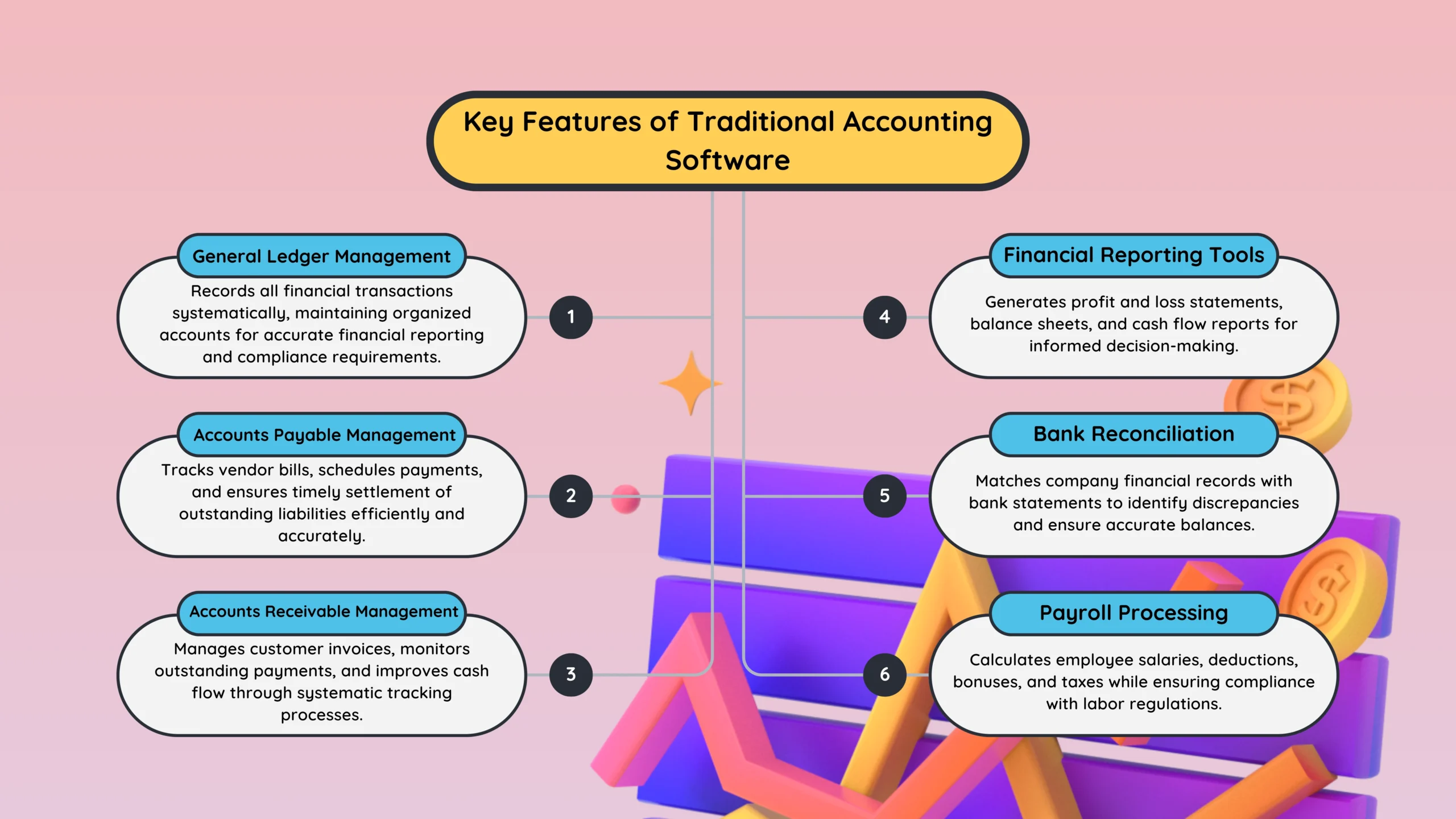
Traditional accounting software typically includes the following capabilities:
- General ledger management
- Invoicing and billing
- Tax computation (GST, VAT, etc.)
- Bank reconciliation
- Basic inventory management
- Payroll processing
- Financial reporting (P&L, balance sheet, cash flow)
These features are genuinely useful. For a startup jeweler or a one-store operation, they might cover the basics reasonably well.
Common Examples Used by Small Jewelers
Software like Tally ERP 9, QuickBooks, Zoho Books, and FreshBooks are among the most popular traditional accounting tools. Many small to mid-sized jewelry businesses use these because they’re affordable, widely supported, and easy to learn. However, as the business grows and the complexity of operations increases, limitations start to emerge rapidly.
Also Read – 15 Top AI Consulting Companies in 2026 | Expert Guide & Rankings
What Is Bullion ERP and How Is It Different?
Bullion ERP is an Enterprise Resource Planning (ERP) system purpose-built for jewelry manufacturers, retailers, wholesalers, and bullion traders. Unlike traditional accounting software, a Bullion ERP integrates every operational function of your business — from procurement and inventory to sales, CRM, compliance, and live pricing — into a single unified platform.
Think of it as the central nervous system of your jewelry business. Every department, every process, every transaction flows through it.
Core Modules of a Bullion ERP System
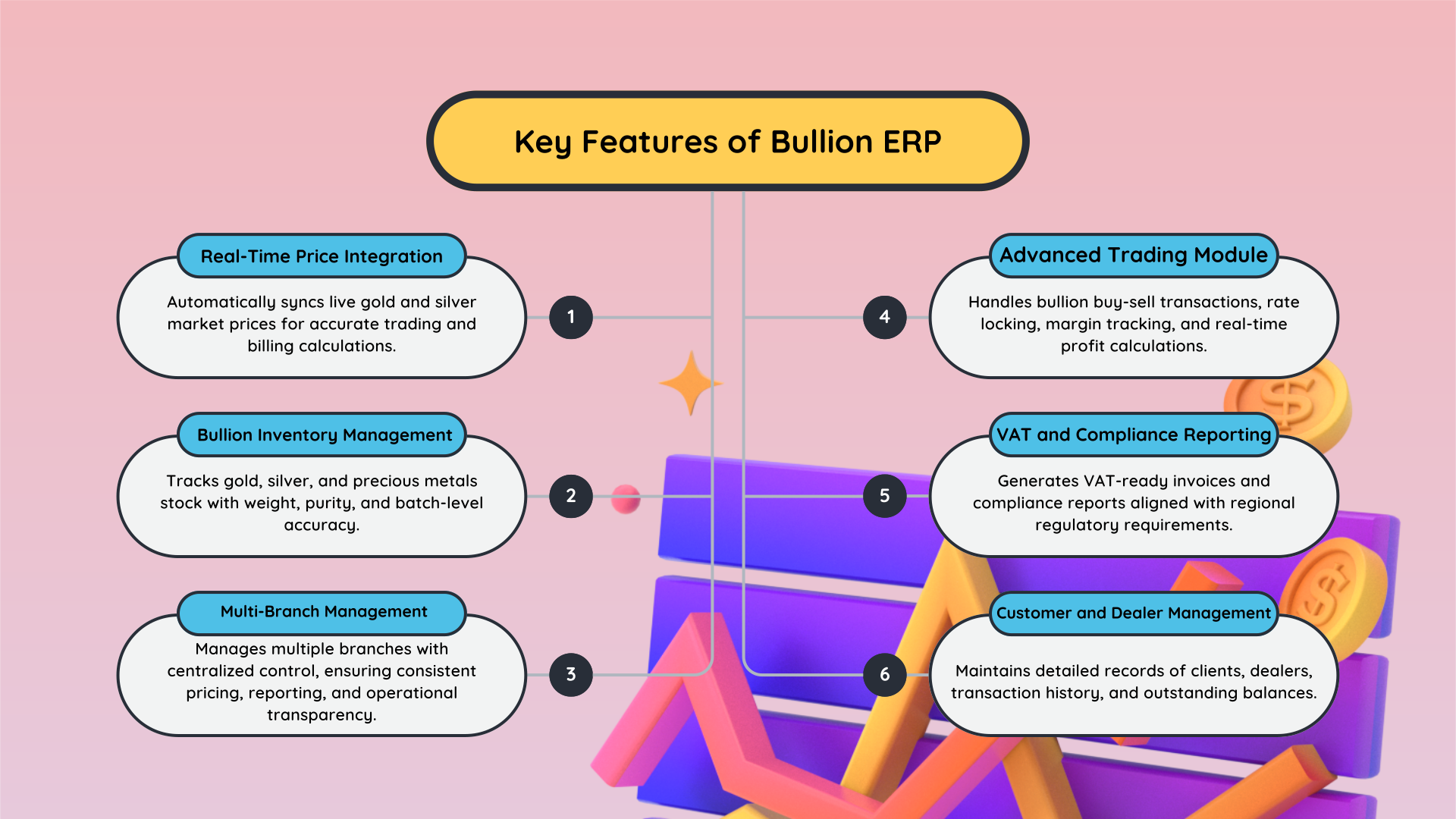
A robust Bullion ERP typically includes the following modules:
- Live Metal Rate Integration (gold, silver, platinum pricing via MCX/COMEX)
- Karatage & Weight-based Inventory Management
- Job Work / Karigar Management
- Hallmarking & Certification Tracking
- Customer Relationship Management (CRM)
- Order & Quotation Management
- Billing, Invoicing & GST Compliance
- Vendor & Supplier Management
- Barcode / RFID Tagging for Jewellery
- Multi-branch & Multi-currency Support
- Analytics & Business Intelligence Dashboards
How Bullion ERP Was Built for the Jewelry & Precious Metals Industry
The jewelry and bullion industry operates on unique parameters. Gold pricing changes by the minute. Inventory is valued not just by quantity but by purity, weight, and design. Labour costs vary by artisan, by piece, and by job. These complexities simply cannot be handled efficiently by a generic accounting tool. Bullion ERP systems are engineered to handle all of this natively, without the need for complicated workarounds or third-party plugins.
Also Read – AI Statistics 2026: 77% Are Ahead—Are You Behind?
Bullion ERP vs Traditional Accounting Software – A Feature-by-Feature Breakdown
Let’s get into the heart of the matter. Below is a comprehensive comparison that every jewelry business founder needs to see before making a software decision.
| Feature | Traditional Accounting Software | Bullion ERP |
|---|---|---|
| Inventory Management | Basic quantity-based | Weight, karatage, purity, design-based |
| Live Metal Pricing | Not available | Real-time MCX/COMEX integration |
| Job Work / Karigar Tracking | Not available | Full module with labour cost tracking |
| Hallmarking Compliance | Manual/external | Built-in compliance tracking |
| GST & Tax Filing | Basic GST support | Advanced GST with jewellery-specific rules |
| Multi-branch Management | Limited | Full multi-branch, multi-warehouse support |
| Customer Loyalty & CRM | None | Integrated CRM with loyalty programs |
| Barcode/RFID Tagging | Not applicable | Native support |
| Reporting & BI | Standard financial reports | Industry-specific dashboards & analytics |
| Scalability | Limited | Enterprise-grade scalability |
Inventory & Stock Management
In the jewelry business, “inventory management” is not as simple as counting units. A single piece of jewellery could have multiple attributes — gold weight (in grams), stone weight (in carats), making charges (per gram or per piece), wastage allowance, purity percentage, and design code. Traditional accounting software tracks inventory as simple units with a fixed price. It has no understanding of these layered attributes.
Bullion ERP, on the other hand, allows you to define inventory at a granular level. You can track net weight vs. gross weight, manage stones separately, apply different pricing for different karatages, and even track pieces through their entire manufacturing lifecycle from raw material to finished product.
Live Metal Pricing & Rate Integration
This is arguably the most critical differentiator. Gold prices fluctuate multiple times a day. A system that can’t reflect real-time rates is not just inconvenient — it’s a liability.
Why Real-Time Bullion Pricing Is a Game-Changer
Traditional accounting software requires manual rate updates. You’d need to check the MCX or spot price, log in to your software, update the rate, and then generate invoices. In a busy retail environment, this creates costly delays and potential pricing errors.
Bullion ERP integrates directly with live market data feeds. The moment gold prices change, your billing, inventory valuation, and purchase orders update automatically. According to data from the World Gold Council, global gold demand in 2023 reached approximately 4,448 tonnes — and in such a high-volume market, even a 0.1% pricing error can result in significant financial losses.
Also Read – Build a Fundable MVP in 2026: The Ultimate Founder’s Guide
Financial Management & Reporting
Accounting Capabilities Compared
Both traditional software and Bullion ERP offer core accounting features. However, the depth and industry relevance of those features differ dramatically.
Traditional accounting software gives you a solid double-entry bookkeeping framework. You get your standard ledgers, bank reconciliation, and financial statements. For a purely administrative perspective, this is fine.
Bullion ERP goes further by integrating financial data with operational data. So instead of just seeing “Sales: ₹50,00,000,” you see a breakdown by product category, by metal type, by store branch, by salesperson, and by customer segment — all in real time.
Compliance, Taxation & Audit Trails
The jewelry sector in India and globally is heavily regulated. In India alone, jewelers must comply with BIS hallmarking norms, GST regulations, PMLA (Prevention of Money Laundering Act), and PAN-based transaction rules for high-value purchases.
Traditional accounting software handles basic GST calculations but is not equipped for the specific compliance requirements of the jewelry sector — like capturing customer PAN details for purchases above ₹2 lakh, generating proper hallmarking records, or maintaining item-level audit trails required by regulatory bodies.
Bullion ERP has these compliance requirements baked in. It automatically flags transactions that require documentation, maintains tamper-proof audit logs, and generates compliance-ready reports.
Scalability & Business Growth
Can Traditional Software Keep Up with Growth?
Here’s a scenario many jewelry founders know too well: you start with one store, use Tally or QuickBooks, and things work fine. Then you open a second location. Suddenly, you’re maintaining two separate books, manually reconciling inter-branch transfers, and dealing with consolidated reporting nightmares.
Add a manufacturing unit to the mix, and you’ve essentially created three or four separate operational silos that your accounting software was never designed to bridge.
How Bullion ERP Adapts to Your Expanding Business
Bullion ERP is designed for scale from day one. Whether you’re operating one boutique store or a chain of 50 retail outlets with a centralised manufacturing facility, the system grows with you. Multi-branch management, centralised inventory visibility, role-based access control, and consolidated financial reporting are all part of the package.
According to a Gartner report on ERP adoption, businesses that implement ERP solutions see an average improvement of 23% in process efficiency and a 22% reduction in operational costs within the first two years of deployment. For a margin-sensitive business like jewelry retail, this translates directly to the bottom line.
Also Read – In-House vs. Outsourcing Development 2026: Full Cost-Benefit Guide
Operational Efficiency & Automation
Manual Processes vs Automated Workflows
Time is money — and nowhere is that truer than in a busy jewelry store during peak season. With traditional accounting software, a significant portion of daily operations remains manual: updating metal rates, raising purchase orders, calculating making charges, issuing repair receipts, and generating customer-specific quotations.
Every manual step is a potential point of error. Every error in a jewellery invoice — wrong weight, wrong purity, wrong GST rate — can turn into a customer dispute or a compliance issue.
Bullion ERP automates these workflows. Metal rates update automatically. Making charges are calculated based on predefined rules. Purchase orders are generated when stock falls below threshold levels. Customer quotations are generated in seconds based on current market rates.
Order Management, Billing & Invoicing
| Process | Traditional Software | Bullion ERP |
|---|---|---|
| Quotation Generation | Manual, time-consuming | Auto-generated from live rates |
| Making Charges Calculation | Manual spreadsheet | Rule-based automation |
| Repair & Job Orders | Manual tracking | Dedicated module with status updates |
| Barcode-based Billing | Not supported | Native support |
| Old Gold Exchange Calculations | Manual | Automated with purity-based rates |
| Customer-wise Pricing | Not available | Scheme and discount management |
| E-Invoice & E-Way Bill | Basic / plugin required | Built-in integration |
Bullion ERP can reduce the time taken to generate a single invoice from 5–8 minutes to under 60 seconds. Multiply that by hundreds of transactions a day across multiple branches, and the efficiency gain is enormous.
Data Security & Cloud Accessibility
Data security in the jewelry business is non-negotiable. You’re dealing with customer personal data, high-value transaction records, and sensitive business intelligence. Traditional accounting software, especially desktop-based versions, stores data locally — which means a hardware failure, theft, or malware attack could wipe out years of records.
Modern Bullion ERP systems are cloud-based or hybrid-cloud deployments. Your data is encrypted, backed up in real-time, and accessible from anywhere — whether you’re at the store, at a trade fair, or reviewing performance from your home at midnight. Multi-factor authentication, role-based access control, and session-based security ensure that only authorised personnel can access sensitive data.
Cloud ERP solutions also allow your team to collaborate across branches in real-time, something that’s simply not possible with a traditional desktop accounting tool.
Cost Comparison – What’s the Real Investment?
Let’s address the elephant in the room: cost. Traditional accounting software wins on upfront price — no question. A Tally subscription might cost you ₹18,000–₹25,000 per year. QuickBooks or Zoho could be similar. Bullion ERP solutions, on the other hand, typically range from ₹1,00,000 to ₹5,00,000+, depending on the number of modules, users, and customisation requirements.
But here’s the thing — cost comparison must include the cost of not having the right tool.
Consider the cumulative cost of:
- Manual pricing errors leading to customer disputes
- Non-compliance penalties from tax authorities
- Lost sales due to poor inventory visibility
- Employee hours spent on manual data entry
- IT costs to maintain legacy desktop software
- The cost of data loss from a non-cloud system
When you factor in all of these hidden costs, the ROI on a well-implemented Bullion ERP typically pays for itself within 12–18 months for a mid-sized operation.
Also Read – AI App Development Cost in 2025: From MVPs to Full-Scale Solutions
Who Should Choose What? Decision Guide for Founders
Not every business needs a full Bullion ERP on day one. Here’s a simple framework to help you decide:
Choose Traditional Accounting Software if:
- You’re a single-store operation with fewer than 5 staff members
- Your monthly transaction volume is under 200 bills
- You deal in limited SKUs and don’t manufacture in-house
- You’re in the early stage of your business with limited capital
Choose Bullion ERP if:
- You manage multiple branches or are planning to expand
- You have an in-house manufacturing unit or work with karigar networks
- You deal in high transaction volumes (500+ bills per month)
- You want real-time metal rate integration and automated billing
- You’re facing compliance challenges with GST or BIS hallmarking
- You want deep analytics and data-driven decision-making
- You’re planning to integrate e-commerce or B2B portals
The decision ultimately comes down to where you are today versus where you want to be in three years. If your growth ambitions are serious, building your operations on traditional accounting software is like laying the foundation of a skyscraper with brick and mortar — it might hold for a while, but it won’t scale.
Real-World Use Cases: How Jewelry Businesses Transformed with ERP
Across the jewelry industry, businesses that have transitioned from traditional accounting tools to Bullion ERP report transformative results:
A multi-branch jewellery chain in Rajasthan with 12 outlets was using Tally across all branches. Inventory reconciliation at month-end took a full week and required a team of 4 accountants. After implementing Bullion ERP, real-time inventory visibility was established across all branches, and month-end reconciliation was reduced to a single day.
A diamond jewellery manufacturer in Surat struggled with karigar payment reconciliation and job order tracking. Bullion ERP’s job work module gave them complete visibility into piece-wise labour costs, wastage tracking, and karigar dues — resulting in a 15% reduction in manufacturing cost leakage.
These are not isolated success stories. They represent a pattern of measurable business transformation that occurs when the right technology is matched to the right industry problem.
Also Read – AI Agents Explained: Why They Matter and Real-World Use Cases
How IPH Technologies Can Help You Build the Right Solution
At IPH Technologies, we understand that no two jewelry businesses are alike. With over 500 successful projects and 430+ satisfied clients, we’ve helped businesses across industries make the leap from legacy systems to modern, scalable digital solutions.
Whether you need a custom-built Bullion ERP from scratch, want to integrate existing accounting software with advanced jewellery-specific modules, or need a mobile-first platform for your sales team in the field, our team has the expertise to deliver.
Our approach is simple: we start with your business goals, understand your operational workflows, and build technology that aligns with your specific needs — not the other way around.
We leverage agile methodologies, the latest tech stack, and deep domain expertise to deliver solutions that are not just functional but genuinely transformative.
From initial consultation to deployment and beyond, we’re your technology partner at every stage of the journey.
Our expertise spans mobile app development, web applications, and custom software engineering — giving us the flexibility to build integrated ecosystems that cover your entire business operations.
If you’re ready to explore what the right ERP solution could mean for your jewelry or bullion trading business, our team is just a conversation away.
Conclusion
The debate between Bullion ERP and traditional accounting software isn’t really about features on a spec sheet — it’s about your vision for your business. If you’re content managing a small, stable operation, traditional tools might still serve you adequately. But if you’re a founder with ambitions to grow, scale, and compete in an increasingly digital marketplace, clinging to traditional accounting software is a strategic liability.
Bullion ERP isn’t just software — it’s infrastructure. It’s the operational backbone that allows jewelry businesses to move faster, make smarter decisions, maintain tighter compliance, and deliver better experiences to their customers. In an industry as competitive and margin-sensitive as jewelry and bullion trading, that backbone can be the difference between thriving and merely surviving.
The question isn’t whether you can afford to invest in a Bullion ERP. The real question is: can you afford not to?








.png)