





























































































Introduction The Custom Software Revolution in Startup Culture
The startup landscape is evolving at lightning speed, and savvy entrepreneurs are discovering that off-the-shelf software solutions are holding them back rather than propelling them forward. While generic software packages might seem like the safe, budget-friendly choice when you’re just starting out, growing startups are increasingly recognizing that custom software development isn’t just a luxury—it’s a strategic necessity.
Think about it: your startup isn’t like every other business. You’ve identified a unique market gap, developed an innovative approach, or created a business model that challenges the status quo. So why would you try to run that distinctive business on the same generic software everyone else uses? It’s like trying to win a Formula 1 race in a rental car. Sure, it’ll get you around the track, but you’ll never reach the podium.
The shift toward custom software development among growing startups represents a fundamental understanding that technology should enable your vision, not constrain it. Let’s explore the eight compelling reasons why forward-thinking startups are making this strategic move.
Understanding the Shift from Off-the-Shelf to Custom Software
The Startup Growth Challenge
Every successful startup faces a critical inflection point. You’ve validated your concept, attracted initial customers, and secured funding. Now comes the challenging part: scaling rapidly while maintaining the agility and innovation that made you successful in the first place. This is precisely where off-the-shelf software begins to crack under pressure.
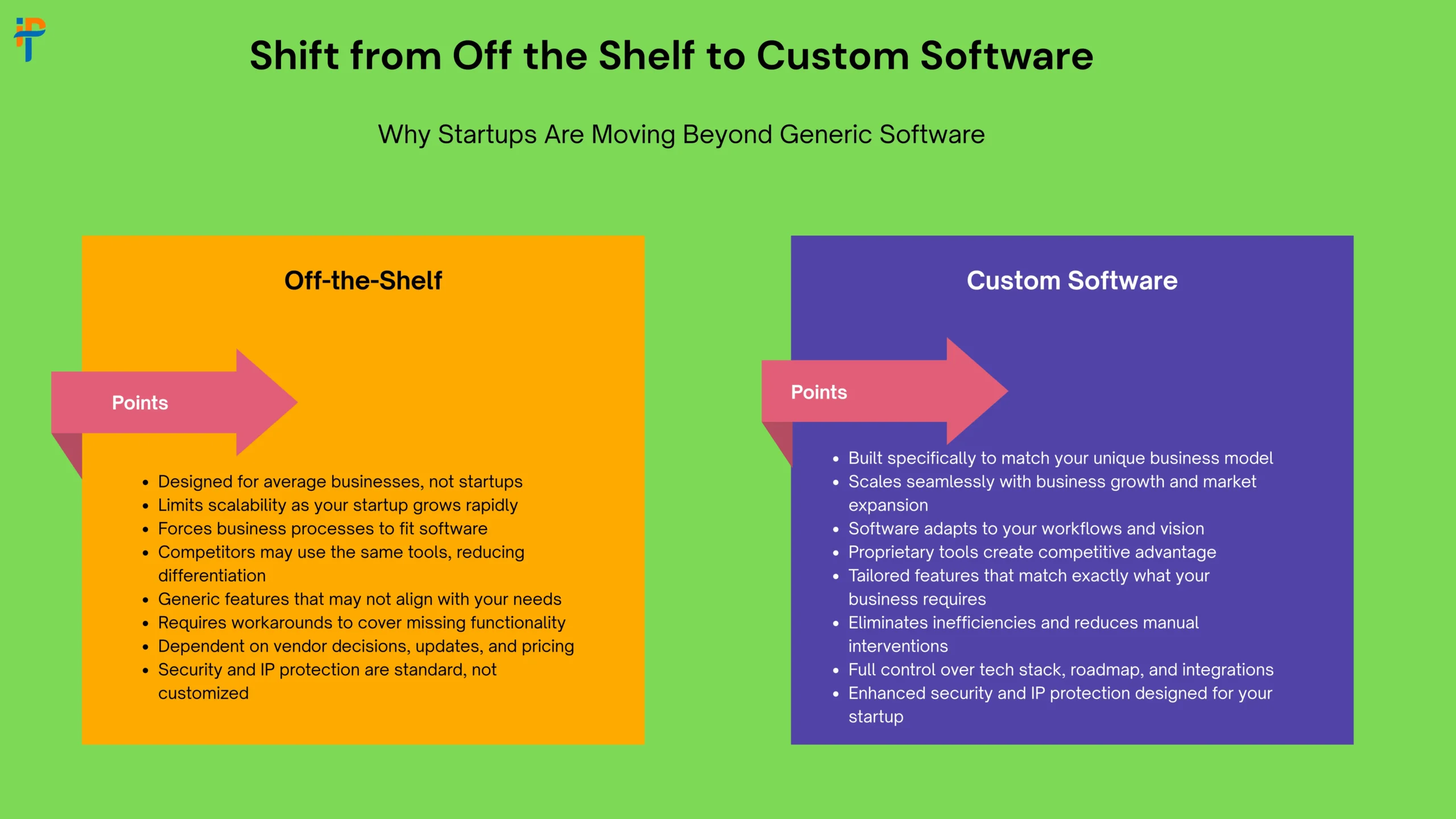
Generic software solutions are designed for the average business with average needs. But startups aren’t average—they’re exceptional. They’re disrupting industries, creating new markets, and moving at speeds that traditional businesses can’t match. When you’re growing at 20%, 50%, or even 100% month-over-month, you need technology that can keep pace.
Why Ready-Made Solutions Fall Short
Ready-made software creates a ceiling on your potential. You’re limited by someone else’s vision of what features matter, how workflows should function, and how fast the platform can scale. Even worse, you’re competing with other startups using the exact same tools, eliminating any technological advantage you might gain.
Moreover, as your startup evolves, you’ll find yourself constantly wrestling with software limitations, implementing workarounds, or worse—changing your business processes to fit the software rather than the other way around. This is where custom software development changes the game entirely.
Also read- Step-by-Step Guide to Building a Successful Mobile App in 2026
Top 8 Reasons Growing Startups Choose Custom Software Development
Perfect Alignment with Unique Business Models
Your business model is your competitive secret sauce. Whether you’re pioneering a new subscription model, creating a unique marketplace, or developing an innovative service delivery approach, your software should be built specifically to support that model.
Custom software development allows you to embed your unique processes, workflows, and business logic directly into your technology infrastructure. Instead of forcing your innovative ideas into rigid software templates, you create tools that work exactly as your business operates. This alignment eliminates friction, reduces errors, and allows your team to work more efficiently.
For instance, if your startup uses a dynamic pricing model based on multiple variables, custom software can automate these calculations precisely according to your algorithms. If you’ve developed a unique customer onboarding process that’s central to your retention strategy, custom applications can guide users through each step seamlessly. The software becomes an extension of your business strategy, not a constraint on it.
Competitive Differentiation in Crowded Markets
In today’s startup ecosystem, product and service differentiation alone isn’t always enough. The companies that dominate their markets often do so because they’ve built superior technology that enhances their customer experience in ways competitors can’t match.
Custom software development gives you proprietary tools that competitors simply can’t access. While they’re stuck with the same features available to everyone using popular platforms, you’re delivering experiences that are uniquely yours. This technological differentiation becomes a moat around your business—something that’s difficult for competitors to replicate quickly.
Consider how tech giants like Netflix, Spotify, and Airbnb didn’t achieve dominance just through their business concepts, but through custom-built platforms that delivered superior user experiences. While they’re now massive corporations, they started as startups that recognized the strategic value of proprietary technology from early on.
Scalability That Grows with Your Vision
One of the most frustrating experiences for a growing startup is hitting the limitations of your software stack just when momentum is building. Suddenly, you need to migrate platforms, retrain your team, transfer data, and potentially disrupt operations—all while trying to maintain growth.
Custom software is built with scalability baked into its architecture from day one. As your user base grows from hundreds to thousands to millions, your custom applications can scale accordingly. Need to expand into new geographic markets? Your software can accommodate multiple languages, currencies, and regulatory requirements. Planning to add new product lines? Your platform can evolve to support them.
This scalability isn’t just technical—it’s strategic. Your software can grow in sophistication as your business matures, adding features and capabilities precisely when you need them rather than being forced into upgrade cycles dictated by vendors.
Cost Efficiency in the Long Run
At first glance, custom software development appears more expensive than subscribing to ready-made solutions. And yes, the upfront investment is typically higher. However, growing startups are discovering that custom development often proves more cost-effective over time.
Breaking Down the True Cost of Ownership
When calculating software costs, consider the complete picture. Off-the-shelf solutions charge per-user fees that multiply as your team grows. Add-on features, premium tiers, integration tools, and API access often come with additional costs. Before you know it, you’re paying thousands monthly for software that still doesn’t do exactly what you need.
Custom software involves a development investment but no ongoing licensing fees. You own the code, control the infrastructure, and avoid the escalating costs that come with team growth. Additionally, you eliminate the hidden costs of inefficiency—the hours wasted on workarounds, the lost opportunities from feature limitations, and the productivity drag of disconnected systems.
Cost Comparison – Custom Software vs. Off-the-Shelf Solutions (5-Year Analysis)
| Cost Factor | Off-the-Shelf Software | Custom Software Development |
|---|---|---|
| Initial Investment | $500 – $2,000 | $30,000 – $150,000 |
| Total Cost | $6,000 – $24,000 | $30,000 – $150,000 |
| Total Cost | $12,000 – $48,000 | $35,000 – $165,000 |
| Total Cost | $18,000 – $72,000 | $40,000 – $180,000 |
| Total Cost | $24,000 – $96,000 | $45,000 – $195,000 |
| Total Cost | $30,000 – $120,000 | $50,000 – $210,000 |
| Hidden Costs (inefficiency, workarounds) | $25,000 – $75,000 | Minimal |
Faster Time-to-Market for Innovative Features
In the startup world, speed is everything. The ability to launch new features, test hypotheses, and respond to market feedback faster than competitors can make the difference between success and failure.
With custom software, you control the development roadmap entirely. Want to test a new feature with a segment of users? You can build and deploy it within weeks rather than waiting for a vendor’s quarterly update cycle. Received customer feedback that requires adjusting functionality? Your development team can implement changes immediately.
This agility is particularly crucial for startups practicing lean methodologies. You can rapidly iterate based on real user data, A/B test different approaches, and pivot your product direction without being constrained by software limitations. The speed advantage compounds over time, allowing you to stay ahead of market trends and competitor movements.
Complete Control Over Your Technology Stack
When you rely on third-party software, you’re at the mercy of vendor decisions. Features you depend on might be deprecated. Pricing could change dramatically. The company could be acquired, shut down, or shift strategic direction. For a growing startup, these uncertainties represent serious risks.
Custom software development gives you complete autonomy. You choose the technologies, control the architecture, and make all strategic decisions about your platform’s evolution. This control extends beyond just features—you decide security protocols, data management approaches, and integration strategies.
This independence is particularly valuable as you scale. You’re not locked into a vendor’s ecosystem or forced to use their preferred integration partners. Instead, you can select the best tools for each job and connect them exactly as needed. Your technology stack becomes a competitive advantage rather than a constraint.
Enhanced Data Security and IP Protection
For startups, especially those in fintech, healthtech, or any data-sensitive industry, security isn’t optional—it’s fundamental to business viability. Custom software development allows you to implement security measures tailored to your specific risks and compliance requirements.
Rather than relying on generic security configurations, you can build protection mechanisms specifically designed for your data types, user behaviors, and threat landscape. This is particularly important if you’re handling proprietary algorithms, sensitive customer information, or intellectual property that represents your core competitive advantage.
Additionally, custom software means your code, processes, and innovations remain proprietary. You’re not sharing platforms with competitors who might reverse-engineer your approaches or learn from your implementations. Your technological innovations stay yours.
Seamless Integration with Existing Tools
Growing startups typically use a diverse ecosystem of tools—CRMs, analytics platforms, communication systems, payment processors, and more. One of the biggest challenges with off-the-shelf software is integration limitations.
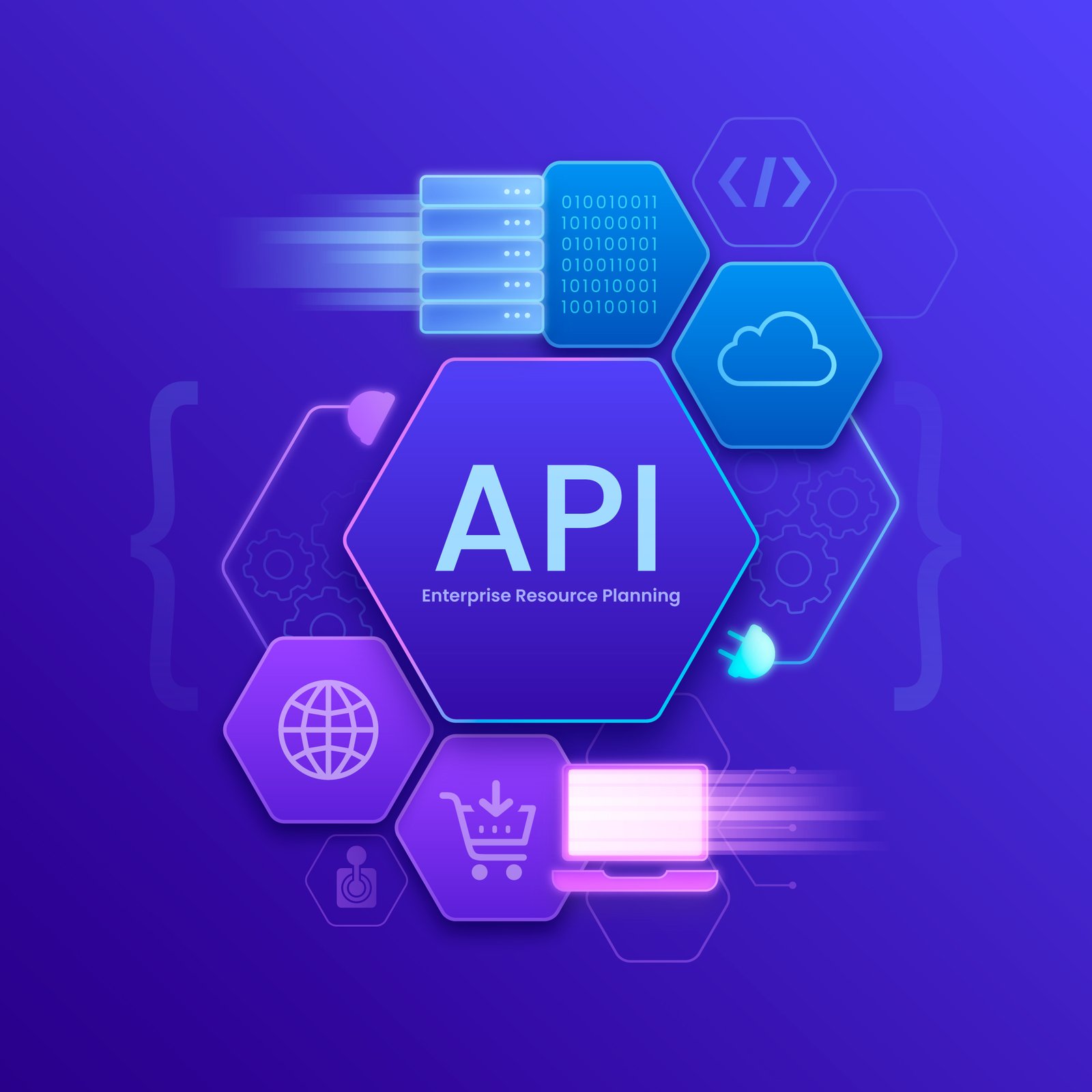
Custom applications are built from the ground up with integration in mind. Using modern APIs and middleware, your custom software can connect seamlessly with any tool in your stack, creating a unified ecosystem where data flows freely and processes interconnect smoothly.
This integration capability eliminates data silos, reduces manual data entry, and ensures everyone in your organization works from the same information. It also means you can continue using tools your team already knows and loves rather than being forced to switch to a vendor’s preferred alternatives.
Also read- Native vs Cross Platform App Development: 2026 Guide
Real-World Impact How Custom Software Transforms Startup Operations
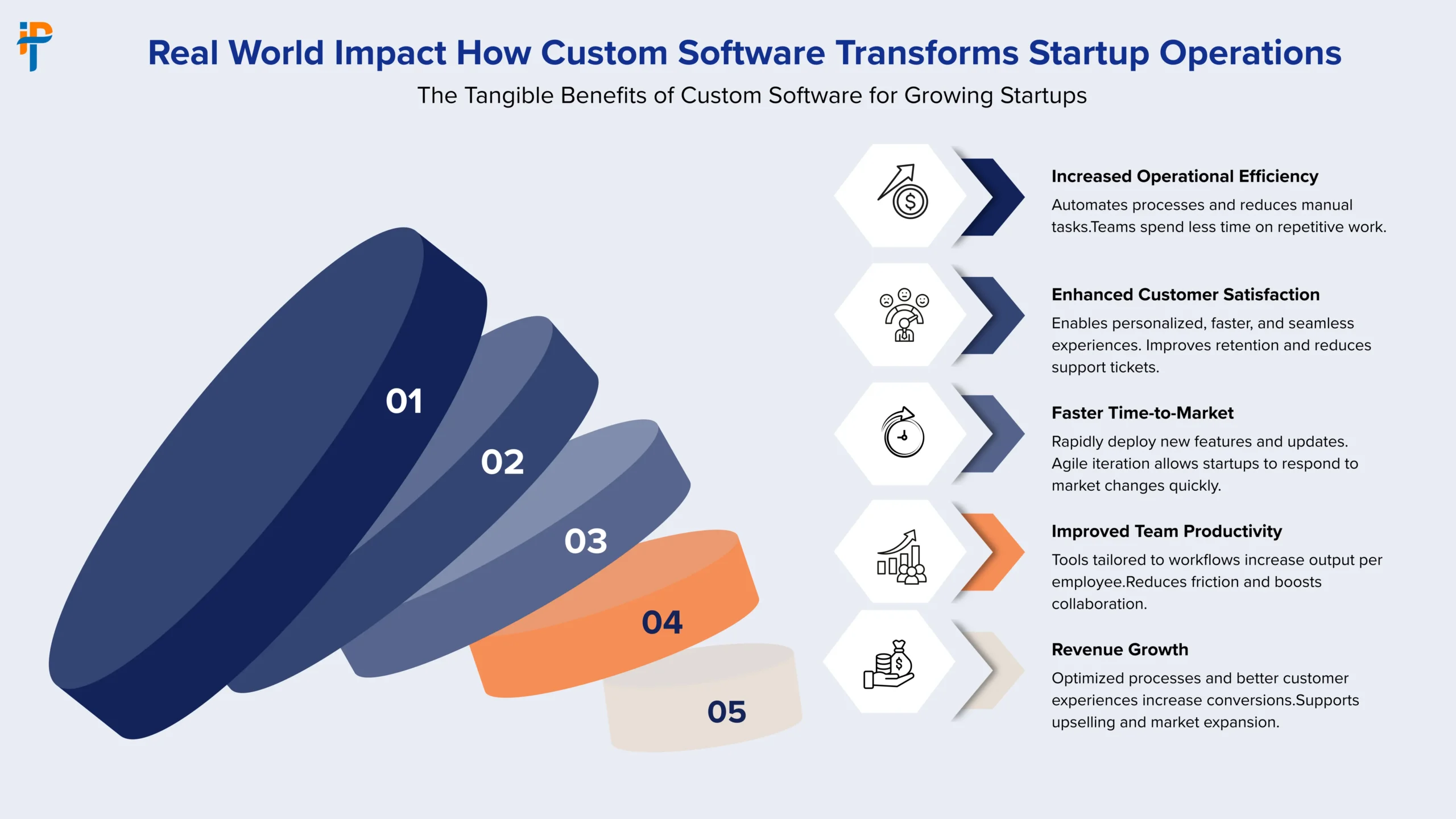
The benefits of custom software extend far beyond the features themselves. Startups that invest in custom development report transformative impacts across their entire organization.
Teams become more productive because they’re working with tools designed specifically for their workflows. Customer satisfaction improves because the technology enables better, faster, more personalized service. Decision-making accelerates because data is accessible, accurate, and presented in actionable formats.
Perhaps most importantly, custom software changes your startup’s culture. It reinforces the message that you’re not like everyone else—you’re building something unique and special. This mindset permeates the organization, encouraging innovation and bold thinking at every level.
Table 2: Business Impact Metrics – Startups Using Custom Software
| Business Area | Key Metrics | Average Improvement | Timeline to Realize |
|---|---|---|---|
| Operational Efficiency | Process automation, manual task reduction | 40-60% | 3-6 months |
| Customer Satisfaction | NPS score, retention rate, support tickets | 25-45% | 6-12 months |
| Time-to-Market | Feature deployment speed, release cycles | 50-70% faster | 4-8 months |
| Team Productivity | Output per employee, task completion rate | 35-55% | 3-9 months |
| Revenue Growth | Sales conversion, upsell rates, market share | 30-50% | 12-18 months |
| Innovation Capacity | New features launched, experiments conducted | 60-80% increase | 6-12 months |
| Customer Acquisition Cost | Marketing efficiency, conversion optimization | 20-35% reduction | 9-15 months |
The Custom Software Development Process for Startups
Agile Development for Startup Speed
Custom software development for startups isn’t the waterfall process of traditional enterprise software. Instead, modern development partners use agile methodologies specifically tailored to startup needs and constraints.
Agile development breaks projects into short sprints, typically two to four weeks long. Each sprint delivers working software that you can review, test, and provide feedback on. This iterative approach means you see progress continuously rather than waiting months for a big reveal. It also allows you to adjust direction based on what you learn from each iteration.
For startups operating in uncertain environments where requirements might shift based on market feedback or investor input, this flexibility is invaluable. You’re never locked into decisions made months ago that no longer reflect current realities.
MVP to Full Product Evolution
Most startups benefit from an MVP (Minimum Viable Product) approach to custom software development. Rather than building the complete vision from day one, you start with core functionality that addresses your most critical needs and provides the most value to users.
This MVP gets deployed quickly—often within two to four months—allowing you to start realizing benefits immediately. Then, based on usage data, user feedback, and business priorities, you iteratively add features and enhance functionality. This approach reduces upfront investment, accelerates time-to-value, and ensures you’re building features users actually need rather than ones you think they might want.
Also read- Low-Code No-Code Automation Transform Business Processes in 2026
Overcoming Common Startup Concerns About Custom Development
Budget Constraints and Funding Considerations
The most common concern startups express about custom development is cost. And yes, it requires investment. However, forward-thinking startups are recognizing that custom software isn’t an expense—it’s an investment in their competitive infrastructure.
Many development partners offer flexible engagement models for startups, including phased development that spreads costs over time, equity arrangements for early-stage companies, or milestone-based payment structures that align with funding rounds. The key is finding a partner who understands startup economics and can structure agreements accordingly.
Additionally, the ROI from custom software often justifies the investment to investors. VCs and angel investors increasingly recognize that proprietary technology represents defensible competitive advantage, making startups more attractive investment opportunities.
Technical Expertise Requirements
Another concern is the need for technical expertise to manage custom software development. While having a technical co-founder or CTO is beneficial, it’s not absolutely necessary if you choose the right development partner.
The best development partners act as your extended technical team, providing not just coding services but strategic guidance, architecture planning, and ongoing support. They translate business requirements into technical solutions and communicate in terms you understand rather than jargon.
Choosing the Right Development Partner for Your Startup
Not all development partners are created equal, especially when it comes to understanding startup needs. Look for partners with specific startup experience who understand rapid iteration, budget constraints, and the need for speed.
The ideal partner combines technical excellence with business acumen. They should ask probing questions about your business model, target market, and growth plans—not just technical specifications. They should challenge your assumptions constructively and offer insights based on experience with similar startups.
At IPH Technologies, we specialize in turning visionary ideas into impactful solutions. As a leading app development company, we offer a comprehensive suite of services designed to meet your unique business needs. From innovative mobile apps and web applications to custom software solutions, our team leverages the latest technology and agile methodologies to deliver exceptional results.
With a track record of over 500 successful projects and 430+ satisfied clients, we pride ourselves on our ability to exceed expectations. Our expertise extends across various domains, including app development, web development, and custom software engineering, ensuring we provide the perfect solution for every challenge.
We understand that staying ahead in today’s competitive market requires more than just technology—it requires a partner who is dedicated to your success. That’s why we focus on delivering not only cutting-edge solutions but also an unparalleled client experience. At IPH Technologies, we’re committed to helping you stay ahead of the curve and achieve your business objectives with our innovative and tailored solutions.
Also read- Healthcare App Development Trends 2026: Complete Guide
Future-Proofing Your Startup with Custom Solutions
The technology landscape evolves constantly, with new platforms, frameworks, and capabilities emerging regularly. Custom software development positions your startup to capitalize on these innovations rather than being left behind by vendor roadmaps.
As artificial intelligence, machine learning, blockchain, and other emerging technologies mature, you can selectively integrate them into your custom applications exactly where they provide the most value. This selective adoption allows you to stay cutting-edge without the complexity and cost of overhauling entire systems.
Moreover, custom software that’s well-architected can evolve indefinitely. The applications you build today can continue serving your business five or ten years from now, continuously enhanced and adapted as your needs change. This longevity is impossible with commercial software, where you’re eventually forced to migrate to new platforms as vendors discontinue old ones.
Conclusion
The shift toward custom software development among growing startups isn’t a trend—it’s a recognition of fundamental truths about competition, innovation, and scalability in today’s business environment. While off-the-shelf solutions serve a purpose for early-stage validation and basic operations, startups serious about scaling and dominating their markets are increasingly recognizing that custom software is essential infrastructure, not optional luxury.
The eight reasons we’ve explored—perfect business model alignment, competitive differentiation, scalability, cost efficiency, speed to market, technology control, enhanced security, and seamless integration—represent compelling arguments for custom development. Together, they paint a clear picture: custom software transforms startups from fast followers into market leaders.
Yes, custom development requires investment, thoughtful planning, and the right partner. But for growing startups with ambitious visions and the determination to dominate their markets, it’s one of the smartest investments you can make. Your software should be as unique and innovative as your business itself. Anything less is a compromise that could cost you the competitive edge that makes the difference between success and failure.
The question isn’t whether growing startups should shift to custom software development. The question is: can you afford not to?










.png)