




































































































How to Build an App Like Astrotalk: Complete Business Breakdown
Have you ever wondered how a simple idea about connecting people with astrologers turned into a company worth hundreds of millions of dollars? That’s exactly what Astrotalk did — and it’s proof that there’s gold in the astrology and wellness app space. If you’re an entrepreneur, startup founder, or business owner thinking about building a similar platform, you’re in the right place.
In this complete guide, we’ll break down everything — from the features you need and the tech stack to use, to the business model and astrology app development costs. Think of this as your road map to building the next big thing in the spiritual tech space. Let’s dive in.
What Is Astrotalk and Why Is It a Billion-Dollar Idea?
Astrotalk is India’s leading online astrology platform, connecting users with professional astrologers via live chat, voice calls, and video consultations. Founded in 2017 by Puneet Gupta, the platform has grown to host thousands of verified astrologers and serves millions of users globally. According to industry reports, Astrotalk’s revenue crossed ₹600 crore (approx. $72 million) in FY2024, making it one of the fastest-growing edtech-meets-wellness platforms in the world.
So why is this a billion-dollar idea? Simple — people are genuinely looking for guidance. Whether it’s career decisions, relationships, or health worries, astrology offers comfort and direction. When you pair that age-old human need with a sleek mobile app and real-time connectivity, you’ve got a recipe for massive success.
Also Read – From Passion to Profit: Monetization Strategies for AI Astrology Apps
The Astrology App Market — Bigger Than You Think
Let’s look at some numbers that’ll blow your mind. The global astrology market is valued at approximately $12.8 billion and is projected to grow at a CAGR of over 5.7% through 2030, according to Grand View Research. The surge in demand for spiritual wellness, especially post-pandemic, has pushed millions of users toward platforms like Astrotalk, Astroyogi, and similar apps.
This isn’t just an India story either — markets in the US, Southeast Asia, and the Middle East are catching up fast. That means the opportunity to build a localized, niche-focused astrology app is enormous right now.
Core Features You Must Have in an App Like Astrotalk
Think of an astrology app like a three-sided marketplace — users, astrologers, and the platform itself. Every feature you build needs to serve at least one of these sides effectively.
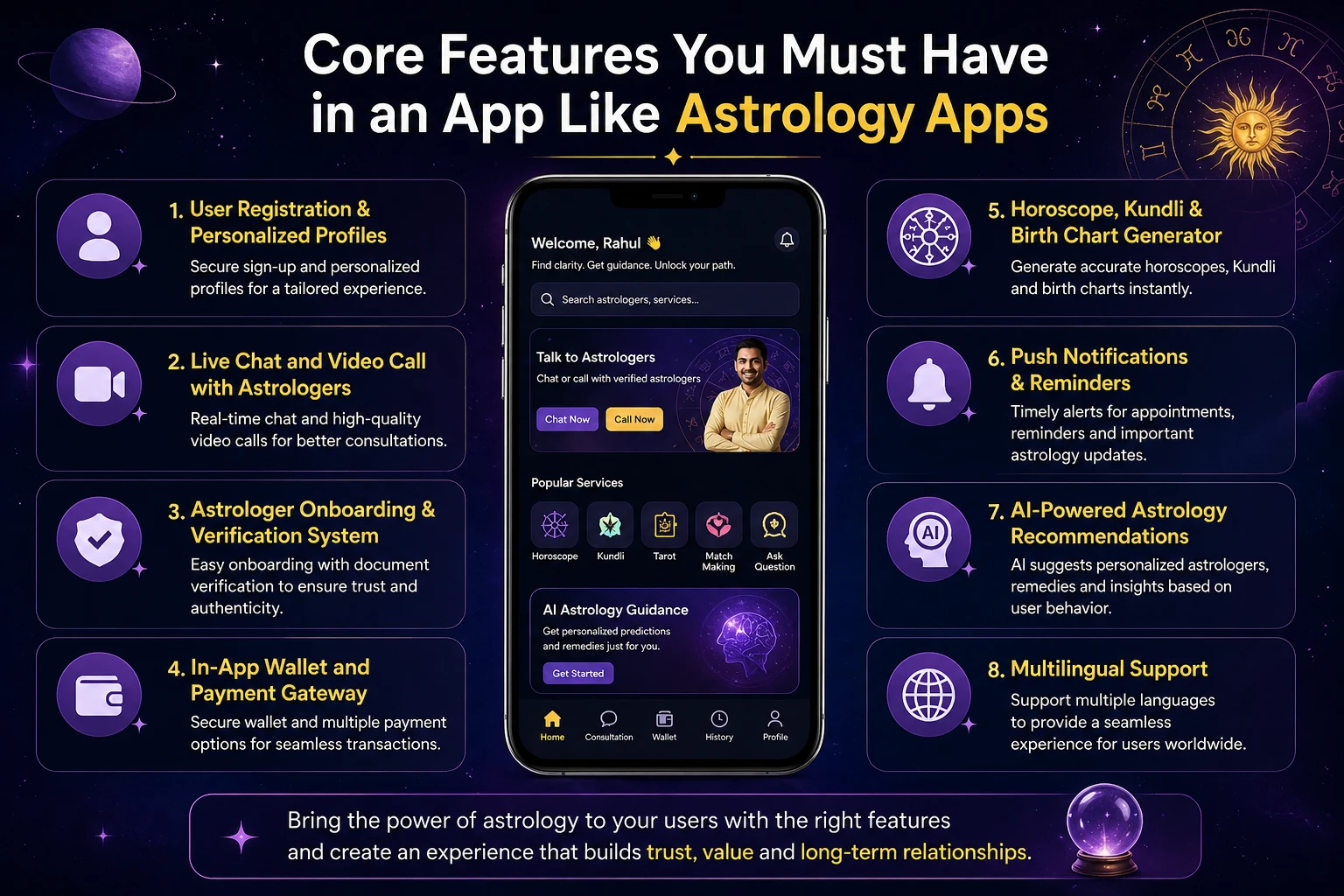
User Registration & Personalized Profiles
Your app’s onboarding experience sets the tone for everything that follows. Allow users to sign up via email, phone number, or social login (Google/Facebook). More importantly, collect birth details — date, time, and place of birth — during registration. Why? Because this data powers personalized horoscopes, Kundli generation, and matched astrologer recommendations. A personalized experience is the backbone of retention.
Live Chat and Video Call with Astrologers
This is the heartbeat of the app. Just like Astrotalk, your platform must support real-time chat and video/voice calling between users and astrologers. This requires WebSocket integration for chat and WebRTC or a third-party solution like Agora or Twilio for audio/video calls. Low latency, clear audio, and reliable connectivity are non-negotiable here.
Astrologer Onboarding & Verification System
You’re building a trust-based platform. That means you can’t just let anyone call themselves an astrologer. Build a robust KYC (Know Your Customer) and verification system where astrologers submit credentials, certifications, and ID proofs. Add a review and rating system so users can make informed decisions. Astrotalk does this brilliantly — every astrologer has reviews, years of experience, and specialty tags.
In-App Wallet and Payment Gateway
Astrotalk uses a prepaid wallet model — users add money to their wallet and deduct it per minute during consultations. This is a smart monetization mechanic because it encourages users to load more than they plan to spend.
Integrate popular payment gateways such as Razorpay, Stripe, or PayPal to ensure a seamless transaction experience. Offer multiple payment options — UPI, cards, net banking, and even buy-now-pay-later for premium services.
Horoscope, Kundli & Birth Chart Generator
This is where the magic happens for astrology lovers. Your app should generate daily, weekly, and monthly horoscopes based on the user’s sun sign. Additionally, a Kundli (birth chart) generator using Vedic astrology algorithms is a massive value-add. Users come for free horoscopes but stay (and pay) for detailed consultations. APIs like AstroSeek or custom Vedic calculation engines can power this.
Push Notifications & Reminders
Engagement is everything. Push notifications for daily horoscopes, lucky days, upcoming planetary transits, or “Your astrologer is online now!” alerts drive Daily Active Users (DAU) significantly. Personalized notifications based on user birth charts make them feel like the app truly knows them.
Advanced Features That Set You Apart from Competitors
Once your MVP is live, these advanced features will be what make users choose you over every other platform on the market.
AI-Powered Astrology Recommendations
Use machine learning to match users with the most compatible astrologers based on their query type, birth chart, language preference, and previous consultation history. AI-driven chatbots for basic astrological queries (like “what does Mercury retrograde mean for me?”) can reduce the load on human astrologers while keeping users engaged around the clock.
Multilingual Support
India alone has 22 official languages, and astrology transcends all of them. Support for Hindi, Tamil, Telugu, Marathi, Bengali, and English is crucial, at a minimum, if you’re targeting the Indian market. For global expansion, add Arabic, Spanish, and Mandarin. Multilingual support can literally double your addressable market overnight.
Also Read – Build a Fundable MVP in 2026: The Ultimate Founder’s Guide
Tech Stack Required to Build an Astrotalk-Like App
Choosing the right technology is like laying the foundation of a skyscraper — get it wrong and everything crumbles. Here’s a reliable tech stack for an Astrotalk-like app:
| Component | Technology Options |
|---|---|
| Frontend (Mobile) | React Native, Flutter |
| Frontend (Web) | React.js, Next.js |
| Backend | Node.js, Django, Ruby on Rails |
| Database | PostgreSQL, MongoDB, Firebase |
| Real-Time Chat | WebSockets, Socket.io, Firebase Realtime DB |
| Video/Voice Calls | Agora SDK, Twilio, WebRTC |
| Payment Gateway | Razorpay, Stripe, PayPal |
| Push Notifications | Firebase Cloud Messaging (FCM), OneSignal |
| AI/ML | Python (TensorFlow, Scikit-learn), AWS SageMaker |
| Cloud Hosting | AWS, Google Cloud Platform, Azure |
| CDN | Cloudflare, AWS CloudFront |
React Native or Flutter are the go-to choices for cross-platform mobile development — they let you build for both iOS and Android from a single codebase, dramatically cutting development time and cost.
Astrotalk Business Model — How Does It Actually Make Money?
Astrotalk’s business model is elegantly simple yet deeply effective. It’s a marketplace model where the platform takes a commission from every consultation, much like Uber takes a cut from every ride. But there’s more to it than that.
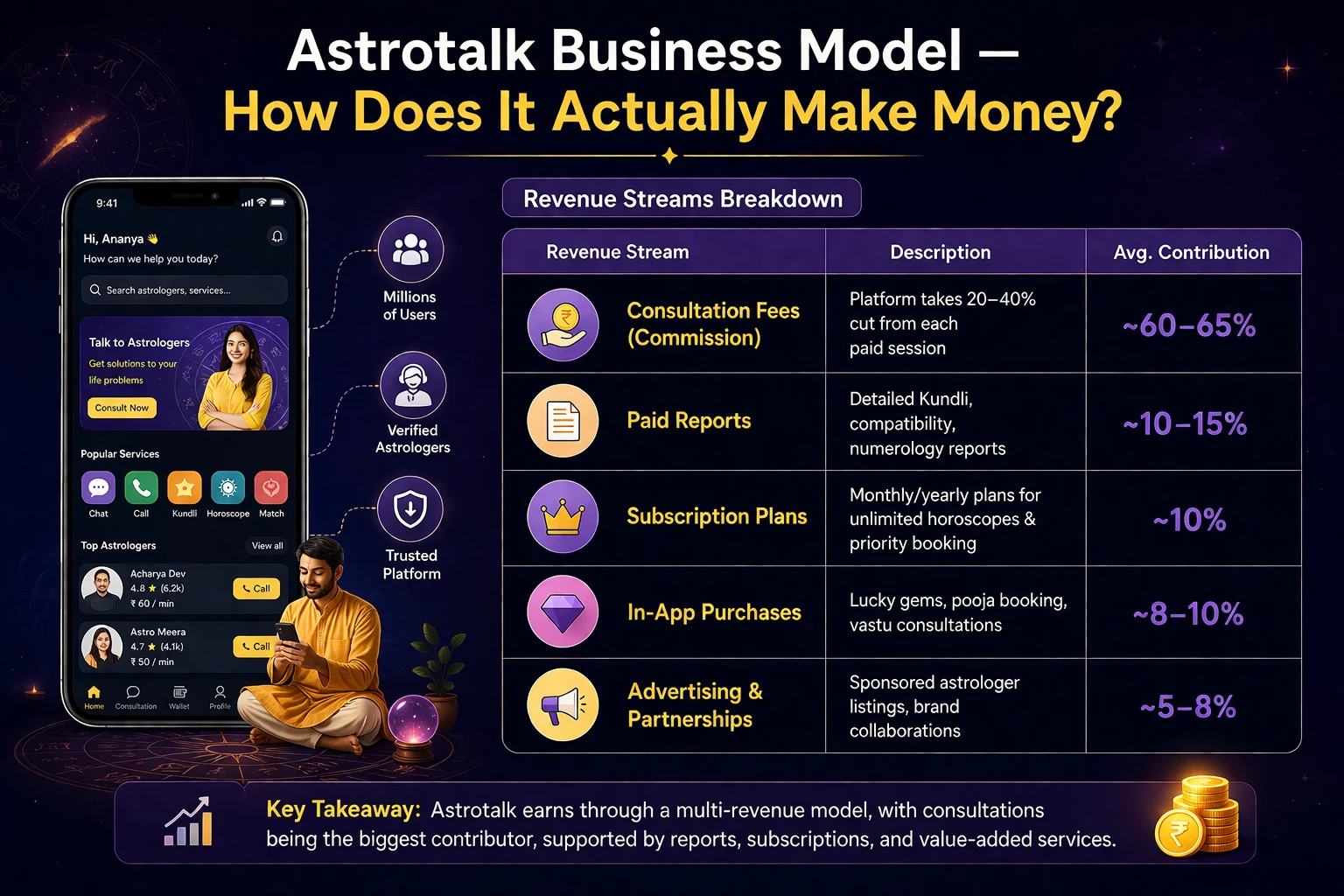
Revenue Streams Breakdown
| Revenue Stream | Description | Avg. Contribution |
|---|---|---|
| Consultation Fees (Commission) | Platform takes a 20–40% cut from each paid session | ~60–65% |
| Paid Reports | Detailed Kundli, compatibility, and numerology reports | ~10–15% |
| Subscription Plans | Monthly/yearly plans for unlimited horoscopes & priority booking | ~10% |
| In-App Purchases | Lucky gems, pooja booking, vastu consultations | ~8–10% |
| Advertising & Partnerships | Sponsored astrologer listings, brand collaborations | ~5–8% |
The beauty of this model? It’s recurring by nature. People don’t consult their astrologer just once — they come back for birthdays, major life decisions, festivals, and eclipses. That’s built-in retention.
Also Read – Build a Custom AI Agent: A Small Business Guide
How to Build an App Like Astrotalk — Step-by-Step Process
Now let’s get into the nuts and bolts. Here’s how to go from idea to a live, revenue-generating platform.
Step 1 — Market Research and Niche Targeting
Before you write a single line of code, do your homework. Who is your primary audience? Are you building for the mass market or targeting a specific niche — say, Vedic astrology for millennials, or tarot for wellness enthusiasts? Research your competitors, identify gaps, and define your Unique Value Proposition (UVP). The more specific you are, the more powerfully you can market your app.
Step 2 — UI/UX Design
Astrology apps live and die by their design. Users are on these platforms when they’re anxious, curious, or seeking comfort — so the UI must feel calming, trustworthy, and intuitive. Invest in professional UI/UX design with dark cosmic themes, easy navigation, and clear call-to-actions.
Wireframe → Prototype → User Test → Iterate. Don’t skip the testing phase.
Step 3 — Backend and Frontend Development
This is where your development team builds the actual product. The backend handles user data, astrologer profiles, session management, payment processing, and API integrations. The frontend handles what users see and interact with. Use Agile development sprints of 2 weeks to stay flexible and ship incremental improvements. At IPH Technologies, we use battle-tested agile methodologies to deliver faster without compromising quality.
Step 4 — Testing and Quality Assurance
Never skip QA. Test for functionality, performance, security, and user experience across multiple devices and OS versions. Load testing is particularly critical for real-time features — your video call functionality must work smoothly even when 1,000 users are on calls simultaneously. Security testing is non-negotiable for an app handling financial transactions and personal birth data.
Step 5 — Launch and Marketing
Your launch strategy determines whether you get 100 or 100,000 users in the first month. Start with a soft launch to a limited audience, gather feedback, fix critical bugs, then do a full launch. For marketing, focus on:
- App Store Optimization (ASO) with relevant keywords
- Social media marketing on Instagram, YouTube, and Facebook
- Influencer partnerships with astrologers and spiritual content creators
- Content marketing through daily horoscope blogs and YouTube channels
- Referral programs offering free consultation credits
How Much Does It Cost to Build an App Like Astrotalk?
This is the question everyone’s dying to know. The honest answer: it depends on scope, features, and the development team you choose. Here’s a realistic breakdown:
| Development Phase | Estimated Cost (USD) | Timeline |
|---|---|---|
| UI/UX Design | $3,000 – $8,000 | 3–5 weeks |
| Frontend Development (iOS+Android) | $15,000 – $30,000 | 8–12 weeks |
| Backend Development | $12,000 – $25,000 | 8–10 weeks |
| Admin Dashboard | $4,000 – $8,000 | 3–4 weeks |
| Real-Time Chat & Video | $5,000 – $10,000 | 4–5 weeks |
| Payment Integration | $2,000 – $5,000 | 2–3 weeks |
| QA & Testing | $3,000 – $7,000 | 3–4 weeks |
| Total Estimated Cost | $44,000 – $93,000 | 5–8 months |
A basic MVP version focusing on core features can be built for $30,000–$50,000, while a full-featured platform with AI recommendations, multilingual support, and advanced analytics might run $80,000–$1,50,000+. Partnering with a specialized app development company like IPH Technologies ensures you get maximum ROI by avoiding costly rework and delays.
Also Read – AI App Development Cost in 2025: From MVPs to Full-Scale Solutions
Monetization Strategies for Your Astrology App
Beyond the core consultation model, here are smart monetization strategies to diversify your revenue:
- Freemium Model: Free basic horoscopes; premium features behind a paywall
- Tiered Subscription Plans: Bronze, Silver, Gold — each unlocking more features
- Live Events & Webinars: Host group sessions with popular astrologers; charge entry fees
- E-commerce Integration: Sell astrology-related products — gemstones, rudraksha, pooja kits
- White Label Solutions: License your platform to astrology brands or spiritual coaches
- Corporate Wellness Packages: Offer team astrology sessions to HR departments (yes, it’s a thing!)
Why IPH Technologies Is Your Perfect Development Partner
Building an app like Astrotalk isn’t just about writing code — it’s about building a scalable, secure, and user-loved product that can grow from 100 users to 10 million without breaking a sweat. That’s where IPH Technologies comes in.
With 500+ successful projects and 430+ satisfied clients, IPH Technologies has the proven expertise to bring your astrology app vision to life. Our team of experienced developers, designers, and strategists leverage the latest technologies and agile methodologies to deliver solutions that don’t just meet expectations — they exceed them.
Whether you need a lean MVP to validate your concept or a full-featured platform ready for scale, we tailor every solution to your unique business needs. We understand that in today’s competitive market, speed, quality, and innovation are non-negotiable. That’s exactly what you get with IPH Technologies.
Ready to turn your vision into the next Astrotalk? Let’s build it together.
Common Mistakes to Avoid When Building an Astrology App
Learn from the mistakes of others so you don’t have to make them yourself:
- Skipping the MVP: Trying to build every feature at once leads to delays, budget overruns, and products that miss the market. Start lean, validate, then scale.
- Neglecting Astrologer Onboarding: Your supply side (astrologers) is as important as your demand side (users). A poor onboarding experience drives away quality astrologers before your app even launches.
- Ignoring Security: You’re handling sensitive personal data and financial transactions. A single security breach can destroy your reputation overnight.
- Poor Real-Time Performance: Nothing kills a consultation app faster than laggy video calls or messages that take forever to deliver.
- No Retention Strategy: Acquiring a user costs 5–7x more than retaining one. Build daily engagement loops — daily horoscopes, push notifications, and gamification elements from day one.
- Underestimating Localization: If you’re targeting India or Southeast Asia, multilingual support isn’t an optional feature — it’s a core requirement.
Conclusion
Building an app like Astrotalk is one of the most exciting and potentially lucrative opportunities in the mobile app market right now. The demand for spiritual guidance, wellness apps, and personalized astrology app services is skyrocketing — and the technology to build world-class platforms has never been more accessible.
The key is to start with a clear vision, build the right core features, choose a reliable tech stack, and partner with a development team that genuinely understands your business goals. Whether you’re looking to disrupt the Indian astrology market or build a global spiritual wellness platform, the blueprint is right here.
At IPH Technologies, we specialize in turning exactly these kinds of visionary ideas into impactful, revenue-generating products. With a track record of 500+ successful projects and a passionate team committed to your success, we’re ready to help you build the next big thing in the spiritual tech space.
The stars are aligned. Let’s build your future.










.png)