







































































































10 MVP Features Every Startup Must Include
Introduction: Why Every Startup Needs an MVP
Let’s face it—building a startup is like walking a tightrope while juggling flaming torches. One wrong move, and everything comes crashing down. But here’s the thing: most startups don’t fail because they had a bad idea. They failed because they tried to build everything at once.
The Startup Failure Statistics You Need to Know
According to research, approximately 90% of startups fail, and one of the top reasons? Building products that nobody wants. Even more shocking, a study by the Startup Genome Project revealed that startups that scale prematurely are 70% more likely to fail. That’s where the Minimum Viable Product (MVP) comes in—your safety net in the high-wire act of entrepreneurship.
What exactly is an MVP?
An MVP isn’t just a buzzword that Silicon Valley likes to throw around at coffee shops. It’s a strategic approach to product development that focuses on creating the simplest version of your product that can still deliver value to early adopters. Think of it as the foundation of a house—you need it solid and functional before you start adding the fancy chandeliers and marble countertops.
The term was popularized by Eric Ries in his book “The Lean Startup,” and it revolutionized how companies approach product development. Instead of spending years and millions of dollars building a “perfect” product, you launch quickly, learn from real users, and iterate based on actual data rather than assumptions.
The Cost of Building Too Much Too Soon
Here’s a hard truth: every feature you add to your MVP increases your development time, costs, and complexity. According to research from Harvard Business Review, the average cost of developing a complex mobile app can range from $50,000 to $500,000 or more. But an MVP? You could launch one for a fraction of that cost.
At IPH Technologies, we’ve witnessed countless startups struggle with feature bloat. With over 500 successful projects and 430+ satisfied clients under our belt, we’ve learned that the most successful launches happen when founders embrace the “less is more” philosophy. Our agile methodologies ensure that startups focus on what truly matters—solving a real problem for real users.
Also Read- Build a Fundable MVP in 2025: The Ultimate Founder’s Guide
The Non-Negotiable 10 Your MVP’s Foundation for Success
Now, let’s get to the meat of the matter. What features absolutely must be in your MVP? These are the building blocks you simply cannot skip. Think of them as the essential organs in a body—without them, nothing else functions.
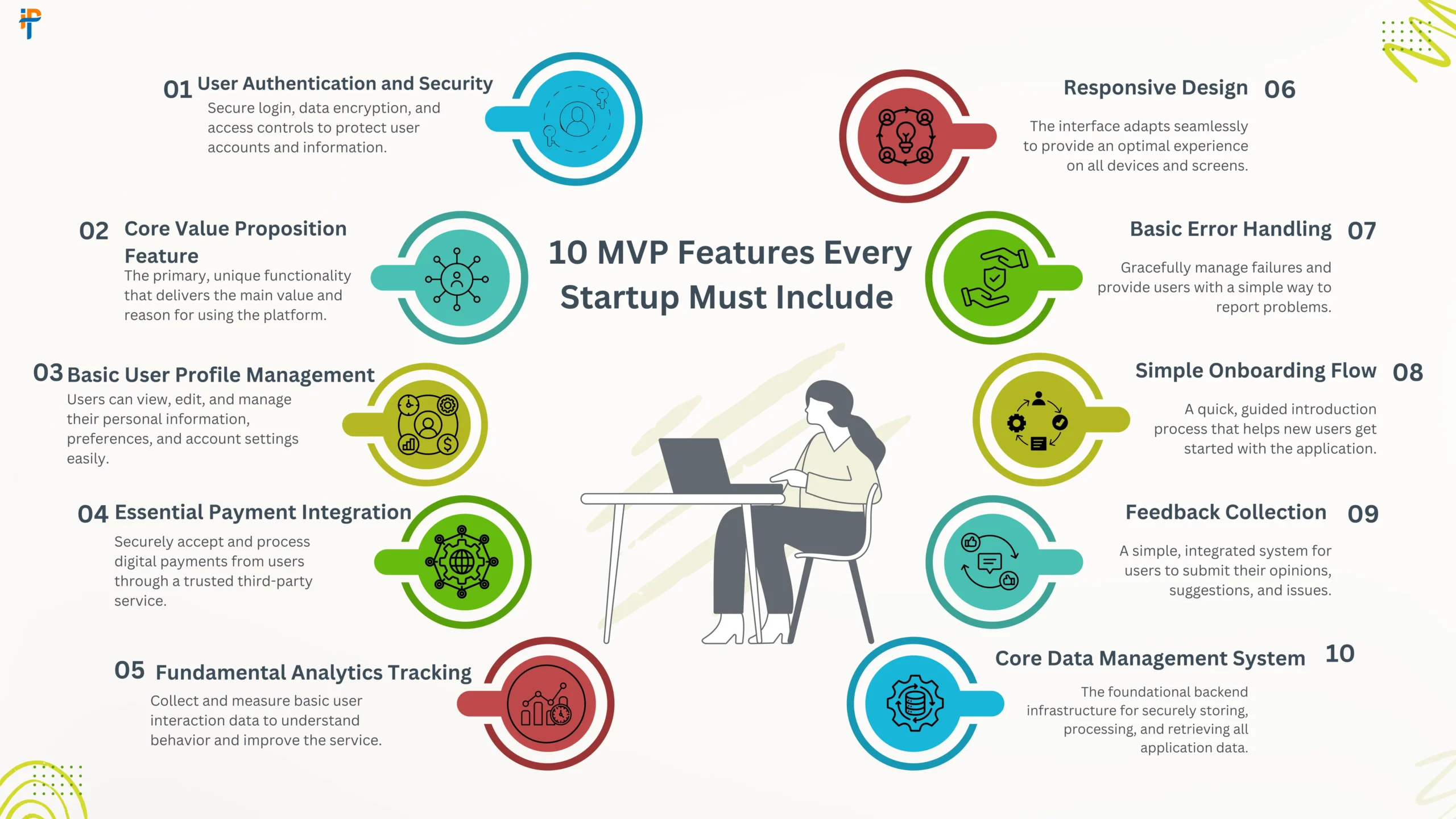
1. User Authentication and Security
You can’t have users without a way for them to sign up, log in, and trust that their data is secure. This isn’t negotiable. Whether it’s a simple email and password combination, social login (Google, Facebook), or two-factor authentication, you need a solid authentication system from day one.
Why? Because according to IBM’s Cost of a Data Breach Report, the average cost of a data breach in 2023 was $4.45 million. Even as an MVP, you need to build trust with your early adopters. A security breach at this stage could be fatal to your startup’s reputation.
2. Core Value Proposition Feature
This is the reason your product exists. It’s the one feature that solves the specific problem you identified. For Uber, it was “request a ride.” For Airbnb, it was “book a place to stay.” For your startup, what’s that one thing that makes users say, “Aha! This solves my problem!”
Everything else is secondary. If your core value proposition doesn’t work flawlessly, nothing else matters. This feature should consume 40-50% of your MVP development time and resources.
3. Basic User Profile Management
Users need to manage their basic information—name, email, profile picture, and relevant settings. Keep it simple. You don’t need 50 customization options. Just the essentials that allow users to personalize their experience minimally and update their critical information.
4. Essential Payment Integration
If your business model involves transactions (and let’s be honest, most do), you need a reliable payment system. But here’s the key: start with one payment method. Don’t try to integrate PayPal, Stripe, Apple Pay, Google Pay, and cryptocurrency all at once. Pick the most popular option for your target market and nail that integration.
According to Statista’s payment methods data, credit and debit cards remain the most popular online payment method globally, followed closely by digital wallets. Start there.
5. Fundamental Analytics Tracking
How will you know if your MVP is successful if you’re not measuring anything? You need basic analytics from day one—user acquisition, retention rates, feature usage, and conversion metrics. Tools like Google Analytics, Mixpanel, or Amplitude can be integrated relatively easily and provide invaluable insights.
6. Responsive Design and Mobile Compatibility
With over 58% of global website traffic coming from mobile devices, your MVP must work seamlessly across different screen sizes. This doesn’t mean building separate iOS and Android apps right away—a responsive web app can serve you well initially.
7. Basic Error Handling and Bug Reporting
Things will break. It’s inevitable. What matters is how quickly you can identify and fix issues. Implement basic error handling that prevents complete app crashes and consider tools like Sentry or Bugsnag that automatically report errors to your development team.
8. Simple Onboarding Flow
First impressions matter. Your onboarding should be smooth enough that users understand your product’s value within the first 60 seconds. According to Appcues research, a good onboarding experience can increase user retention by up to 50%. Keep it to 3-5 steps maximum.
9. Feedback Collection Mechanism
Your MVP users are your product development partners. You need an easy way for them to share feedback, report issues, and suggest improvements. This could be as simple as a feedback button that triggers an email or a lightweight in-app survey tool.
10. Core Data Management System
Whatever data your application handles—whether it’s user-generated content, transactions, or interactions—you need a reliable system to store, retrieve, and manage that data. Choose a scalable database solution from the start, even if you’re starting small.
Also Read- Launch a Loan Lending App MVP: Affordable Steps to Validate Your Idea
The Strategic 5: Features to Skip Now (But Plan for Later)
Here’s where things get interesting. These are features that might seem essential but can actually wait until after your MVP launch. Skipping these doesn’t mean they’re not important—it means you’re being strategic with your resources.
1. Advanced Customization Options
Sure, it would be cool if users could customize every color, font, and layout option in your app. But does that solve their core problem? Probably not. Advanced personalization features can wait until you’ve validated your core value proposition and understand what customizations actually matter to your users.
Skip it because: Development time for robust customization frameworks can add 3-6 weeks to your timeline. That’s 3-6 weeks you could be getting real market feedback.
2. Social Media Integration Beyond Basics
Yes, social sharing can be valuable for growth. But do you really need to integrate with Facebook, Twitter, LinkedIn, Instagram, TikTok, and Pinterest all at once? Probably not. Start with one or two that make the most sense for your audience. You can always add more later based on user demand.
Skip it because: Each social platform has its own API, authentication requirements, and quirks. Integrating them all upfront can consume weeks of development time without guaranteed ROI.
3. Multiple Language Support
Unless your initial target market spans multiple languages, internationalization can wait. Building a proper multi-language system involves more than just translations—it requires right-to-left text support, locale-specific formatting for dates and numbers, and cultural adaptations.
Skip it because: According to our experience at IPH Technologies, adding comprehensive internationalization can increase development time by 30-40%. Focus on nailing one language and market first.
4. Complex Reporting and Analytics Dashboards
While basic analytics are essential (remember, that was in the Non-Negotiable 10), complex dashboards with multiple data visualizations, custom report builders, and advanced filtering options can wait. Most MVPs need simple metrics displayed clearly, not a Bloomberg Terminal-level interface.
Skip it because: Advanced reporting features often require significant backend infrastructure and frontend complexity. Save this for version 2.0 when you know which metrics actually matter to your users.
5. Advanced AI and Machine Learning Features
AI is sexy. Machine learning is trendy. But unless AI is your core value proposition, these features can wait. Smart recommendations, predictive analytics, and intelligent automation are powerful—but they require substantial data to train and refine.
Skip it because: Effective AI/ML implementation requires not just development time but also data scientists, training datasets, and ongoing optimization. Start simple, gather data, and implement AI when you have the resources and data to do it right.
Also read- AI App Development Cost in 2025: From MVPs to Full-Scale Solutions
The Feature Prioritization Matrix: A Data-Driven Framework
So how do you actually decide what makes the cut? Let’s talk about frameworks. At IPH Technologies, we use proven methodologies to help our clients make smart decisions about feature prioritization.
Understanding the MoSCoW Method
The MoSCoW method is a tried-and-true prioritization technique that categorizes features into four buckets:
Must Have: Non-negotiable features that are absolutely essential for launch
Should Have: Important but not vital features that can wait if necessary
Could Have: Nice-to-have features that add value but aren’t crucial
Won’t Have (this time): Features explicitly out of scope for the current iteration
This framework forces you to make hard decisions and prevents the “everything is a priority” trap.
The RICE Scoring Model for Features
RICE stands for Reach, Impact, Confidence, and Effort. It’s a quantitative approach developed by Intercom that helps you score features objectively:
RICE Score = (Reach × Impact × Confidence) / Effort
Let’s break it down with an example:
| Feature | Reach | Impact | Confidence | Effort | RICE Score |
|---|---|---|---|---|---|
| User Authentication | 100 | 3 | 100% | 5 | 60 |
| Advanced Reporting | 30 | 2 | 70% | 8 | 5.25 |
| Social Sharing | 60 | 2 | 80% | 3 | 32 |
| AI Recommendations | 50 | 3 | 50% | 12 | 6.25 |
| Row 5 Col 1 | Row 5 Col 2 | Row 5 Col 3 | Row 5 Col 4 | Row 5 Col 5 | Row 5 Col 6 |
In this example, user authentication clearly scores highest and should be prioritized, while advanced reporting and AI recommendations score lower relative to their effort.
Creating Your Custom Prioritization Matrix
Here’s a practical framework you can implement today:
| Priority Tier | Criteria | Decision Rule |
|---|---|---|
| P0 – Critical | Without it, the product doesn’t work | Must launch with MVP |
| P1 – High | Significantly impacts user experience or business goals | Include if time/budget allows |
| P2 – Medium | Enhances experience but not essential | Post-MVP priority |
| P3 – Low | Nice-to-have, minimal impact | Future roadmap consideration |
Impact vs. Effort Analysis
The simplest yet most effective tool is the classic 2×2 matrix:
High Impact, Low Effort: Do these immediately (Quick Wins)
High Impact, High Effort: Plan these carefully for your MVP (Major Projects)
Low Impact, Low Effort: Do these if you have spare time (Fill-ins)
Low Impact, High Effort: Skip these entirely for now (Time Sinks)
According to research from ProductPlan, teams that use structured prioritization frameworks are 2.5 times more likely to deliver products on time and within budget.
Also Read- Web vs Native vs Hybrid Apps in 2025: The Ultimate Guide
Beyond the Launch: Building Your Post-MVP Feature Roadmap
Congratulations! You’ve launched your MVP. But the journey is just beginning. Now comes the critical phase of evolution—transforming your MVP into a fully-fledged product based on real-world data and feedback.
Gathering and Analyzing User Feedback
Your early users are gold mines of information. But collecting feedback is an art and science combined. You need both quantitative data (usage metrics, conversion rates, retention statistics) and qualitative insights (user interviews, support tickets, feedback forms).
Create multiple feedback channels:
- In-app feedback buttons
- User interviews (aim for 10-15 in-depth conversations monthly)
- Net Promoter Score (NPS) surveys
- Usage analytics (What features are being used? What’s being ignored?)
- Support ticket analysis
According to research from Qualtrics, companies that excel at customer experience have 1.5 times more engaged employees and can reduce customer churn by up to 15%.
Setting Realistic Development Timelines
Here’s where many startups stumble. They rush to add every requested feature immediately. Don’t fall into this trap. Create a structured roadmap with realistic timelines:
Months 1-3 post-launch: Focus entirely on stability, bug fixes, and critical improvements based on user feedback. Don’t add new features yet.
Months 4-6: Introduce 2-3 carefully selected features that address the most common user requests or pain points.
Months 7-12: Continue iterative improvement, adding features that demonstrate clear ROI or user demand.
At IPH Technologies, we’ve guided over 430 clients through this post-MVP phase using agile methodologies that ensure continuous improvement without overwhelming the development team or confusing users with constant changes.
Scaling Your MVP Based on Market Response
Market response will tell you whether to accelerate, maintain pace, or pivot. Key indicators to watch:
User Growth Rate: Are you acquiring users consistently?
Retention Metrics: Are users coming back? (Day 1, Day 7, Day 30 retention)
Engagement Levels: How frequently are users engaging with your core feature?
Revenue Growth (if applicable): Is your business model working?
According to data from Lendle, successful startups typically see at least 40% retention after Day 1 and 20% after Day 7. If your numbers are significantly lower, it might be time to reconsider your approach.
When to Pivot and When to Persevere
This is the million-dollar question. Eric Ries, in “The Lean Startup,” suggests that a pivot should occur when:
- You’ve validated that your current approach isn’t working through data
- You’ve identified a better opportunity while maintaining your core vision
- You have the resources to execute the pivot effectively
Don’t pivot after one bad week. But don’t stubbornly persist when all data points to failure. The sweet spot? Give your MVP 3-6 months of real-world testing before making major strategic changes.
Signs you should pivot:
- Consistently low user engagement despite marketing efforts
- User feedback indicates you’re solving the wrong problem
- Market dynamics have shifted significantly
- A competitor has emerged with a clearly superior solution
Signs you should persevere:
- Core metrics are improving, even if slowly
- Users love your product but you’re struggling with acquisition (marketing problem, not product problem)
- You’re seeing pockets of high engagement in specific user segments
- Feedback is generally positive with requests for enhancements, not fundamental changes
Conclusion
Building an MVP is both an art and a science. It requires the wisdom to know what’s essential and the courage to cut everything else. Remember, your MVP isn’t the final product—it’s the first step in a journey of continuous learning and improvement.
The 10 non-negotiable features we discussed form the bedrock of any successful MVP: authentication, core value proposition, basic profile management, payment integration, analytics, responsive design, error handling, onboarding, feedback mechanisms, and data management. These aren’t optional—they’re essential.
Conversely, the strategic 5 features to skip—advanced customization, comprehensive social media integration, multi-language support, complex analytics dashboards, and advanced AI—can wait. They’re valuable, but not at the expense of delaying your launch or diluting your focus.
The frameworks we’ve explored—MoSCoW, RICE scoring, and Impact vs. Effort matrices—provide structured approaches to making these difficult decisions objectively rather than emotionally.
At IPH Technologies, our mission is to turn visionary ideas into impactful solutions. With our comprehensive suite of services spanning app development, web development, and custom software engineering, we leverage cutting-edge technology and agile methodologies to help startups like yours navigate the complex journey from MVP to market leader.
Your MVP is your conversation starter with the market. It’s how you test assumptions, validate hypotheses, and build a foundation for sustainable growth. Don’t overcomplicate it. Launch, learn, iterate, and scale strategically.
The startups that win aren’t necessarily those with the most features—they’re the ones that solve real problems elegantly and evolve based on real user feedback. Now go build something amazing.


 | 2026)








.png)